Motorcycle Insurance in Texas: The Helmet Rule Ties to Your Coverage
Texas motorcycle insurance requirements, the helmet exemption that depends on carrying medical coverage, and why uninsured motorist cover matters most here.

Table of contents
Texas has an unusual arrangement that links a safety law directly to an insurance decision, and a lot of riders rely on it without ever confirming they actually qualify.
What the state requires
Texas requires liability insurance to register and ride a motorcycle, at minimum limits of:
- $30,000 bodily injury per injured person
- $60,000 bodily injury per accident
- $25,000 property damage
Written as 30/60/25. Those numbers are the floor for legal compliance, not a recommendation, and the gap between the two is the main subject of this article.
Unlike Florida, which our motorcycle insurance by state guide covers as the national outlier, Texas treats motorcycles broadly like other vehicles for insurance purposes. You must carry liability, and you must be able to show it.
The helmet rule is an insurance rule
This is the part that makes Texas distinctive.
Riders and passengers under 21 must wear a helmet. No exceptions.
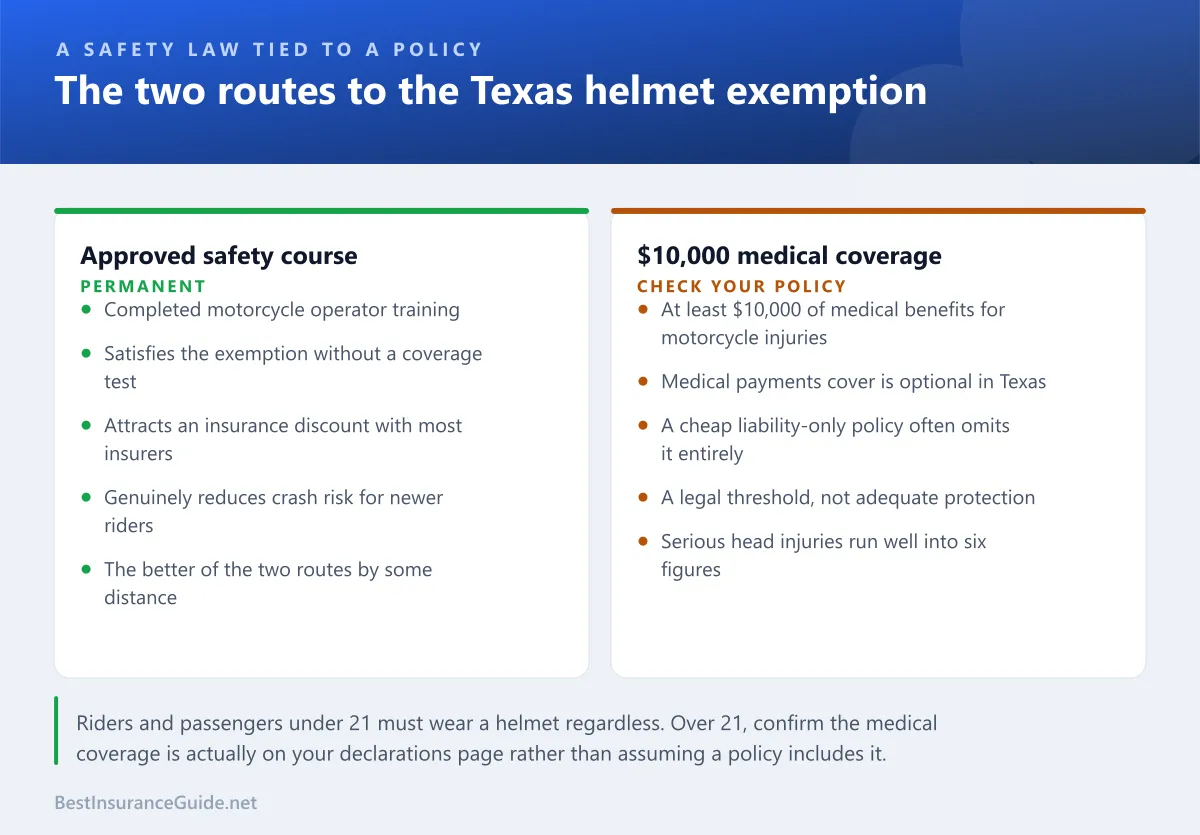
Riders 21 and over may ride without a helmet only if they meet one of two conditions: they have completed an approved motorcycle operator training course, or they carry at least $10,000 of medical insurance coverage for injuries sustained in a motorcycle accident.
Two practical consequences that catch people.
Your policy may not include medical coverage by default. Medical payments coverage is optional in Texas, and a liability-only policy bought on price frequently does not include it. If you are riding without a helmet on the basis of the medical coverage route, check the declarations page rather than assuming.
$10,000 is a legal threshold, not a clinical one. It satisfies the statute. It does not go far against a serious head or spinal injury, where costs run into six figures. Treating $10,000 of medical benefits as adequate protection because it is what the law names is a category error.
The safety course route is worth taking regardless. It attracts an insurance discount with most insurers, it satisfies the exemption permanently, and the training genuinely reduces crash risk for newer riders.
The coverage that actually matters here
State minimums protect other people. On a motorcycle, the person most likely to be seriously hurt is you, and liability does nothing for that.
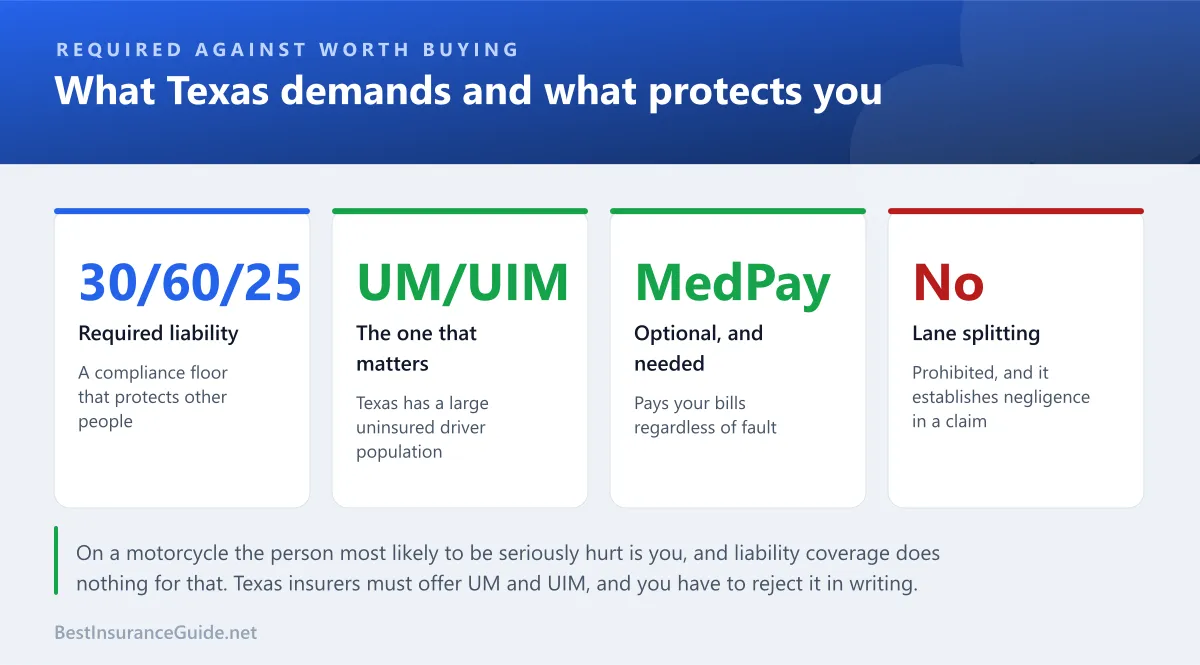
Uninsured and underinsured motorist coverage is the single most valuable optional coverage for a Texas rider. Texas has a substantial uninsured driver population, and a large share of insured drivers carry only state minimums, which a serious motorcycle injury will exhaust immediately.
If a driver with 30/60 limits causes injuries costing $180,000, their policy pays $30,000 and stops. Your underinsured motorist coverage is what pays the rest.
Texas insurers must offer UM and UIM coverage, and you must reject it in writing to go without. Do not reject it.
Medical payments coverage pays your medical bills regardless of fault, without waiting for liability to be resolved. It also satisfies the helmet exemption. Buy meaningfully more than $10,000 if you intend to rely on it.
Personal injury protection is offered in Texas and works more broadly than medical payments, extending to lost wages. It must be rejected in writing if you do not want it.
Comprehensive and collision for the bike itself, required by any lender, and worth having on anything with real value given Texas theft rates in the large metros.
Worked example: a minimum-limits crash
A rider is hit by a driver carrying Texas minimums. Injuries and losses total $210,000.
| Source | Amount |
|---|---|
| At-fault driver’s bodily injury limit | $30,000 |
| Your underinsured motorist coverage, $100,000 | $70,000 |
| Your medical payments coverage, $25,000 | $25,000 |
| Total recovered | $125,000 |
| Shortfall | $85,000 |
With no UM or UIM at all, the recovery would have been $30,000 against a $210,000 loss. That is the case for the coverage in one table.
What moves a Texas premium
Metro against rural. Austin, Dallas, Houston and San Antonio price well above West Texas and the Panhandle, following claim costs, theft rates and traffic density.
Bike type. Sport bikes cost substantially more than cruisers or touring bikes of similar value, because of how they are ridden and how often they are stolen.
Rider age and experience. The youth curve on motorcycles is steeper than on cars. A newly licensed nineteen-year-old on a litre sport bike is close to the most expensive risk in personal lines.
Riding season. Texas rides year-round, which raises exposure relative to northern states and removes the winter lay-up option that riders in Ohio or Michigan use.
Storage. Garaged bikes cost less and are stolen less.
Safety course completion, which produces a discount with most insurers.
Custom parts, and the cap that catches builders
Standard motorcycle policies cap aftermarket parts and accessories at a low figure, frequently a couple of thousand dollars.
For a stock commuter bike that is fine. For anything with exhausts, bodywork, custom paint, bags, seats or performance work, the cap is well below what the owner has actually spent, and it applies at exactly the moment the bike is written off.
The fix is scheduling the parts with documentation and photographs. Our guide to custom motorcycle insurance covers agreed value and how to document a build so a claim reflects what you spent.
Delivery riding
Worth stating because it comes up constantly in the Texas metros.
Personal motorcycle policies exclude carrying goods for compensation. Food delivery, courier work and any paid delivery is outside the policy, and a claim arising during a delivery can be declined entirely.
Platform coverage exists but is staged and frequently thin between accepting a job and collecting it. Our guide to motorcycle courier insurance covers what a courier endorsement does and where platform cover stops.
If you deliver on a bike in Texas, tell your insurer and get the endorsement. The alternative is discovering the exclusion after a crash.
Lane splitting, and why it matters to a claim
Texas does not permit lane splitting or lane filtering.
Beyond the citation, this matters for insurance. Riding between lanes where it is prohibited establishes negligence, and Texas applies proportionate responsibility rules to injury claims. A rider found partly at fault has their recovery reduced accordingly, and above a threshold share of fault, recovery can be barred entirely.
That turns a legal question into a financial one, and it is worth knowing before assuming a crash was purely the other party’s fault.
What to do before you ride
Set liability well above 30/60/25. State minimums are a compliance floor and they protect other people, not you.
Do not reject uninsured and underinsured motorist coverage. It is the coverage most likely to matter on a bike in this state.
Check whether you actually carry medical benefits if you ride without a helmet on that basis, and carry more than $10,000.
Take an approved safety course. It satisfies the helmet exemption permanently, produces an insurance discount, and reduces crash risk.
Schedule custom parts with invoices and photographs.
Declare delivery use if you do any.
The short version
Texas requires 30/60/25 liability to register and ride, and links its helmet exemption for riders over 21 to either an approved safety course or at least $10,000 of medical coverage.
If you rely on the medical coverage route, confirm the coverage is genuinely on your policy, because medical payments is optional in Texas and a cheap liability-only policy frequently omits it. And do not mistake $10,000 for adequate; it is a legal threshold, not a clinical one.
The coverage that matters most is uninsured and underinsured motorist, because Texas has a large uninsured driver population and on a motorcycle your own injuries are the main exposure.
Take the safety course, carry limits well above the minimum, schedule any custom work, and declare delivery riding if you do it.
For requirements in other states, see motorcycle insurance by state.
Theft, and what comprehensive actually does
Motorcycle theft is the most common comprehensive claim nationally, and the large Texas metros see plenty of it.
Three things worth knowing.
Comprehensive covers theft, fire, vandalism, weather and animal strikes. Collision covers impact. A stolen bike is a comprehensive claim, and comprehensive is generally the cheaper of the two coverages.
Settlement is at actual cash value unless you have agreed value cover. On an older or modified bike, actual cash value and what you would need to replace it can diverge sharply. Our guide to custom motorcycle insurance covers agreed value and why it matters on anything that is not a stock recent machine.
Garaging and security genuinely affect both the premium and the outcome. A locked garage, a ground anchor, a disc lock and a tracker all reduce risk, and most insurers rate for at least some of them.
Texas heat adds a second comprehensive consideration: hail. Severe convective storms across north and central Texas produce hail damage claims, and a bike parked outside is fully exposed.
Riding season, and why Texas has no lay-up option
Riders in Ohio or Michigan can reduce coverage for four or five months and keep comprehensive against theft. Texas riders largely cannot, because there is no off-season.
That has two consequences.
Annual exposure is higher, which is part of why Texas prices above northern states for the same rider and bike.
The savings levers are different. Instead of a lay-up period, Texas riders reduce premium through the safety course discount, garaging, higher deductibles, multi-policy bundling and mileage-based rating where offered.
If you genuinely ride very little, ask specifically about low-mileage or pleasure-use rating. Not every insurer offers it, and it is rarely volunteered.
Uninsured motorist, stacked against the state minimum
Worth restating with numbers, because it is the recurring theme of Texas motorcycle insurance.
Texas minimum bodily injury liability is $30,000 per person. A serious motorcycle injury — a fracture requiring surgery, a hospital stay and rehabilitation — passes that figure without difficulty, before any consideration of lost income.
So even when the driver who hits you is fully insured to the state minimum, you are very likely to be underinsured by their policy. Underinsured motorist coverage is what fills that, and it is inexpensive relative to what it does.
Texas insurers must offer UM and UIM and obtain a written rejection to leave it off. If you do not remember making that choice, check your declarations page, because it may have been made for you at the point of sale.
The short checklist for a Texas rider
Set liability well above 30/60/25.
Do not reject uninsured and underinsured motorist coverage.
Carry medical payments well above the $10,000 helmet threshold, and confirm it is actually on the policy.
Take an approved safety course, which satisfies the helmet exemption permanently and produces a discount.
Garage the bike where possible, and use physical security.
Schedule custom parts with documentation.
Declare any delivery or paid carriage use, because personal policies exclude it entirely.
Comparable states
Texas ties its helmet exemption to carrying medical coverage, which is a coverage rule disguised as a helmet law. Florida takes a comparable approach to financial responsibility, and Georgia takes the opposite one by requiring helmets universally.
A note on scope and sources
Minimum financial responsibility requirements, helmet rules and licensing requirements are set by Texas statute and administered by the Texas Department of Insurance, the Department of Public Safety and the Department of Motor Vehicles. All three publish current requirements, and they change from time to time.
Confirm the current position with those agencies rather than relying on any article, particularly the helmet exemption conditions and the exact medical coverage threshold. Nothing here is legal advice, and this site is independent and not affiliated with any insurer.