Motorcycle Insurance in Ohio: The Winter Decision That Costs Most
Ohio motorcycle insurance requirements, the novice helmet rule, deer strike claims, and why storage cover beats cancelling over winter.

Table of contents
Ohio riders face a decision every autumn that most other states do not, and getting it wrong quietly costs more than any premium comparison will save.
What the state requires
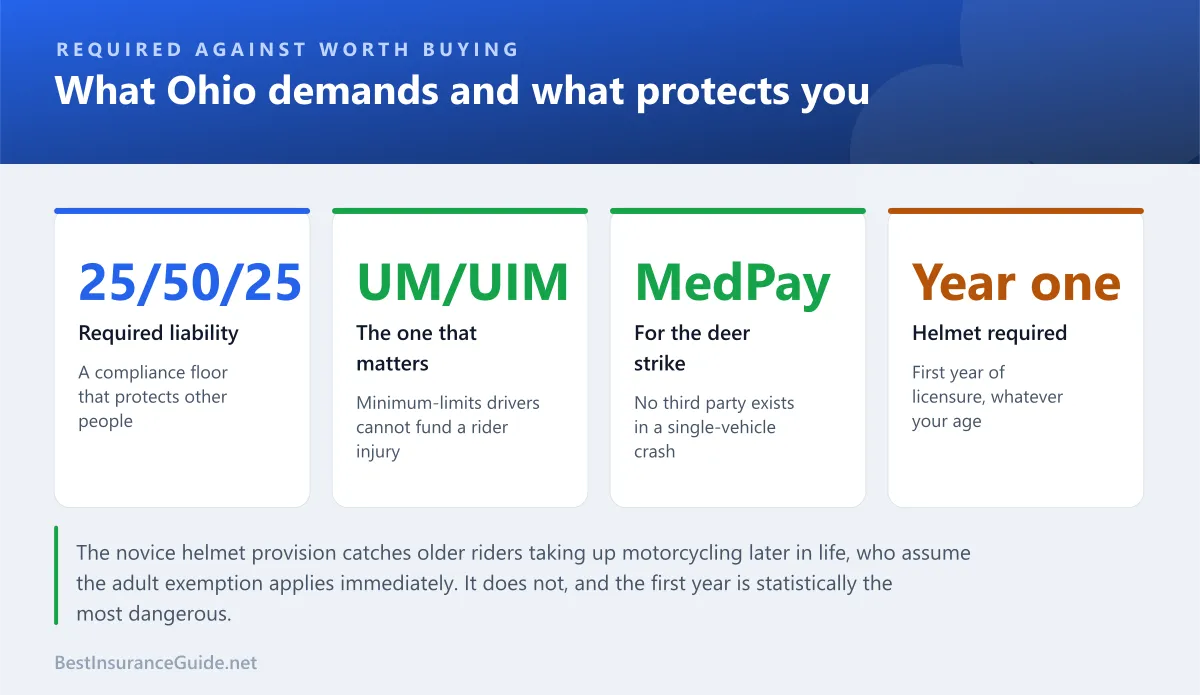
Ohio requires liability insurance to register and operate a motorcycle, at minimum limits of:
- $25,000 bodily injury per injured person
- $50,000 bodily injury per accident
- $25,000 property damage
Written as 25/50/25. Those are compliance minimums. On a motorcycle they are thin, for reasons covered below.
Ohio also verifies coverage actively. The Bureau of Motor Vehicles operates electronic verification with insurers and sends random verification requests to registered owners. Failing to respond, or being unable to demonstrate cover for the date in question, can produce licence and registration suspension and reinstatement requirements.
That is a separate consequence from anything your insurer does, and it is one reason a lapse in Ohio is more troublesome than in states without active verification.
The winter decision
Ohio has a genuine riding season of roughly seven months, and every autumn riders reasonably ask whether to keep paying for five months of not riding.
The instinct to cancel is understandable and usually wrong.
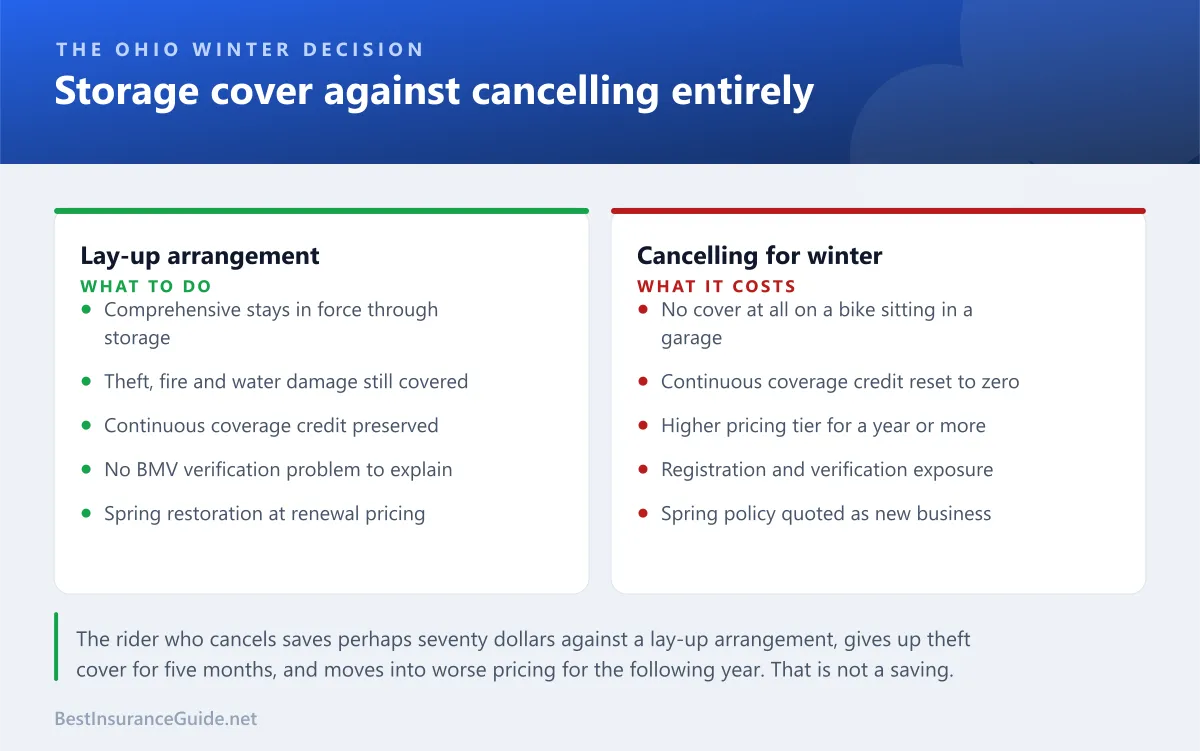
Cancelling breaks continuous coverage. Continuous coverage is itself a rated factor, and a five-month gap resets it. The next policy is quoted from a worse band, and that pricing follows you for a year or more.
A stored bike is still exposed. Theft, fire, water damage, a collapsed shelf, a garage break-in. Those are comprehensive claims, and comprehensive is the cheaper of the two physical damage coverages.
Ohio’s verification system notices. A registered motorcycle with no insurance on file can attract a verification request, and satisfying it retrospectively is harder than never having lapsed.
Restarting is not free. New business pricing after a gap is frequently worse than continuous renewal pricing, so the spring policy costs more than the one you cancelled.
Worked example: three approaches to an Ohio winter
| Full cover year-round | Lay-up arrangement | Cancelled for winter | |
|---|---|---|---|
| Months of full cover | 12 | 7 | 7 |
| Months of comprehensive only | 0 | 5 | 0 |
| Indicative annual premium | $620 | $440 | $370 |
| Theft and fire cover in storage | Yes | Yes | No |
| Continuous coverage preserved | Yes | Yes | No |
| Effect on next renewal | None | None | Higher tier |
The rider who cancelled saved $70 against the lay-up rider, gave up theft cover on a bike sitting in a garage for five months, and moved into worse pricing for the following year. That is not a saving.
Ask your insurer specifically for a lay-up, storage or suspension arrangement. Most insurers writing in northern states offer one, and it is rarely volunteered.
The helmet rule is about experience, not just age
Ohio does not have a universal helmet law, but the exemption is narrower than riders assume.
Helmets are required for riders under 18.
Helmets are also required for any rider in their first year of licensure, regardless of age, and for the passengers of those riders.
Eye protection is required unless the motorcycle is fitted with a windscreen.
That novice provision catches older riders who take up motorcycling later in life and assume the adult exemption applies to them immediately. It does not, and the first year is statistically the most dangerous one.
Deer, and which coverage responds
Ohio has a high rate of vehicle-deer collisions, concentrated in autumn and heaviest around dawn and dusk. For a car that is a bodywork claim. For a motorcycle it is a serious injury event.
Two insurance points worth knowing before it happens.
Damage to the bike is normally a comprehensive claim, not collision, because animal strikes are typically classed under comprehensive in most wordings. Comprehensive usually carries a lower deductible, so claiming under the right coverage saves money.
Your injuries are a different question. Ohio is a fault state, and there is no other driver to claim against in a deer strike. What responds is your own medical payments coverage if you carry it, and your health insurance.
That makes medical payments coverage more valuable in Ohio than riders expect, because the single-vehicle and animal-strike scenarios are common here and there is no third party to pursue.
What to buy above the minimum
State minimums protect other people. On a motorcycle, the person most likely to be badly hurt is you.
Uninsured and underinsured motorist coverage is the most valuable optional coverage. Even a fully insured driver carrying Ohio minimums has $25,000 of bodily injury cover per person, which a serious motorcycle injury exhausts before rehabilitation begins.
Medical payments coverage, for the reasons above.
Comprehensive and collision if the bike has value or is financed, and comprehensive specifically because it covers the deer strike, the theft and the winter storage risks.
Custom parts and accessories cover. Standard policies cap aftermarket parts low, frequently around a couple of thousand dollars. Our guide to custom motorcycle insurance covers scheduling a build and agreed value.
Worked example: a minimum-limits collision
A rider is struck by a driver carrying Ohio minimums. Injuries and losses total $145,000.
| Source | Amount |
|---|---|
| At-fault driver’s bodily injury limit | $25,000 |
| Rider’s underinsured motorist, $100,000 | $75,000 |
| Rider’s medical payments, $10,000 | $10,000 |
| Total recovered | $110,000 |
| Shortfall | $35,000 |
Without UM or UIM, the recovery on $145,000 of loss would have been $25,000.
What moves an Ohio premium
Metro against rural. Columbus, Cleveland and Cincinnati price above rural counties, following claim costs, traffic density and theft rates.
Bike type. Sport bikes cost substantially more than cruisers or touring bikes of similar value.
Rider age and experience, with a steep youth curve and a first-year loading that reflects the novice risk the helmet rule also targets.
Shortened riding season, which reduces annual exposure and is part of why Ohio prices below year-round states.
Storage. A garaged bike costs less and is stolen less, and in Ohio garaging is standard anyway for five months.
Safety course completion, which produces a discount with most insurers and is worth taking regardless.
Delivery riding
Personal motorcycle policies exclude carrying goods for compensation, and the Ohio metros have a substantial delivery population.
Platform coverage is staged and frequently thin in the window between logging in and collecting an order. Our guide to motorcycle courier insurance sets out where each period begins and ends and what a courier endorsement adds.
If you deliver on a bike, declare it and get the endorsement. Discovering the exclusion after a crash is the expensive route.
The short version
Ohio requires 25/50/25 liability, verifies coverage actively through the BMV, and requires helmets for riders under 18 and for anyone in their first year of licensure regardless of age.
The decision that costs most is the winter one. Cancelling to save five months of premium breaks continuous coverage, removes theft cover from a stored bike, risks a verification problem and produces worse pricing in spring. Ask for a lay-up or storage arrangement instead, which keeps comprehensive in force and reduces the rest.
Beyond that, carry liability well above the minimum, do not decline uninsured and underinsured motorist coverage, and take medical payments seriously because deer strikes and single-vehicle losses leave nobody else to claim against.
For how other states handle the same questions, see motorcycle insurance by state.
Deer season, and when claims cluster
Ohio deer activity peaks sharply in autumn, and the concentration is worth planning around because it coincides with the end of the riding season.
Activity is heaviest around dawn and dusk, and worst from late October through early December during the rut, when deer move unpredictably and in groups. A deer that crosses is frequently followed by another.
Three practical points for a rider.
A deer strike on a motorcycle is not a bodywork claim. Even a glancing contact at moderate speed usually puts the rider down. Treat it as a serious injury risk rather than a vehicle damage risk.
Reduce speed at dawn and dusk in wooded and field-edge country, which is most of rural Ohio. High beams where legal, and scanning verges rather than the road surface.
If you see one, expect more. Deer are rarely alone, and the second animal is the one that catches riders who have already relaxed.
Because there is no other driver involved, everything on the medical side runs through your own coverage. That is the argument for medical payments made concrete.
Comparing quotes properly in Ohio
Ohio has a competitive market and the spread between insurers for the same rider is genuinely wide, so shopping pays. It only pays if you compare the same thing.
Match five fields across every quote before looking at price: bodily injury liability limits, property damage limit, uninsured and underinsured motorist limits, comprehensive deductible and collision deductible. A quote that looks cheaper is frequently a quote with the state minimum where you asked for more.
Ask each insurer whether they offer a lay-up or storage arrangement, and what it costs. This varies more between insurers than the headline premium does, and in Ohio it is worth real money.
Ask about the safety course discount and how long it lasts.
Ask about custom parts limits if your bike has any aftermarket work.
Check the renewal pattern. Some insurers quote aggressively for new business and increase sharply at first renewal, which wipes out the saving you calculated.
Our guide to comparing insurance quotes the right way sets out the general discipline, and it applies directly here.
One Ohio-specific timing note: shop in late winter, before the season starts, rather than in spring when everyone else is. You will have time to arrange cover properly and to sort out any lay-up arrangement before the bike comes out.
Rally season and group riding
Ohio has an active rally and group riding culture, and both raise questions worth settling before the season.
Group riding does not change your coverage, but it does change how fault is assessed in a multi-bike incident. If a rider ahead brakes hard and three bikes go down, each rider’s claim is assessed on their own following distance and reaction. Ohio applies comparative negligence, so a rider found partly responsible has their recovery reduced accordingly.
Carrying a passenger is covered by your liability for their injuries, but your own medical payments coverage may or may not extend to them depending on the wording. Ask specifically if you carry passengers regularly, because a passenger injury claim against you is a liability claim and your limits are what respond.
Riding out of state is covered, and most policies contain an out-of-state provision that raises your limits automatically to meet the requirements of whichever state you are in. That protects legal compliance without raising your limits generally, so a rider touring into higher-cost states remains underinsured if their Ohio limits are thin.
Organised events and track days are frequently excluded. Any timed or competitive activity, and often any closed-course event, falls outside a standard policy. If you do track days, ask about event insurance separately rather than assuming.
A note on figures
Premium figures throughout this article are illustrative, chosen to show the relative effect of decisions such as lay-up arrangements rather than to predict a quote. Actual pricing depends on your postcode, machine, riding record, age, coverage selections and, in Ohio as in most states, a credit-based insurance score.
Quote your own circumstances with several insurers using matched coverage before comparing anything.
Comparable states
Ohio’s long lay-up season and the cost of cancelling cover over winter is shared with Michigan and Colorado. On the treatment of motorcycles within the state auto system, Pennsylvania is the closest neighbour with a very different set of rules.
A note on scope and sources
Ohio’s minimum financial responsibility requirements, helmet and eye protection rules, and the BMV’s insurance verification process are set by statute and administered by the Ohio Bureau of Motor Vehicles, with insurance regulated by the Ohio Department of Insurance. Both publish current requirements and both change from time to time.
Confirm the current position with those agencies rather than relying on any article, particularly the novice licensure helmet provision and the verification process. Premium figures here are illustrative rather than quotes. Nothing here is legal advice, and this site is independent and not affiliated with any insurer.