Motorcycle Insurance by State: Requirements, Costs and the Florida Exception
Motorcycle insurance requirements and costs by state, including Texas, Ohio, Georgia, Michigan and the Florida rule that catches most riders out.

Table of contents

Motorcycle insurance varies between states more than car insurance does, and for reasons that are worth understanding before you quote.
Cars are regulated similarly almost everywhere. Motorcycles are not. Helmet laws differ, liability requirements differ, and at least one large state treats bikes fundamentally differently from cars.
Why the state matters so much
Three forces set the price, and all three are local.
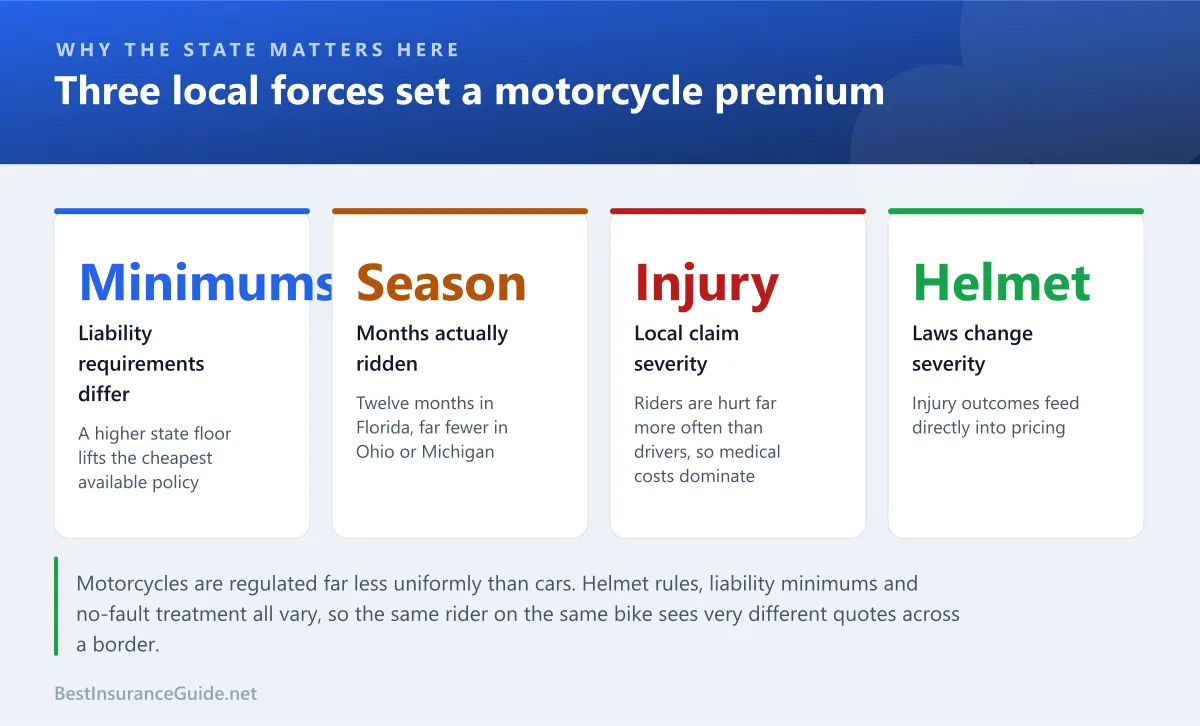
Minimum liability requirements. Most states set a minimum in the form of three numbers, for example 25/50/25, meaning $25,000 per injured person, $50,000 per accident, and $25,000 of property damage. Those minimums vary, and where they are higher the floor premium is higher.
Riding season. A motorcycle in Ohio, Michigan or Massachusetts is parked for a meaningful part of the year. A motorcycle in Florida, Texas, Arizona or Georgia is not. More riding months means more exposure, and pricing reflects it. It also means northern riders have a storage-season option that southern riders do not.
Injury claim costs. Motorcycle crashes produce serious injuries at a much higher rate than car crashes, so local medical costs and liability settlement norms matter more here than in almost any other line. States with high medical costs and generous liability environments price above states without.
Layer on helmet laws, which affect injury severity, and lane-splitting rules where they exist, and the same rider on the same bike can see very different quotes across a border.
The Florida exception
This is the most misunderstood rule in motorcycle insurance, and it deserves a section of its own.
Florida’s no-fault system requires car owners to carry personal injury protection and property damage liability. Motorcycles are outside that system. Florida does not require a rider to carry bodily injury liability in order to register a motorcycle, and the PIP requirement does not apply.
So, strictly, you can register and ride a motorcycle in Florida without liability insurance.
What Florida does require is that you can meet a financial responsibility obligation if you cause a crash with injuries. Riders who choose to go without insurance must satisfy that requirement another way, and if they cannot, the consequences fall on their licence and registration as well as their finances.
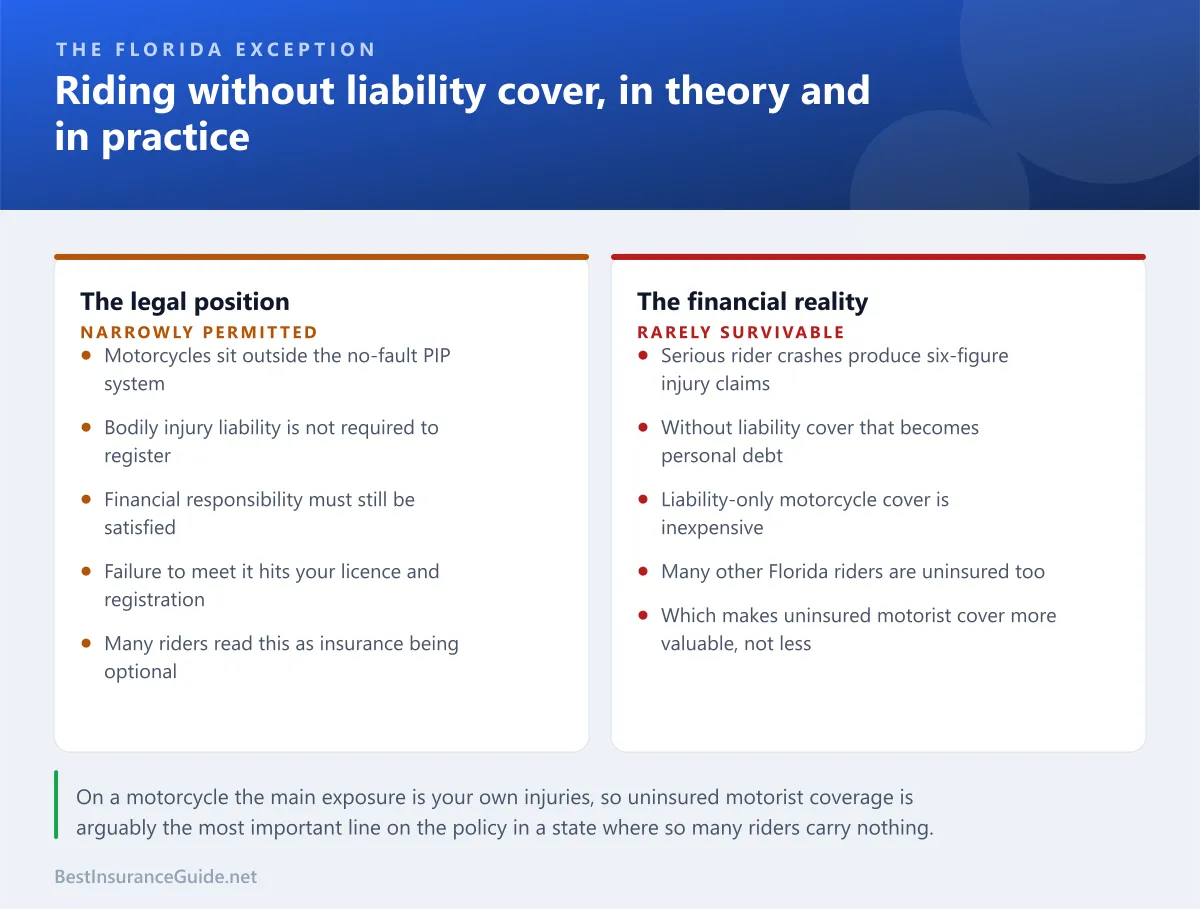
The practical reality is straightforward. A serious motorcycle crash routinely produces injury claims in the hundreds of thousands. Without liability cover, that is a personal debt. Liability-only motorcycle insurance in Florida is not expensive, and the gap between “legally permitted” and “financially survivable” here is enormous.
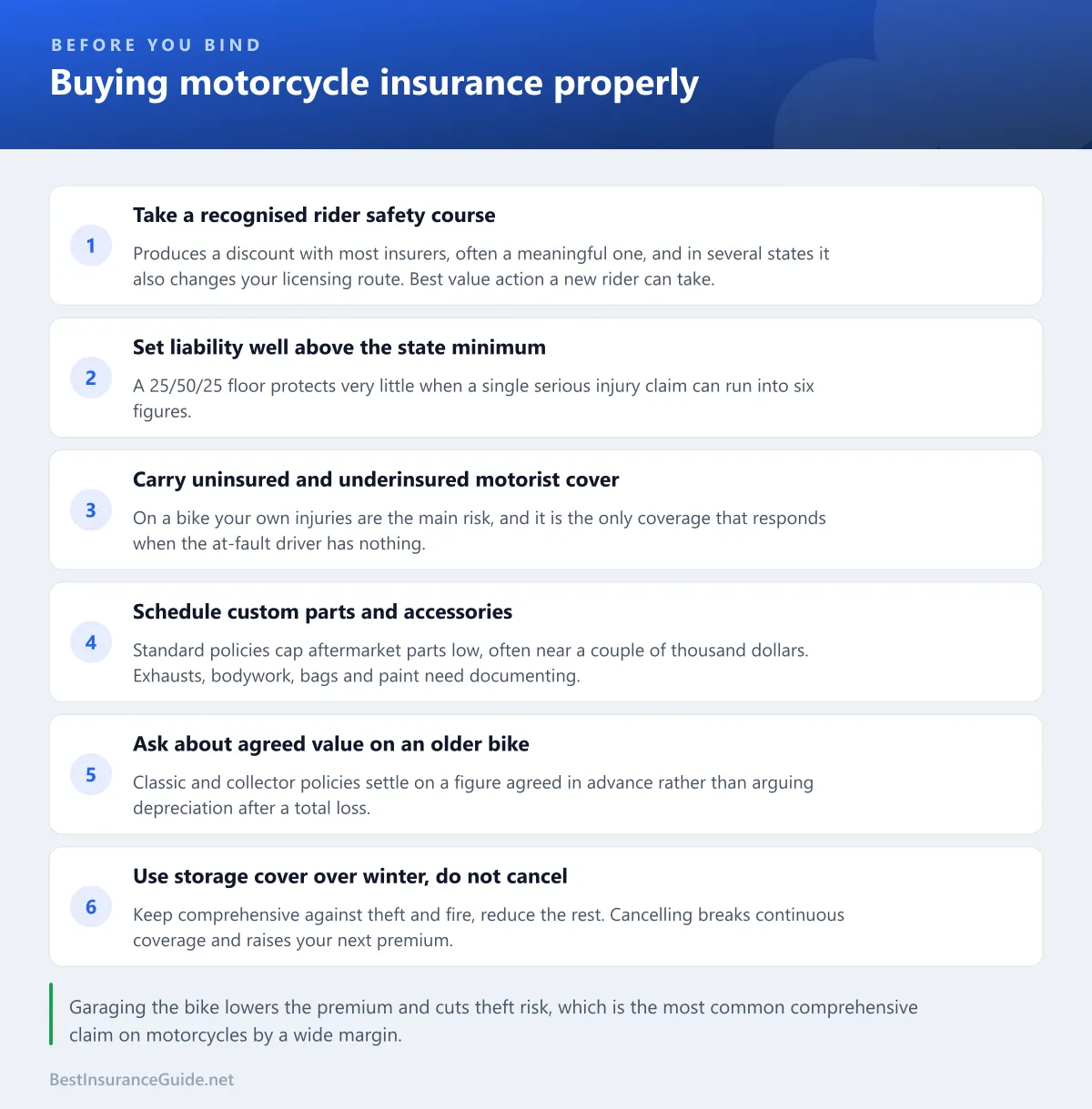
There is a second consequence riders often miss. Because so many Florida motorcyclists ride uninsured, uninsured motorist coverage is unusually valuable there. If someone hits you and has nothing, your own UM coverage is what pays for your injuries. On a motorcycle, where injuries are the main risk, that is arguably the most important coverage on the policy.
What states typically require
The pattern across most of the country looks like this.
| Requirement | Typical position |
|---|---|
| Bodily injury liability | Required in most states, minimums vary widely |
| Property damage liability | Required in most states |
| Uninsured motorist | Required in some, offered and declinable in many |
| Personal injury protection | Required in some no-fault states, but motorcycles are often excluded or optional |
| Medical payments | Optional almost everywhere, and worth having |
| Comprehensive and collision | Never required by a state, usually required by a lender |
Two notes that catch riders out.
Motorcycles are often carved out of no-fault rules. Several no-fault states apply PIP to cars and treat motorcycles differently, either excluding them or making the cover optional and expensive. Michigan riders in particular should read their medical coverage options closely rather than assuming a car-like system applies.
Minimums are almost always too low. A 25/50/25 minimum sounds substantial until you consider what a single serious injury costs. For a motorcycle, where you are far more likely to injure yourself than to damage someone’s property, minimum limits protect very little.
What actually moves your quote
State is the backdrop. These are the levers.
Engine size and bike type. A cruiser, a touring bike and a sport bike of the same value are priced very differently. Sport bikes carry the highest rates by a wide margin because of how they are ridden and how often they are stolen.
Rider age and experience. The youth curve is even steeper here than for cars. A 19-year-old on a litre sport bike is close to the most expensive risk in personal lines insurance.
Rider training. A recognised safety course produces a discount with most insurers, often a meaningful one, and in several states it also affects licensing requirements. It is the single best-value action a new rider can take.
Storage. A garaged bike costs less to insure than one on the street, and it materially reduces theft risk, which is the most common comprehensive claim on motorcycles.
Annual mileage. Genuinely low mileage attracts real discounts, particularly on pleasure-use policies.
Custom parts and accessories. Standard policies cap aftermarket parts at a low figure, often a couple of thousand dollars. Anyone who has spent real money on exhausts, bodywork, bags or paint needs a specific endorsement. Our guide to custom motorcycle insurance covers agreed value and how to document a build so it actually pays.
Classic and collector cover
If the bike is older, is not your daily transport, and is stored properly, a classic or collector policy is usually both cheaper and better.
Cheaper because it assumes limited annual mileage, secure storage and pleasure use. Better because it typically writes agreed value rather than actual cash value, which means you and the insurer settle on the figure in advance rather than arguing about depreciation after a total loss.
The trade-offs are real: mileage limits, storage requirements, sometimes a requirement that you have another vehicle for daily use, and often an age minimum for the rider. For a bike that is appreciating rather than depreciating, it is almost always the right structure.
The winter question
In states with a real off-season, riders reasonably ask whether to cancel the policy for four months.
Reducing coverage is sensible. Cancelling it is usually not.
A gap in continuous coverage raises your next premium, because continuous coverage is itself a rated factor, and in many states a reported lapse creates registration problems. Meanwhile a stored bike is still exposed to theft, fire and water damage, which are exactly the perils comprehensive covers.
The better move is a storage or lay-up arrangement: keep comprehensive, drop or reduce collision and liability for the months the bike is not ridden, and restore full cover in spring. Most insurers that write in northern states will do this, and it preserves both the coverage that matters and the continuous-coverage credit.
The short version
Motorcycle insurance requirements and prices vary sharply by state, driven by minimum liability rules, how long the riding season is, and what injury claims cost locally. Texas, Georgia, Arizona and Florida price against a twelve-month season; Ohio, Michigan, Pennsylvania and Massachusetts do not.
Florida is the genuine outlier: motorcycles sit outside the no-fault system and liability insurance is not required to register. That does not make riding uninsured sensible there, and it makes uninsured motorist coverage more valuable rather than less.
Wherever you ride, take the safety course, buy liability well above the state minimum, carry uninsured motorist cover, schedule any custom parts, and use storage cover rather than cancelling over winter.
If you carry paid deliveries on the bike, note that personal policies exclude it entirely. Motorcycle courier insurance explains what a courier endorsement covers and where platform cover stops.