Dog Bite Insurance: Your Pet Policy Does Not Cover This
Dog bite liability is covered by homeowners or renters insurance, not pet insurance. Breed exclusions, limits to carry, and standalone canine liability cover.

Table of contents

This is the most common misunderstanding in pet insurance, and it is worth correcting before anything else.
Pet insurance covers your dog. It does not cover what your dog does to other people.
If your dog bites someone, injures another dog, or knocks a cyclist off their bike, the claim that follows is a liability claim, and it belongs to a completely different policy.
Which policy actually responds
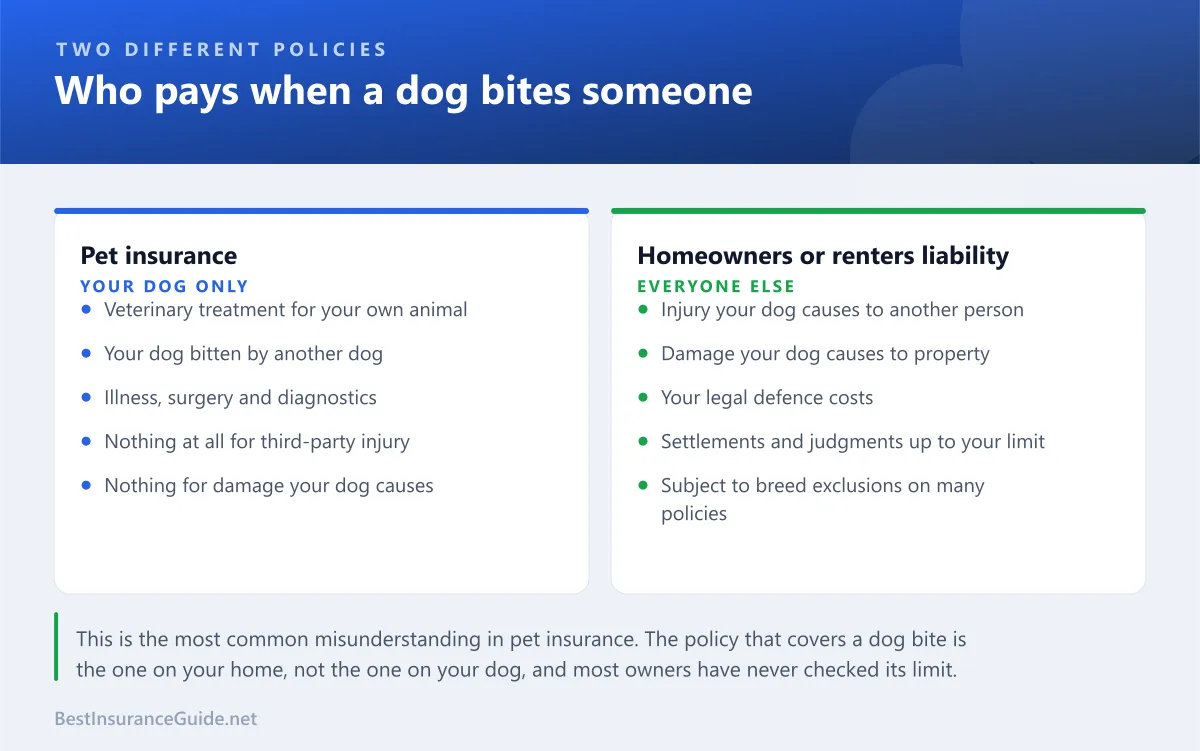
Pet insurance reimburses veterinary treatment for your own animal. If your dog is bitten by another dog, your pet policy pays for your dog’s treatment. That is the whole scope.
Homeowners or renters personal liability, shown as Coverage E on a standard policy, responds when you are legally responsible for injuring someone or damaging their property. A dog bite is the textbook example. It pays the injured party’s medical costs, your legal defence, and any settlement or judgment up to your limit.
Medical payments to others, Coverage F, is a small no-fault amount, typically $1,000 to $5,000, that can settle a minor injury without anyone establishing blame. Its purpose is to handle a nipped hand before it becomes a liability claim.
Our guides to what home insurance actually covers and the renters insurance guide set out how those coverages work generally.
Why the limit matters more than you think
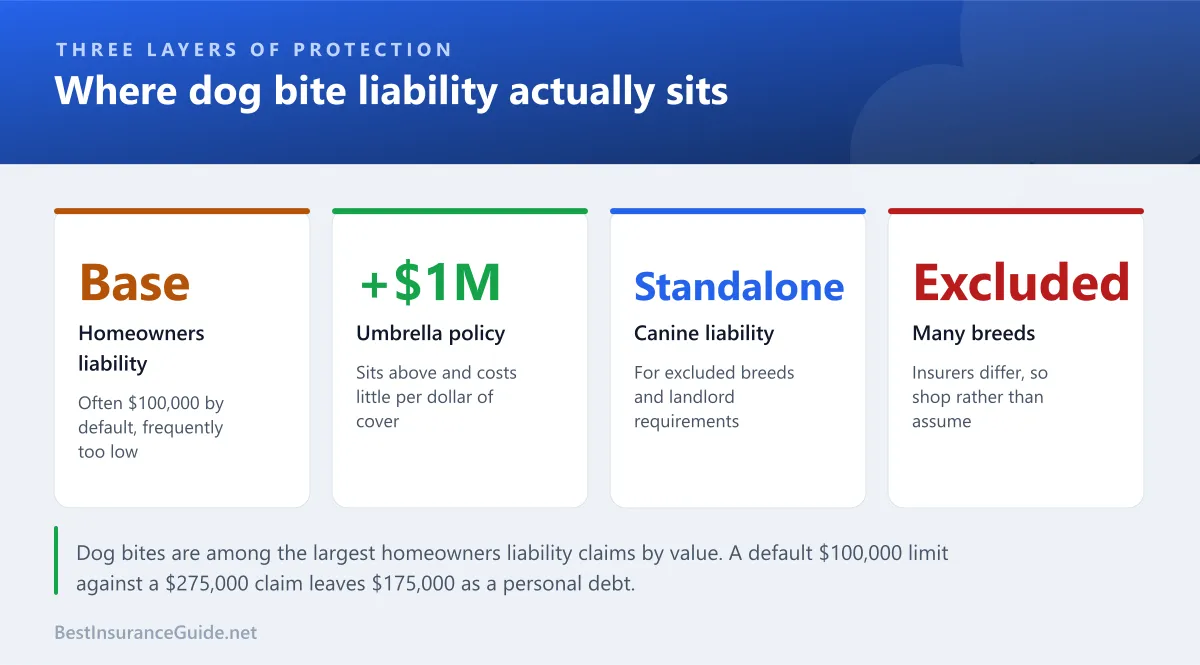
Dog bites are one of the largest categories of homeowners liability claim by total value, and the average settlement runs well into five figures. Serious injuries, facial injuries and injuries to children can produce claims several times that.
The problem is that most people carry the liability limit their policy came with, which is frequently $100,000 or $300,000, and have never thought about it.
Worked example: a bite that exceeded the limit
A visitor’s child is bitten on the face. The dog had no prior history.
| Item | Amount |
|---|---|
| Emergency treatment and initial surgery | $22,000 |
| Reconstructive surgery, two procedures | $61,000 |
| Ongoing treatment and scar revision | $18,000 |
| Pain and suffering settlement | $140,000 |
| Legal defence costs | $34,000 |
| Total claim | $275,000 |
| Homeowners liability limit | $100,000 |
| Paid by the homeowner personally | $175,000 |
That shortfall is not an insurance problem. It is a wage garnishment and a lien on a house.
Two fixes, and they are cheap.
Raise the underlying liability limit from $100,000 to $300,000 or $500,000. On most policies this costs a modest amount per year.
Add an umbrella policy. An umbrella sits above your homeowners and auto liability and continues paying when they are exhausted, usually in million-dollar increments. It is priced low because it rarely pays, and dog ownership is one of the clearest reasons to hold one.
Breed exclusions, and what to do about them
Here is where dog owners run into a wall that has nothing to do with their individual animal.
Many homeowners and renters insurers maintain lists of breeds they will not cover, will exclude from liability, or will not write a policy for at all. The lists vary between insurers and typically include some combination of pit bull type dogs, Rottweilers, Dobermans, German Shepherds, Akitas, Chow Chows, Huskies and wolf hybrids.
Insurers also commonly exclude any dog with a bite history, regardless of breed, which is arguably the more rational underwriting position.
Three things follow.
Disclose the dog honestly. Concealing a dog to get a policy issued is misrepresentation, and it gives the insurer grounds to deny the exact claim you bought the policy for.
Shop, because insurers differ. Breed policy is not standardised. An insurer that declines your dog outright and one that writes it without comment may quote similar premiums. This is one of the clearest cases where an independent agent who knows the local market earns their commission.
Check your state. A small number of states restrict or prohibit breed-based underwriting for homeowners insurance, requiring insurers to assess the individual animal rather than the breed. The position varies and has been changing, so check your own state insurance department rather than assuming.
Standalone canine liability insurance
If your homeowners insurer excludes your dog, or has non-renewed you after an incident, standalone canine liability insurance exists and is written by specialist insurers.
It covers bodily injury and property damage caused by your dog, independently of your homeowners policy. Typical characteristics:
Limits commonly available from $25,000 up to $300,000 or more.
It sits alongside, not inside, your homeowners policy, so it works even where the homeowners policy has excluded the dog entirely.
It satisfies landlord requirements, which is frequently the practical reason people buy it. Many landlords now require proof of liability cover for tenants with dogs.
Underwriting looks at the individual dog, including bite history, training, and sometimes a behavioural assessment, rather than applying a blanket breed rule.
It costs more per dollar of cover than adding liability to a homeowners policy, which is the trade for being available at all when the mainstream market has declined you.
Strict liability and the one-bite rule
Whether you are legally responsible for a bite depends on your state, and there are broadly two systems.
Strict liability states hold the owner responsible for a bite regardless of whether the dog had shown any prior aggression. The fact of the bite is largely enough. Most states operate some version of this.
One-bite rule states require the injured party to show that the owner knew or should have known the dog was dangerous, which in practice often means a prior incident. Fewer states use this, and even there, negligence claims can succeed without a prior bite.
Several states also have leash law and negligence provisions that operate alongside either system, and many have specific rules about trespassers and provocation.
The practical point for insurance is that in most of the country you do not get a free first bite, and the assumption that you do is one of the more expensive misconceptions in dog ownership.
What to do this week
Find your liability limit. It is on the declarations page of your homeowners or renters policy, listed as personal liability or Coverage E.
Ask your insurer directly whether your dog is covered, by breed and by name, and get the answer in writing. Do not rely on the absence of an exclusion in the policy summary.
Raise the limit to at least $300,000 if it is lower, and price an umbrella at the same time.
If you rent, read the lease. Many now specify a minimum liability limit for dog owners and require the landlord be named as an interested party, which costs nothing to arrange.
Keep the dog’s training and behaviour records. Certification from a recognised programme helps with standalone underwriting and occasionally with mainstream insurers.
What none of this covers
Worth being clear about the boundaries.
Damage your dog does to your own property is not a liability claim, because liability is third-party cover. Chewed doors and scratched floors are yours.
Injury to members of your own household is generally excluded from personal liability, which is intended for third parties.
Your dog’s own injuries are a pet insurance question, not a liability one. If two dogs fight, your pet policy treats your dog and their liability policy may respond for the other.
Commercial dog activity — breeding, boarding, walking or training as a business — is excluded from personal liability entirely and needs commercial cover. Our guide to business insurance by trade covers how that works.
The short version
Pet insurance does not cover dog bites. Personal liability under your homeowners or renters policy does, and it is the coverage most dog owners have never checked.
Dog bite claims are among the largest homeowners liability claims by value, and default limits of $100,000 are frequently not enough. Raise the limit and price an umbrella, because both are cheap relative to what they protect.
If your breed is excluded, disclose it, shop insurers rather than assuming they all take the same view, check whether your state restricts breed-based underwriting, and look at standalone canine liability cover if the mainstream market says no.
Then keep the pet policy for what it actually does: your own dog’s veterinary treatment. For that, see the pet insurance cost guide.
What a claim actually looks like
If your dog does bite someone, the sequence matters and the instinct to be reassuring can cost you.
Get the injured person medical attention immediately, and be helpful about it. Medical payments coverage exists precisely to fund a minor injury without anyone establishing blame, and using it early frequently prevents escalation.
Do not admit fault or promise to pay. Sympathy is human and appropriate. A commitment is a statement your insurer may have to defend, and liability determination is not yours to make at the scene.
Report it to your insurer promptly, even if the injured party says they are fine. Policies require notice of anything that might become a claim, and late notice is grounds for problems.
Exchange details and identify witnesses, exactly as you would after a road accident.
Comply with local reporting requirements. Many jurisdictions require bite reports to animal control or public health, and there are usually rabies observation or quarantine rules that follow. These are legal obligations separate from insurance.
Photograph the location, particularly if the circumstances matter: whether the person was on your property, whether a gate was open, whether the dog was provoked.
Expect consequences for the policy. After a bite, insurers commonly exclude the dog, decline to renew, or require a higher premium. That is the point at which standalone canine liability cover becomes relevant, and it is worth researching before your renewal arrives rather than after.
Renting with a dog
This has become a significant practical issue, and the requirements are increasingly specific.
Many leases now require dog owners to carry liability cover, frequently at a stated minimum such as $100,000 or $300,000, and to name the landlord as an additional interested party. That designation costs nothing and simply means the landlord is notified if the policy lapses.
Do not name the landlord as an additional insured unless the lease genuinely requires it and you understand the effect, because that extends your liability limit to protect them as well.
Breed restrictions in leases are separate from insurance. A landlord may prohibit a breed regardless of whether you can insure it, and conversely a landlord who permits the dog does not oblige your insurer to cover it.
If your renters insurer excludes your breed, standalone canine liability cover can satisfy the lease requirement independently, which is one of the main reasons the product exists.
Our renters insurance guide covers how the liability section works and what limits are worth carrying in a shared building, where a single incident can involve neighbours as well as visitors.
Reducing the risk itself
Insurance is the backstop. These reduce the chance of needing it.
Training and socialisation, ideally early and ongoing. Certification from a recognised programme also helps with standalone underwriting.
Secure fencing and gates, since a large share of bites involve a dog that got out.
Signage and control around visitors, particularly delivery drivers and meter readers, who are disproportionately represented in bite claims.
Supervision around children, who are both the most common bite victims and the most likely to suffer facial injuries that produce large claims.
Muzzle training as a neutral skill, not a punishment, so it is available when needed at the vet or in crowds.
Honesty about your own dog. A dog that has growled, snapped or shown resource guarding is telling you something, and addressing it with a behaviourist is far cheaper than the claim that follows ignoring it.
Related reading
Does renters insurance cover injuries covers where a dog bite claim actually lands for a tenant, which is the liability section of a renters policy rather than any pet product. Do I need renters insurance covers why that liability limit matters more than the contents cover most people focus on.
A note on scope
Liability law, breed underwriting rules and the availability of standalone canine cover all vary by state and change over time. Nothing here is legal advice. Your state insurance department publishes current rules on underwriting practices, and a local independent agent will know which insurers in your market write which breeds.
Figures used in the worked example are illustrative of the scale these claims can reach rather than a prediction, and this site is independent and not affiliated with any insurer.