Does Renters Insurance Cover Injuries? Other People's, Not Yours
Renters insurance covers injuries you cause to others, not your own. Liability limits, medical payments, dog bites and what personal injury coverage really means.

Table of contents
This is the coverage renters understand least, and the confusion starts with the word “injuries”, which points in two completely different directions.
The distinction that matters
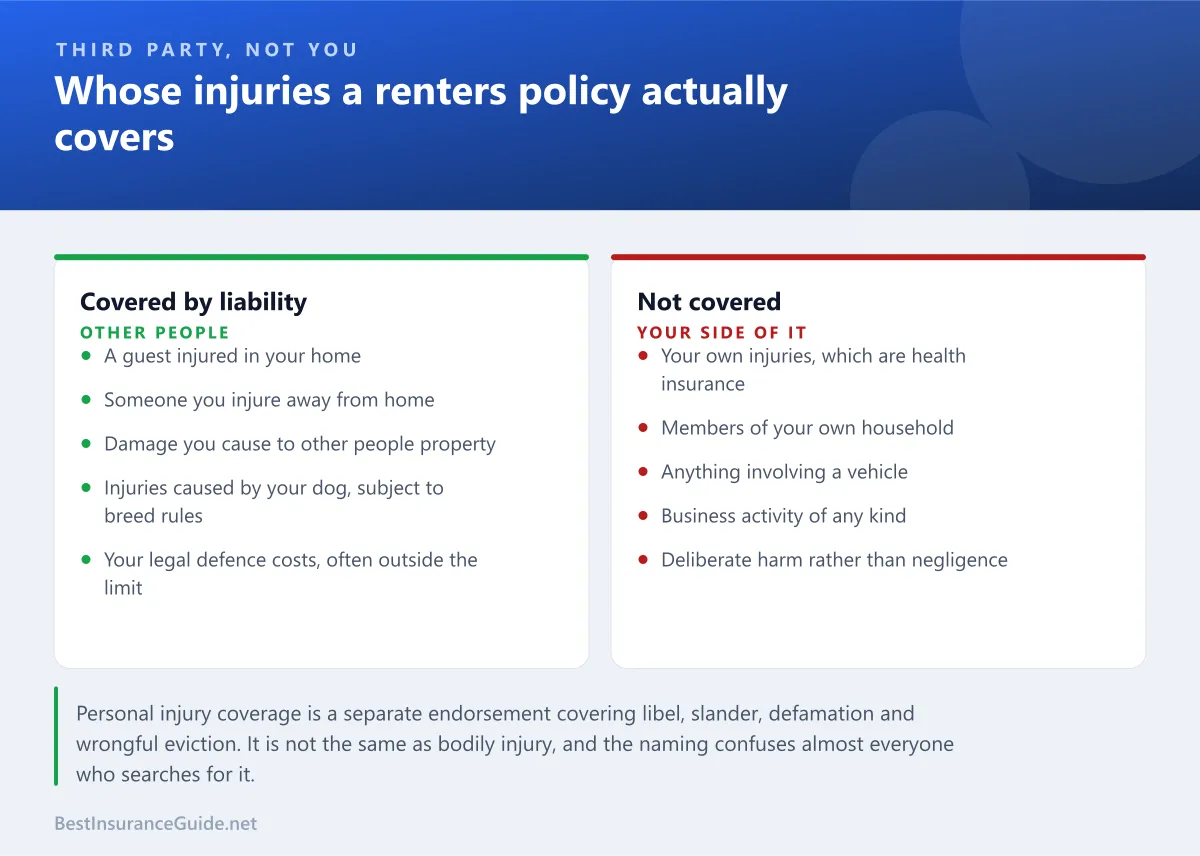
Renters insurance covers injuries you cause to other people. It does not cover injuries to you.
Liability coverage is third-party protection. It exists to pay someone else when you are legally responsible for hurting them.
If you slip in your own kitchen and break a wrist, your renters policy pays nothing toward it. That is your health insurance. If a guest slips in the same kitchen and breaks a wrist, that is exactly what your renters policy is for.
The two coverages that respond
Personal liability, shown as Coverage E, is the main one. It typically starts at $100,000 and pays:
- The injured party’s medical costs
- Their lost earnings, where claimed
- Pain and suffering settlements
- Your legal defence costs, which are frequently substantial and sit outside the limit on many policies
Medical payments to others, Coverage F, is a small no-fault amount, commonly $1,000 to $5,000. It pays a guest’s minor medical bills without anyone establishing blame.
That second one is underused and genuinely useful. If a visitor twists an ankle on your step, offering to have medical payments handle the urgent care visit frequently prevents the situation escalating into a liability claim. Using it is not an admission of fault.
Where liability actually applies
Broader than most tenants realise. Personal liability follows you, not the property.
In your home. A guest falls on stairs, is injured by a falling object, or is hurt by something you did.
Away from home. You knock someone off a bicycle, injure someone playing sport, or cause an accident in a shop. Personal liability generally covers you anywhere.
Damage to other people’s property. Not just injuries. Water escaping from your flat into a neighbour’s, a broken window, damage to a friend’s property.
Your dog, wherever it bites, subject to breed exclusions covered below.
Your children, whose actions are generally covered under your policy.
Three things are excluded and need different policies.
Anything involving a vehicle, which is your auto policy’s job.
Business activity, which needs commercial cover. Our guide to business insurance by trade covers what that looks like.
Intentional harm. Liability covers negligence, not deliberate acts.
Why the default limit is usually too low
$100,000 sounds substantial until you look at what an injury claim actually costs.
Worked example: a guest injured on the stairs
A visitor falls on a loose stair edge and sustains a spinal injury.
| Item | Amount |
|---|---|
| Emergency treatment and surgery | $94,000 |
| Hospitalisation and rehabilitation | $71,000 |
| Lost earnings, eight months | $46,000 |
| Pain and suffering settlement | $120,000 |
| Legal defence costs | $38,000 |
| Total claim | $369,000 |
| Liability limit carried | $100,000 |
| Paid personally | $269,000 |
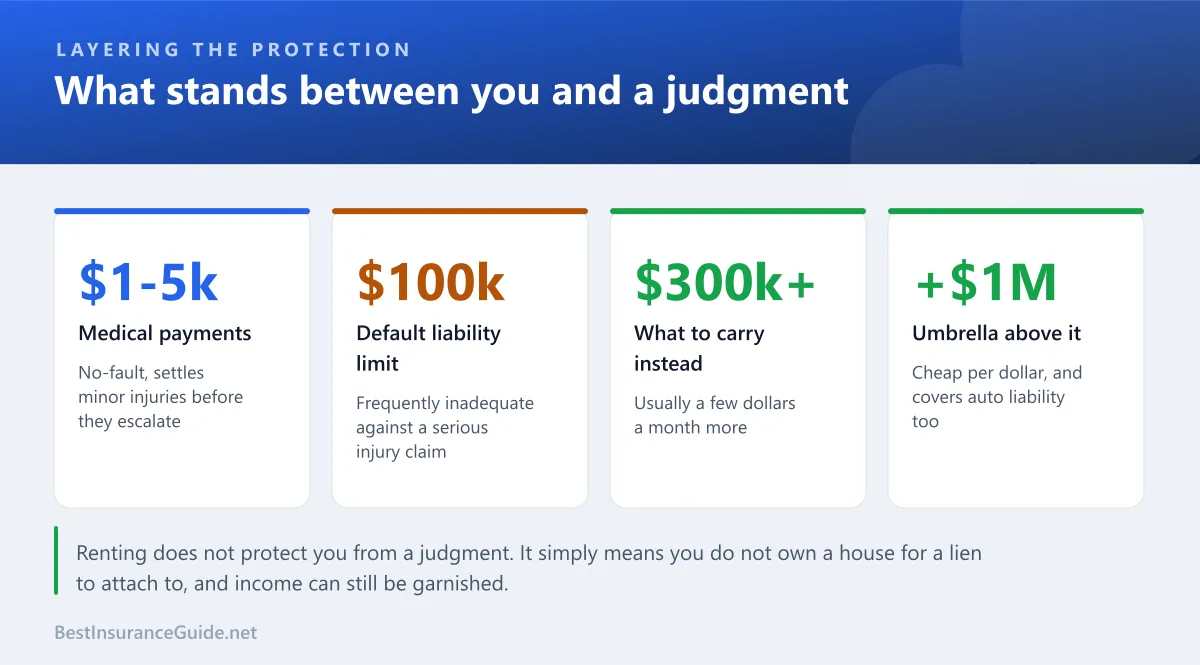
That shortfall is a judgment, wage garnishment and a lien that follows you for years.
Two fixes, both cheap on a renters policy.
Raise the limit from $100,000 to $300,000 or $500,000. On a policy already costing $15 to $30 a month, this typically adds a few dollars.
Add an umbrella policy if you have income or assets worth protecting. It sits above your renters and auto liability and continues paying when both are exhausted, usually in million-dollar increments, at a low cost per dollar of cover.
For a renter, raising the underlying limit is the obvious first step, because the incremental cost is genuinely trivial relative to the exposure.
Dogs, and the exclusion that catches people
Dog bites are among the largest categories of liability claim by value, and coverage is not automatic.
Many insurers exclude specific breeds, and the lists vary between companies. Many also exclude any dog with a bite history, regardless of breed, which is arguably the more rational position.
Disclose the dog honestly. Concealing it to get a policy issued gives the insurer grounds to deny the exact claim you bought the policy for.
Ask by breed and by name, and get the answer in writing. The absence of an exclusion in a summary is not confirmation of coverage.
If your breed is excluded, standalone canine liability insurance exists and can also satisfy a landlord requirement. Our guide to dog bite liability insurance covers that market and how the claim process works.
Many leases now require dog owners to carry liability cover at a stated minimum and to name the landlord as an interested party, which costs nothing to arrange.
“Personal injury” means something else entirely
This is a genuine trap in the terminology, and it is worth being precise about.
Bodily injury means physical harm to a person. That is what standard liability covers.
Personal injury coverage is a separate endorsement covering a completely different category of harm:
- Libel and slander
- Defamation
- False arrest and malicious prosecution
- Invasion of privacy
- Wrongful eviction
It has nothing to do with someone being physically hurt. It is reputational and rights-based harm.
So a search for whether renters insurance covers “personal injury” produces two different correct answers depending on which meaning was intended. If you are asking about someone getting hurt, that is bodily injury under standard liability. If you are asking about being sued for something you said online, that is the personal injury endorsement, and it is not on most policies by default.
The endorsement is inexpensive and increasingly relevant given how much people publish. Worth asking about if you post publicly, review businesses, or are active in a community where disputes escalate.
Injuries to people in your own household
Worth stating clearly because it disappoints people.
Personal liability excludes members of your own household. It is third-party cover, and people who live with you are not third parties for this purpose.
So if your partner or child is injured in your home, that is health insurance rather than your renters liability.
Roommates are a grey area that depends on the wording and on whether they are a named insured. This is one of several reasons roommates should carry separate policies rather than sharing one, as the renters insurance guide explains.
When the landlord is responsible
Not every injury in a rented home is the tenant’s fault, and the direction matters.
If someone is injured because of a structural defect or a failure the landlord was responsible for maintaining — a broken handrail reported and not fixed, inadequate lighting in a communal stairwell, a failed fire door — the claim is against the landlord’s liability policy, not yours.
Two practical points.
Report defects in writing. A dated email reporting a loose handrail is what later establishes that the landlord knew. Without it, the argument becomes about whether they were on notice.
Do not accept blame at the scene. Injuries in shared buildings frequently involve overlapping responsibility, and apportionment is not yours to decide in the moment.
If someone is injured
Get them medical attention, and offer to have medical payments coverage handle it. That is what it exists for and it is not an admission of fault.
Report to your insurer promptly, even if the person says they are fine. Policies require notice of anything that might become a claim, and late notice creates problems.
Do not admit fault or promise to pay. Sympathy is appropriate; commitments are a statement your insurer may have to defend.
Photograph the location and the condition that caused it, before anything is repaired or moved.
Get witness details.
Keep the reporting record if the cause was something you had told the landlord about.
Comparing quotes on liability
Liability is where renters policies differ most and where price comparison sites help least, because the limit is frequently defaulted rather than chosen.
What is the liability limit on this quote? Frequently $100,000 by default. Ask what $300,000 and $500,000 cost, because the answer is usually a few dollars a month.
Are legal defence costs inside or outside the limit? Outside is considerably better, since defence costs on a contested injury claim can run to tens of thousands and would otherwise erode what is available to pay the claimant.
What is the medical payments limit? Commonly $1,000 to $5,000, and the higher figure resolves more situations before they escalate.
How is my dog treated, by breed and by name? In writing.
Is a personal injury endorsement available, covering libel, slander and wrongful eviction, and what does it cost?
Does the policy require an umbrella to be written with the same insurer, if you might add one later?
When an umbrella makes sense
Umbrella policies are usually discussed in a homeowner context and they are frequently more relevant to renters than people assume.
If you have income to garnish or savings to attach, a judgment above your liability limit reaches them. Renting does not protect you; it simply means you do not own the house.
If you have a dog, particularly a large one or one in a household with children visiting.
If you drive, since an umbrella sits above your auto liability as well, and auto claims are the most common way people exceed a liability limit.
If you are a landlord yourself, or rent out a room, which raises exposure considerably.
Umbrella cover is priced low per dollar because it rarely pays, and most insurers require you to carry specified underlying limits on your renters and auto policies before writing one. That underlying requirement frequently improves your base cover as a side effect, which is no bad thing.
A note on scope
Liability limits, medical payments amounts, breed exclusions and the availability of personal injury endorsements vary between insurers and change over time. The figures used in the worked example are illustrative of the scale injury claims can reach rather than a prediction.
Nothing here is legal advice, and liability law differs by state. Your own declarations page states your limit, and it is worth reading tonight. This site is independent and not affiliated with any insurer.
Where liability follows you, briefly
One point worth restating because it is genuinely useful and widely unknown.
Personal liability attaches to you, not to your flat. It travels. Injuring someone in a park, damaging a friend’s property at their home, knocking a stranger off their bike on a shared path: all normally covered by a renters policy, subject to the usual exclusions for vehicles and business activity.
That makes renters insurance meaningfully more valuable than its price suggests, particularly for people who assume a policy costing $15 a month cannot be doing much. The contents cover is the part you notice; the liability cover is the part that prevents a genuinely life-altering bill.
The short version
Renters insurance covers injuries you cause to other people, not injuries to you. Your own medical bills are your health insurance, always.
Personal liability follows you rather than the property, so it covers you away from home as well as in it, and it covers damage to property as well as injury to people.
The default $100,000 limit is frequently inadequate against a serious injury claim, and raising it to $300,000 or more costs a few dollars a month on a policy that is already cheap.
Check how your insurer treats your dog, in writing. And do not confuse bodily injury with personal injury coverage, which is a separate endorsement covering libel, slander and wrongful eviction rather than physical harm.
For the full list of what a renters policy covers, see what renters insurance covers, and for dog-specific liability, dog bite liability insurance.