Does Renters Insurance Cover Storage Units? Yes, But Only to 10%
Renters insurance covers a storage unit, but off-premises limits are usually 10% of your contents cover and some perils drop out. What to check first.

Table of contents
Most people move things into storage assuming their renters policy came along for the ride.
It did. That part is genuinely good news, and it surprises tenants who expected a flat no. Your belongings are insured off-premises against the same named perils they were insured against at home.
What did not come along is the full limit. And that is where storage claims go sideways.
The 10% rule
Renters policies split personal property into two buckets: what is at the residence, and what is not.
Everything at your flat draws on the whole contents limit. Everything away from it, including a storage unit, draws on a separate off-premises limit that is typically 10% of that contents figure.
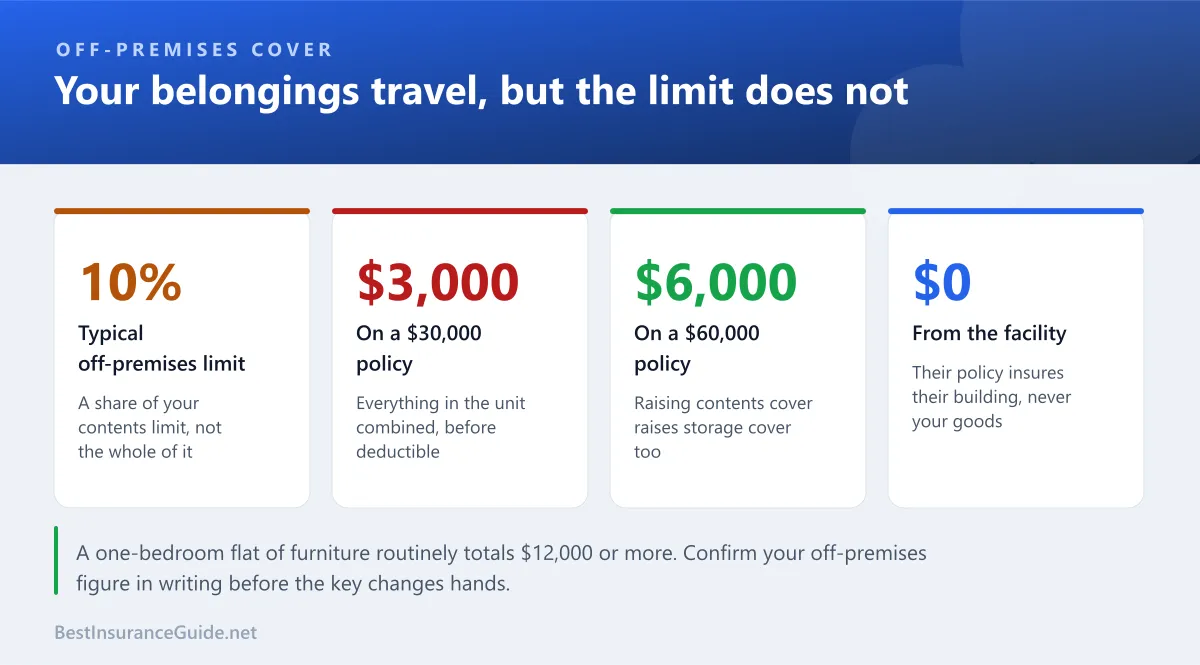
So the real answer to does my renters insurance cover storage units is: yes, up to about a tenth of what you thought.
Worked example: a one-bedroom move-out, in storage for eight months
Someone between leases with a $30,000 contents policy and a $500 deductible.
| In the unit | Replacement cost |
|---|---|
| Sofa, armchair, coffee table | $2,900 |
| Bed frame, mattress, wardrobe | $2,400 |
| Dining table and four chairs | $1,300 |
| Boxed kitchen contents | $1,700 |
| Television, monitor, small electronics | $1,900 |
| Books, tools, sports gear, boxed clothing | $2,600 |
| Total in storage | $12,800 |
A fire in the facility destroys the lot.
| Amount | |
|---|---|
| Loss | $12,800 |
| Off-premises limit (10% of $30,000) | $3,000 |
| Less deductible | $500 |
| Paid | $2,500 |
| Absorbed by the tenant | $10,300 |
The claim was valid, covered, and approved. It still left them $10,300 short, because a one-bedroom flat’s worth of furniture does not fit inside a $3,000 limit.
This is the single most useful thing to know before you sign a storage contract.
The perils that quietly drop out
Coverage in storage is named-peril, exactly as it is at home. Fire, smoke, theft, vandalism, windstorm, lightning and sudden water discharge all travel with you.
What does not travel well is everything storage units are actually prone to.
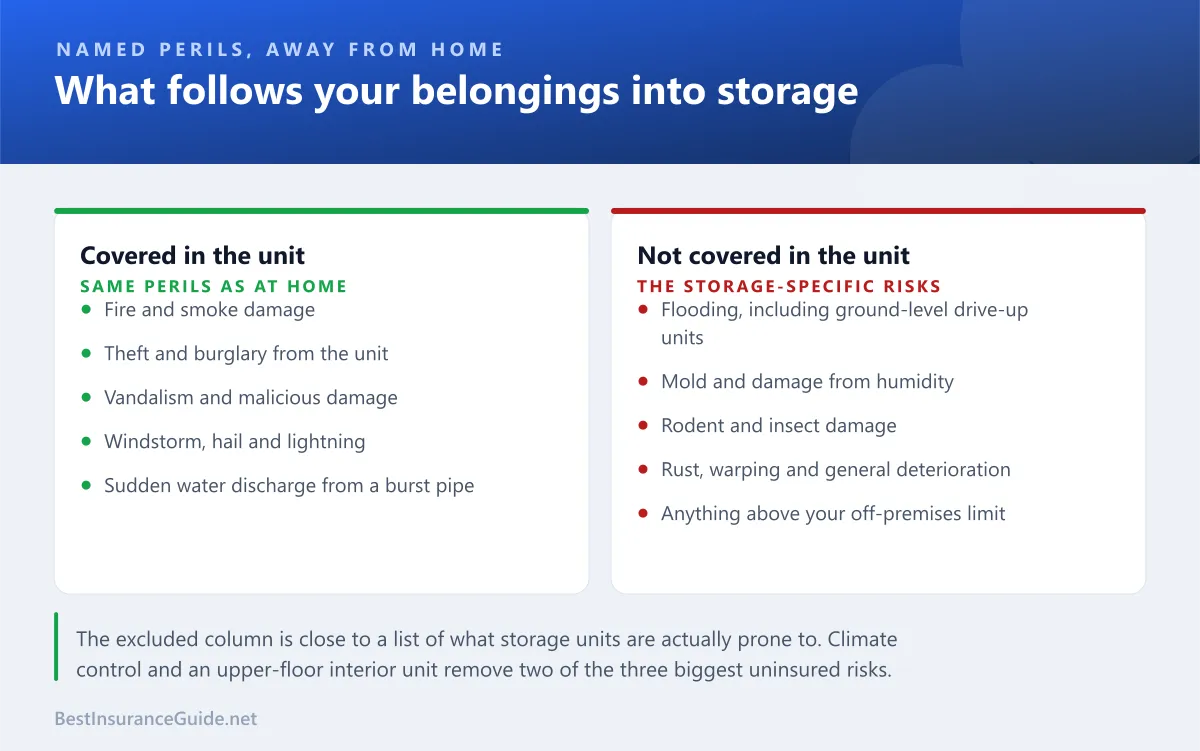
The excluded column is not arbitrary. It is a list of the things that happen slowly, and insurance only pays for things that happen suddenly.
Flood is the big one. Drive-up units at ground level are the cheapest tier for a reason, and they are the first to take water. Rising water is excluded on every renters policy, so a flooded unit is simply an uninsured loss.
Mold and humidity are the second. A non-climate-controlled unit through a humid summer will grow mold on upholstery and paper, and that is treated as gradual damage. Our guide to whether renters insurance covers mold sets out the same sudden-versus-gradual test that decides those claims.
Pests. Rodent and insect damage is excluded essentially everywhere. Cardboard boxes on a concrete floor in a warm building is close to an invitation.
Wear, rust and deterioration. Eight months is long enough for metal to corrode and for particleboard furniture to sag. None of that is a claim.
Where the facility’s insurance stops
Every storage contract you will ever sign says some version of the same thing: the facility is not responsible for your goods.
Their policy covers their buildings, their equipment and their liability as an operator. If the roof fails and rain destroys your belongings, their insurer’s concern is the roof. Your belongings are yours to insure.
Most facilities will offer you a protection plan at the counter, and many make some form of cover mandatory before they hand over a key. These plans are legitimate. They are also priced for convenience.
Worked example: two routes to $10,000 of cover
| Facility protection plan | Renters endorsement | |
|---|---|---|
| Cover on the unit | $10,000 | $10,000 off-premises |
| Typical monthly cost | $25 to $40 | Often $3 to $8 |
| Deductible | Often $100 to $500 | Your policy deductible |
| Covers your flat too | No | Yes |
| Covers liability | No | Already included |
The figures move by insurer and by facility, but the shape holds: raising the off-premises limit on a policy you already pay for is usually cheaper per dollar of cover than buying a second, narrower policy at the counter.
Ask your insurer first. Then decide whether the facility plan is worth adding on top, which it sometimes is if the unit holds more than your policy will stretch to.
Getting the limit raised
This is a five-minute phone call and almost nobody makes it.
Most insurers will either increase the off-premises percentage, write a scheduled amount for a specific storage location, or simply raise your overall contents limit so that 10% of it lands somewhere sensible.
That last option is often the cleanest. Going from $30,000 to $60,000 of contents cover roughly doubles the off-premises limit to $6,000 and costs a few dollars a month, while also fixing the under-insurance most tenants have at home anyway. Our renters insurance guide walks through how to count your contents properly, and the usual result is that people were under-insured before storage entered the picture.
Before you load the unit
The habits below cost nothing and change the outcome of a claim more than the policy wording does.
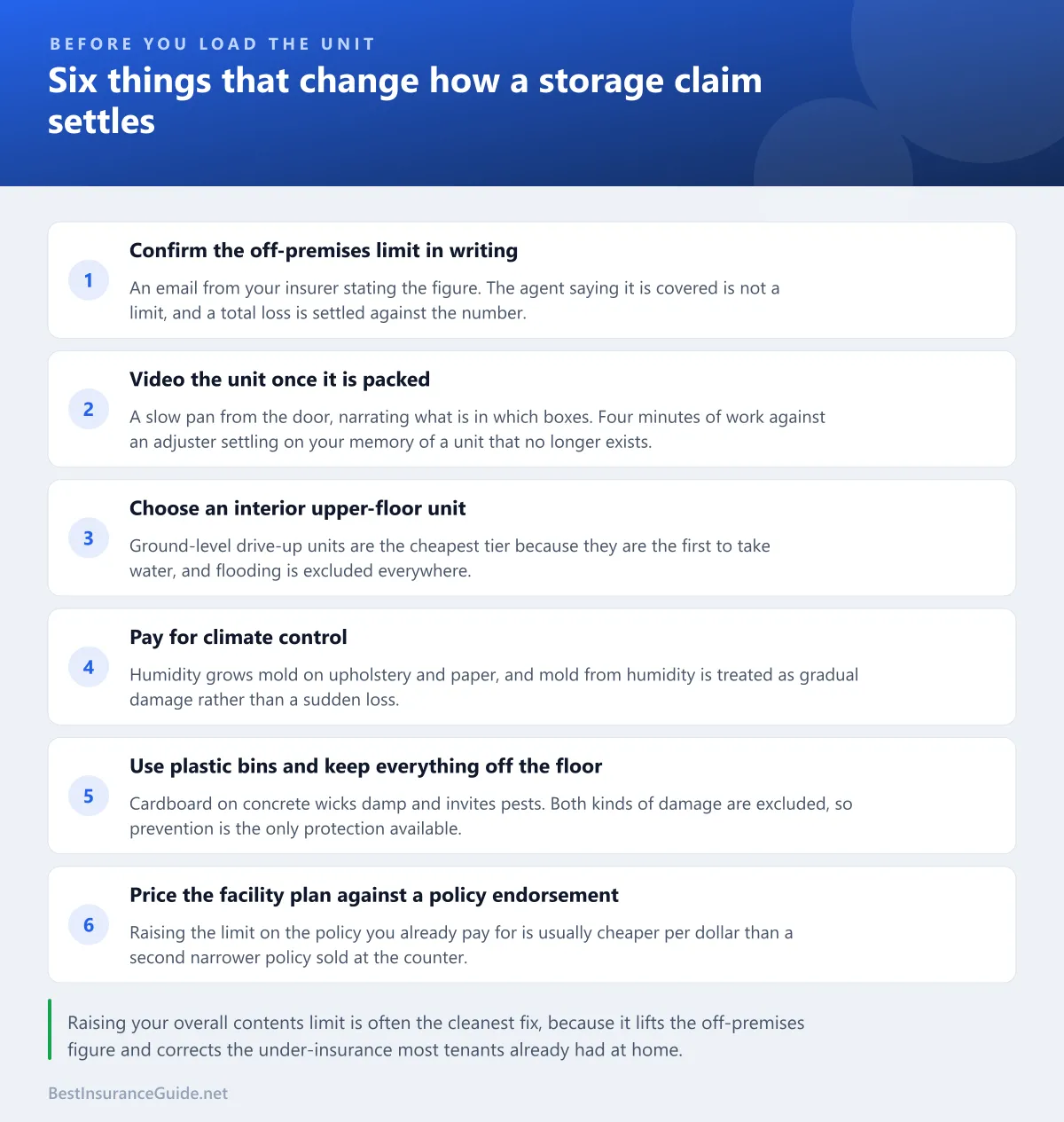
Two of those deserve expanding.
Video the unit once it is packed. Stand at the door and record a slow pan, narrating what is in which boxes. It takes four minutes. Without it, an adjuster is settling a total loss on your memory of what was in a unit that no longer exists, and memory settles low.
Get the off-premises limit in writing. An email from your insurer confirming the figure is worth having, because “the agent told me it was covered” is not a limit. You want the number.
Choosing the unit itself
Insurance rewards boring choices here.
An interior unit on an upper floor avoids the flood exposure that kills ground-level claims. Climate control removes the mold and humidity problem that renters insurance will not pay for. Plastic bins rather than cardboard resist both damp and pests, and stack without collapsing. Pallets or shelving keep everything off a concrete floor that will sweat.
The extra cost of a climate-controlled interior unit over a drive-up is usually modest, and it removes two of the three most likely ways your belongings get damaged, both of which are uninsured.
The short version
Renters insurance does cover storage units, against the same perils as your home, but at roughly 10% of your contents limit. Flood, mold, pests and gradual damage are excluded there just as they are anywhere else, and the facility’s own insurance covers you for nothing.
Do three things before the key changes hands: ask what your off-premises limit actually is, raise it if a room’s worth of furniture is going in, and video the unit once it is packed.
For the broader policy, start with the renters insurance guide. If you are comparing insurers rather than limits, how to compare insurance quotes covers matching the fields that actually make two quotes comparable.