Dog Dental Insurance: What Is Covered and the Clause That Voids It
Dog dental insurance covers disease and fractures, not cleaning. The annual dental exam requirement that voids coverage, and what extractions actually cost.

Table of contents

Dental is the coverage area where pet insurance most often disappoints people, and almost always for one of two reasons: they expected cleaning to be covered, or they missed a clause requiring annual dental care.
Both are avoidable.
The line insurers draw
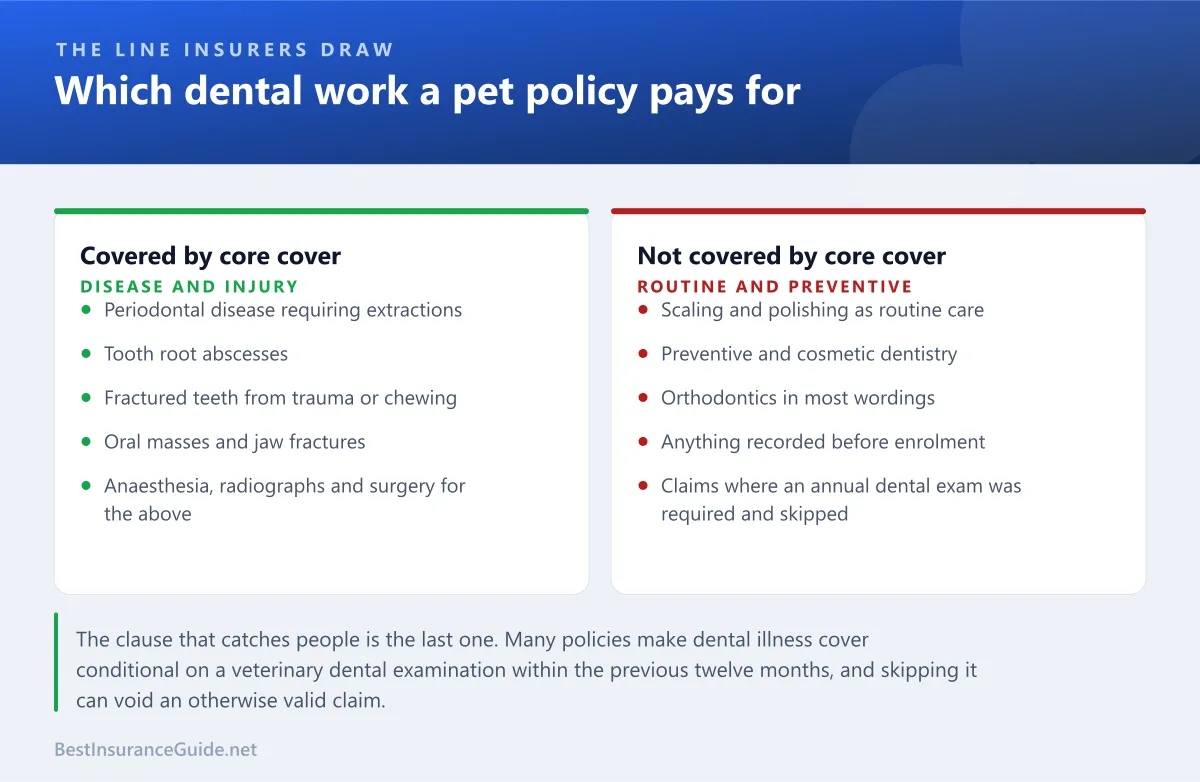
Covered by a core policy: dental disease and dental injury. Periodontal disease requiring extractions, tooth root abscesses, fractured teeth, oral masses, jaw fractures, and the diagnostics, anaesthesia and surgery that go with them.
Not covered: routine scaling and polishing, preventive dentistry, cosmetic procedures, orthodontics in most wordings, and anything relating to a condition recorded before enrolment.
Sometimes covered by a wellness rider: an allowance toward a routine cleaning, commonly $100 to $150.
The logic is the same as everywhere else in pet insurance. Cleaning is scheduled and predictable, so it is a budgeting item. Disease and fractures are unexpected, so they are insurance.
The clause that catches people
This is the part worth reading your own policy for, tonight.
A meaningful number of insurers make dental illness coverage conditional on routine dental care having been provided. The wording varies, but the common shape is that your dog must have had a veterinary dental examination within the previous twelve months, and in stricter versions a professional cleaning within the previous twelve or twenty-four months, for dental disease claims to be payable.
Miss that, and a periodontal disease claim can be refused on a policy that nominally covers dental illness.
The reasoning from the insurer’s side is defensible: untreated periodontal disease is progressive and largely preventable, and they do not want to fund the consequences of never taking a dog to the dentist. The problem is that owners rarely know the clause is there.
What to do: find the dental section of your policy wording, read what it requires, and diarise the annual dental examination. It is usually part of a normal wellness visit anyway, so compliance costs little beyond remembering.
What dental actually costs
Dental disease is extremely common. The majority of dogs show some degree of periodontal disease by middle age, and small breeds are affected earlier and more severely because of tooth crowding.
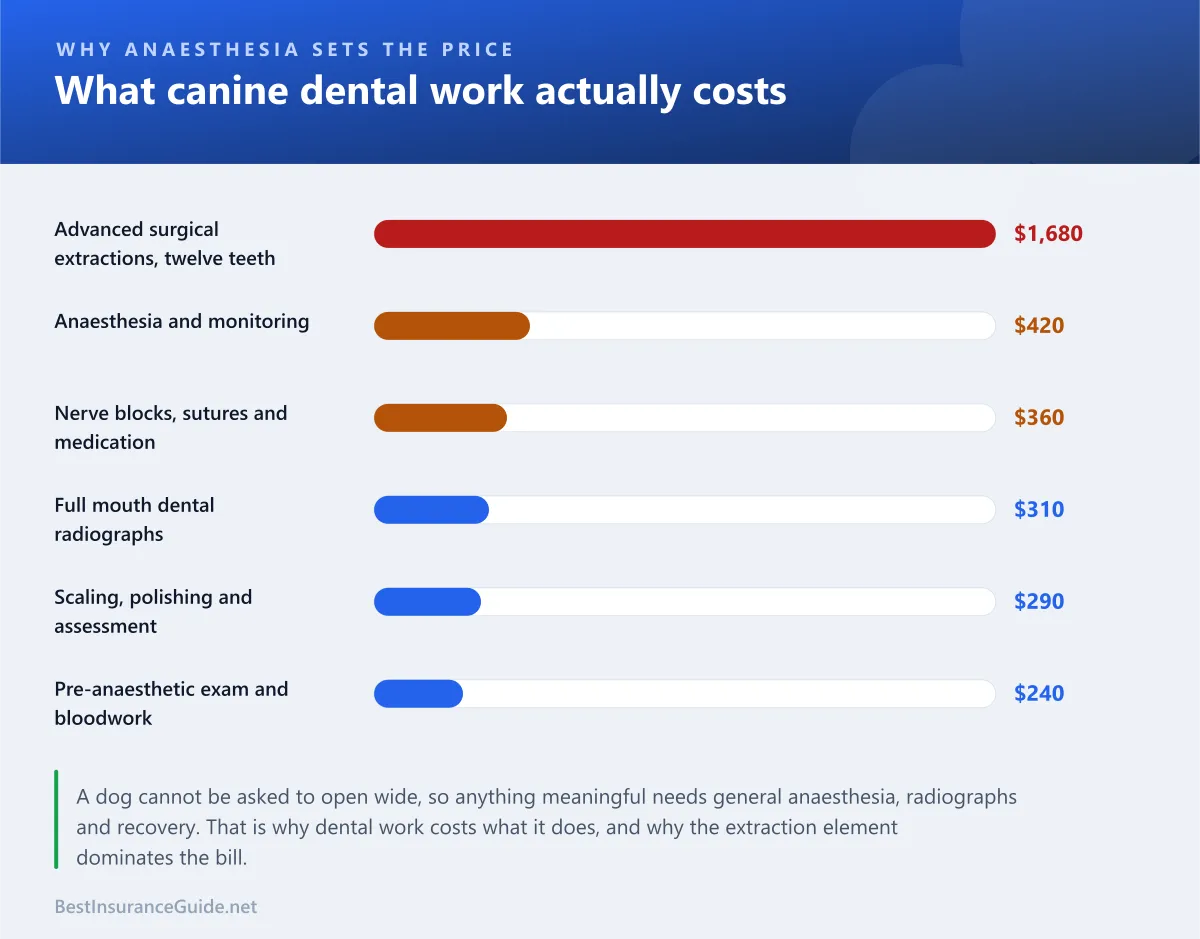
Worked example: periodontal disease with multiple extractions
A seven-year-old small breed dog with advanced periodontal disease. Policy: $500 annual deductible, 80% reimbursement, dental illness covered, annual exam requirement met.
| Item | Cost |
|---|---|
| Pre-anaesthetic examination and bloodwork | $240 |
| Anaesthesia and monitoring | $420 |
| Full mouth dental radiographs | $310 |
| Scaling, polishing and assessment | $290 |
| Twelve extractions, including surgical extractions | $1,680 |
| Nerve blocks, sutures and medication | $360 |
| Post-operative recheck | $90 |
| Total | $3,390 |
| Less deductible | $500 |
| Reimbursed at 80% | $2,312 |
| Owner pays | $1,078 |
Two things worth noticing. The extractions are the bulk of it, and they are covered because they arise from disease. And the scaling and polishing portion may be deducted as routine care by some insurers even within a disease claim, so check whether your insurer apportions the bill or covers the whole procedure once disease is established.
Anaesthesia is the reason dental work costs what it does. A dog cannot be asked to open wide, so anything meaningful requires general anaesthesia, monitoring, radiographs and a recovery period.
Pre-existing dental conditions
Dental is one of the areas where pre-existing exclusions bite hardest, because dental disease is progressive and frequently noted long before it is treated.
A recorded diagnosis of periodontal disease before enrolment is excluded, permanently, by essentially every insurer.
A note describing tartar or calculus is the grey area. Some insurers treat it as the documented beginning of periodontal disease and exclude accordingly; others do not. If there is anything on your dog’s record, ask the insurer in writing how they will read it before you pay a premium.
Retained deciduous teeth, malocclusion and other developmental dental issues are frequently identified at the puppy check or the neuter appointment, which makes them pre-existing for a policy bought afterwards. This is another argument for insuring at the point of collection rather than after the first veterinary visit.
The practical sequence is the same as everywhere: get the records, read them, insure before the next examination rather than after it.
Anaesthesia-free dentistry
Worth a short warning, because it is marketed at exactly the owners reading this article.
Anaesthesia-free or non-anaesthetic dental scaling removes visible tartar from the crown of the tooth. It does not clean below the gumline, where periodontal disease actually lives, and it does not allow radiographs, which is where the majority of significant pathology is found.
The veterinary dental profession is broadly united against it, on the grounds that it produces a cosmetically improved mouth while leaving disease untreated, and that it can delay a diagnosis.
For insurance purposes it is also unlikely to satisfy a policy’s routine dental care requirement, since that clause generally specifies a veterinary dental examination. If you are having it done to keep a policy condition satisfied, check first, because you may be paying for something that does not count.
Cats, briefly
Cats get dental disease at similar or higher rates than dogs, and two feline conditions deserve a mention because they are expensive and specific.
Tooth resorption affects a large share of adult cats. Lesions form on the tooth and it progressively breaks down, which is painful and usually requires extraction.
Chronic gingivostomatitis is a severe inflammatory condition that can require full-mouth extraction to resolve. It is one of the more expensive feline dental claims and it is genuinely miserable for the animal.
Both are covered as dental disease under the same rules described above, including the annual examination requirement where one applies.
How to buy for dental specifically
If dental is a concern, and for a small breed it should be, four questions decide the value of a policy.
Does the policy cover dental illness at all, or only dental accidents? Some cheaper policies cover a fractured tooth and exclude periodontal disease entirely. That is a large distinction, because disease is far more likely than trauma.
Is there an annual dental examination or cleaning requirement? And what exactly does it require?
Is there a dental sublimit? Some policies cap dental claims separately and well below the main annual limit.
How is the routine portion of a disease procedure treated? Whether the scaling element is deducted from a covered extraction claim.
Ask those four before comparing premiums, and read the answer in the policy wording rather than the summary page.
The short version
Pet insurance covers dental disease and dental injury. It never covers routine cleaning, which is a wellness item with a small allowance at best.
The clause that catches people is the annual dental care requirement. A meaningful number of policies make dental illness cover conditional on a veterinary dental examination within the previous twelve months, and skipping it can void a periodontal disease claim entirely.
Extractions are the expensive part, driven by anaesthesia, radiographs and surgical time, and a full-mouth case runs into four figures. Small breeds are affected earliest, so this is not a distant concern for them.
Check four things in your own policy: whether dental illness is covered at all, what the routine care requirement says, whether there is a dental sublimit, and how the scaling portion of a disease claim is treated.
For the wider picture on limits and deductibles, see the pet insurance cost guide, and for what wellness riders actually reimburse, does pet insurance cover vaccines.
Keeping the policy condition satisfied
If your policy requires annual dental care for dental illness cover to apply, treating that as an administrative task rather than a clinical one is the mistake.
Diarise it. An annual dental examination is usually part of a routine wellness visit, so the compliance cost is remembering rather than money.
Get it documented properly. The clinical record needs to show a dental examination was performed and what was found. “Annual vaccination” with no dental note may not satisfy an insurer reviewing a later claim.
Understand what your policy asks for. Some require only an examination. Stricter versions require a professional cleaning within a defined period, which is a considerably larger commitment at $600 to $1,000 a time.
Keep your own copy. If you change practices, the history needs to travel with you, and gaps are resolved against the policyholder.
Home dental care, which genuinely reduces claims
Periodontal disease is largely preventable, and the interventions are cheap relative to a four-figure extraction bill.
Toothbrushing is the single most effective measure, and it works if done most days. Every few weeks achieves very little. Start young if you can, because a puppy accepts it far more readily than an adult dog.
Dental diets and appropriately sized dental chews have some evidence behind them, and products carrying a recognised veterinary oral health seal have been assessed against published standards.
Avoid genuinely hard chews. Antlers, bones, hard nylon toys and ice are common causes of slab fractures of the carnassial teeth, which is one of the more expensive dental accidents and entirely avoidable. The usual rule of thumb is that if you cannot indent it with a thumbnail or would not want it dropped on your knee, it is too hard.
Watch the small breeds especially. Tooth crowding in small and toy breeds means periodontal disease starts earlier and progresses faster, and for those dogs annual dental attention is not optional.
Signs that mean a dental visit
Dogs rarely stop eating because of dental pain, which is why owners underestimate it. Watch instead for:
Bad breath that is genuinely offensive rather than doggy. Chewing on one side. Dropping food. Pawing at the mouth. Facial swelling below an eye, which frequently indicates a tooth root abscess. Blood in the water bowl or on toys. Reluctance to have the head touched.
Facial swelling in particular is worth a same-day call, because a carnassial tooth root abscess can track and is painful.
Acting early on any of these tends to mean extractions rather than more complex surgery, which is better for the animal and smaller for the claim.
A note on scope
Dental coverage terms, sublimits and routine care requirements vary considerably between insurers and change over time. Whether a policy requires an annual dental examination, a professional cleaning, or nothing at all is set by the individual wording, and it is the single term most worth reading in your own documents.
The figures here are illustrative ranges rather than any particular company’s schedule, and dental pricing varies substantially by region and by whether the work is performed in general practice or by a board-certified veterinary dentist.
Clinical questions, including whether a particular dog needs a dental procedure, when, and which home care products suit it, are for your veterinarian. This site is independent and not affiliated with any insurer.
Related reading
Puppy wellness plans covers the routine care products that dental cleaning usually sits inside, and the difference between an insurer rider and a practice contract. Cat insurance covers the same dental question for cats, where the disease pattern differs.
A note on scope
Dental coverage terms, sublimits and routine care requirements vary considerably between insurers and change over time. The figures here are illustrative ranges rather than any particular company’s schedule, and dental pricing varies substantially by region and by whether the work is done in general practice or by a veterinary dentist.
Clinical questions, including whether a particular dog needs a dental procedure and when, are for your veterinarian. This site is independent and not affiliated with any insurer.