Accident-Only Pet Insurance: Cheap, Narrow, and Right for Some Pets
Accident-only pet insurance costs far less than accident and illness cover but excludes all disease. When it is the right choice and when it is a false economy.

Table of contents
Accident-only pet insurance is the most misunderstood product in this market. It is genuinely useful for a specific set of animals and genuinely a false economy for most others, and the line between the two is clear once you look at what actually goes wrong with pets.
What it covers, precisely
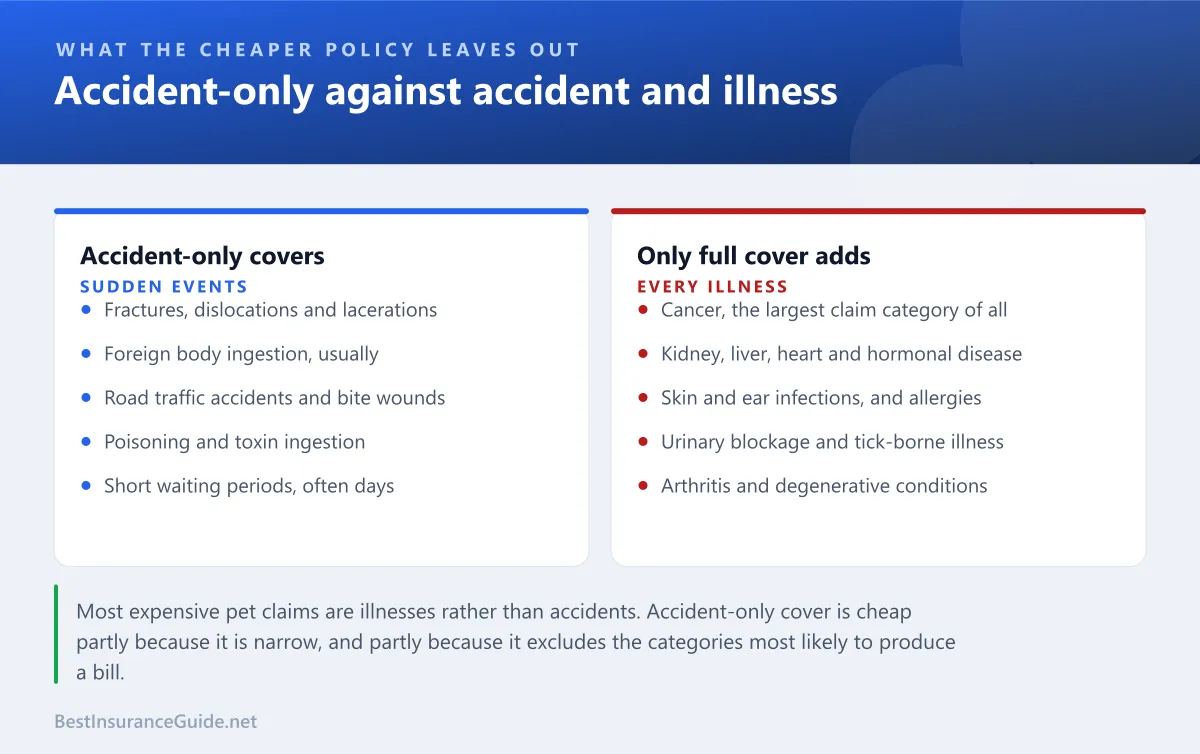
Accident-only cover responds to sudden, unexpected external events. The usual list:
- Fractures and dislocations
- Lacerations, bite wounds and puncture injuries
- Foreign body ingestion, including the swallowed sock and the corn cob
- Road traffic accidents
- Poisoning and toxin ingestion
- Burns, electrocution and heatstroke in some wordings
- Eye injuries from trauma
- Snake bites and insect stings
It covers the whole event, not just the first consultation: diagnostics, imaging, surgery, hospitalisation, medication and follow-up, subject to your annual limit and deductible.
What it does not cover
Everything that is not an accident, which is most of what actually happens to pets.
Cancer. Diabetes. Kidney and liver disease. Heart disease. Arthritis. Skin and ear infections. Urinary blockage. Tick-borne illness. Gastrointestinal disease. Hormonal conditions. Respiratory disease. Dental disease.
It also excludes routine and preventive care, as every core pet policy does.
Two grey areas worth resolving with your own insurer before buying:
Foreign body ingestion is normally classed as an accident, which matters because it is the single most common expensive emergency. Confirm it.
Cruciate ligament tears are sometimes classed as accidents and sometimes as degenerative illness, and insurers genuinely differ. On an accident-only policy this is a large question, because cruciate injuries are among the most common four-figure claims.
The number that decides it
Here is the honest problem with accident-only cover: most expensive pet claims are illnesses, not accidents.
Across the market, the conditions that generate the largest and most frequent claims are dominated by disease rather than trauma. Cancer, gastrointestinal disease, skin conditions and chronic organ disease account for far more claim value than fractures and lacerations do.
So an accident-only policy is cheap partly because it is narrow, and partly because it excludes the categories most likely to produce a bill.
When accident-only is the right answer
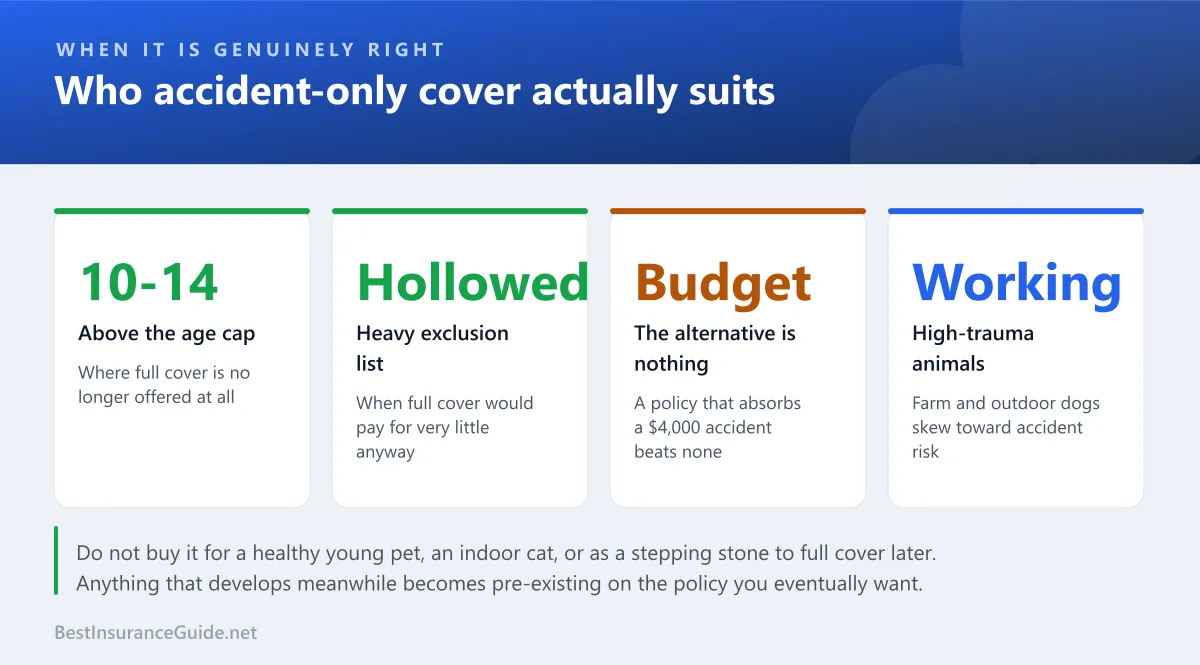
Four situations, and they are real.
The animal is above the age cap for full cover. Most insurers stop selling new accident and illness policies somewhere between ten and fourteen. Accident-only is frequently still available above that, and for a twelve-year-old dog it may be the only cover on offer.
The medical history has produced so many exclusions that full cover would pay for little. A nine-year-old with recorded arthritis, a heart murmur, chronic skin disease and a prior tick-borne infection may find that a full policy excludes most of what is likely to happen. Accident-only costs a fraction and covers the fracture, which is not excluded.
The budget genuinely will not stretch to full cover. The choice is not between accident-only and full cover; it is between accident-only and nothing. A policy that absorbs a $4,000 road accident is meaningfully better than no policy, and this is a perfectly respectable reason to buy it.
The animal is high-trauma and low-illness risk. Working dogs, farm dogs and outdoor dogs face elevated accident exposure. Full cover is still better if affordable, but the accident-only trade is less lopsided for these animals than for a house cat.
Worked example: a twelve-year-old dog
| Accident-only | Accident and illness | |
|---|---|---|
| Available at this age? | Usually yes | Often no |
| Indicative monthly premium | $28 | $140 if offered |
| Pre-existing exclusions | Irrelevant to accidents | Extensive |
| Covers a $4,200 fracture repair | Yes | Yes |
| Covers a $6,000 cancer workup | No | Only if not pre-existing |
For this animal, accident-only is not a compromise. It is frequently the only sensible product on the table.
When it is a false economy
A healthy young animal. This is the common mistake. A two-year-old dog has decades of illness risk ahead and accident-only cover excludes all of it. The premium saving is real and the protection gap is enormous. If you can afford full cover for a young animal, buy full cover; the enrolment date you establish now is the most valuable thing you will ever own on that policy.
As a stepping stone to full cover later. Upgrading rarely works, because anything that develops while you hold accident-only becomes pre-existing on the full policy. You would be buying full cover precisely when it can no longer cover what you need.
For a cat you think is low risk because it stays indoors. Indoor cats have low accident exposure and normal illness exposure. Urinary blockage, kidney disease and hyperthyroidism are all illnesses. An accident-only policy on an indoor cat covers close to nothing that is actually likely to happen.
Where the saving is small. For a young animal the gap between accident-only and full cover can be modest in absolute terms. Paying $22 a month instead of $38 to exclude every disease is a poor trade.
Comparing accident-only policies
The same four fields decide the value here as on any pet policy: the annual limit, the deductible and whether it is annual or per condition, the reimbursement percentage, and the waiting periods.
Accident waiting periods are usually short, commonly a few days and sometimes as little as 24 to 48 hours, which is one genuine advantage over full cover where illness and orthopaedic waiting periods run much longer.
Three additional questions specific to this product.
Is foreign body ingestion covered as an accident? The most important single question, because it is the most common expensive emergency.
How are cruciate ligament injuries classified? Accident or degenerative illness, and the answer decides a large category of claim.
Is there a per-incident limit as well as an annual one? Some accident-only policies cap each event separately, which can bite on a multi-injury road accident.
The alternative worth pricing first
Before buying accident-only cover for an older animal, price full cover with a high deductible and a lower reimbursement percentage.
A policy at 70% reimbursement with a $1,000 deductible costs far less than one at 90% with $250, and it still covers illness. For an animal that is insurable at all, that structure frequently beats accident-only at a similar premium, because it keeps disease in scope.
Accident-only makes sense when full cover is unavailable or when its exclusions have hollowed it out. It makes less sense purely as the cheapest line on a comparison page.
What a claim looks like
Accident-only claims are usually straightforward, because the trigger is a discrete event with a date attached. That is genuinely easier to evidence than an illness that developed gradually.
Report promptly. Most insurers want notice within a defined window, and an accident with a clear date is simple to report. Delay is the main reason an otherwise clean claim gets questioned.
Get the cause recorded in the clinical notes. This is the one thing that matters more on an accident-only policy than on a full one. “Hit by car” or “swallowed corn cob, witnessed” establishes the accident. “Lame on right hind, cause unknown” does not, and on an accident-only policy an unexplained lameness will be assessed as a possible degenerative condition, which is excluded.
Tell the vet what happened, plainly and at the first visit, and check that it made it into the record.
Keep the itemised invoice. Insurers pay against line items rather than a total.
Expect the deductible to apply per year or per condition depending on the policy, exactly as on full cover.
Worked example: a road accident
Accident-only policy, $250 annual deductible, 80% reimbursement, $5,000 annual limit.
| Item | Cost |
|---|---|
| Emergency presentation and stabilisation | $780 |
| Imaging, radiographs and ultrasound | $940 |
| Orthopaedic surgery, pelvic fracture | $3,600 |
| Hospitalisation, four days | $1,240 |
| Medication and rechecks | $410 |
| Total | $6,970 |
| Less deductible | $250 |
| Reimbursed at 80% | $4,000 (limit reached) |
| Owner pays | $2,970 |
Note what happened at the bottom. The 80% calculation would have produced $5,376, but the $5,000 annual limit capped the payment at $4,000 after the deductible. On an accident-only policy the premium is low enough that a higher limit is usually affordable, and a serious road accident is exactly the scenario that finds a $5,000 cap.
If you are buying accident-only cover, buy a higher limit than you would instinctively choose. The whole point of the product is the single catastrophic event, and single catastrophic events are expensive.
Rehabilitation and follow-on care
One question worth resolving before you buy: does the policy cover rehabilitation after an accident?
Post-surgical hydrotherapy, physiotherapy and laser therapy are standard in orthopaedic recovery, and they are excluded or sublimited by a meaningful number of policies. On an accident-only product, where orthopaedic trauma is the main thing being insured, that exclusion removes a large part of the recovery pathway.
Similarly, ask how the policy treats complications that develop weeks later. A wound infection following an accident-related surgery is arguably an illness rather than an accident, and insurers differ on whether they treat it as part of the original claim or as an excluded illness. Get the answer in writing before you need it.
Comparing accident-only quotes
Because these policies are narrow, the differences between them are proportionally larger than between full policies, and three questions do most of the work.
What exactly counts as an accident? Ask for the policy’s own definition rather than the marketing list. The boundary cases that matter are foreign body ingestion, cruciate ligament injury, heatstroke, toxin ingestion and insect stings. An insurer that classes all five as accidents is offering a materially better product than one that classes three.
Is there a per-incident limit as well as an annual one? A multi-injury road accident can hit a per-incident cap even where the annual limit is comfortable.
Are dental fractures covered? A broken tooth from chewing something hard is an accident, and it is expensive to treat. Some accident-only policies cover it and some exclude all dental work regardless of cause.
Then compare the annual limit, deductible, reimbursement percentage and waiting periods as you would on any policy. Our pet insurance cost guide covers how those four interact.
The short version
Accident-only pet insurance covers sudden injuries and excludes every illness. It costs perhaps a third to a half of full cover, and it excludes the categories that generate most claim value.
Buy it when the animal is above the age cap for full cover, when accumulated exclusions have gutted what a full policy would pay, when the genuine alternative is no insurance at all, or for a high-trauma working animal.
Do not buy it for a healthy young pet, for an indoor cat, or as a stepping stone to full cover later, because anything that develops in the meantime will be pre-existing.
Before you commit, price full cover with a high deductible and a lower reimbursement percentage. For many animals that structure costs about the same and keeps illness in scope, which is where the money usually goes.
For how deductibles, limits and reimbursement percentages interact, see the pet insurance cost guide, and for why enrolment timing matters so much, pet insurance by state.