Does Pet Insurance Cover Vaccines? No, and the Reason Matters
Pet insurance does not cover vaccines under a core policy. What a wellness add-on reimburses, whether the maths works, and how missed shots affect claims.

Table of contents

The short answer is no, and it disappoints people who assumed pet insurance worked like human health insurance. It does not, and the reason is worth understanding because it explains most of what pet insurance does and does not do.
Why vaccines are not covered
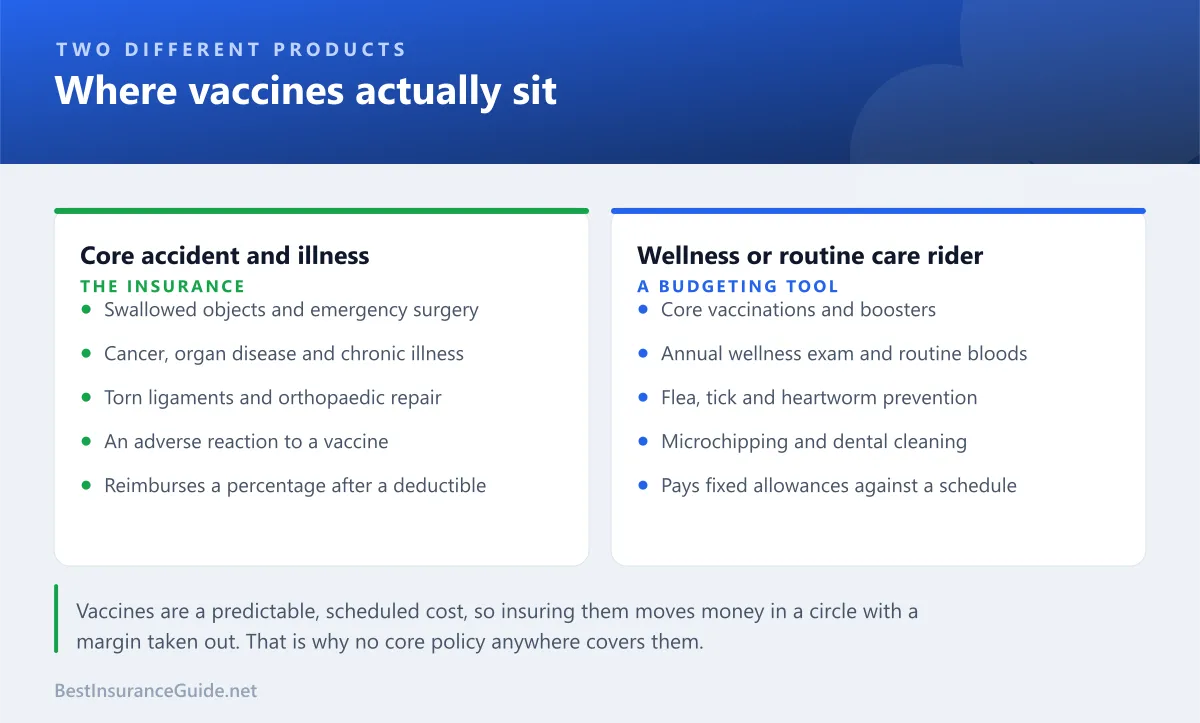
Core pet insurance is accident and illness cover. It exists for the unexpected: the swallowed sock, the torn cruciate ligament, the cancer diagnosis, the road accident.
Vaccines are neither unexpected nor unplanned. They are a known, scheduled, budgetable cost that every owner will incur, and insuring a certainty simply moves the money in a circle with an administrative margin taken out of it.
That is the design, and it is the same logic that keeps neutering, flea prevention, nail trims and dental cleaning outside a core policy.
What a wellness add-on actually pays
Most major insurers sell an optional wellness or routine care rider. It works differently from the main policy, and the difference matters.
The core policy reimburses a percentage of a bill after a deductible. A wellness rider pays fixed allowances against a schedule, with no deductible and an overall annual cap.
A typical schedule looks something like this, though every insurer publishes its own:
| Item | Typical allowance |
|---|---|
| Core vaccinations | $75 to $150 |
| Annual wellness exam | $50 to $75 |
| Routine bloodwork | $50 to $100 |
| Flea, tick and heartworm prevention | $75 to $150 |
| Microchipping | $20 to $50 |
| Dental cleaning | $100 to $150 |
| Spay or neuter | $100 to $200 |
The allowance is what you get, not the bill. If the vaccination series costs $180 and the allowance is $120, you receive $120.
Does the arithmetic work?
This is the only question that matters, and it is answerable in about five minutes.
Total the published allowances for the items you would actually buy. Subtract the rider premium. If the result is positive, buy it. If not, do not.
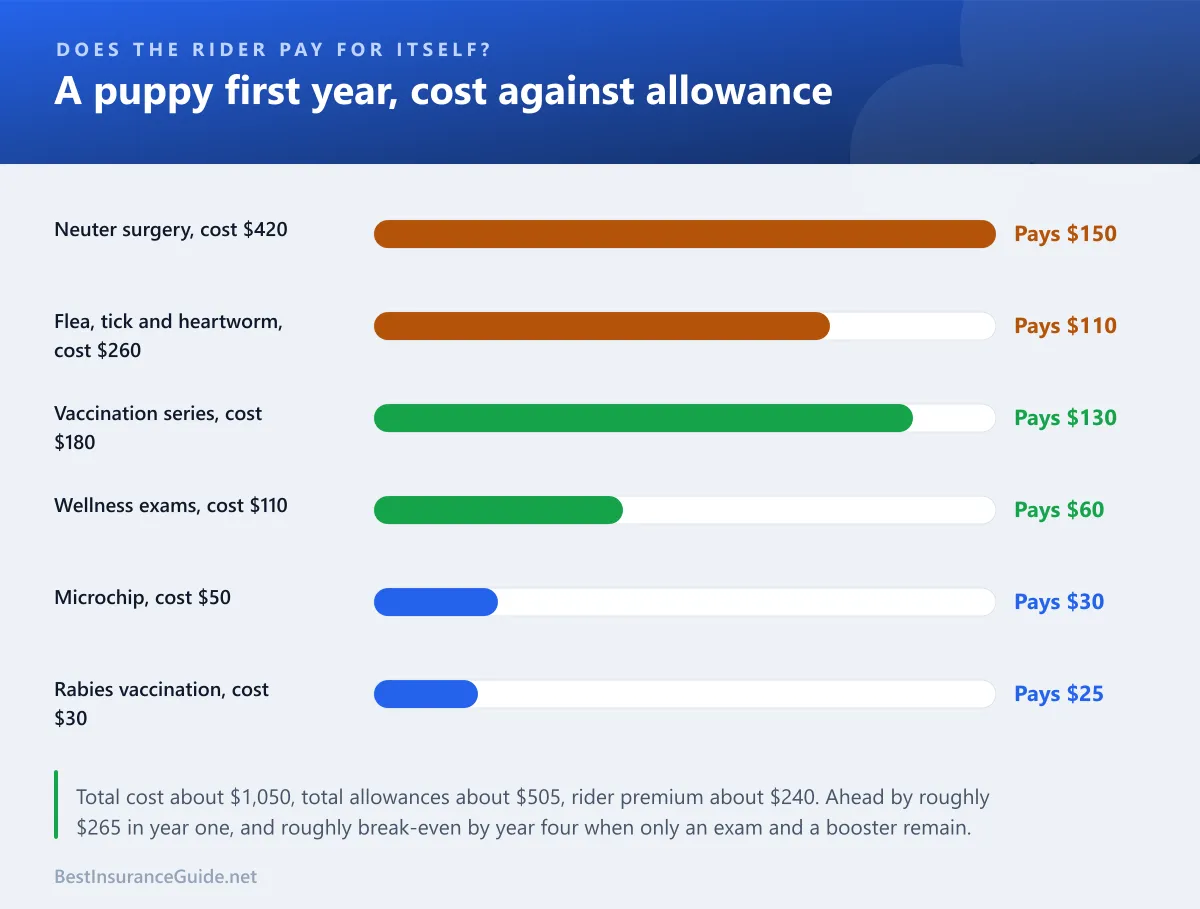
Worked example: a puppy’s first year
| Routine item | Typical cost | Allowance paid |
|---|---|---|
| Core vaccination series, three visits | $180 | $130 |
| Rabies vaccination | $30 | $25 |
| Wellness exams | $110 | $60 |
| Neuter surgery | $420 | $150 |
| Flea, tick and heartworm prevention | $260 | $110 |
| Microchip | $50 | $30 |
| Total | $1,050 | $505 |
| Rider premium for the year | $240 | |
| Net benefit | $265 |
In year one the rider comes out ahead, because the vaccination series and the neuter both land.
Worked example: the same dog in year four
| Routine item | Typical cost | Allowance paid |
|---|---|---|
| Annual booster | $65 | $65 |
| Wellness exam | $70 | $60 |
| Flea, tick and heartworm prevention | $290 | $110 |
| Total | $425 | $235 |
| Rider premium for the year | $240 | |
| Net benefit | -$5 |
Roughly a wash, and that is the typical adult-year outcome. Across a full lifetime a wellness rider is close to break-even by design, because insurers price it against the same schedule you are reading.
The honest conclusion: a wellness rider is a budgeting tool, not insurance. It smooths a predictable few hundred dollars a year. If you would struggle to find $1,000 in a puppy’s first year, it has real value. If you would not, put the money into a higher annual limit on the core policy instead, which is where it does more work.
The trap: skipping vaccines can void a real claim
This is the part almost nobody knows, and it is the strongest practical reason to keep vaccinations current.
Many policies contain an exclusion for conditions that a routine vaccination would have prevented. The wording varies, but the effect is consistent: if an unvaccinated dog contracts parvovirus, distemper or leptospirosis, and the policy carries that exclusion, the claim can be refused.
Parvovirus is the clearest example. It is a multi-day hospitalisation with a four-figure bill, it is genuinely covered as an illness for a vaccinated dog whose vaccine failed, and it can be excluded outright for an unvaccinated one.
Worked example: parvovirus, two dogs
| Vaccinated, vaccine failed | Never vaccinated | |
|---|---|---|
| Hospitalisation, five days | $3,900 | $3,900 |
| Fluids, medication, monitoring | $1,200 | $1,200 |
| Total | $5,100 | $5,100 |
| Policy response | Covered as illness | Excluded as preventable |
| Owner pays | $1,420 | $5,100 |
The vaccine cost around $30. That is the entire difference between those two columns.
Check your own policy wording for a preventable-disease exclusion, and if it is there, treat the core vaccination schedule as a condition of your coverage rather than an optional extra.
What vaccination-related things are covered
Two useful exceptions.
Adverse reactions. The vaccine itself is preventive and not covered, but a reaction to it is an unexpected medical event. Facial swelling, hives, vomiting or anaphylaxis following vaccination are normally treated as a covered illness or accident, and anaphylaxis in particular is a genuine emergency with a real bill attached.
Diagnostic titres. A titre run as part of routine care, to decide whether a booster is needed, is preventive and usually not covered. A titre run to investigate an actual illness is diagnostic and normally is.
Which vaccines your pet actually needs
Vaccination is divided into core and non-core, and only the second group is really a decision.
Core vaccines are recommended for essentially every dog or cat. For dogs that is distemper, adenovirus, parvovirus and rabies, usually given as a combination. For cats it is panleukopenia, calicivirus, herpesvirus and rabies.
Non-core vaccines depend on where you live and how your animal lives. Leptospirosis is widely recommended in wet regions and in cities with rodent populations. Lyme matters in the Northeast and upper Midwest. Bordetella and canine influenza matter for dogs using daycare, boarding or dog parks. Rattlesnake vaccine appears in parts of the Southwest.
Two notes worth knowing. Rabies is a legal requirement in most states, with the schedule set by state or local law rather than by your vet’s preference. And Hawaii is the only rabies-free state, with different rules for resident animals and a strict import programme.
Which non-core vaccines make sense is genuinely local, and it is a conversation for your veterinarian rather than an article. Our state guides, such as pet insurance in Florida and pet insurance in Wisconsin, set out which regional diseases actually drive claims in those places.
How this fits the rest of the policy
Three things follow from vaccines being outside core cover.
Waiting periods still apply to everything else. Buying a wellness rider does not accelerate the accident or illness waiting periods on the core policy.
Wellness riders do not affect pre-existing conditions. Nothing you claim on a rider changes what the core policy will or will not cover later.
The rider is usually cancellable separately. If it stops paying for itself after the first year, you can typically drop it and keep the core policy, which is exactly the right move for most owners.
How wellness riders differ between insurers
If you decide a rider is worth buying, the schedules are not interchangeable and the differences are worth ten minutes.
Allowance per item against a single pooled cap. Some riders assign a fixed amount to each item; others give you one annual pot to spend across anything on the list. A pooled cap is generally more useful, because it does not strand an allowance you cannot use.
Whether unused allowance rolls over. It almost never does. The rider is a use-it-or-lose-it annual product.
Tiered riders. Most insurers offer two or three tiers. The higher tier costs more and pays more, and the arithmetic has to be run on each tier separately, because the mid tier is not always the best value.
Waiting periods on the rider. Frequently shorter than the core policy, sometimes as little as 24 hours, but not always zero. If you buy a rider intending to claim a neuter next week, check.
Whether the rider can be added mid-term or only at renewal. Several insurers only allow it at renewal, which matters if you have just acquired a puppy.
A quick way to decide
Write down the routine care you will actually buy in the next twelve months, at your own vet’s prices. Total the rider’s allowances against exactly that list. Subtract the rider premium.
If the answer is positive by a meaningful margin, buy it. If it is close to zero, put the money toward a higher annual limit on the core policy instead, where it protects against the $6,000 year rather than smoothing the $400 one.
Vaccination records and your claim
One administrative habit prevents a specific and avoidable problem.
Insurers request full clinical history when you first claim, and vaccination status is part of that record. If your policy contains a preventable-disease exclusion, the insurer will check whether core vaccinations were current at the relevant time.
Keep your own copy of the vaccination record, including dates, and if you change practices make sure the history transfers. Gaps in the record are resolved against the policyholder, and reconstructing a vaccination history after a claim has been questioned is considerably harder than keeping it.
A note on scope
Wellness rider schedules, allowances and exclusions vary between insurers and change over time, and the figures here are illustrative ranges rather than any particular company’s published schedule. Check your own insurer’s current schedule before deciding, and run the arithmetic against your own veterinary practice’s prices rather than national averages.
Vaccination protocols are also a clinical matter. Which non-core vaccines a given animal needs depends on where it lives, how it lives and its individual health, and that is a conversation for your veterinarian. Rabies requirements in particular are set by state and local law rather than by preference.
This site is independent and not affiliated with any insurer.
The short version
Pet insurance does not cover vaccines under any core accident and illness policy, anywhere, because vaccines are a predictable cost rather than an unexpected one.
A wellness add-on reimburses them against fixed allowances. Do the arithmetic rather than the argument: total the allowances for what you would actually buy, subtract the premium, and buy only if it is positive. It typically wins in a puppy or kitten’s first year and roughly breaks even thereafter.
The genuinely important point is the reverse of the question. Skipping core vaccines can invalidate a claim for a preventable disease under many policies, which makes a $30 vaccine one of the cheapest pieces of coverage protection available.
For what a core policy does cover and how limits and deductibles work, see the pet insurance cost guide. If you are specifically asking about spay and neuter costs, pet insurance that covers neutering deals with that directly.