What Age Does Car Insurance Go Down? The 25 Myth, Corrected
Car insurance drops gradually from 19, with the steepest falls at 19, 21 and 25. What a 16-year-old actually costs and how to cut it without waiting.

Table of contents

Almost everyone believes car insurance drops sharply at 25. It is one of the most durable pieces of folk wisdom in personal finance, and it is mostly wrong.
Premiums do not fall off a cliff on any birthday. They decline gradually, every year, from around 19 through the mid-twenties, and the largest single-year improvements happen well before 25.
The actual age curve
Age is a proxy for crash risk, and crash risk falls steeply with experience rather than in steps.
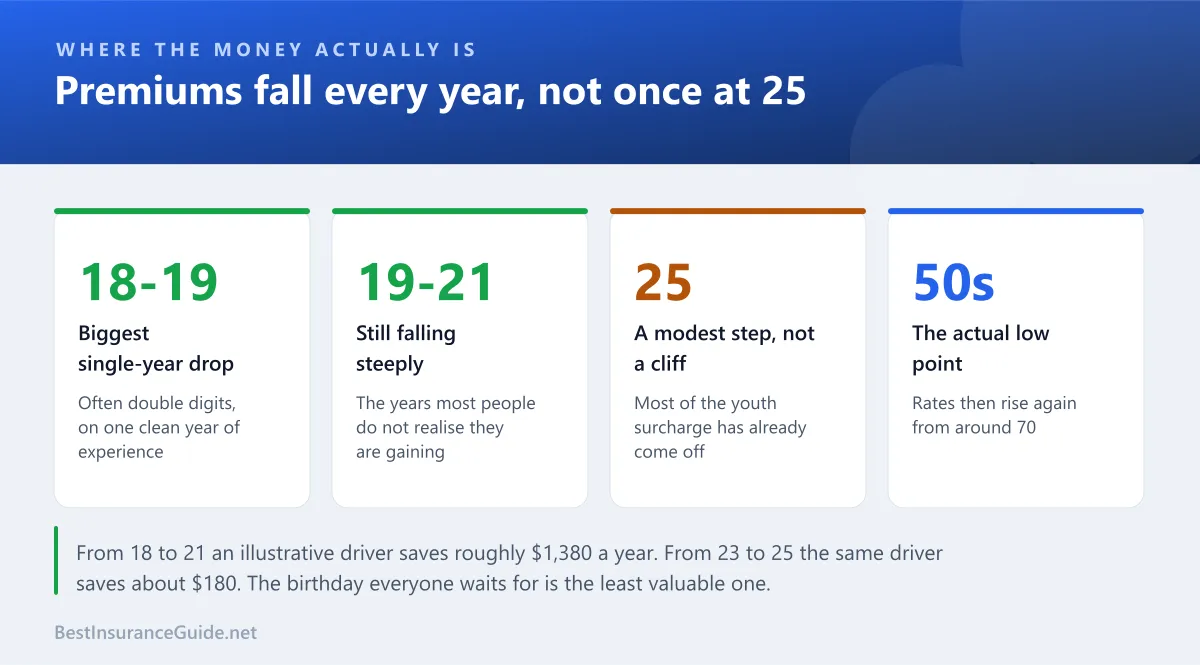
The pattern that shows up consistently:
16 to 18 is the peak. A newly licensed driver is the most expensive person an insurer will cover, and the first year is the worst of it.
18 to 19 is usually the single biggest improvement, often a double-digit percentage, simply because a year of licensed driving without a claim is strong evidence.
19 to 21 continues falling meaningfully each year.
21 to 25 flattens out. Each year still helps, but the steps get smaller because most of the youth surcharge has already come off.
25 to 30 brings the remaining normalisation, and by 30 age has largely stopped being a significant factor.
30 to 55 drifts slowly downward, usually reaching its lowest point somewhere in the fifties.
70 onward turns back up, as claim frequency and severity rise again.
Worked example: the same driver, same car, same clean record
Illustrative figures for a single driver with no violations, full coverage, holding everything else constant.
| Age | Annual premium | Change |
|---|---|---|
| 16 (added to parents) | $4,180 | — |
| 18 | $3,620 | -13% |
| 19 | $2,890 | -20% |
| 21 | $2,240 | -22% |
| 23 | $1,940 | -13% |
| 25 | $1,760 | -9% |
| 30 | $1,540 | -13% |
Look at where the money actually is. From 18 to 21, this driver’s premium fell by $1,380. From 23 to 25, it fell by $180.
The years everyone waits for have already happened by the time they start waiting.
How much is car insurance for a 16 year old?
The honest answer is that it depends enormously on how you buy it.
Added to a parent’s policy, a 16-year-old typically increases the total household premium by somewhere around 100% to 150%. That is a large number, but it is applied to a policy that already carries multi-car and multi-driver discounts.
On their own policy, a 16-year-old faces a much higher figure again, because they lose every household discount and have no claims history to rate against. Very few families do this, and there is rarely a reason to.
Three factors move the number more than anything else at this age.
The car. A used mid-size saloon with strong safety ratings and a modest repair cost is dramatically cheaper to insure for a teenager than anything fast, new, or expensive to fix. This is the largest single lever available.
Whether they are the primary driver of a specific vehicle. Rating a teen as an occasional driver on a household car costs less than assigning them their own vehicle. It has to be true, though. Misrepresenting it is a claims problem waiting to happen.
Where you live. Territory rating means the same 16-year-old costs very different amounts across state lines and even across town.
Our post on car insurance for young drivers works through these levers with worked examples of what each one saves.
Why 25 got the reputation
There is a real reason the number stuck.
Historically, 25 was where several rating systems moved a driver out of the “youthful operator” classification entirely, and where car rental companies stop applying young-driver surcharges. Those are visible, discrete thresholds, so they became the story.
Modern pricing is far more granular. Insurers rate by individual age, driving record, telematics data, credit-based insurance scores where permitted, mileage and vehicle. Age is one input among many, and it moves smoothly.
The practical consequence is that waiting is a bad strategy. If you are 21 and paying too much, the levers below will do more for you this month than four more birthdays will.
What beats waiting
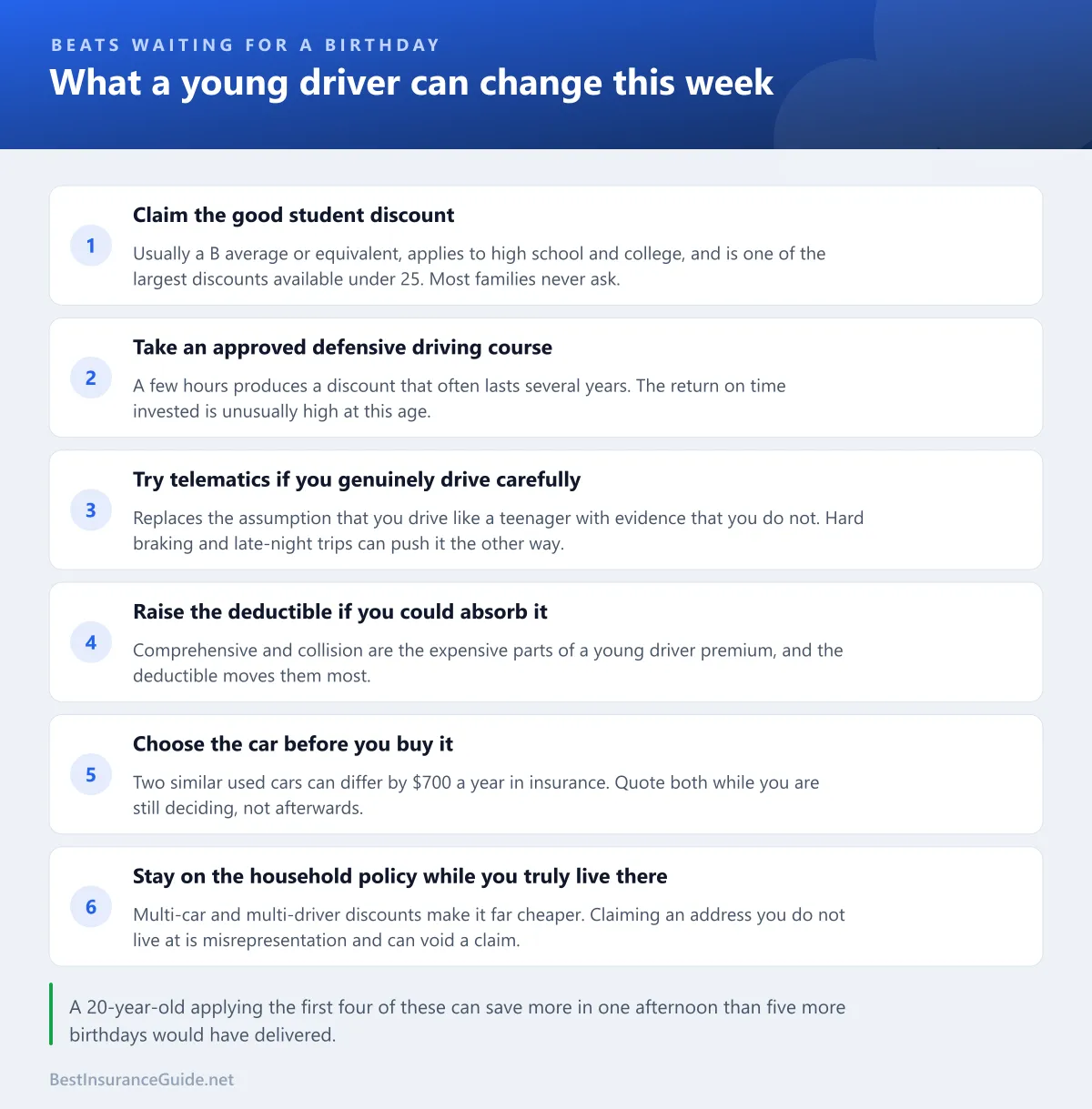
Good student discount. Usually requires a B average or equivalent, and is one of the largest discounts available to anyone under 25. It applies to high school and college students, and many families never claim it.
Defensive driving or driver training course. A state-approved course often produces a discount that lasts several years. For a young driver the return on a few hours is unusually good.
Telematics. For a genuinely careful driver, usage-based programmes are the most powerful tool at this age, because they replace the assumption that you drive like a 19-year-old with evidence that you do not. The caveat is real: hard braking and late-night driving can increase the price, so it suits some drivers and not others.
Raise the deductible, if you can absorb it. Moving from $500 to $1,000 typically cuts the comprehensive and collision portion noticeably, and those are the expensive parts of a young driver’s premium.
Stay on the household policy while you genuinely live there. The saving is substantial. The condition is that it must be true; claiming a parent’s address while living elsewhere is misrepresentation and can void a claim at the worst possible moment.
Choose the car deliberately. A driver considering two used cars can easily find a $700 annual difference in insurance between them. Quote both before buying, not after.
Worked example: a 20-year-old who did not wait
| Action | Annual saving |
|---|---|
| Claimed good student discount | $310 |
| Completed approved defensive driving course | $145 |
| Enrolled in telematics, careful driver | $420 |
| Raised deductible $500 to $1,000 | $230 |
| Total | $1,105 |
That is a bigger improvement than this driver would get from ageing from 20 to 25, and it arrived in one afternoon.
The other end of the curve
Worth knowing if you are helping a parent rather than a teenager.
Premiums typically bottom out in the fifties and begin rising again somewhere around 70, as reaction times and injury severity both move the wrong way. The increase is gentler than the youth surcharge but it is real.
The levers there are different: mature driver courses attract discounts in many states, low annual mileage matters more once commuting stops, and this is often the point at which dropping collision coverage on an older, low-value car starts to make sense.
The short version
Car insurance goes down every year from about 19, most steeply between 18 and 21, and by 25 the majority of the age effect has already been priced out. There is no dramatic drop on your twenty-fifth birthday.
A 16-year-old is cheapest added to a parent’s policy on a sensible, safe, inexpensive-to-repair car, and most of what makes that number bearable is the vehicle choice rather than anything else.
If you are young and paying too much now, do not wait for a birthday. Claim the good student discount, take the defensive driving course, try telematics if you drive carefully, and re-shop the whole policy. Our guide to switching car insurance covers doing that without creating a gap, and auto insurance discounts lists everything worth asking for.