Does Insurance Follow the Car or the Driver? Mostly the Car
Car insurance usually follows the vehicle, with the driver's policy as secondary cover. When it does not, and who pays if a friend crashes your car.

Table of contents
The short answer is that car insurance mostly follows the car. But the useful answer is that different parts of the policy behave differently, and knowing which is which decides who pays after a crash in someone else’s vehicle.
The default rule
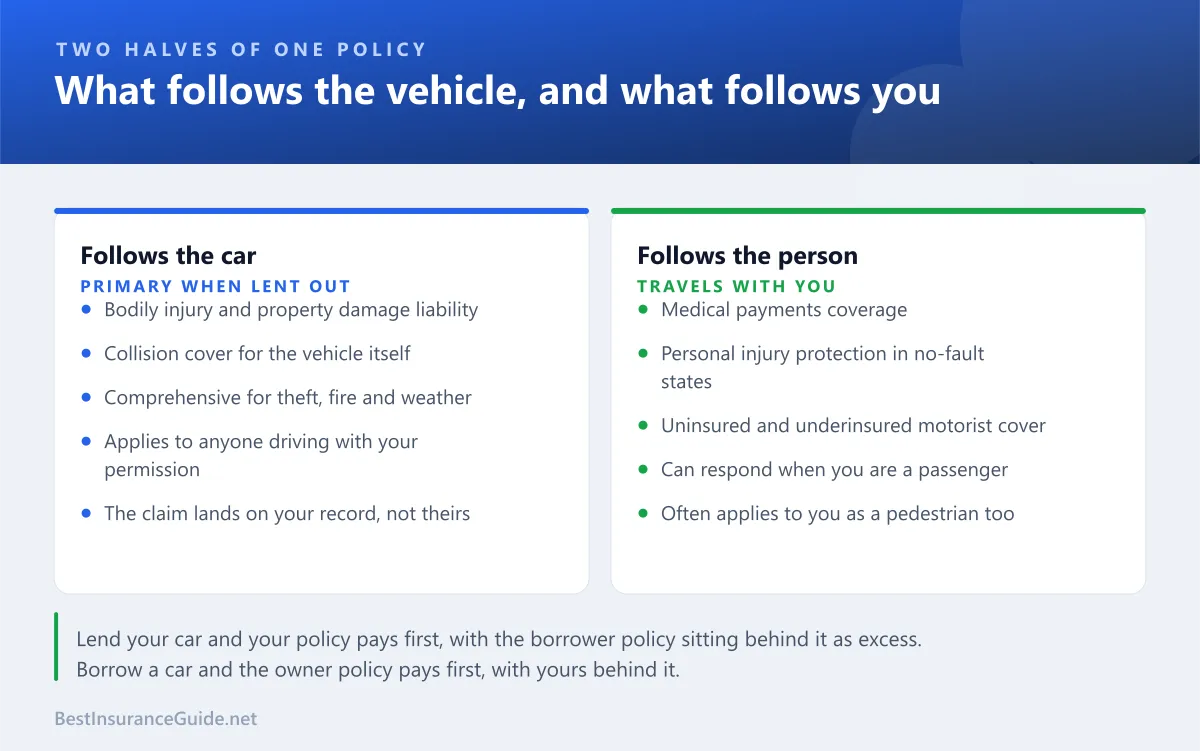
Lend your car to a friend, they cause a collision, and your policy responds first. Your liability coverage pays the other party’s injuries and property damage. Your collision coverage repairs your car, subject to your deductible.
Your claims record carries it, too. Not theirs. That surprises people more than the coverage question does.
The driver’s own insurance is not irrelevant, but it sits behind yours as excess. If the damages exceed your limits, their policy can pick up the remainder, up to theirs.
Worked example: a friend borrows the car
Your limits are $100,000 per person and $300,000 per accident for bodily injury, with $50,000 property damage and a $500 collision deductible. Your friend, who has their own policy, causes a crash.
| Loss | Whose policy | Amount |
|---|---|---|
| Other driver’s injuries | Yours, primary | $78,000 |
| Other vehicle written off | Yours, primary | $34,000 |
| Repairs to your car | Yours, collision | $9,200 less $500 |
| Total paid by your insurer | $120,700 | |
| Paid by your friend’s insurer | $0 | |
| Effect on your renewal | An at-fault claim on your record |
Your friend walks away without a claim. You get the surcharge. This is worth remembering before you hand over the keys casually, and it is the strongest practical argument for carrying liability limits well above the state minimum.
If the injuries had come to $260,000, your policy would have paid its $100,000 per-person limit and the friend’s own liability coverage would have been available for the excess.
What follows the person instead
Not everything attaches to the vehicle. Two coverages travel with you.
Medical payments coverage pays your and your passengers’ medical bills regardless of fault, and it typically covers you as a passenger in someone else’s car, and in many wordings as a pedestrian struck by a vehicle.
Personal injury protection, in no-fault states, works similarly and more broadly, often extending to lost wages and essential services.
So if you are a passenger in a friend’s car and are injured, your own medical payments or PIP can respond even though you were nowhere near your own vehicle.
Uninsured and underinsured motorist coverage sits in between. It generally protects you as a person, including as a passenger or pedestrian, as well as protecting your vehicle. It is one of the most undervalued coverages on a policy, and in a country where a significant share of drivers carry no insurance at all, it is the coverage that matters when the at-fault party has nothing.
Permissive use, and where it stops
The reason lending your car works at all is a concept called permissive use: your policy extends to anyone driving with your permission.
That permission is doing a lot of work, and it has boundaries.
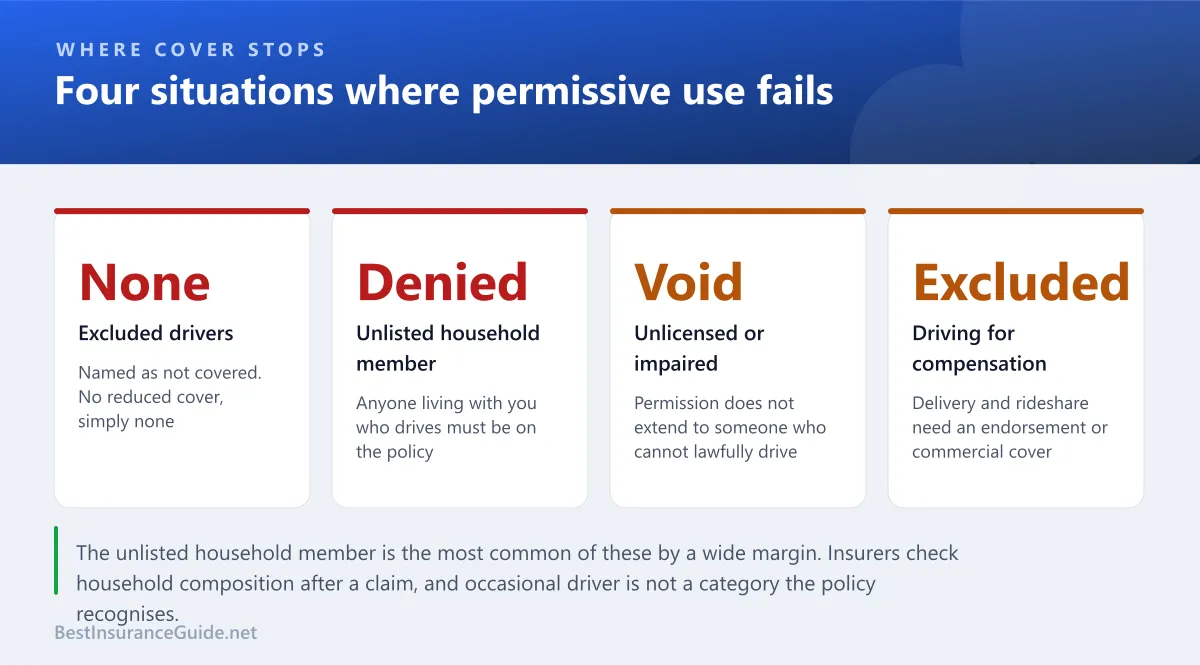
Excluded drivers. If someone is named on your policy as excluded, there is no coverage when they drive, full stop. Not reduced coverage, none. Exclusions are usually added to keep a premium affordable after a household member’s record became expensive, and the trade is exactly this. If an excluded driver takes your car and causes a serious injury, you are personally exposed for the whole amount.
Household members who were never listed. This is the most common gap. Anyone who lives with you and drives your car regularly must be on the policy. An adult child home from college, a partner who moved in, a parent staying long-term. Insurers check household composition after a claim, and “they only drive it occasionally” is not a category the policy recognises.
Unlicensed, suspended or intoxicated drivers. Permission does not extend to someone who cannot lawfully drive. Handing keys to someone visibly impaired can also create negligent entrustment liability against you personally, outside the policy.
Commercial and delivery use. A personal auto policy excludes driving for compensation. Food delivery, rideshare and courier work all need either a rideshare endorsement or a commercial policy. Our guide to motorcycle courier insurance covers the same exclusion on two wheels, and the principle is identical for cars.
Regular use of a car you do not own. If you drive the same borrowed vehicle daily, most policies stop treating it as occasional permissive use. A car you rely on should be listed on a policy somewhere.
Driving someone else’s car
The mirror image. You borrow a friend’s car with permission, and you crash it.
Their policy is primary. Yours is secondary, sitting behind theirs for anything above their limits. Their deductible applies to the repair of their car, and their claims record takes it.
This creates an awkward social reality: borrowing a car and damaging it costs your friend money and raises their premium. Offering to pay their deductible is the decent move and is not something insurance will do for you.
If you do not own a car and therefore have no policy, a non-owner auto policy provides that secondary liability layer. It is inexpensive, and it is genuinely useful for anyone who borrows or rents regularly, or who needs to maintain continuous coverage between cars so their rates do not reset. That continuity point matters more than people expect, as our guide to switching car insurance explains.
Rental cars
For a personal rental inside the United States, your own policy generally extends: liability applies, and if you carry comprehensive and collision, physical damage to the rental usually follows too, with your deductible.
Three things commonly fall outside it.
Loss of use. Rental companies charge for the income lost while the car is repaired. Many personal policies exclude it, and it is a routine line on a rental damage bill.
Administrative and diminished value fees. Similarly often excluded.
Rentals abroad. Coverage typically stops at the border, with limited exceptions for Canada. For an overseas rental you generally need the counter product or a credit card benefit.
A credit card with primary rental coverage is often the better answer than the counter waiver, because it pays without involving your own insurer at all, so no claim lands on your record.
What to actually do
Check whether anyone is excluded on your policy, and make sure everyone in the household who drives is listed. Those two checks close the largest gaps in this entire topic.
Look at your liability limits. Because your policy is primary when others drive your car, your limits are protecting decisions made by people who are not you. State minimums are almost always too low for that job.
Confirm you carry uninsured and underinsured motorist coverage, at limits matching your liability where the state allows it.
Do not lend to anyone who cannot lawfully drive, regardless of the circumstances. That is the one decision that can reach past the policy and into your own assets.
The short version
Car insurance follows the car for liability, comprehensive and collision, and follows the person for medical payments, personal injury protection and uninsured motorist cover.
Lend your car and your policy pays first, your deductible applies, and your record carries the claim. Borrow a car and the owner’s policy pays first, with yours behind it.
The exceptions are the part worth memorising: excluded drivers, unlisted household members, unlicensed drivers, and any use for compensation. In each of those, coverage does not follow anything at all.
For the wider mechanics of limits, deductibles and what a policy is actually made of, insurance 101 is the place to start.