How Does Gap Insurance Work, and How Much Is It Really?
Gap insurance covers the shortfall between your loan balance and your car actual cash value after a total loss. How much gap insurance costs and who needs it.

Table of contents
Gap insurance is one of the few products in car insurance that is either obviously worth it or obviously pointless, with very little in between.
The trick is working out which one applies to you, and that comes down to a single number you can check in about two minutes.
What the gap actually is
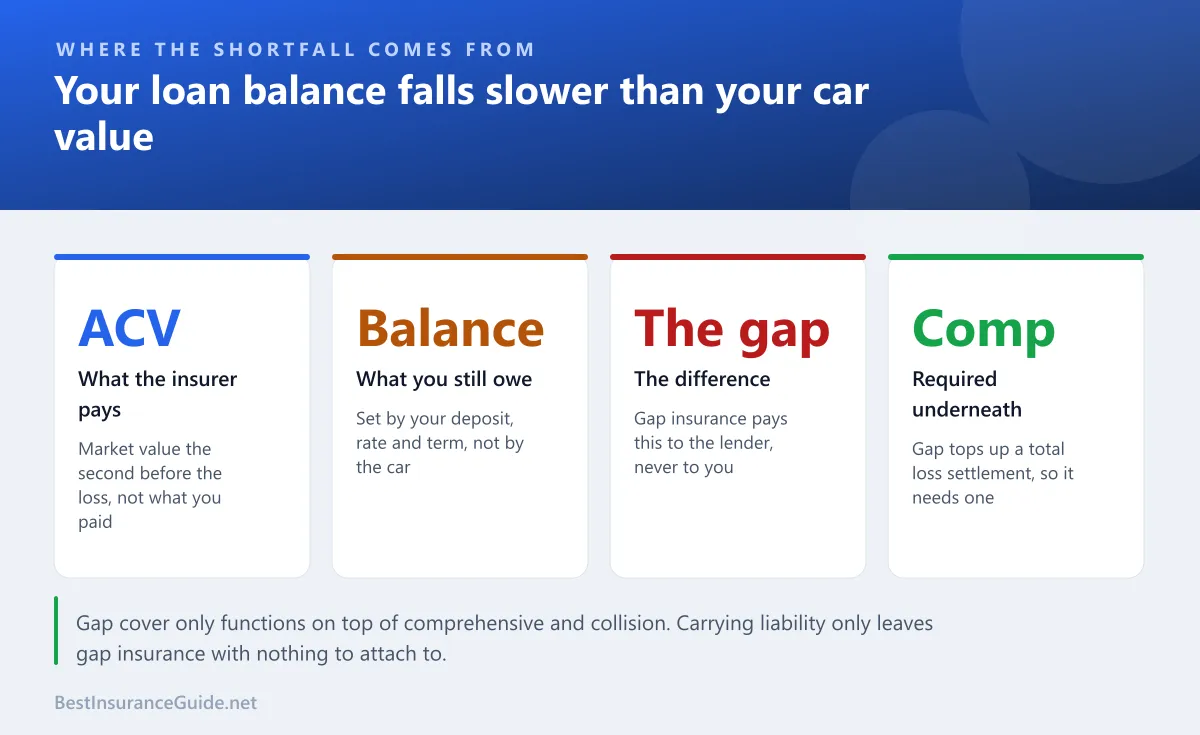
When a car is written off, your insurer does not pay what you paid for it, and does not pay what you still owe. It pays actual cash value: what that car, at that mileage, in that condition, was worth on the open market the second before the crash.
A loan balance does not follow the same curve. New cars lose a large share of their value in the first year, while a loan with little down and a long term comes down slowly. For a stretch in the middle, you owe more than the car is worth.
That difference is the gap. Gap insurance pays it to the lender.
Two things follow from this that people find counter-intuitive.
It pays the lender, not you. You never see the money. It clears a debt that would otherwise survive the car.
It needs comprehensive and collision to work. Gap sits on top of a total loss settlement. No settlement, nothing for gap to top up. If you are carrying liability only, gap has nothing to attach to.
Worked example: eighteen months into a five-year loan
A $34,000 car, $1,500 down, 60 months, written off after an 18-month-old driver-at-fault collision.
| Amount | |
|---|---|
| Purchase price | $34,000 |
| Deposit | $1,500 |
| Financed | $32,500 |
| Loan balance at month 18 | $25,700 |
| Actual cash value at month 18 | $20,400 |
| The gap | $5,300 |
| Less collision deductible | $1,000 |
| Owed after the insurer pays | $6,300 |
Without gap cover, that is $6,300 owed on a car sitting in a salvage yard, while also needing to fund a replacement. With it, the loan is cleared and the only cost is the deductible, or nothing at all if the policy includes a deductible credit.
How much gap insurance costs
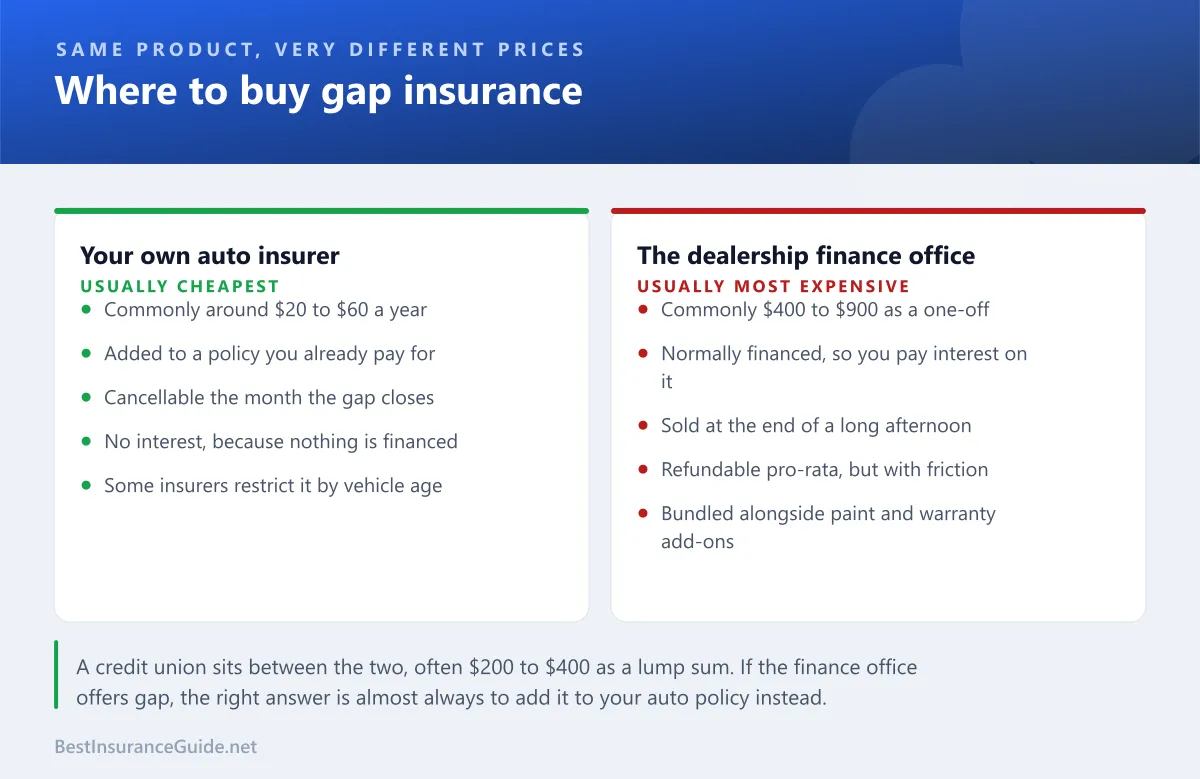
This is where most of the money is won or lost, because the same product is sold at wildly different prices depending on which counter you buy it from.
Worked example: the same cover, three prices
Cover for a four-year loan.
| Auto insurer | Credit union | Dealer | |
|---|---|---|---|
| Price | About $40 a year | About $300 once | About $700 once |
| Paid over 4 years | About $160 | $300 | $700 |
| Financed at 7%? | No | Usually no | Commonly yes |
| Total cost including interest | About $160 | $300 | About $805 |
| Cancellable for a refund | Any time | Pro-rata | Pro-rata, with friction |
The dealer version costs roughly five times the insurer version for the same protection, and because it is usually rolled into the loan you pay interest on it for four years. It is also sold at the exact moment you are least inclined to argue, at the end of a long afternoon, alongside paint protection and an extended warranty.
If the finance office offers it, the right answer is almost always “I will add it to my auto policy on Monday.” Then actually do it, because that is the step people forget.
One caveat: a small number of insurers will not add gap to a policy after the car is more than a certain age, or once the loan is already some way in. Ask before you decline at the dealership rather than after.
Whether you need it at all
Gap insurance is worth having when there is a gap. That sounds circular, but it is the whole test, and it is checkable.
Find your current loan payoff figure, then look up a private-party and trade-in value for your car and mileage. If the payoff is higher, you have a gap and gap insurance is doing something. If the car is worth more than you owe, you are paying for nothing.
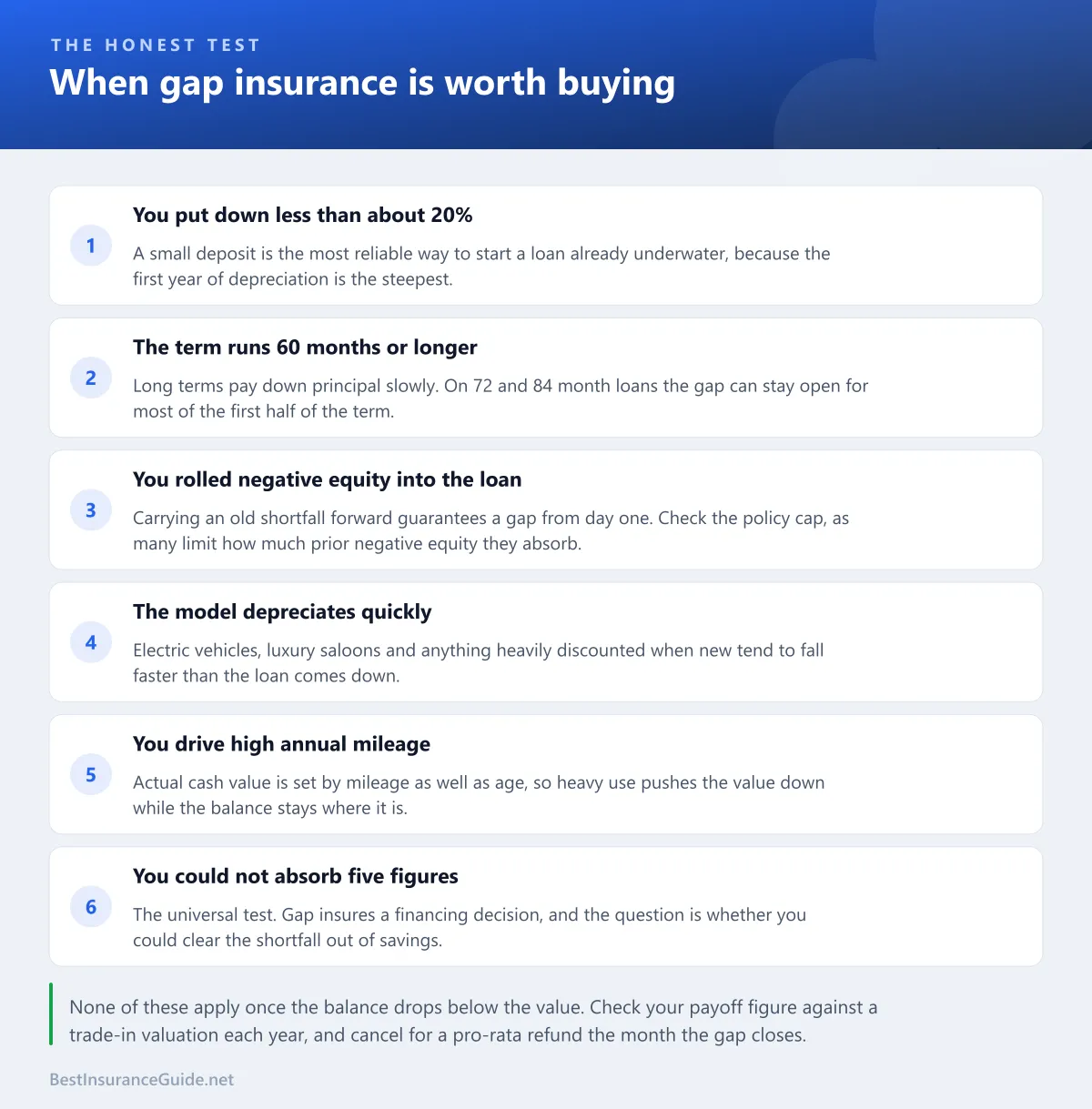
The strongest cases are the ones where several of those stack. A small deposit on a 72- or 84-month loan with negative equity rolled in from the last car will keep you underwater for years, and that is precisely the borrower for whom a total loss becomes a financial event rather than an inconvenience.
The weakest case is a large deposit on a short loan for a model that holds its value. Two years in, the car is worth more than the balance and the cover is dead weight.
Worked example: when the gap closes
The same $34,000 car, this time with $7,000 down over 48 months.
| Month | Loan balance | Actual cash value | Gap |
|---|---|---|---|
| 6 | $24,600 | $25,900 | None |
| 12 | $21,500 | $23,200 | None |
| 24 | $14,900 | $18,700 | None |
| 36 | $7,800 | $15,400 | None |
There is no month in that table where gap insurance would have paid a penny. A bigger deposit and a shorter term did the same job the product does, permanently and for free.
That is the honest version of this product: it insures a financing decision, and a better financing decision removes the need for it.
The bits people get caught by
Leases usually already include it. Most lease contracts contain a gap waiver. Read the agreement before buying a second one at the counter.
It does not cover missed payments. If you are behind, that arrears figure is not part of the gap and gap will not clear it.
Rolled-over negative equity has a cap. Many gap policies limit how much prior negative equity they will absorb, commonly to a percentage of the vehicle value. Roll $9,000 of an old loan into a new one and the gap policy may only cover part of it.
Cancel it when the gap closes. This is free money most people leave on the table. Once you are right side up, cancel and take the pro-rata refund. On a dealer policy that refund can run to a few hundred dollars.
Check the deductible credit. Some policies pay your collision deductible on top of the shortfall. Some do not. It is worth up to $1,000 and takes one question to establish.
The short version
Gap insurance pays your lender the difference between what your car was worth and what you still owed, after a total loss or theft. It costs roughly $20 to $60 a year through your own auto insurer, several hundred through a credit union, and often the better part of a thousand through a dealership.
Buy it if you put little down, financed over a long term, or rolled negative equity forward. Buy it from your insurer rather than the finance office. Then cancel it the month your loan balance drops below your car’s value, and take the refund.
For how a total loss settlement is calculated in the first place, what really drives your insurance premiums explains actual cash value and the rating factors behind it. If you are shopping the whole policy rather than one add-on, how to compare insurance quotes covers matching coverage properly, and auto insurance discounts lists the reductions most drivers never claim.