Does Renters Insurance Cover Fire, Theft, Electronics and Earthquakes?
Does renters insurance cover fire damage, robbery, bike theft, electronics, appliances, earthquakes or a hotel? Straight answers with the limits that apply.

Table of contents

Most renters questions come down to the same shape: does my policy cover this specific thing that just happened?
Below are the twelve that come up most, answered directly, with the limits that actually decide the outcome. If you want the wider picture first, our renters insurance guide covers how the policy is structured.
One rule underpins nearly all of it. A renters policy is named perils: it lists what it covers, and anything not on the list is not covered. The list is fire, smoke, lightning, windstorm, hail, explosion, theft, vandalism, falling objects, weight of ice or snow, and sudden water discharge from plumbing or appliances.
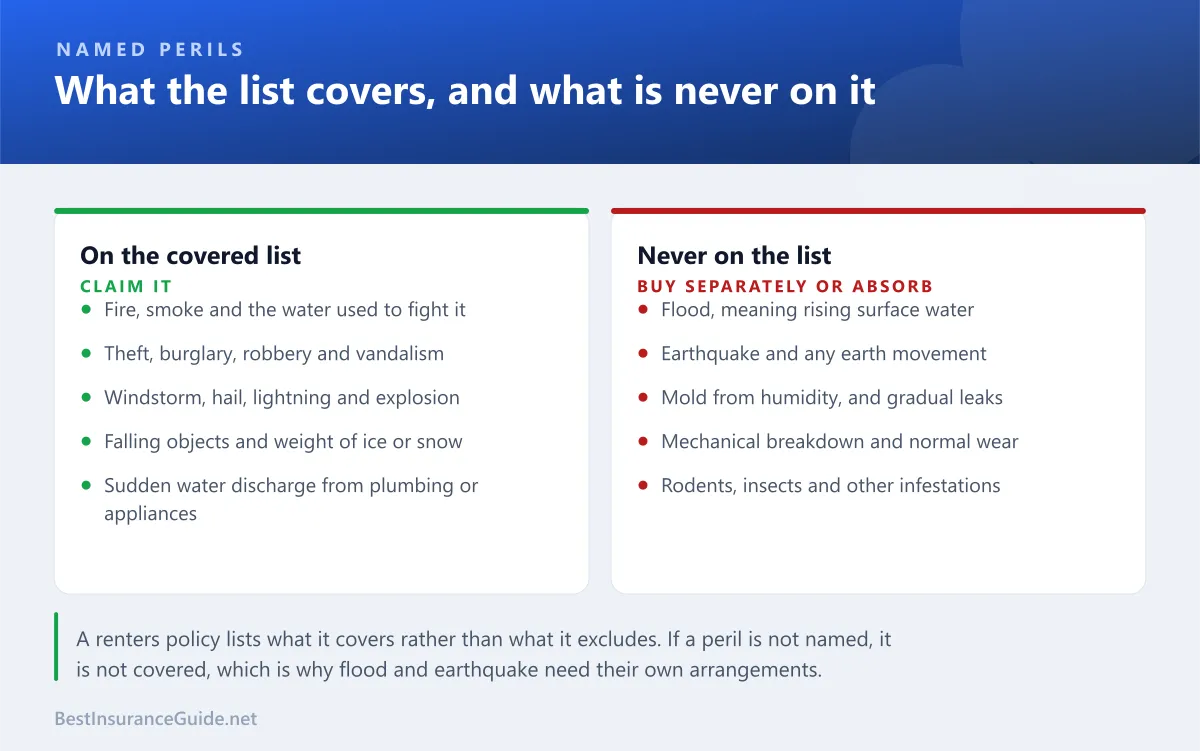
Keep that list in mind and most answers become predictable.
Does renters insurance cover fire damage?
Yes, and this is the coverage the policy does best.
Fire and smoke are core perils. It does not matter where the fire started, so a blaze two floors up that fills your flat with smoke is covered exactly as one in your own kitchen would be. Three things people do not expect are also included:
Smoke damage without flame. Clothing, bedding and upholstery that smell of smoke are a covered loss even if nothing burned.
Water and firefighting damage. The water used to extinguish a fire is part of the same claim.
Your liability if you started it. If the fire began in your unit through negligence, your liability coverage responds to the landlord’s and neighbours’ claims. That exposure runs to six figures in a multi-unit building and is the single strongest argument for a decent liability limit.
The main exclusion is arson by the policyholder, and intentional damage generally.
Worked example: a kitchen fire, contained to one room
| Item | Settled |
|---|---|
| Contents destroyed in the kitchen | $4,600 |
| Smoke damage: clothing, curtains, bedding | $3,100 |
| Professional smoke and odour remediation of contents | $1,400 |
| Hotel for 11 nights while cleaning ran | $1,650 |
| Total paid across contents and loss of use | $10,750 |
| Less deductible | $500 |
| Net to the tenant | $10,250 |
Note how much of that is smoke rather than flame. The fire itself was out in minutes.
Does renters insurance cover electronics?
Yes, as normal personal property. Laptops, phones, televisions, monitors, consoles and cameras are all covered against the named perils, and coverage generally follows you away from home.
Two things decide whether the claim feels adequate.
Sublimits. Some policies cap electronics as a category. If yours does, a home office with two laptops, a monitor and a camera can exceed it in one theft.
Replacement cost versus actual cash value. This is the setting that matters most on electronics, because they depreciate faster than anything else you own. A four-year-old laptop that cost $1,600 might have a depreciated value of $350 and a replacement cost of $1,400. The premium difference between the two settings is usually a couple of dollars a month.
Business equipment is a separate issue. If you work from home and the kit belongs to your employer, or you run a business from the flat, personal contents cover often excludes it or caps it low. That needs an endorsement or a separate policy.
Does renters insurance cover robbery and theft?
Yes. Theft, burglary and robbery are all covered, and unlike a lot of policies there is no requirement for forced entry in most wordings.
Coverage typically extends off-premises, so a bag taken in a restaurant or a phone lifted on the street is generally covered too, subject to your deductible.
What you need is a police report. Insurers ask for it on essentially every theft claim, and filing it promptly matters. A report made three days later invites questions.
The category sublimits are where theft claims disappoint people. Jewellery, watches, furs, firearms, cameras and collectibles all carry per-category caps that are much lower than your overall contents limit. A theft of jewellery can hit a cap of a couple of thousand dollars regardless of what was actually taken. Anything valuable should be scheduled, which means listed individually with an agreed value, usually after an appraisal.
Does renters insurance cover bike theft?
Usually yes, and from anywhere: a shared hallway, a communal bike store, a rack outside work, or the street.
The catch is the same as with jewellery. Some policies treat bicycles as ordinary contents with no special limit, and some apply a sublimit that a decent road or electric bike will exceed immediately.
If your bike cost more than about $1,000, ask two questions: is there a bicycle sublimit, and can I schedule it? Scheduling usually removes the deductible on that item as well as raising the limit, which on a bike claim is often the difference between a worthwhile payout and a pointless one.
E-bikes deserve a specific check. Some insurers classify them as motorised vehicles and exclude them from contents cover entirely.
Does renters insurance cover a car break-in?
Partly, and the split confuses people.
The car is your auto policy’s problem. The smashed window, the damaged door lock, the ripped-out stereo fitted to the vehicle: that is comprehensive coverage on your car insurance.
The contents are your renters policy’s problem. The laptop on the passenger seat, the gym bag, the camera in the boot: those are personal property, covered away from home, subject to your renters deductible.
Worked example: one break-in, two claims
| Loss | Which policy | Deductible | Paid |
|---|---|---|---|
| Smashed window and door trim, $780 | Auto comprehensive | $500 | $280 |
| Laptop and headphones, $1,850 | Renters contents | $500 | $1,350 |
Two claims, two deductibles. Worth knowing before you file, because a $780 window against a $500 comprehensive deductible may not be worth claiming at all once you account for the effect on your auto renewal.
Does renters insurance cover appliances?
This one turns on a distinction people find frustrating but which is consistent everywhere.
Covered: your own appliances damaged by a covered peril. A fire destroys your microwave, a power surge from lightning kills your television, a burst pipe ruins a washing machine you own. All claims.
Not covered: the appliance simply failing. Mechanical breakdown, motor burnout, a compressor going, or anything wearing out with age is explicitly excluded. Insurance covers sudden accidental damage, not the end of a service life.
Not yours anyway: appliances that came with the flat belong to the landlord and are insured, or not, by them. If the landlord’s dishwasher dies, that is a maintenance request, not a claim.
There is one important crossover. If the landlord’s appliance fails and floods your flat, the water damage to your belongings is covered by your policy, and your insurer may then pursue the landlord.
For appliance breakdown specifically, some insurers sell an equipment breakdown endorsement for a small amount a year. It covers the mechanical failure the base policy excludes, and in a flat full of your own appliances it is reasonable value.
Does renters insurance cover earthquakes?
No. Earthquake is excluded from every standard renters policy in the country, in the same category as flood.
Renters can buy it back in two ways. Most insurers sell an earthquake endorsement onto the existing policy. In California, renters can also buy contents-only cover through the California Earthquake Authority, sold through participating insurers, or from a private earthquake insurer.
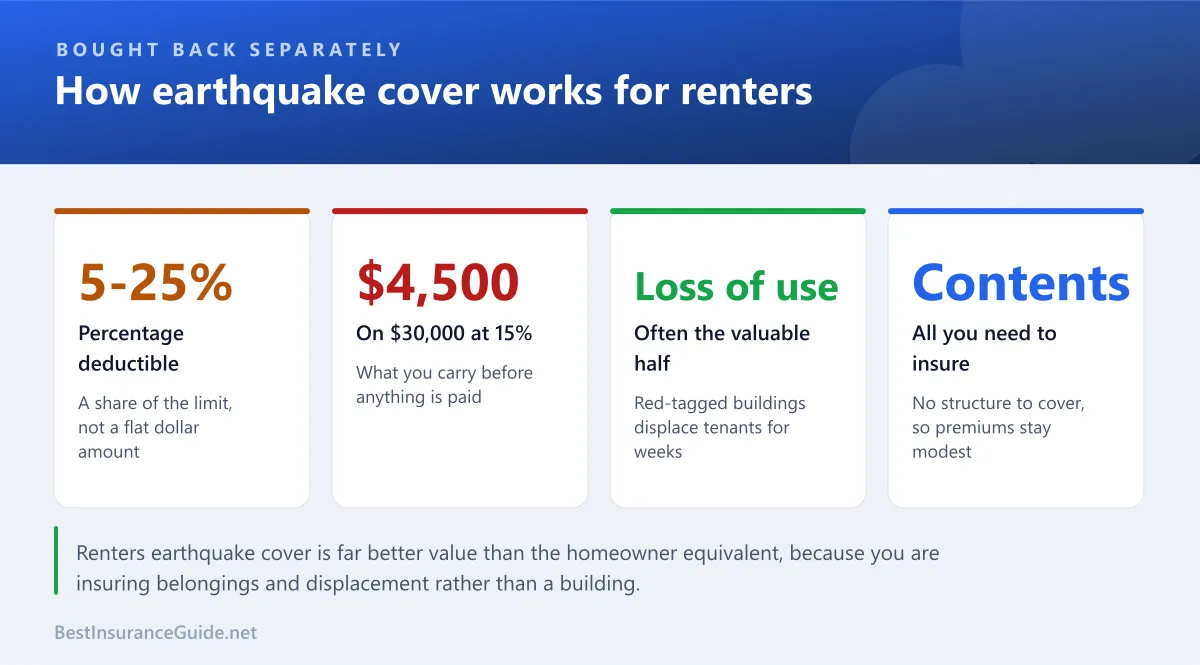
Two features make earthquake cover behave unlike the rest of your policy.
The deductible is a percentage, not a flat sum. Commonly 5% to 25% of the coverage limit. On $30,000 of contents at a 15% deductible, you carry the first $4,500.
Loss of use is often the more valuable half. After a significant quake, the problem is usually that the building is red-tagged and you cannot go home for weeks. Contents-only earthquake policies frequently include a meaningful loss of use amount, and in an expensive rental market that is the part that pays.
Whether it is worth it depends almost entirely on where you live. In seismic zones, the premium for renters is usually modest because there is no structure to insure, only contents. That makes renters earthquake cover far better value than the homeowner equivalent.
Does renters insurance cover injuries?
Yes, through two separate coverages that do different jobs.
Personal liability responds when someone is injured in your home or by your actions and holds you responsible. It pays their medical costs, your legal defence, and any settlement up to your limit, which typically starts at $100,000. A guest falling on your stairs, a dog bite, or damage you cause to a neighbour’s property all land here.
Medical payments to others is a small no-fault amount, often $1,000 to $5,000. It pays a guest’s minor medical bills without anyone needing to establish blame. Its purpose is to settle a twisted ankle quickly before it turns into a liability claim.
Neither covers your own injuries. If you fall down your own stairs, that is your health insurance. Renters liability is third-party cover only, and this is the most common misunderstanding of the word “personal injury” on a policy.
One thing worth checking: whether your policy excludes specific dog breeds. Many do, and a bite claim from an excluded breed is denied outright.
Does renters insurance pay for a hotel?
Yes. Loss of use, sometimes labelled additional living expense, covers exactly this.
The trigger is that a covered peril made the unit uninhabitable. A fire, a burst pipe, storm damage. Not a landlord renovation, not a boiler that stopped working, not an infestation.
What it pays is the additional cost of living elsewhere. That word does most of the work.
Worked example: three weeks out after a burst pipe
| Normal month | Displaced month | Additional | |
|---|---|---|---|
| Rent (still owed) | $1,650 | $1,650 | $0 |
| Hotel, 21 nights | $0 | $2,730 | $2,730 |
| Groceries | $420 | $180 | -$240 |
| Restaurant meals | $140 | $760 | $620 |
| Laundry and parking | $30 | $180 | $150 |
| Extra commuting | $0 | $135 | $135 |
| Additional living expense claimed | $3,395 |
The grocery line going down matters: the insurer pays the difference, so money you no longer spend at home offsets what you spend away.
Keep every receipt including the small ones. Loss of use is the coverage tenants most often underclaim, simply because they did not think laundry and parking counted.
Limits are usually expressed either as a percentage of your contents limit or as a time cap, commonly 12 months. Check which yours is.
The three that are always excluded
Worth stating plainly, because they account for most denied claims.
Flood. Rising surface water, always excluded. Renters can buy contents-only cover through the National Flood Insurance Program, which almost no tenant knows exists.
Earthquake and earth movement. Covered above. Separate policy or endorsement.
Gradual damage, maintenance and pests. Slow leaks, mold from humidity, rot, rust, and rodent or insect damage are all treated as things that happen over time rather than accidents. Our guide to whether renters insurance covers mold works through the sudden-versus-gradual test that decides those claims.
Two settings worth checking tonight
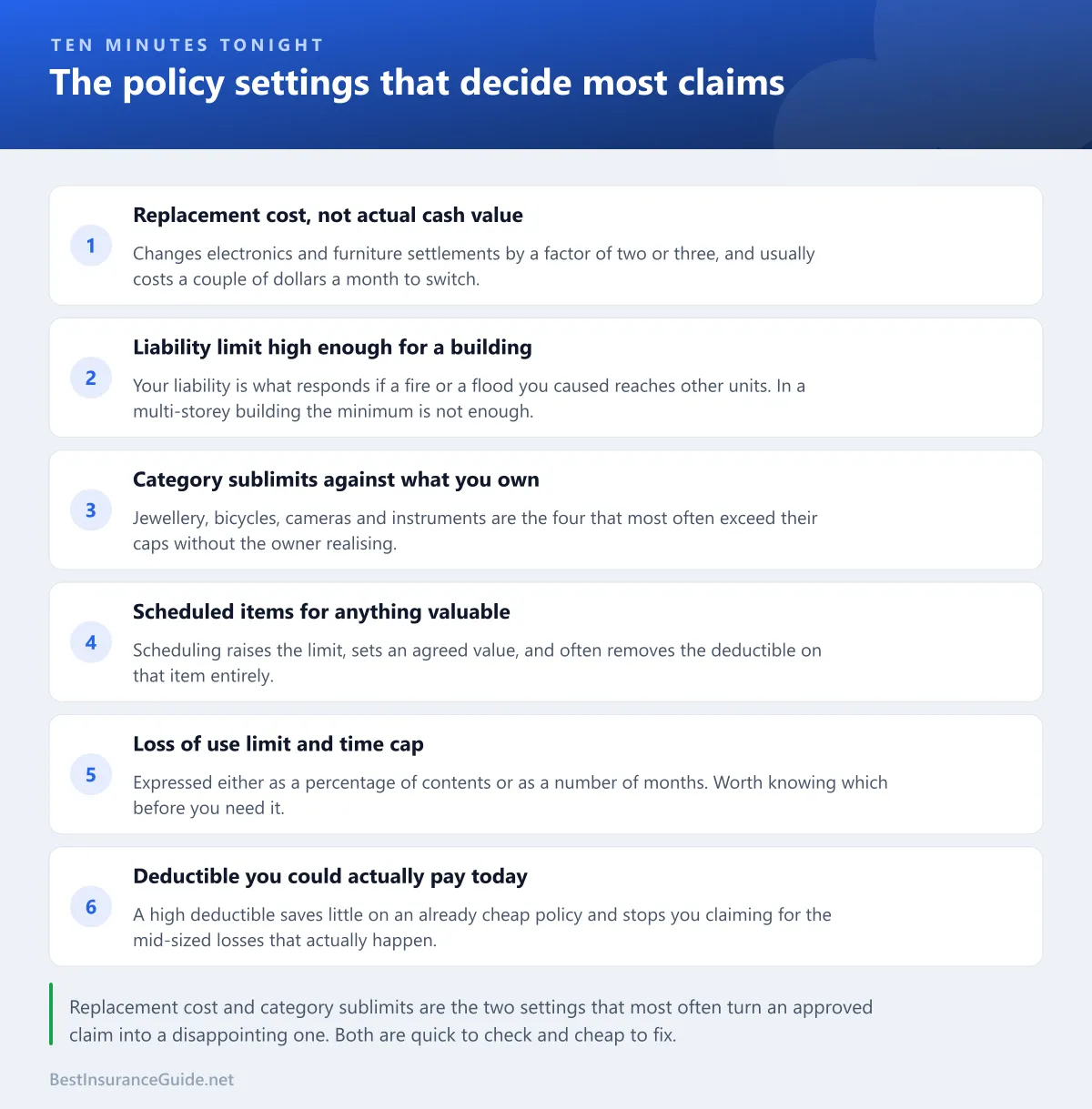
If you only do two things after reading this:
Confirm you are on replacement cost, not actual cash value. It changes electronics and furniture claims by a factor of two or three and costs a couple of dollars a month.
Check your category sublimits against what you actually own. Jewellery, bikes, cameras and instruments are the four that most commonly exceed their caps, and scheduling them is cheap.
Then, if anything in a storage unit is on your mind, does renters insurance cover storage units covers the off-premises limit that applies there.