Puppy Wellness Plans: Two Different Products With One Name
Puppy wellness plans come in two forms: an insurer add-on and a veterinary practice contract. What each covers, what they cost, and which is worth buying.

Table of contents

Two completely different products are sold as puppy wellness plans, and the difference matters enough that buying the wrong one is a common and irritating mistake.
The two products
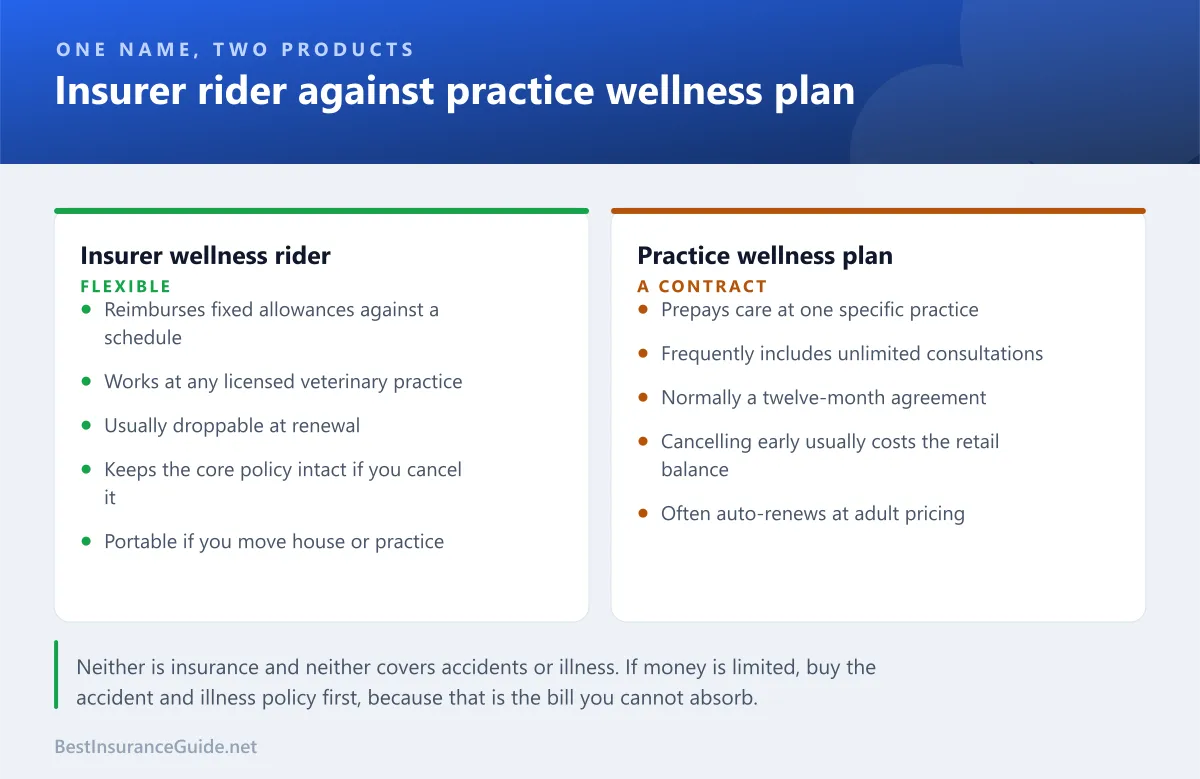
An insurer wellness rider is an optional add-on to a pet insurance policy. It reimburses routine care against fixed allowances, works at any licensed vet, and can usually be dropped at renewal while you keep the underlying policy.
A veterinary practice wellness plan is a monthly payment agreement with a specific practice. It prepays for a defined bundle of routine care at that practice, frequently includes unlimited consultations, and is normally a twelve-month contract.
Neither is insurance. Neither covers accidents or illness. Both exist to spread predictable costs.
The distinction that catches people is the contract. An insurer rider is a product you can walk away from at renewal. A practice plan is an agreement, and cancelling it early usually means paying the difference between what you have paid in and the retail value of what you have already used.
What a puppy actually costs in year one
Before comparing plans, it helps to know the number they are competing against.
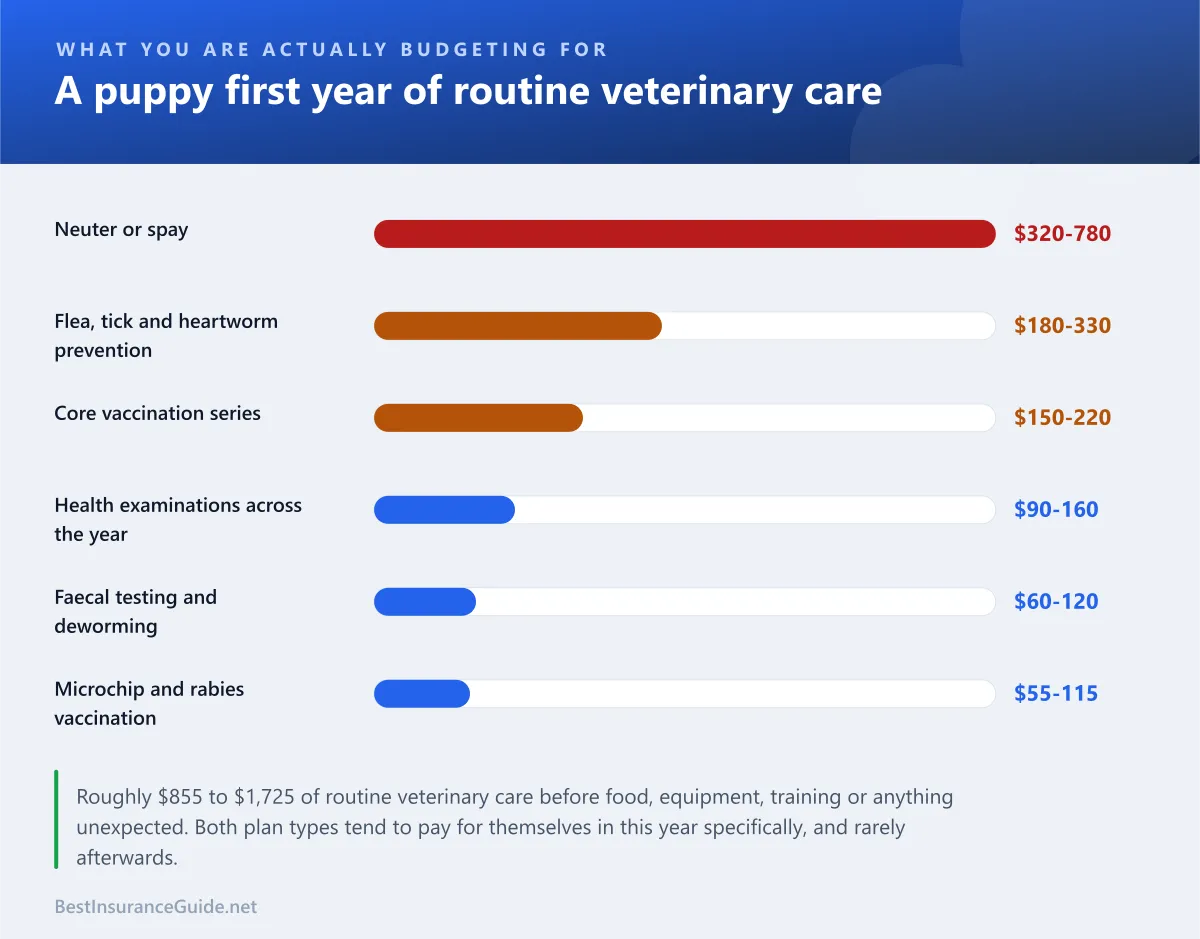
| Item | Typical cost |
|---|---|
| Core vaccination series, three visits | $150 to $220 |
| Rabies vaccination | $25 to $45 |
| Health examinations across the year | $90 to $160 |
| Neuter or spay | $320 to $780 |
| Faecal testing and deworming | $60 to $120 |
| Flea, tick and heartworm prevention | $180 to $330 |
| Microchip | $30 to $70 |
| Total routine veterinary care | $855 to $1,725 |
Non-core vaccines add to that where they are locally recommended: leptospirosis, bordetella for dogs using daycare, Lyme in tick country, canine influenza. Our state guides cover which apply where, for example pet insurance in Wisconsin for tick country and pet insurance in Florida for year-round parasite pressure.
Spay costs more than neuter, and larger breeds cost more than smaller ones, which is why the range is wide.
Does an insurer rider pay?
The arithmetic is straightforward and takes five minutes.
Worked example: a puppy’s first year on a rider
| Routine item | Typical cost | Allowance paid |
|---|---|---|
| Core vaccination series | $180 | $130 |
| Rabies vaccination | $30 | $25 |
| Health examinations | $110 | $60 |
| Neuter surgery | $420 | $150 |
| Flea, tick and heartworm prevention | $260 | $110 |
| Microchip | $50 | $30 |
| Total | $1,050 | $505 |
| Rider premium for the year | $240 | |
| Net benefit | $265 |
Positive in year one, because the vaccination series and the neuter both land. In year four, when the same dog needs one exam and a booster, the same rider typically breaks even or loses slightly.
So the honest recommendation for an insurer rider is: buy it for the first year, review it at the first renewal, and drop it when the arithmetic turns. Most insurers let you do exactly that while keeping the core policy.
Our companion articles on whether pet insurance covers vaccines and pet insurance that covers neutering work through the allowance mechanics in more detail.
Does a practice plan pay?
Sometimes better, sometimes worse, and it depends on one feature more than any other: whether consultations are unlimited.
A puppy is in and out of the vet. Vaccination visits, a limp, an upset stomach, a rash, a check on something the owner is worried about. Practices know this, and many puppy plans include unlimited examinations for the year.
For an anxious first-time owner, that can be worth more than the schedule of included items, because it removes the mental barrier to a $70 consultation and gets the puppy seen when it should be.
What to check before signing
Is it a twelve-month contract, and what does cancelling cost? The single most important question. Read the clause rather than asking at the desk.
What happens if you move? Plans are tied to the practice, and some corporate groups allow transfer between their own locations while independent practices cannot.
Are consultations genuinely unlimited, or capped?
Is the neuter included, or discounted? A discount and an inclusion are very different, and the neuter is the largest single line.
Does it roll over automatically into a second year at adult pricing, and how do you stop that?
What is not included? Almost always: anything to do with illness or injury. That is the insurance policy’s job, and a practice plan is not a substitute.
The mistake worth avoiding
Some owners buy a practice wellness plan and conclude they are covered. They are not, in the way that matters.
A wellness plan handles the $900 of predictable first-year care. It does nothing for the $4,000 foreign body surgery when the puppy eats a sock, which is statistically the most likely expensive thing to happen to a young dog.
If money is limited, buy the accident and illness policy first. It protects against the bill you cannot absorb. The wellness product smooths a bill you probably can.
The correct order is: accident and illness policy, enrolled before the first vet visit; then a wellness rider or practice plan if the arithmetic works for year one.
Timing, which matters more than the plan
Everything above is secondary to one thing.
Enrol the insurance policy before the first veterinary visit. Anything recorded in the clinical notes before your policy starts is pre-existing and excluded permanently. Puppies frequently arrive with something noted at the first check: a heart murmur, a hernia, retained deciduous teeth, kennel cough, giardia, a luxating patella.
If that first visit happens before the policy exists, those conditions are uninsurable for life. Our guide to pet insurance that starts immediately covers waiting periods and why enrolment timing outranks almost every other decision.
Buy the policy the day you collect the puppy, or before, and book the first vet visit afterwards.
The short version
Puppy wellness plans come in two forms and the names do not distinguish them. An insurer rider reimburses allowances, works anywhere and can be dropped at renewal. A practice plan prepays care at one clinic and is usually a twelve-month contract with a cancellation cost.
Neither is insurance. Both cover routine care only.
A puppy’s first-year routine veterinary care runs roughly $850 to $1,700, and both product types generally pay for themselves in that first year specifically, because the vaccination series and the neuter fall together. Neither reliably pays in adult years.
If your practice plan includes unlimited consultations, that is frequently the feature that decides it, particularly for a first-time owner.
But buy the accident and illness policy first, and buy it before the first vet visit. That is the decision that actually protects you.
What neither product covers
This is worth spelling out, because the word “wellness” does a lot of reassuring work that the product does not.
Accidents. The swallowed sock, the fractured leg, the road accident. A puppy is statistically most likely to produce exactly these, and neither a rider nor a practice plan pays a penny toward them.
Illness. Parvovirus, kennel cough progressing to pneumonia, giardia, chronic skin disease, a congenital heart defect discovered at six months.
Emergency and out-of-hours care. Practice plans cover care at that practice during opening hours. A 2am emergency at a different hospital is entirely outside them.
Anything already recorded. Both products are prospective, and neither reaches back.
Worked example: the year a puppy actually has
A boisterous eight-month-old swallows part of a toy.
| Item | Cost | Wellness plan | Insurance policy |
|---|---|---|---|
| Emergency exam and imaging | $640 | $0 | Covered |
| Exploratory surgery and foreign body removal | $2,900 | $0 | Covered |
| Hospitalisation, two days | $780 | $0 | Covered |
| Medication and recheck | $310 | $0 | Covered |
| Total | $4,630 | $0 | $3,304 at 80% after $500 |
The wellness product did its job perfectly across the year, reimbursing vaccinations and the neuter. It was simply never the thing standing between this owner and $4,630.
Choosing between them, practically
If you are going to buy one, four questions decide which.
Do you already have, or intend to buy, an accident and illness policy? If yes, an insurer rider is usually the tidier option because it lives alongside the policy and drops off at renewal. If you are buying insurance from a company that does not offer a rider, a practice plan may be the only route.
How often will you realistically visit? Unlimited consultations are the practice plan’s strongest feature, and for a first-time owner with an anxious streak they can genuinely change behaviour for the better.
Are you settled at this practice? A twelve-month tie is fine if you are. It is a problem if you might move, or if you are still deciding whether you like the vet.
Run the numbers against your own practice’s price list, not against national averages. The gap between a $60 and a $95 consultation changes the answer.
What to do in the first week
The order matters more than the products.
Buy the accident and illness policy before the first veterinary visit. This is the single highest-value action, and it is free to get right and impossible to fix later.
Book the first vet check afterwards, and ask at that appointment whether the insurer offers an orthopaedic waiting period waiver following an examination, since the window for that is short.
Then decide on the wellness product, with the first-year numbers in front of you.
Diarise the renewal date for both, because the rider that made sense in year one usually stops making sense in year two, and practice plans frequently auto-renew at adult pricing without a prompt.
Our guide to pet insurance that starts immediately covers the waiting periods that make that sequence matter.
A note on scope
Wellness rider schedules, practice plan terms, pricing and cancellation clauses all vary considerably between providers and change over time. The figures here are illustrative ranges rather than any particular company’s or practice’s published pricing, and veterinary costs differ substantially by region and by practice type.
Run the arithmetic against your own practice’s actual price list before deciding, and read any practice agreement in full, particularly the cancellation, transfer and auto-renewal clauses. Those are the terms that differ most between providers and the ones least likely to be explained at the desk.
This site is independent and not affiliated with any insurer or veterinary group.
Related reading
Does pet insurance cover vaccines covers the same routine care question from the policy side rather than the practice side. Dog dental insurance covers the other routine-versus-illness boundary that wellness products blur.
A note on scope
Wellness rider schedules, practice plan terms and cancellation clauses vary considerably and change over time. The figures here are illustrative ranges rather than any particular company’s or practice’s published pricing, and veterinary costs differ substantially by region.
Run the arithmetic against your own practice’s actual prices before deciding, and read any practice agreement in full, particularly the cancellation and auto-renewal clauses. This site is independent and not affiliated with any insurer or veterinary group.