Pet Insurance in Wisconsin: Blastomycosis Country and Heavy Lyme Exposure
Pet insurance in Wisconsin has to handle heavy Lyme exposure and blastomycosis, both long and expensive. What to buy and why enrolment timing matters.

Table of contents

Wisconsin gives you two long, expensive diseases that most states do not have together. One is well known. The other catches almost every owner by surprise.
What sets the price
Pet insurance reimburses a share of your actual vet bill, so premiums follow local veterinary pricing.
Milwaukee and Madison price above rural Wisconsin, following clinic overheads and the concentration of emergency and specialist hospitals. The University of Wisconsin’s veterinary teaching hospital in Madison provides genuine referral access.
Rural and northern Wisconsin quote lower, with the usual trade of longer drives to specialist care.
Wisconsin sits around the national middle overall. Our pet insurance by state guide covers why the ZIP code rather than the state line is the real rating factor.
The disease nobody warns you about
Blastomycosis is a fungal infection caused by spores that live in damp soil, particularly along rivers and lakes and in wooded areas with decaying organic matter. Dogs inhale them when soil is disturbed by digging, running or construction.
Wisconsin is one of the country’s endemic hotspots, and northern Wisconsin in particular records some of the highest canine incidence anywhere.
Three features make it the defining insurance issue in this state.
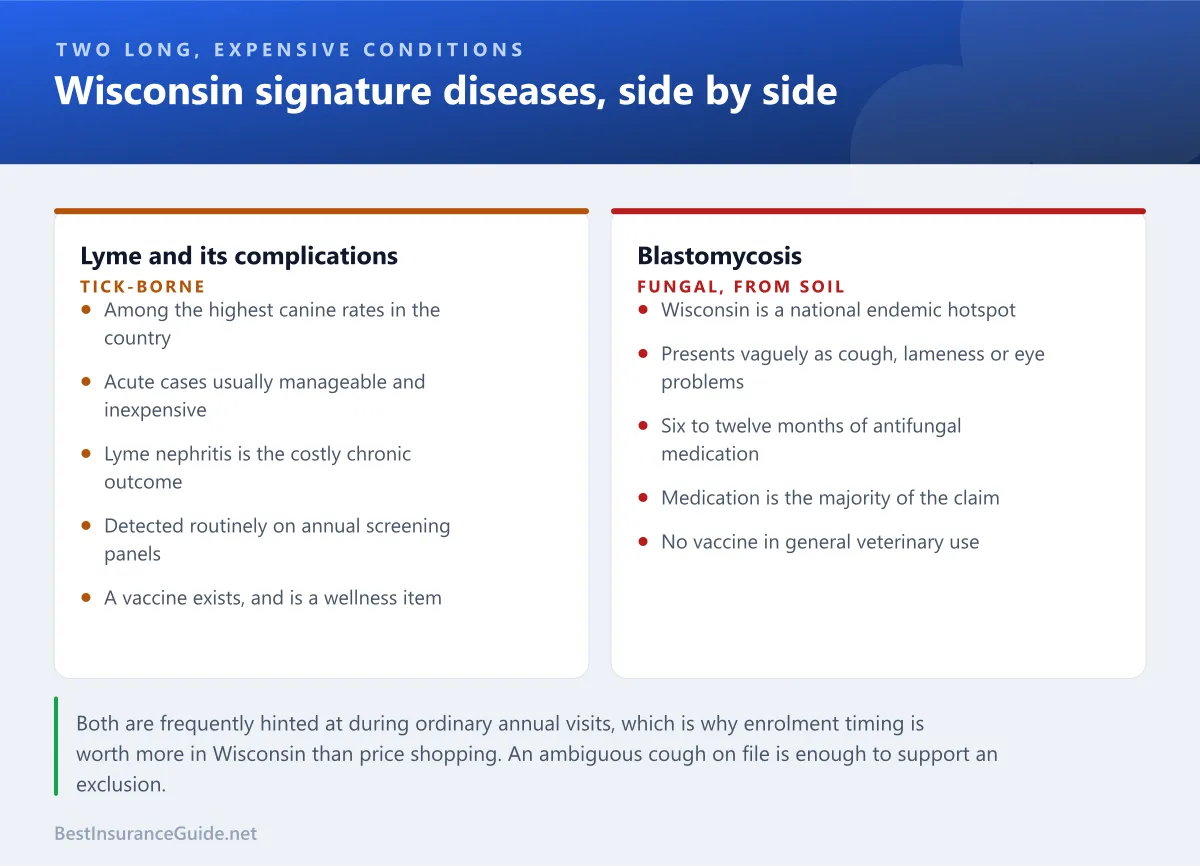
It is easy to miss early. It commonly presents as a persistent cough, lameness, skin lesions that will not heal, or eye problems, and it is frequently mistaken for something else first. Owners often have several ambiguous veterinary visits on file before a diagnosis.
It is long and drug-heavy. Treatment is antifungal medication for six to twelve months at minimum, and disseminated cases affecting bone, eyes or the nervous system can require considerably longer. The medication is the majority of the cost.
It creates a pre-existing condition problem. A dog diagnosed, or showing recorded signs, before enrolment will have blastomycosis excluded permanently by essentially every insurer. Because the early presentation is vague, this happens more often than owners expect.
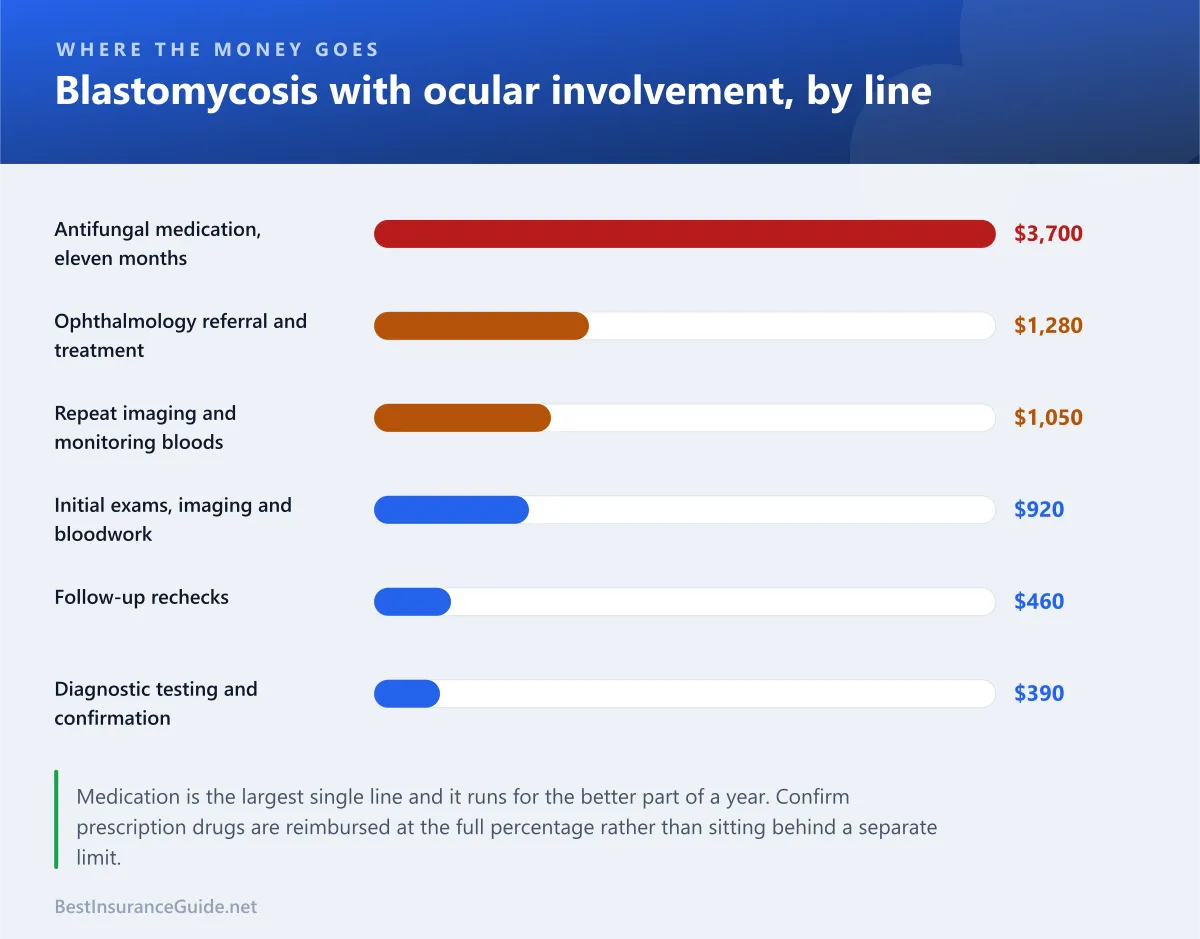
Worked example: blastomycosis with ocular involvement
Policy: $500 annual deductible, 80% reimbursement, $10,000 annual limit.
| Item | Cost |
|---|---|
| Initial exams, chest imaging and bloodwork | $920 |
| Diagnostic testing and confirmation | $390 |
| Antifungal medication, eleven months | $3,700 |
| Ophthalmology referral and treatment | $1,280 |
| Repeat imaging and monitoring bloods | $1,050 |
| Follow-up rechecks | $460 |
| Total across two policy years | $7,800 |
| Deductibles (two policy years) | $1,000 |
| Reimbursed at 80% | $5,440 |
| Owner pays | $2,360 |
Two lessons. The claim spans policy years, which is normal for blastomycosis, so the deductible type and the treatment of chronic conditions across renewals both matter. And medication is the largest line, so confirm prescription drugs are covered at the same reimbursement percentage rather than sitting behind a separate limit.
The tick problem, which is also top-tier
Wisconsin sits in the upper Midwest tick belt alongside Minnesota, and canine Lyme disease and anaplasmosis rates here are consistently among the highest in the country. The lake country and wooded north carry the heaviest burden, but exposure is not confined to them.
Treatment is covered; prevention is not. Tick preventives, the Lyme vaccine and annual screening are wellness items.
The expensive outcome is Lyme nephritis, a chronic kidney complication that is uncommon relative to simple infections but serious, long-running and costly.
Routine screening closes the door. Wisconsin vets run tick panels as standard at annual visits, and a positive result recorded before you enrol excludes that condition permanently, whether or not the dog was ever ill.
Put the two diseases together and the conclusion for Wisconsin is unusually clear: the value of a pet policy here falls sharply the longer you wait, because two of the most likely expensive conditions are both routinely detected at annual visits.
The rest of the year
Winter. Antifreeze poisoning is time-critical and expensive, and treatment is covered as toxin ingestion. Road salt and ice melt cause paw irritation and gastrointestinal upset. Ice produces cruciate ligament tears and soft tissue injuries, which brings the orthopaedic waiting period into play, commonly six or twelve months on cruciate and hip conditions rather than the few days covering ordinary accidents.
Summer. Blue-green algae on Wisconsin lakes is rapidly dangerous and covered as toxin ingestion. Heat injury appears in July and August.
Year-round. Foreign body ingestion, the most common expensive emergency nationally.
Hunting and rural injuries. Wisconsin has a large hunting dog population, and lacerations, gunshot injuries, wildlife encounters and exertional injuries all appear. All covered as accidents. If your dog works, declare it accurately; a small number of insurers ask about working use.
How to buy in Wisconsin
Match four fields across every quote before comparing a premium: the annual limit, the deductible and whether it is annual or per condition, the reimbursement percentage, and the waiting periods.
Four Wisconsin leanings, in order of importance.
Confirm a single condition can be claimed across multiple policy years, without a per-condition lifetime cap. Blastomycosis is exactly the disease that exposes those limits, and so is chronic renal disease from Lyme.
Confirm prescription medication is covered at the full reimbursement percentage. It is the majority of a blastomycosis claim.
Prefer an annual deductible. Both of this state’s signature diseases run for months.
Check the orthopaedic waiting period before winter, and ask whether a clean veterinary exam can shorten it.
Vaccines, prevention and wellness riders
Core pet insurance covers neither vaccines nor neutering, and it does not cover tick preventives. All are preventive or elective.
There is no vaccine for blastomycosis in general veterinary use, so prevention there is limited to reducing exposure to disturbed damp soil near water, which is difficult in practice for a Wisconsin dog.
For ticks, the preventive load is real:
| Preventive item | Typical annual cost |
|---|---|
| Year-round tick and flea preventive | $200 to $300 |
| Lyme vaccine, series then annual booster | $60 to $110 |
| Annual tick-borne disease screening | $50 to $90 |
| Core vaccinations and boosters | $90 to $160 |
Whether a wellness rider pays is arithmetic: total the published allowances, subtract the rider premium, and buy only if the result is positive for care you would purchase anyway. It usually earns its keep in a puppy’s first year and loses money afterwards.
Regulation
Pet insurance in Wisconsin is regulated by the Office of the Commissioner of Insurance as a property and casualty line rather than as health insurance. That is why it reimburses you after the fact and why there is no network: any licensed vet works, including Madison.
A growing number of states have adopted rules based on the NAIC Pet Insurance Model Act, standardising how waiting periods, pre-existing condition definitions and exam requirements are disclosed. Check the office’s current position rather than assuming.
Read the pre-existing condition definition yourself in any case. In a state with two diseases that present vaguely before they are diagnosed, that clause does more work than anywhere else in the contract.
The mistakes that cost Wisconsin owners money
Enrolling after an ambiguous cough or limp has been recorded. Blastomycosis frequently produces exactly that entry before anyone suspects it, and the entry is enough to support an exclusion.
Enrolling after the annual tick panel. Wisconsin vets screen as standard.
Buying a policy with a per-condition lifetime cap. Blastomycosis will find it.
Not confirming prescription medication is covered. For this state’s signature disease, the drugs are the claim.
Choosing a per-condition deductible. Both major conditions here span policy years.
Cancelling as premiums rise with age. Raise the deductible or lower the reimbursement percentage instead; both preserve the enrolment date, which is the asset you have been building.
Cats in Wisconsin
Cats cost considerably less to insure and their expensive claims differ: urinary blockage, chronic kidney disease in older cats, hyperthyroidism, dental disease and foreign body ingestion.
Cats can contract blastomycosis too, though less commonly than dogs, and outdoor cats carry tick exposure and abscesses from fight wounds. Indoor cats avoid most of that and still warrant cover, because a male cat with a urinary blockage is a sudden four-figure emergency with no warning.
Multi-pet discounts run around five to ten per cent per additional animal. Worth requesting, never worth delaying an enrolment over.
A note on figures and sources
Premiums and treatment costs here are illustrative, drawn from typical ranges rather than any single insurer’s rate filing. Actual pricing depends on your ZIP code, the species, breed and age of the animal, and the limits chosen, and veterinary charges differ meaningfully between rural practice and referral centres.
Blastomycosis and tick-borne disease distribution both shift over time. The Companion Animal Parasite Council publishes regularly updated county-level prevalence maps for tick-borne disease, and the Wisconsin Department of Health Services tracks blastomycosis, which is a reportable condition in this state. Both are more current than any article, and your own veterinarian will know what is presenting locally.
Insuring a hunting or working dog
Wisconsin has a large hunting dog population and the insurance treatment deserves a note.
Accidents are covered regardless of activity. Lacerations from wire and cover, gunshot injuries, wildlife encounters, exertional injuries and water-related incidents are all claimable under a standard accident and illness policy.
Declare working use accurately. A small number of insurers ask whether a dog is used for hunting, herding or guarding, and some rate or restrict accordingly. An inaccurate declaration is a coverage problem waiting to surface.
Blastomycosis exposure is higher for dogs working near water, riverbanks and disturbed soil, which is precisely where hunting dogs spend their time. That raises the value of the terms discussed above rather than changing them.
Consider the orthopaedic waiting period seriously. Working dogs generate cruciate and soft tissue injuries at a higher rate, and a twelve-month exclusion covers none of the season you bought it for.
Cats in Wisconsin
Cats cost considerably less to insure and their expensive claims differ: urinary blockage, chronic kidney disease in older cats, hyperthyroidism, dental disease and foreign body ingestion.
Cats can contract blastomycosis, though less commonly than dogs, and it is frequently more advanced by the time it is diagnosed in cats. Outdoor cats also carry tick exposure and abscesses from fight wounds.
Indoor cats avoid most of that and still warrant cover, because a male cat with a urinary blockage is a sudden four-figure emergency with no warning. Multi-pet discounts of roughly five to ten per cent per additional animal are widely available and worth asking for.
Comparable states
Wisconsin carries both a top-tier tick burden and blastomycosis, which is an unusual combination. Minnesota is the closest comparison on both counts, and Michigan shares the Great Lakes winter and the spreading Lyme picture.
The short version
Wisconsin combines a top-tier tick burden with blastomycosis, a fungal disease most of the country never encounters. Both are long, both are expensive, and both are frequently detected or hinted at during ordinary annual visits.
That makes enrolment timing worth more here than price shopping. Insure before an ambiguous cough or a routine tick panel lands in the clinical notes.
When you buy, confirm that a single condition can be claimed across multiple policy years, that prescription medication is covered at the full percentage, and that the deductible is annual rather than per condition. Then check the orthopaedic waiting period before the ice arrives.
For lifetime costs and how premiums climb with age, see the pet insurance cost guide.