Pet Insurance That Starts Immediately: Why Nothing Truly Does
No pet insurance starts immediately. Typical accident, illness and orthopaedic waiting periods, which can be waived, and why a sick pet cannot be insured now.

Table of contents
Searching for pet insurance that starts immediately usually means one of two things: a pet has just done something expensive, or a new animal has arrived and the owner wants cover in place today.
The answers are different, and only one of them has a solution.
Nothing starts immediately, and the reason is simple
Every pet insurance policy in the market has waiting periods: a gap between the policy becoming active and claims becoming payable.
They exist because without them the product could not function. If cover began the moment you paid, people would buy a policy in the waiting room of an emergency clinic, claim, and cancel. The premium for everyone else would have to absorb that, and the product would collapse.
So waiting periods are not a trick. They are the mechanism that lets insurance be affordable for people who buy it before they need it.
What the actual periods are
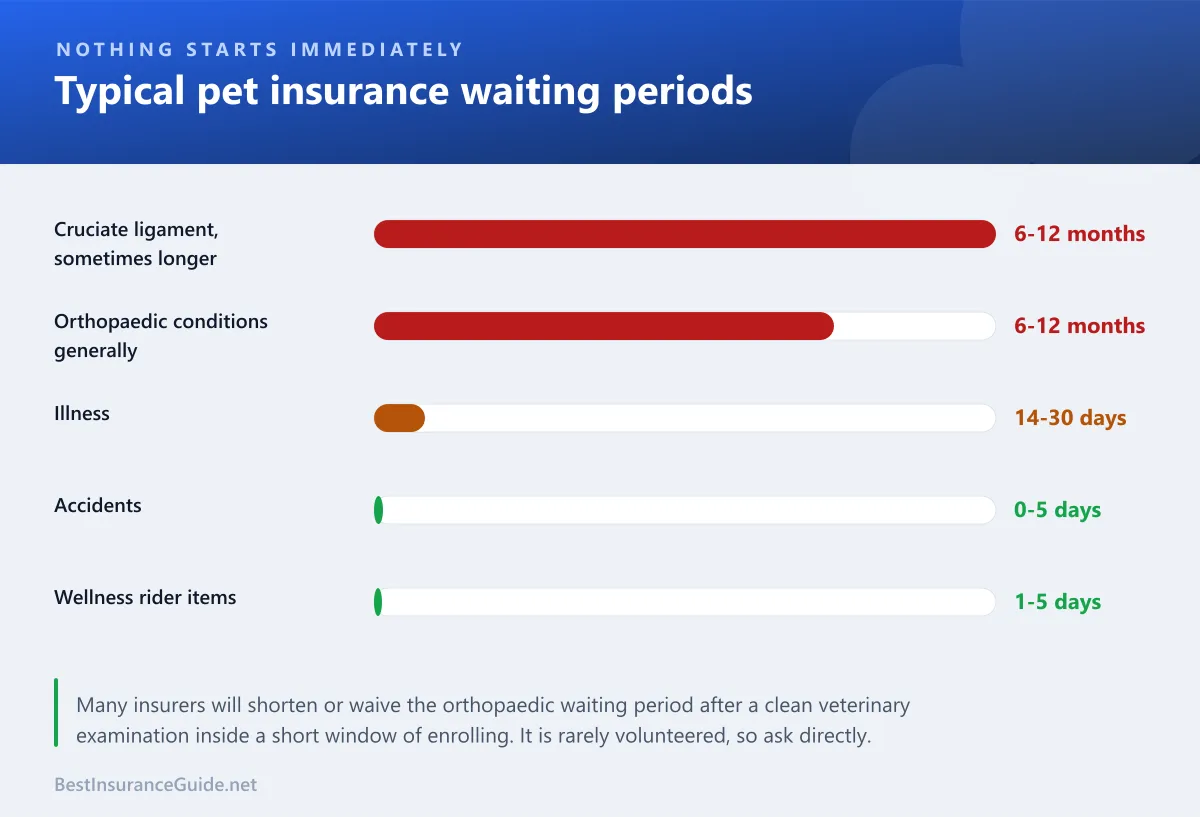
They vary by insurer, and the differences are worth comparing, but the shape is consistent.
| Cover type | Typical waiting period |
|---|---|
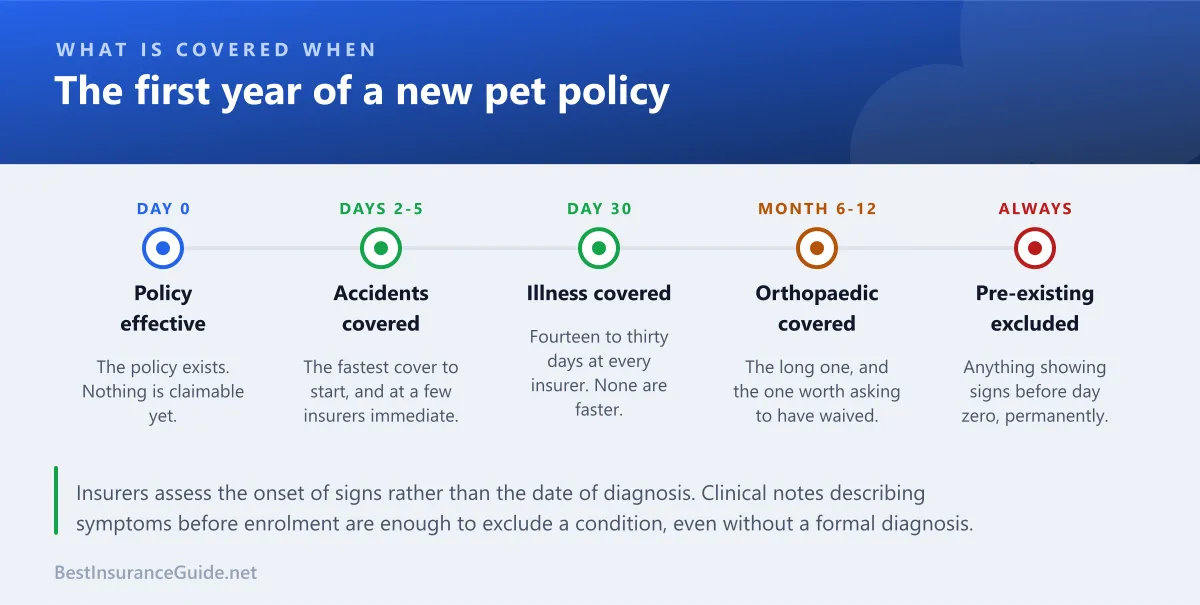
| Accidents | 2 to 5 days, sometimes 24 hours, occasionally none |
| Illness | 14 to 30 days |
| Orthopaedic conditions generally | 6 to 12 months |
| Cruciate ligament specifically | 6 to 12 months, sometimes longer |
| Wellness rider items | Often 24 hours to a few days |
Accident cover is the fastest, and this is what marketing that promises near-immediate cover is usually referring to. A handful of insurers begin accident cover as soon as the policy is active.
Illness is always slower. Fourteen days is common, thirty is not unusual, and no insurer offers immediate illness cover. The reason is incubation: an animal can be carrying something at the point of enrolment that has not yet shown itself.
Orthopaedic waits are the longest by a wide margin, and they catch the most people.
The orthopaedic wait, and how to shorten it
Cruciate ligament disease and hip dysplasia are the reason this category exists. Both frequently develop gradually, both are extremely expensive, and both may already be underway when a policy is bought without anyone knowing.
Six or twelve months is the common answer. For an active dog, that is a long time to be uncovered for one of the most likely claims.
Here is the part almost nobody is told: many insurers will shorten or waive it.
The mechanism is usually a veterinary examination within a defined window of enrolling, often the first thirty days, which finds no existing orthopaedic signs. Submit the exam report and the insurer reduces the waiting period, sometimes to the standard illness wait, sometimes to nothing.
It is not universal, the window is short, and it is rarely volunteered at the point of sale. Ask the question directly: do you offer an orthopaedic waiting period waiver following a veterinary examination, and what is the deadline?
If your pet is already unwell
This is the harder version of the question, and it deserves a straight answer.
A condition that has already appeared cannot be insured. If your dog is limping today, or vomiting today, or has a lump today, no policy bought today will cover it. That is true at every insurer, and it is not a matter of shopping harder.
It applies whether or not a diagnosis exists yet. Insurers assess the onset of signs, not the date of diagnosis, and clinical notes describing symptoms before enrolment are sufficient.
Three things are still worth knowing.
Everything else remains insurable. A dog with an excluded skin condition is still covered for a foreign body surgery, a fracture, cancer or a cruciate tear. A policy with one exclusion is considerably better than no policy, and people talk themselves out of this too often.
Some insurers will re-cover a cured condition. A number treat a resolved condition as insurable again after a defined symptom-free and treatment-free period, commonly twelve or eighteen months. That does not usually extend to anything chronic, but for a single resolved episode it matters. Ask which insurers in your market do this.
Do not delay enrolling the rest. Every week you wait is another week in which something new can be recorded and excluded too.
For the immediate financial problem, our guides to vet credit cards and how deferred interest works and what to do when vets will not take payment plans cover the realistic options.
What “cover starts today” actually means
Two dates get confused, and the distinction matters when you are reading a confirmation email.
The effective date is when the policy exists. It can be the day you buy, or the next day, depending on the insurer and the time you enrolled.
The waiting period end date is when claims for that category become payable, counted from the effective date.
A policy can therefore be genuinely active today and pay nothing for an illness that begins tomorrow. That is not a discrepancy; it is how the two dates work together, and reputable insurers state both clearly in the schedule.
Check the effective date on your documents, and diarise each waiting period end date separately.
Switching insurers restarts everything
Worth stating plainly because it is the most expensive mistake in this whole area.
If you move to a new insurer, waiting periods start again and everything diagnosed under the old policy becomes pre-existing on the new one.
For a two-year-old dog with a clean record, that is survivable. For a six-year-old that has been screened annually, treated for anything, or had a single ambiguous note, it usually converts a functioning policy into a nearly empty one.
The practical rule: raise the deductible or lower the reimbursement percentage at renewal if the premium becomes uncomfortable, but do not switch insurers to save money on an established animal. The enrolment date is the asset.
A small number of insurers will honour waiting periods already served elsewhere for a pet transferring without a gap, which is worth asking about if you genuinely must move.
How to get covered as fast as possible
If the goal is minimum time to meaningful cover, this is the sequence.
Enrol before the first veterinary visit, particularly for a new puppy or kitten. Nothing on the record means nothing excluded.
Compare accident waiting periods specifically if speed matters most. The range across insurers is genuinely wide, from none to five days.
Book the veterinary examination immediately and ask about the orthopaedic waiver window before you book, so the exam falls inside it.
Read what the exam needs to cover. A waiver exam is not always the same as a routine health check, and an insurer may specify what must be assessed and documented.
Diarise every waiting period end date on the day you enrol.
The short version
No pet insurance starts immediately. Accident cover starts fastest, sometimes within a day. Illness cover takes fourteen to thirty days at every insurer. Orthopaedic conditions commonly carry six to twelve months, and that is the one worth negotiating.
Many insurers will shorten or waive the orthopaedic wait after a clean veterinary examination inside a short window of enrolling, and almost nobody is told this unless they ask.
A pet that is already showing signs of something cannot be insured for it, anywhere. But everything else about that animal remains insurable, and delaying enrolment only adds to the exclusion list.
If you already hold a policy, do not switch insurers to save money, because waiting periods restart and your pet’s whole history becomes pre-existing.
For how limits, deductibles and reimbursement percentages interact once cover is live, see the pet insurance cost guide.
What “pre-existing” actually means in practice
The word does more work than any other in pet insurance, and the definitions differ enough between insurers to be worth reading.
Onset of signs, not diagnosis. Every insurer assesses when symptoms first appeared, not when a name was put to them. A note reading “intermittent lameness, owner reports two weeks” establishes onset before that appointment.
Curable against incurable. A number of insurers distinguish between the two. A resolved ear infection that has not recurred for twelve or eighteen months may become insurable again with some companies. Chronic conditions, and anything on a defined list, generally do not.
Bilateral conditions. If one knee, hip or eye is affected before enrolment, many insurers treat the other side as the same pre-existing condition. For cruciate ligaments and hip dysplasia, which are frequently bilateral, this is a large exclusion and it is rarely volunteered.
Related conditions. An exclusion for one condition can extend to anything the insurer considers medically related, which is broader than owners expect.
Ask for the insurer’s definition in writing before you buy, and if your pet has anything on record, ask specifically how they will treat it.
Getting a waiting period waived, step by step
For the orthopaedic waiver, the process is usually mechanical and time-limited.
Ask before you buy whether the insurer offers it, what the deadline is, and what the examination must cover.
Book the examination immediately, inside the window, which is frequently the first thirty days.
Tell the vet what it is for. A waiver examination is not the same as a routine health check, and the insurer may specify that the joints must be assessed and the findings documented.
Submit it promptly and keep a copy.
Get written confirmation that the waiting period has been reduced, and note the new date.
The same discipline applies to any insurer that will honour waiting periods already served with a previous insurer for a pet transferring without a gap. That is not universal, it usually requires proof of continuous cover, and it has to be arranged at the point of switching rather than afterwards.
Why the timing question keeps arising
Almost everyone searching for immediate cover is in one of three situations, and the honest advice differs.
A new puppy or kitten has arrived. Buy today, before the first vet visit. Waiting periods will run while the animal is healthy, which is exactly how the product is meant to work, and nothing will be excluded.
Something has just happened. No policy will cover it. Deal with the immediate bill through the routes in our guides to vet credit cards and payment plans at the practice, and insure afterwards for everything else.
A pet is getting older and the owner has finally decided to insure. Do it now rather than after the next senior bloodwork panel, because that panel is likely to find something and everything it finds becomes uninsurable.
In all three cases the answer is the same: the best time to enrol was earlier, and the second best time is before the next veterinary appointment.
Related reading
Cat insurance and pet insurance for rabbits both cover markets where waiting periods and availability interact differently from the mainstream dog market. For how enrolment timing interacts with regional disease risk, pet insurance in Virginia shows why a routine screening can close a condition off permanently.
A note on scope
Waiting periods, waiver availability and the treatment of cured conditions vary between insurers and change over time. The ranges here are typical rather than universal, and your own policy schedule is the authority.
Ask for waiting periods and any waiver process in writing before you buy, and check whether your state has adopted rules based on the NAIC Pet Insurance Model Act, which standardises how these terms must be disclosed. This site is independent and not affiliated with any insurer.