Pet Insurance in Virginia: Northern Virginia Pricing and Heavy Tick Country
Pet insurance in Virginia costs most in the DC suburbs. Lyme, ehrlichiosis, heartworm and the policy terms that decide claims across the state.

Table of contents

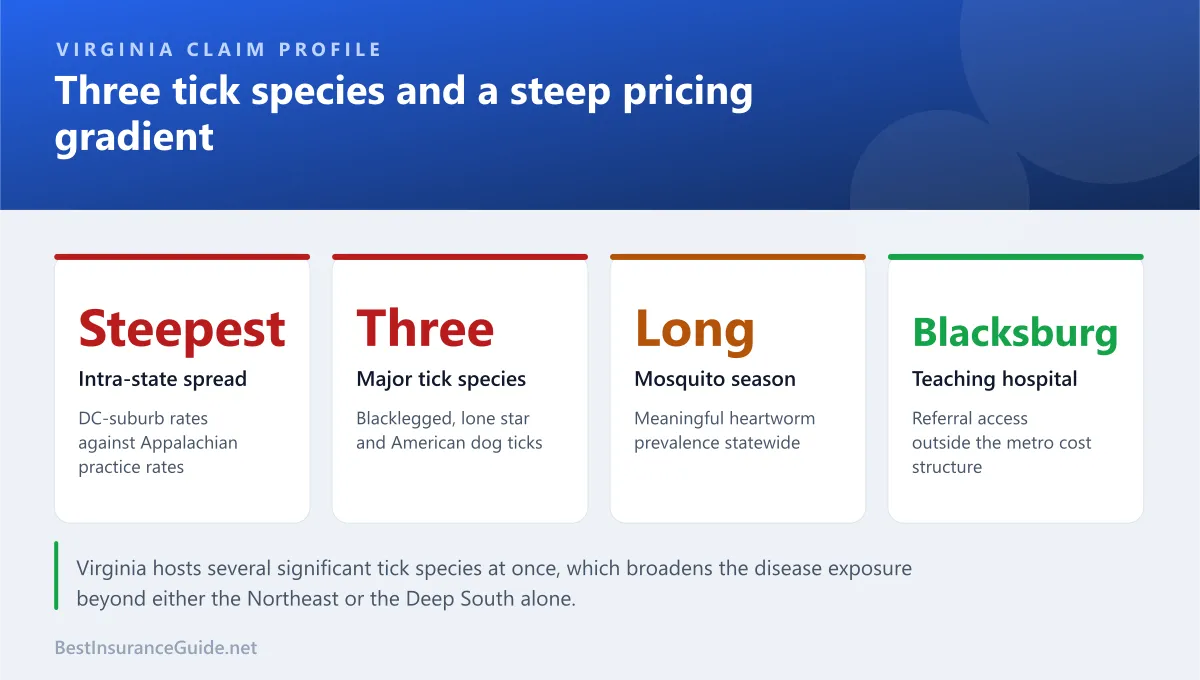
Virginia contains one of the sharpest internal pricing gradients in the country. The same dog, same policy, same insurer costs dramatically different amounts in Arlington and in Wise County.
The Northern Virginia effect
Pet insurance reimburses a percentage of your actual vet bill, so the premium follows local veterinary pricing rather than anything about your pet.
Northern Virginia sits inside the Washington DC metropolitan cost structure. Clinic overheads, commercial rents and veterinary salaries are all set by that market, and the region has dense referral and 24-hour emergency capacity. Where specialist care is readily available, more cases escalate to it, and that utilisation is priced.
Move south and west and the picture changes:
Richmond and Hampton Roads sit meaningfully below Northern Virginia.
The Shenandoah Valley, Southside and southwest Virginia are cheaper again, with the Virginia-Maryland College of Veterinary Medicine at Blacksburg providing teaching hospital referral access without metro pricing.
Our pet insurance by state guide covers why that intra-state spread routinely exceeds the difference between two states.
Virginia is heavy tick country
This is the risk that most shapes what a Virginia policy needs to do.
Virginia carries a substantial and expanding tick burden, and unusually it hosts several significant species at once. Blacklegged ticks carry Lyme and anaplasmosis, and canine Lyme is well established across northern and western Virginia. Lone star ticks are abundant across much of the state and carry ehrlichiosis. American dog ticks carry Rocky Mountain spotted fever.
That combination means a Virginia dog is exposed to a broader set of tick-borne diseases than a dog in either the Northeast or the Deep South alone.
The insurance position is consistent:
Treatment is covered for all of them, provided there was no prior diagnosis and the waiting period has passed.
Prevention is not. Year-round tick preventives, the Lyme vaccine and annual screening panels are wellness items.
Routine screening creates the trap. Virginia vets run tick panels as standard at annual visits. A positive result recorded before you enrol excludes that condition permanently with essentially every insurer, whether or not the dog was ever ill.
The expensive outcome, as elsewhere in Lyme country, is Lyme nephritis: a chronic kidney complication that is uncommon relative to simple infections but serious, long-running and costly to manage.
Worked example: Lyme nephritis in Northern Virginia
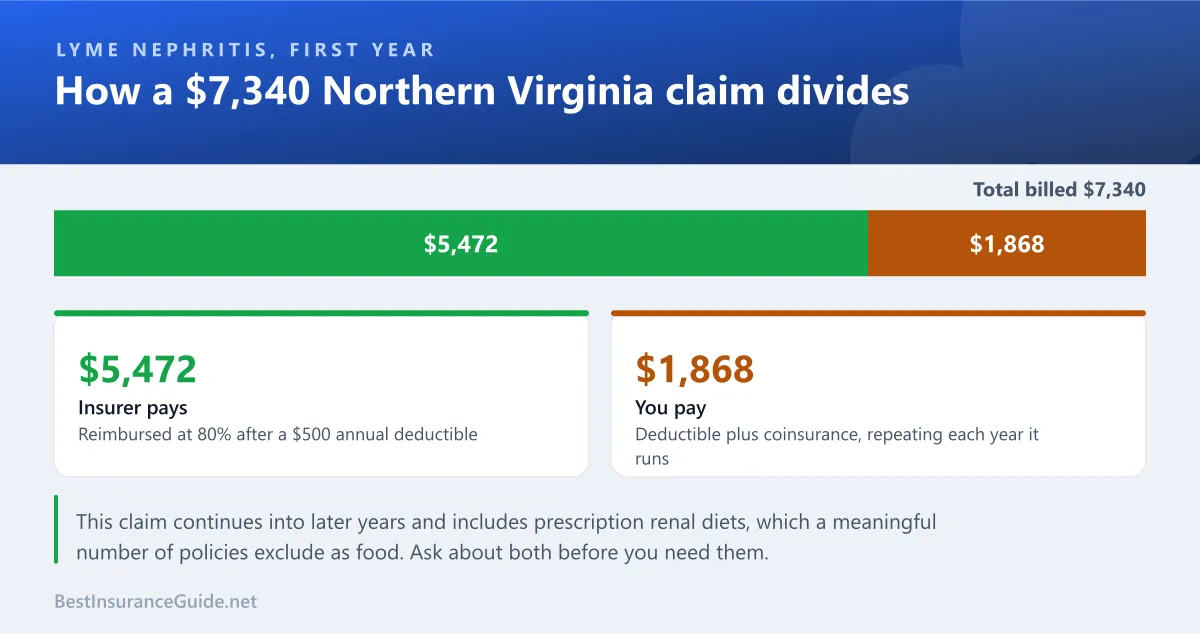
Policy: $500 annual deductible, 80% reimbursement, $10,000 annual limit.
| Item | Cost |
|---|---|
| Workup, bloods, urinalysis and tick panel | $890 |
| Hospitalisation with IV fluids, four days | $3,600 |
| Internal medicine referral and consultation | $410 |
| Renal medication and prescription diet, first year | $1,580 |
| Quarterly monitoring bloods | $860 |
| Total | $7,340 |
| Less deductible | $500 |
| Reimbursed at 80% | $5,472 |
| Owner pays | $1,868 |
The same case managed in southwest Virginia would produce a smaller bill and a proportionally similar out-of-pocket share. What changes with the postcode is the scale.
Two features of this claim drive the buying advice. It continues into subsequent years, which makes the deductible type important. And prescription renal diets are a real ongoing cost that a meaningful number of policies exclude as food.
The rest of the Virginia profile
Heartworm. Virginia sits in a region of meaningful prevalence with a long mosquito season. Year-round prevention is standard advice. Prevention is a wellness item; treatment is covered provided the dog was clear at enrolment.
Heat and humidity. Virginia summers produce heat injury cases, and severe ones are multi-day intensive care admissions. Brachycephalic breeds are heavily over-represented, and they are popular across the Northern Virginia suburbs.
Snake bites. Copperheads are widespread across Virginia and are the most common venomous bite here; timber rattlesnakes and cottonmouths appear regionally. Treatment is covered as an accident.
Coastal exposure. Hampton Roads and the Eastern Shore carry hurricane and flooding risk. Injuries are covered as accidents; boarding, evacuation and relocation costs are not, and sit under homeowners or renters loss-of-use instead.
Chronic skin and ear disease. Humidity through the warm months drives recurring dermatological problems, which are among the most common claims nationally and frequently chronic.
Foreign body ingestion, the most common expensive emergency anywhere.
How to buy in Virginia
Match four fields across every quote before comparing a premium: the annual limit, the deductible and whether it is annual or per condition, the reimbursement percentage, and the waiting periods.
Four Virginia leanings.
Prefer an annual deductible. Chronic tick complications, renal management and recurring skin disease all span years, and that is exactly where per-condition designs cost more.
Take the higher reimbursement percentage in Northern Virginia. The percentage applies to bigger numbers there. On the claim above, the gap between 70% and 90% is roughly $1,370.
Buy a high annual limit in the metro. A $5,000 cap is thin against DC-area specialist pricing plus ongoing management.
Confirm prescription diets are covered. Renal and urinary diets are a genuine recurring cost in chronic cases.
Vaccines, prevention and wellness riders
Core pet insurance covers neither vaccines nor neutering, and does not cover tick or heartworm prevention. All are preventive or elective.
Virginia’s preventive load is heavy, because both the tick and heartworm arguments apply at once:
| Preventive item | Typical annual cost |
|---|---|
| Year-round tick and flea preventive | $220 to $320 |
| Year-round heartworm prevention | $120 to $220 |
| Lyme vaccine, series then annual booster | $60 to $110 |
| Annual heartworm and tick-borne disease testing | $60 to $110 |
Every Virginia owner should be carrying most of that regardless of whether they insure. Whether a wellness rider pays is arithmetic: total the published allowances, subtract the rider premium, and buy only if the result is positive for care you would purchase anyway. It usually earns its keep in a pet’s first year and loses money afterwards.
Regulation
Pet insurance in Virginia is regulated by the State Corporation Commission Bureau of Insurance as a property and casualty line rather than as health insurance. That structure is why it reimburses you after the fact and why there is no network: any licensed vet works, including Blacksburg.
A growing number of states have adopted rules based on the NAIC Pet Insurance Model Act, standardising how waiting periods, pre-existing conditions and exam requirements are disclosed. Adoption has been moving, so check the Bureau’s current position rather than assuming.
Read the pre-existing condition definition yourself regardless. In a state where routine screening frequently returns positives, it is the clause doing the most work.
The mistakes that cost Virginia owners money
Enrolling after the annual tick and heartworm panel. The most expensive timing error available here, and Virginia vets test as standard.
Choosing a per-condition deductible. Chronic renal and skin conditions are exactly what that design punishes.
Assuming a Roanoke quote applies in Arlington. The intra-state gradient here is among the steepest in the country. Tell your insurer when you move.
Buying a brachycephalic breed without pricing insurance first. Several insurers rate these breeds substantially higher and some exclude specific airway conditions.
Assuming prescription diets are covered. Ask specifically before you need them.
Cancelling as premiums rise with age. Adjust the deductible or reimbursement percentage instead; both preserve the enrolment date, which is the asset you have been paying to build.
A note on the figures
Premiums and treatment costs in this article are illustrative, drawn from typical ranges rather than any single insurer’s rates. Actual pricing depends on your ZIP code, the species, breed and age of the animal, and the limits selected, and veterinary charges differ substantially between Northern Virginia and the rest of the state. Quote your own circumstances and read the policy wording rather than the summary.
Moving into or out of Northern Virginia
Virginia’s pricing gradient is steep enough that relocation within the state is a genuine insurance event, and it is handled badly more often than not.
Tell your insurer and change the address. Rating is by ZIP code. Moving from Roanoke to Arlington will raise the premium at renewal, and that is legitimate: local vet costs really are higher. Not telling them risks a coverage dispute at claim time, and the saving was never real.
Do not switch insurers to chase a better local price. This is the expensive mistake. Your enrolment date is the most valuable thing about an existing policy, and switching converts your dog’s entire accumulated history into pre-existing exclusions on the first day of the new policy. For a dog of five or six that has been screened annually in tick country, that is usually catastrophic.
Moving out of Northern Virginia should lower the premium. Ask for the re-rate rather than waiting for the renewal to arrive.
Cats in Virginia
Cats cost considerably less to insure and their expensive claims differ: urinary blockage, chronic kidney disease, hyperthyroidism, dental disease and foreign body ingestion.
Outdoor cats in Virginia carry substantial tick exposure, given the three significant species present, and abscesses from fight wounds are a common claim. Indoor cats avoid nearly all of it and still warrant cover, because a male cat with a urinary blockage is a genuine emergency arriving without warning and costing four figures.
Feline heartworm is also present in Virginia and is harder to treat than the canine form, since the adulticide protocol used in dogs is not safe in cats. Prevention carries more weight for that reason and remains a wellness item.
Questions worth asking a Virginia insurer
Five questions decide whether a policy performs here.
Is the deductible annual or per condition? Chronic renal and skin conditions both span years.
Are prescription diets covered? Renal and urinary diets are a genuine recurring cost and many policies exclude food.
Do you cover a chronic condition across renewals? Decisive for anything ongoing.
Are exam fees reimbursed? Relevant given the volume of rechecks in chronic tick-borne cases.
How are brachycephalic airway conditions handled? These breeds are popular across the Northern Virginia suburbs and several insurers restrict them.
A note on the figures
Premiums and treatment costs here are illustrative, drawn from typical ranges rather than any single insurer’s rates. Actual pricing depends on your ZIP code, the species, breed and age of the animal, and the limits selected. Tick distribution also shifts over time, and the Companion Animal Parasite Council publishes county-level prevalence maps that are more current than any article.
Comparable states
Virginia runs from DC-suburb pricing to Appalachian practice rates, which is the same spread Georgia and Illinois carry. On tick burden it sits close to Connecticut and Missouri, though the dominant organisms differ.
The short version
Virginia has one of the steepest internal pricing gradients in the country, from DC-suburb rates in the north to Appalachian practice rates in the southwest. Rating is by ZIP code, so quote your own.
The dominant risk is ticks, and unusually Virginia carries several significant species at once, which broadens the disease exposure beyond either the Northeast or the South alone. Treatment is covered, prevention is not, and a positive panel before enrolment closes that condition permanently.
Buy an annual deductible, take the higher reimbursement percentage and a high annual limit if you are in Northern Virginia, confirm prescription diets are covered, and enrol before the next annual panel.
For lifetime costs and how premiums climb with age, see the pet insurance cost guide.