Pet Insurance in Illinois: Chicago Prices and Four Distinct Risk Seasons
Pet insurance in Illinois costs most in Chicago. Leptospirosis, winter antifreeze risk, tick expansion and the policy terms that decide claims here.

Table of contents

Illinois compresses a lot of variety into one state. A dog in Lincoln Park and a dog on a farm outside Decatur face different risks and generate very different premiums, and the calendar changes both.
What sets the price
Pet insurance reimburses a percentage of your actual vet bill, so the premium follows local veterinary pricing.
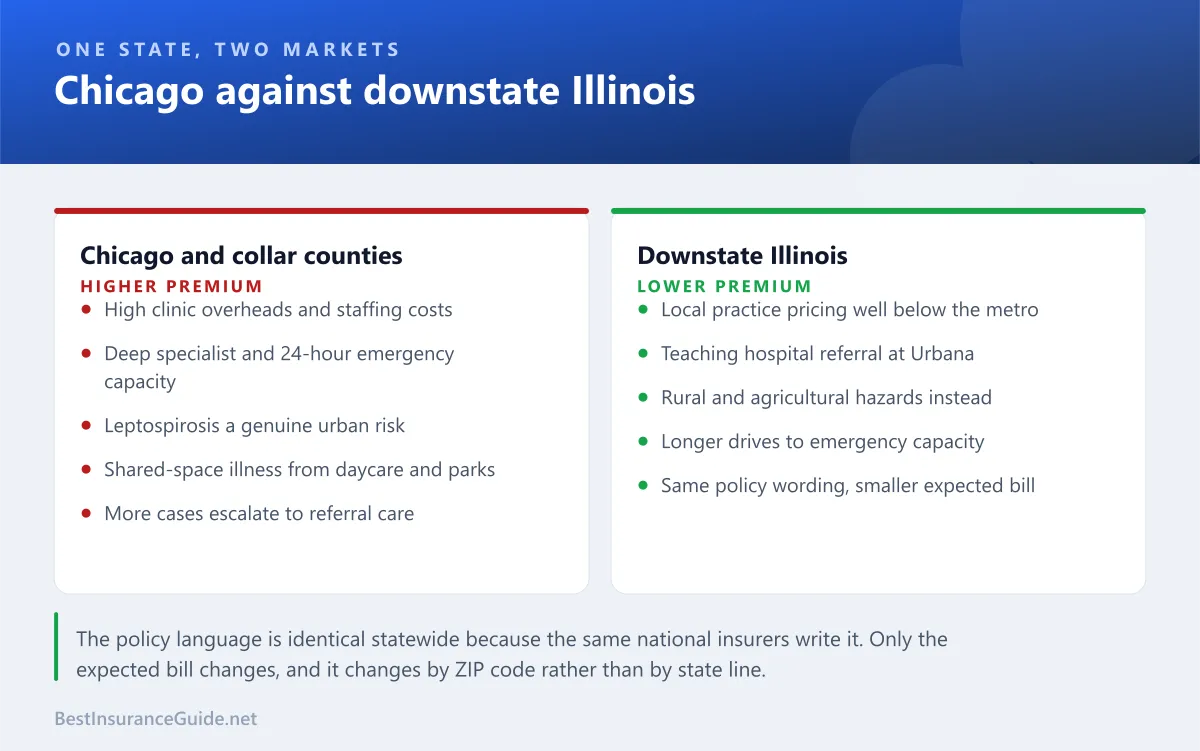
Chicago and the collar counties are the expensive end, with high clinic overheads, a competitive labour market and a deep bench of specialists and 24-hour emergency hospitals. Where referral care is readily available, more cases use it.
Downstate is materially cheaper, and the University of Illinois teaching hospital at Urbana provides genuine specialist access without metro pricing across the surrounding region.
The policy language is broadly identical statewide, because the same national insurers write it. Only the expected bill changes. Our pet insurance by state guide explains why that intra-state gap frequently exceeds the difference between states.
Four seasons, four claim patterns
Illinois is one of the clearer states for seeing how a claim calendar actually works.
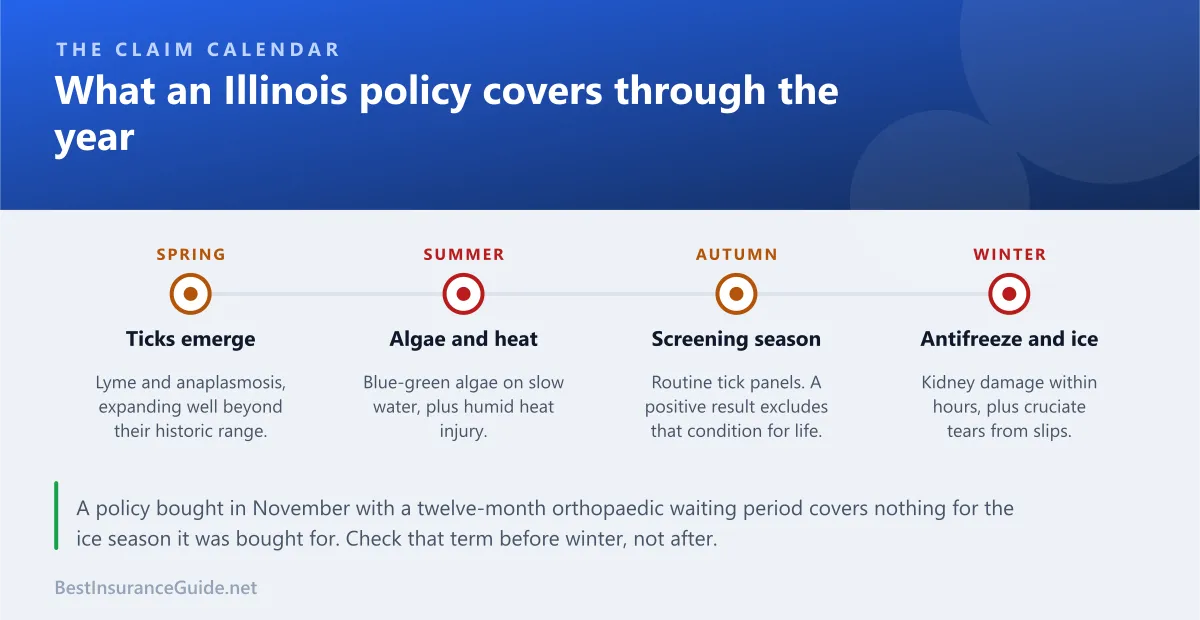
Spring: ticks. The blacklegged tick has expanded steadily across Illinois, and canine Lyme and anaplasmosis now appear well beyond their historic range. Treatment is covered; the Lyme vaccine and tick preventives are not.
Summer: water and heat. Blue-green algae on Illinois lakes and slow water is rapidly dangerous and covered as toxin ingestion. Heat injury arrives in July and August, and the humidity makes it worse than the temperature alone suggests.
Autumn: screening. Illinois vets increasingly run tick-borne disease panels as standard at annual visits. This is the pre-existing condition trap: a positive result recorded before you enrol excludes that condition permanently, whether or not the dog was ever ill.
Winter: toxins and ice. Ethylene glycol poisoning is the serious one. It is sweet, animals drink it, and it destroys kidneys within hours. Treatment is time-critical, involves multi-day hospitalisation and intensive monitoring, and is genuinely expensive. Alongside it, road salt and ice melt cause paw irritation and gastrointestinal upset, and ice produces the seasonal spike in cruciate ligament tears and soft tissue injuries.
That last point connects to a policy term worth checking before you sign. Many insurers apply an orthopaedic waiting period of six or twelve months to cruciate and hip conditions rather than the few days that cover ordinary accidents. A policy bought in November with a twelve-month cruciate exclusion covers nothing for the ice season it was bought for.
The Chicago-specific risk: leptospirosis
This deserves its own section because it is one of the few genuinely urban pet health risks and it is frequently underestimated.
Leptospirosis spreads through the urine of infected wildlife, including rats, and dense city environments with standing water sustain it well. Chicago has recurring case activity, and it is not confined to dogs that go hiking; a puddle on a city street is a plausible exposure.
It is a bacterial infection that attacks the kidneys and liver. Mild cases are manageable; severe ones mean hospitalisation, aggressive IV fluid therapy and sometimes dialysis referral, and it can be fatal.
Treatment is covered as an illness. The vaccine is preventive and sits under a wellness rider, not core cover. Leptospirosis vaccination is widely recommended for Chicago dogs, and it is inexpensive relative to the claim.
Worked example: a severe leptospirosis case in Chicago
Policy: $500 annual deductible, 80% reimbursement, $10,000 annual limit.
| Item | Cost |
|---|---|
| Emergency presentation, bloods and urinalysis | $840 |
| Hospitalisation with IV fluids, five days | $4,300 |
| Repeat diagnostics and monitoring | $1,120 |
| Internal medicine consultation | $340 |
| Medication and discharge care | $520 |
| Follow-up renal monitoring, first year | $890 |
| Total | $8,010 |
| Less deductible | $500 |
| Reimbursed at 80% | $6,008 |
| Owner pays | $2,002 |
Two things follow. The follow-up monitoring continues past the initial episode, so the deductible type matters: an annual deductible handles a condition that spans months better than some per-condition designs. And a $5,000 annual cap would have been exhausted before the monitoring began.
Dog parks, daycare and shared-space illness
City dogs share space in ways rural dogs do not, and it shows up in claims.
Canine infectious respiratory disease, commonly called kennel cough, spreads readily through daycare, boarding and dog parks. Treatment is covered as illness. The bordetella vaccine, which most Chicago facilities require, is preventive and is not.
Canine influenza has produced significant Chicago-area outbreaks historically. Treatment is covered; vaccination is not.
Giardia and other gastrointestinal infections from shared water sources are common and usually inexpensive, though occasionally not.
Bite wounds and altercations at dog parks are covered as accidents. Worth noting separately: your liability if your dog injures another dog or a person is not part of pet insurance in the United States. That sits under your homeowners or renters liability coverage, and some insurers exclude particular breeds. Our renters insurance guide covers how that works.
How to buy in Illinois
Match four fields before comparing any premium: the annual limit, the deductible and its type, the reimbursement percentage, and the waiting periods.
Three Illinois leanings.
Prefer an annual deductible. Renal follow-up after leptospirosis, chronic tick complications and orthopaedic management all span months.
Check the orthopaedic waiting period, particularly if buying in autumn ahead of the ice season.
Take a higher annual limit in the metro. Chicago intensive care pricing finds the top of a $5,000 cap quickly.
Vaccines, prevention and wellness
Core pet insurance covers neither vaccines nor neutering, in Illinois or anywhere. Both are preventive or elective.
Illinois has a moderately heavy preventive load for city dogs specifically: leptospirosis, bordetella, canine influenza and year-round tick prevention are all reasonable recommendations for a Chicago dog using daycare and parks. Total the rider’s published allowances against its premium and buy only if the arithmetic works for care you would purchase anyway. As usual, the rider mostly earns its value in a puppy’s first year.
Regulation
Pet insurance in Illinois is regulated by the Illinois Department of Insurance as a property and casualty line, which is why it reimburses rather than running a network. Any licensed vet works.
Several states have adopted rules based on the NAIC Pet Insurance Model Act, standardising disclosure of waiting periods, pre-existing condition definitions and exam requirements. Check the Department’s current position rather than assuming a protection applies.
Read the pre-existing condition definition yourself in any case. In a state where autumn screening is routine, it is the clause doing the most work.
The mistakes that cost Illinois owners money
Enrolling after the autumn tick panel. The most expensive timing error available here.
Skipping the leptospirosis vaccine because insurance covers lepto. It covers a five-day hospitalisation. Prevention costs a fraction of that and is not covered at all.
Buying in November with a twelve-month orthopaedic waiting period. The ice season arrives before the cover does.
Assuming a downstate quote applies in Chicago. Rating is by ZIP code, and the metro premium is substantially higher.
Cancelling as the premium climbs with age. Adjust the deductible or reimbursement percentage instead; both preserve the enrolment date.
A note on the figures
Premiums and treatment costs here are illustrative, drawn from typical ranges rather than any single insurer’s rates. Actual pricing depends on your ZIP code, the species, breed and age of the animal, and the limits chosen, and veterinary charges differ substantially between Chicago and downstate practices. Quote your own postcode and read the policy wording rather than the summary.
Apartment and condo dogs
A large share of Chicago dogs live in buildings, and that changes two things about the insurance picture.
Pet insurance does not cover your liability. If your dog bites someone or injures another dog, that claim sits under your renters or homeowners liability coverage, not your pet policy. Many Chicago leases and condo associations require proof of liability cover for dog owners, and some insurers exclude specific breeds outright. Our renters insurance guide covers how that liability works and why the limit matters more in a dense building than in a detached house.
Damage your dog does to the unit is also not pet insurance. Chewed doors, scratched floors and stained carpet are a deposit question, and accidental damage to the building itself may fall under your renters liability. Neither is claimable on a pet policy.
What the pet policy does cover, and what apartment living genuinely increases, is shared-space illness and injury: respiratory infections from daycare and parks, giardia from communal water, bite wounds from altercations, and the orthopaedic injuries that come from stairs and hard floors.
What the premium does over time
| Age band | Indicative monthly premium, Chicago | Paid in the band |
|---|---|---|
| Years 1 to 3 | $47 | $1,692 |
| Years 4 to 6 | $65 | $2,340 |
| Years 7 to 9 | $97 | $3,492 |
| Years 10 to 12 | $145 | $5,220 |
| Total to age twelve | $12,744 |
Downstate runs meaningfully below that at every band. The shape is what matters: premiums accelerate after seven, which is exactly when claims begin, and cancelling at that point wastes a decade of payments.
Adjust the deductible or the reimbursement percentage instead. Both preserve the enrolment date.
Questions worth asking an Illinois insurer
Five questions decide whether a policy performs in this state.
Is the deductible annual or per condition? Renal follow-up after leptospirosis and chronic orthopaedic management both span months.
What is the orthopaedic waiting period, and can an exam shorten it? Decisive if you are buying ahead of the ice season, and several insurers will reduce it after a clean examination.
Are exam fees reimbursed? Relevant for any condition requiring repeat rechecks.
Do you cover a chronic condition across renewals? A small number of policies treat conditions as pre-existing at each anniversary.
How are bilateral conditions treated? If one cruciate goes the other frequently follows, and some insurers decline the second knee as the same pre-existing condition.
A note on the figures
Premiums and treatment costs here are illustrative, drawn from typical ranges rather than any single insurer’s rate filing. Actual pricing depends on your ZIP code, the species, breed and age of the animal, and the limits chosen. Quote your own postcode and read the policy wording rather than the summary.
Multi-pet households
Multi-pet discounts run around five to ten per cent per additional animal at most insurers. Worth requesting, never worth delaying an enrolment over, because the enrolment date is worth far more than the discount.
Enrol each animal separately and as early as you can. A puppy or kitten insured at ten weeks is a fundamentally better policy than the same animal insured at ten months, because nothing has reached the clinical notes yet.
Comparable states
Illinois runs from a dense expensive metro to farm country, which is the same structure as Missouri and Michigan. On tick exposure it sits closer to Minnesota and Wisconsin, both of which carry heavier burdens than the Illinois average suggests.
The short version
Illinois prices on your ZIP code, with Chicago and the collar counties well above downstate. The claim calendar runs through four distinct seasons: ticks in spring, algae and heat in summer, screening in autumn, and antifreeze and ice injuries in winter.
Leptospirosis is the genuinely urban risk and the one Chicago owners most often underestimate. Treatment is covered and expensive; the vaccine is neither.
Buy an annual deductible, check the orthopaedic waiting period before winter, and enrol before the next tick panel rather than after it.
For lifetime costs and how premiums climb with age, see the pet insurance cost guide.