Pet Insurance by State: Why the Same Dog Costs Double Across a Border
Why pet insurance in Colorado, Oregon, Georgia or Virginia costs what it does. State-by-state price drivers, plus whether vaccines and neutering are covered.

Table of contents

Two identical three-year-old Labradors, same breed, same health record, same policy from the same insurer. One lives in Oklahoma, one lives in Connecticut. The Connecticut owner pays roughly double.
Nothing about the dog explains that. The explanation is entirely in what a vet charges down the road.
Pet insurance is priced on your vet, not your pet
This is the thing that makes pet insurance behave differently from every other policy you own.
Car insurance rates your driving. Life insurance rates your health. Pet insurance rates your postcode, because the product is a reimbursement of a bill that has not happened yet, and the size of that bill is a local variable.
An emergency exploratory surgery is the same procedure everywhere. What it costs is not. Clinic overheads, specialist availability, staffing costs and local competition move that number by a factor of two or more across the country, and the premium moves with it.
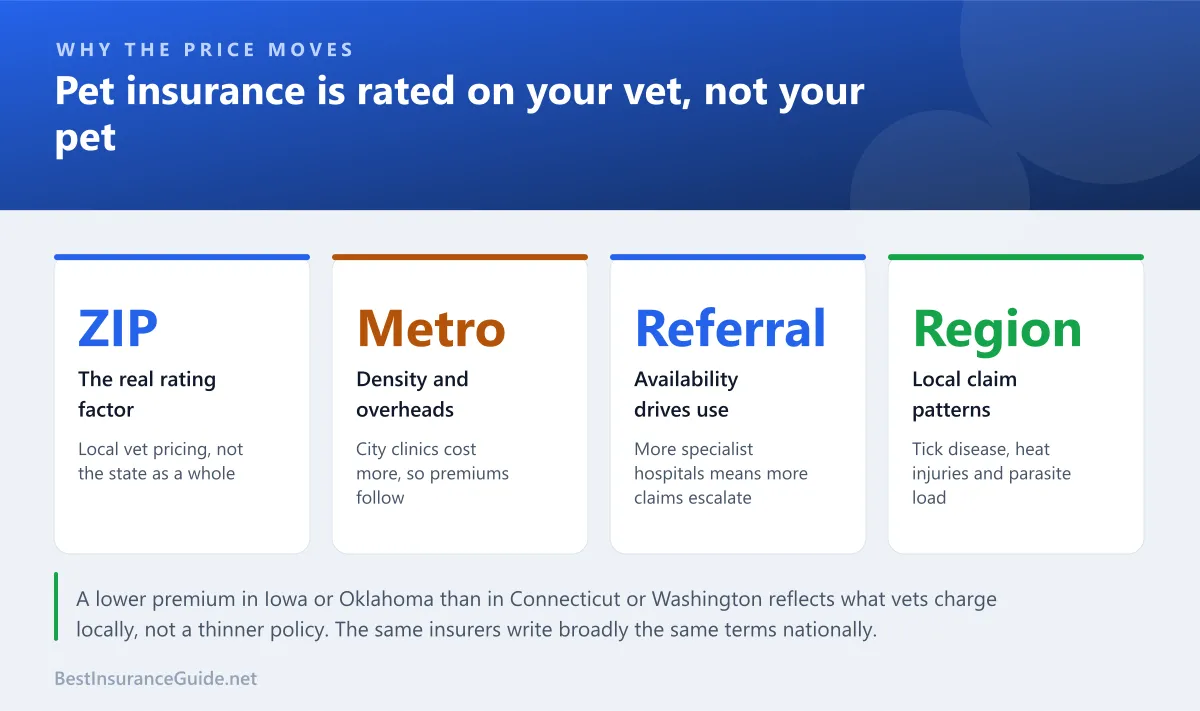
Two consequences follow that are worth internalising before you shop.
The state is a rough proxy. The ZIP code is the real rating factor. Rural Colorado and central Denver are not the same market. In several states the internal spread is wider than the gap to a neighbouring state, so quoting on “pet insurance Colorado” as a category will mislead you if you actually live an hour outside the city.
A cheaper state does not mean a thinner policy. The same national insurers write in most states with broadly the same terms. Pet insurance in Iowa or Oklahoma costs less than pet insurance in Washington state because vets charge less, not because the coverage is worse.
Worked example: the same claim, two markets
A four-year-old dog swallows a sock. Same insurer, same 80% reimbursement, same $500 annual deductible.
| Lower-cost market | Higher-cost market | |
|---|---|---|
| Emergency exam | $145 | $310 |
| Imaging | $420 | $890 |
| Foreign body surgery | $2,300 | $4,600 |
| Overnight care and medication | $610 | $1,240 |
| Total bill | $3,475 | $7,040 |
| Less deductible | $500 | $500 |
| Reimbursed at 80% | $2,380 | $5,232 |
| Owner pays | $1,095 | $1,808 |
The policy behaved identically. The insurer paid more than twice as much in the second market, which is precisely why the second owner was charged a higher premium to begin with.
It also shows why a percentage reimbursement matters more than the headline premium in an expensive area. In the higher-cost market, the difference between 70% and 90% reimbursement on this one claim is over $1,400.
What actually moves your state’s number
Metro concentration. States where most of the population sits in one or two expensive metros price higher across the board. This is a large part of why quotes in Connecticut, Washington and Colorado tend to run above quotes in Iowa, Alabama or Oklahoma.
Specialist density. Where board-certified surgeons, oncologists and 24-hour emergency hospitals are plentiful, more claims escalate to specialist care because that care is available. Availability creates utilisation, and utilisation is priced.
Local claim frequency. Regional differences in what pets are treated for feed into rates: tick-borne disease in the Northeast and upper Midwest, foxtail and heat injuries in the West, parasite load in the humid South.
Regulatory environment. A growing number of states have adopted rules based on the NAIC Pet Insurance Model Act, which standardises disclosure of waiting periods, pre-existing condition definitions and exam requirements. This does not usually move the price much, but it does make policies easier to compare honestly. Check your own state insurance department for the current position, because adoption has been moving quickly.
Vaccines, neutering, and the wellness question
This is the second-most common question after price, and the answer is consistent across every state.
A standard pet insurance policy does not cover vaccines, and does not cover neutering.
Core pet insurance is accident and illness cover. It exists for the unexpected: the swallowed sock, the torn cruciate ligament, the cancer diagnosis, the road accident. Vaccines and spay or neuter surgery are neither unexpected nor unplanned, so they sit outside it by design.
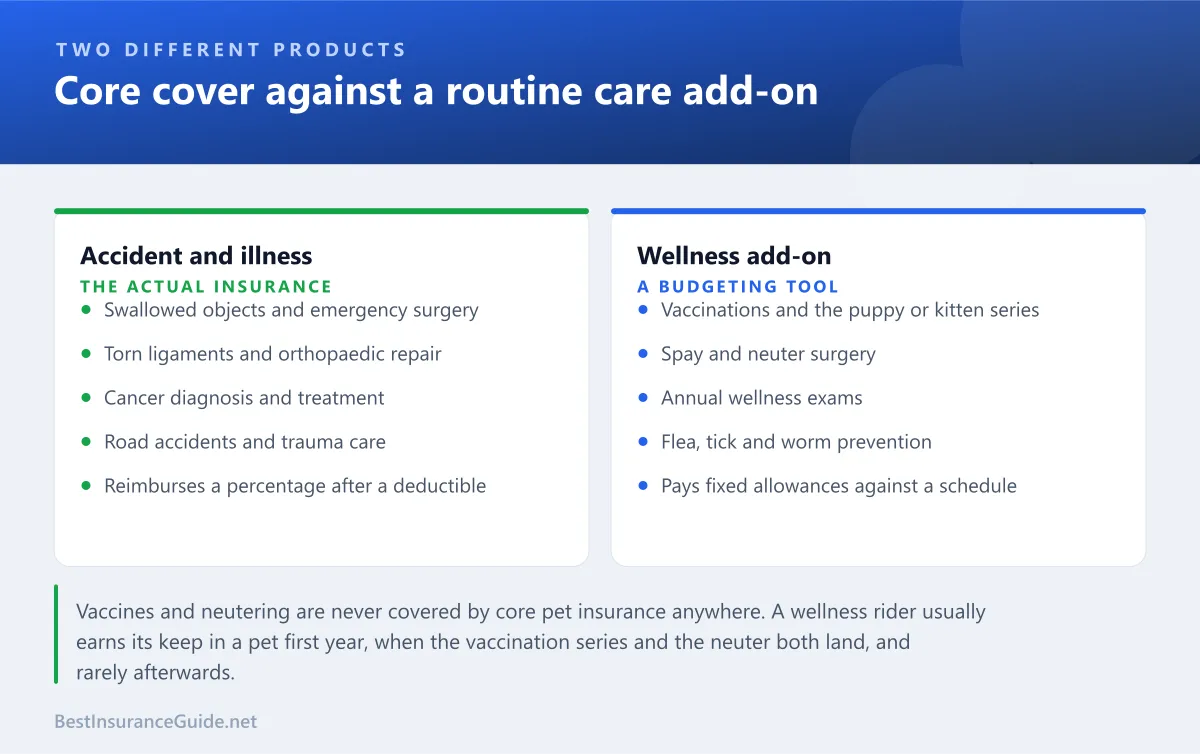
What you can buy is a wellness or routine care add-on. Most major insurers sell one. It works differently from the main policy: instead of reimbursing a percentage after a deductible, it typically pays fixed allowances against a schedule.
Worked example: does a wellness add-on pay for itself?
A puppy’s first year, with a routine care rider carrying an annual allowance.
| Routine item | Typical cost | Allowance paid |
|---|---|---|
| Core vaccination series | $180 | $180 |
| Annual wellness exam | $75 | $50 |
| Neuter surgery | $420 | $150 |
| Flea, tick and worm prevention | $260 | $100 |
| Microchip | $50 | $25 |
| Total | $985 | $505 |
| Cost of the rider for the year | $240 | |
| Net benefit | $265 |
In a puppy’s first year, when the vaccination series and the neuter both land, a wellness rider often comes out ahead. In year four, when the same pet needs one exam and a booster, it usually does not.
That is the honest shape of it: routine care riders are a budgeting tool rather than insurance. They smooth a predictable cost and take a margin for doing so. If you would struggle to find $900 in a puppy’s first year, the rider has real value. If you would not, put the money aside instead and keep the accident and illness policy, which is the part that covers the $7,000 surprise.
Our pet insurance cost guide works through the lifetime numbers on the core policy, including how premiums climb as a pet ages.
Quoting properly across states
Pet insurance quotes are unusually easy to compare, because there are only four variables that matter and every insurer exposes all four.
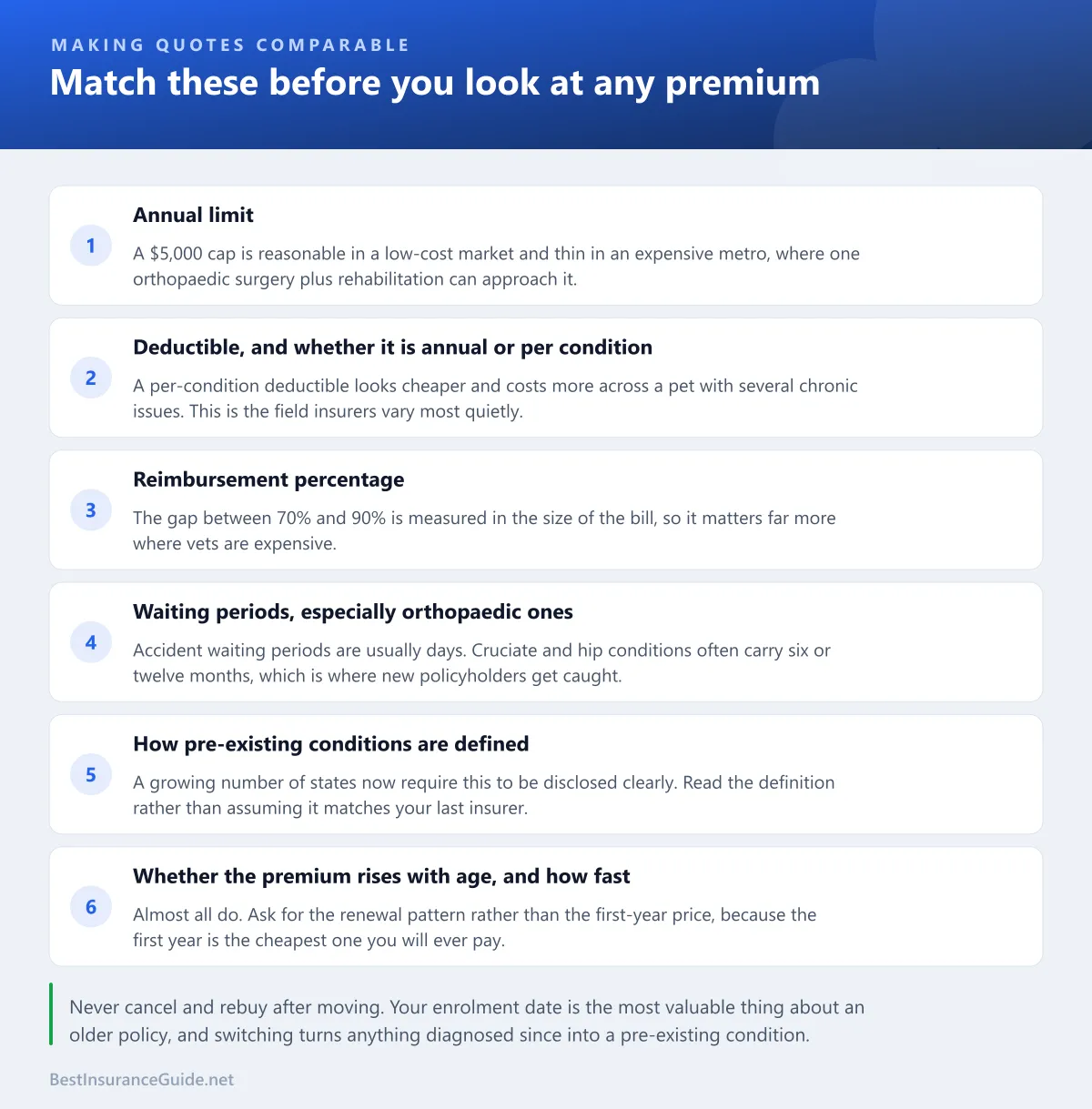
Match those four and the premiums become comparable. Leave them unmatched and you are comparing nothing at all, which is the same problem that ruins most insurance shopping. Our guide to comparing insurance quotes the right way covers the general version of this discipline.
Two state-specific notes.
Reimbursement percentage matters more in expensive markets. As the worked example above shows, the gap between 70% and 90% is measured in the size of the bill, and the bills are bigger in high-cost states. In Connecticut or Washington, paying a little more for 90% is usually the better trade. In a lower-cost market, 80% is often enough.
Annual limits bite sooner where care costs more. A $5,000 annual cap is a reasonable policy in a cheap market and a thin one in an expensive metro, where a single orthopaedic surgery plus rehabilitation can approach it. Unlimited or high-limit policies are worth more in high-cost states than the premium difference suggests.
If you move
Tell your insurer. Premiums are rated on your address, and moving from rural Georgia to Seattle will change the price at renewal whether or not you mention it.
The upside is that your policy travels with you and, crucially, so does your pet’s enrolment date. Cancelling and rebuying with a new insurer after a move resets waiting periods and, far worse, turns anything diagnosed in the meantime into a pre-existing condition. Continuity is the single most valuable thing about a pet policy you have held for years, and it is easy to throw away by shopping at the wrong moment.
The short version
Pet insurance premiums track local veterinary costs, so the same policy for the same pet costs materially different amounts in Oregon, Minnesota, Arizona, Utah, Virginia, Maine or Michigan. That is a pricing difference, not a coverage difference.
Vaccines and neutering are not covered by core pet insurance anywhere. A wellness add-on covers them against fixed allowances, and it earns its keep mostly in a pet’s first year.
When you quote, match the annual limit, deductible, reimbursement percentage and waiting periods first. Lean toward a higher reimbursement percentage and a higher annual cap if you live somewhere vets are expensive, because that is exactly where a thin policy fails.
For the full cost picture over a pet’s lifetime, including what premiums do as a dog or cat ages, read our pet insurance cost guide.