Pet Insurance in Utah: Cheatgrass, Altitude and Very Active Dogs
Pet insurance in Utah: low tick and heartworm burden, high orthopaedic and foxtail claim rates. Why the orthopaedic waiting period matters most here.

Table of contents

Utah reverses the usual pet insurance story. In most of the country the recurring risks are parasites and the diseases they carry. In Utah they are seeds and impact injuries.
What sets the price
Pet insurance reimburses a share of your actual vet bill, so premiums follow local veterinary pricing.
The Wasatch Front is the expensive end. Salt Lake City, Provo and Ogden carry higher clinic overheads and hold most of the state’s emergency and specialist capacity. Where referral care is available, more cases escalate to it.
Rural Utah and St George quote lower, tracking local practice pricing, with the trade being longer drives to referral care.
Utah has no long-established veterinary teaching hospital of its own in the way neighbouring states do, and complex cases are sometimes referred out of state. That travel is not covered by any pet insurance policy, which is worth budgeting for separately.
Our pet insurance by state guide covers why the ZIP code rather than the state line is the real rating factor.
The good news: a light parasite burden
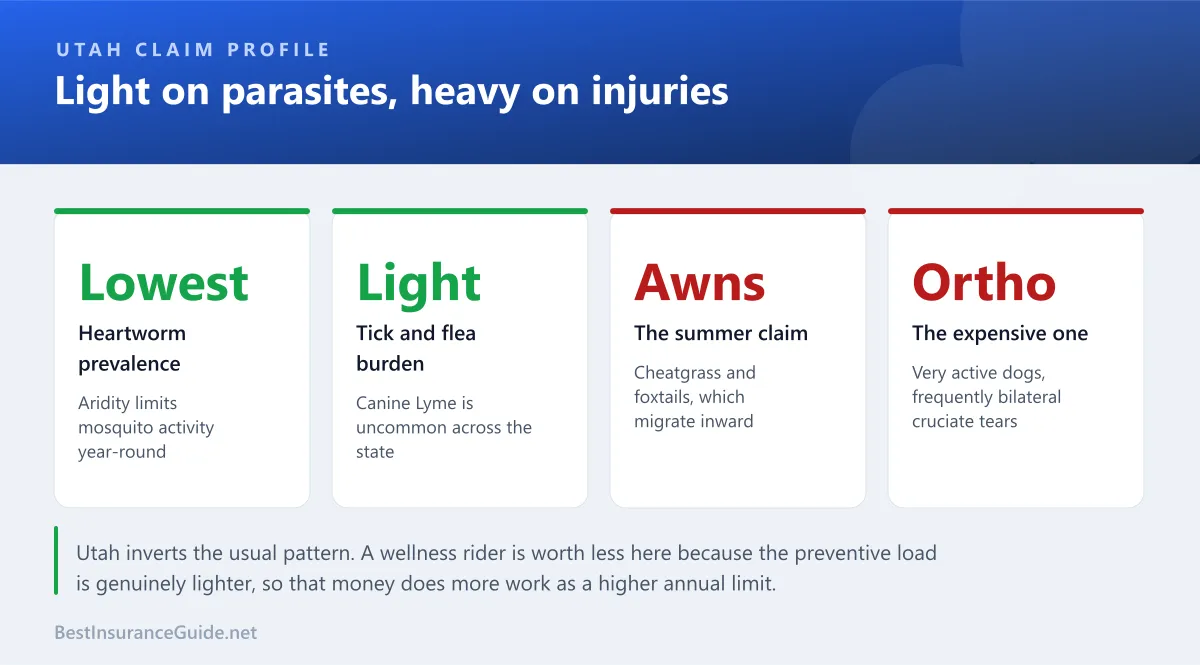
Utah’s dry climate genuinely works in your favour, and it is worth stating because it changes what a policy is for here.
Heartworm prevalence is among the lowest in the country. Mosquito activity is limited by the aridity. Prevention is still commonly recommended, particularly for dogs that travel to other states, but the local risk is real and low rather than real and high.
Tick burden is light relative to the Northeast, upper Midwest and South. Canine Lyme disease is uncommon in Utah. Rocky Mountain spotted fever and tick paralysis do occur, particularly at higher elevations and in brushy country, and both are covered as illness.
Flea pressure is lower than in humid states, which means chronic flea allergy dermatitis, the defining chronic claim of the South, is a smaller factor here.
The practical consequence: a wellness rider is worth less in Utah than in most states, because the preventive load it reimburses is lighter. That money is better spent on a higher annual limit or a better reimbursement percentage.
The bad news: awns and impact injuries
Cheatgrass and foxtails are the defining Utah summer claim. Grass awns lodge in paws, ears, noses and eyes, and they migrate. The barbed structure means they travel one direction only, inward, and an awn that is not found early can end up in the chest or abdomen.
The cost range on this is enormous and the outcome is largely luck.
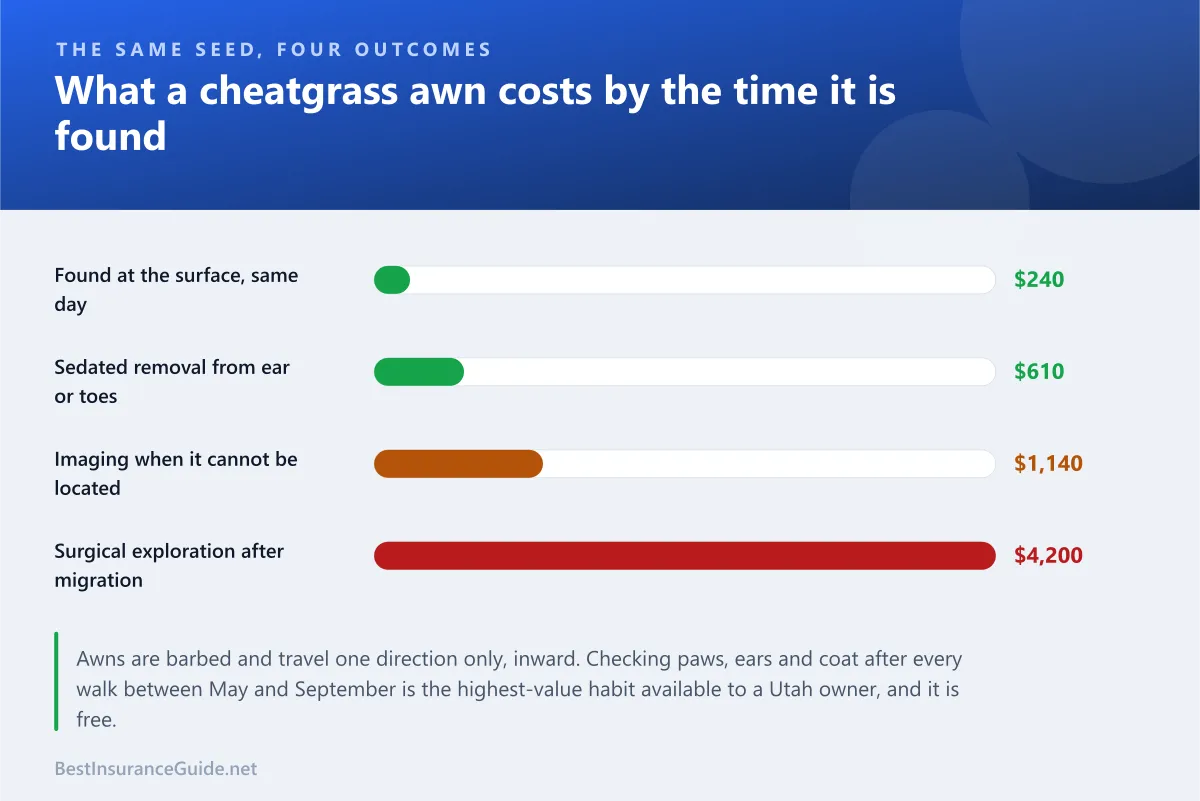
| Scenario | Typical cost |
|---|---|
| Found and removed at the surface, same day | $240 |
| Sedated removal from an ear or between toes | $610 |
| Imaging when the awn cannot be located | $1,140 |
| Surgical exploration after internal migration | $4,200 |
You do not get to choose which version arrives. Checking paws, ears and coat after every walk between May and September is genuinely the highest-value habit available to a Utah dog owner, and it is free.
Orthopaedic injuries are the other half. Utah dogs hike, run trails, ski-tour, chase things at altitude and jump off rocks. Cranial cruciate ligament tears, fractures and soft tissue injuries are over-represented here relative to more sedentary states.
This makes one policy term more important in Utah than any other: the orthopaedic waiting period. Many insurers apply six or twelve months to cruciate and hip conditions rather than the few days that cover ordinary accidents. In a state where those injuries are among the most likely claims, a twelve-month exclusion is a substantial hole.
Ask about it explicitly, and ask whether a clean veterinary examination within a set window of enrolling can shorten or waive it. Several insurers will, and almost nobody is told this unprompted.
Worked example: a cruciate repair on the Wasatch Front
A four-year-old shepherd mix tears a cruciate ligament on a trail. Policy: $500 annual deductible, 80% reimbursement, $10,000 annual limit.
| Item | Cost |
|---|---|
| Emergency exam and initial imaging | $540 |
| Orthopaedic specialist consultation | $190 |
| TPLO surgery | $4,700 |
| Post-operative medication and recheck imaging | $470 |
| Rehabilitation, eight sessions | $920 |
| Total | $6,820 |
| Less deductible | $500 |
| Reimbursed at 80% | $5,056 |
| Owner pays | $1,764 |
Two things to take from that. A $5,000 annual cap would have been exhausted before rehabilitation began. And rehabilitation is excluded or sublimited by a meaningful number of policies, so confirm whether yours treats it as covered treatment.
One further Utah point: cruciate tears are frequently bilateral. If one goes, the other often follows. Some insurers treat the second knee as the same pre-existing condition and decline it, which in this state is a genuinely large exclusion. Ask about the bilateral clause before you buy.
The rest of the profile
Rattlesnake bites at lower elevations and across southern Utah. Antivenom is expensive and treatment is an emergency admission. Covered; the vaccine is not.
Heat injury in St George and the southern desert, and in the Salt Lake valley in high summer. Covered as illness.
Altitude and exertion. Dogs new to elevation can struggle, and exertional injuries on long trail days are common.
Wildlife encounters. Porcupine quills, skunk and, at elevation, larger wildlife.
Foreign body ingestion, the most common expensive emergency nationally.
How to buy in Utah
Match four fields before comparing any premium: the annual limit, the deductible and whether it is annual or per condition, the reimbursement percentage, and the waiting periods.
Four Utah leanings.
The orthopaedic waiting period is the term that matters most. Ask whether an exam can shorten it.
Ask about the bilateral clause. Cruciate tears frequently affect both knees.
Confirm rehabilitation is covered. It is standard in orthopaedic recovery and commonly sublimited.
Spend less on a wellness rider and more on the limit. Utah’s light preventive load makes the rider poor value relative to other states, and a higher annual cap is where the money does more work.
Regulation
Pet insurance in Utah is regulated by the Utah Insurance Department as a property and casualty line rather than as health insurance. That is why it reimburses rather than operating a network, so any licensed vet works, including out-of-state referral centres.
A growing number of states have adopted rules based on the NAIC Pet Insurance Model Act, standardising disclosure of waiting periods, pre-existing condition definitions and exam requirements. Check the Department’s current position rather than assuming.
Read the pre-existing condition definition yourself in any case. In a state where the dominant claims are orthopaedic, pay particular attention to how early lameness is treated.
The mistakes that cost Utah owners money
Insuring after the first limp. An intermittent lameness noted at nine months can exclude cruciate cover for life. Enrol before anything reaches the clinical notes.
Buying in May. Awn season is already running and waiting periods are not. Enrol in winter if you have the choice.
Taking a $5,000 annual limit. One orthopaedic event with rehabilitation approaches it.
Not asking about rehabilitation or the bilateral clause. Both are decisive here and neither is volunteered.
Overbuying the wellness rider. Utah’s preventive load is genuinely lighter than most states, and the rider reflects that poorly.
Cancelling as premiums rise with age. Raise the deductible or lower the reimbursement percentage instead; both preserve the enrolment date.
A note on the figures
Premiums and treatment costs here are illustrative, drawn from typical ranges rather than any single insurer’s rate filing. Actual pricing depends on your ZIP code, the species, breed and age of the animal, and the limits chosen, and veterinary charges differ meaningfully between the Wasatch Front and rural practice. Quote your own circumstances and read the policy wording rather than the summary.
Cats, and dogs that travel
Cats cost substantially less to insure than Utah’s very active dog population, and their expensive claims are different: urinary blockage, chronic kidney disease in older cats, hyperthyroidism, dental disease and foreign body ingestion.
Utah’s dry climate helps cats too. Flea burdens are lighter than in humid states, which reduces one of the more common chronic feline claims. Indoor cats in the Salt Lake valley are cheap to insure and still worth insuring, because a male cat with a urinary blockage is a sudden emergency with a four-figure bill.
Dogs that travel are the Utah-specific consideration. A large share of Utah dogs go on road trips, and leaving the state changes the risk profile substantially. A dog that spends two weeks a year in California, Arizona or the Pacific Northwest is exposed to heartworm, tick species and diseases that are genuinely rare at home.
Two practical consequences. Heartworm prevention is worth maintaining even though local prevalence is low, because the exposure travels with the dog. And your policy follows the animal anywhere in the United States, so treatment received out of state is covered exactly as it would be at home; there is no network to worry about.
If you travel with a dog regularly, keep a copy of the policy details and the insurer’s claim process accessible on your phone. Claims are reimbursement-based, so you pay the out-of-state clinic and claim afterwards, which means you need the funds available at the point of treatment.
Questions worth asking a Utah insurer
Five questions, in the order they matter here.
What is the orthopaedic waiting period, and will a clean vet exam shorten it? The single most important term in a Utah policy.
How are bilateral conditions treated? Cruciate tears frequently affect both knees, and some insurers decline the second as the same pre-existing condition.
Is rehabilitation covered, and is it sublimited? Hydrotherapy and physiotherapy are standard in orthopaedic recovery and commonly restricted.
Is the deductible annual or per condition?
Are exam fees reimbursed?
A note on the figures
Premiums and treatment costs here are illustrative, drawn from typical ranges rather than any single insurer’s rate filing. Actual pricing depends on your ZIP code, the species, breed and age of the animal, and the limits chosen, and charges differ meaningfully between the Wasatch Front and rural practice. Quote your own circumstances and read the policy wording rather than the summary.
Multi-pet households
Multi-pet discounts of roughly five to ten per cent per additional animal are common. Ask for it, but do not choose an insurer on it and never delay an enrolment to arrange one.
Enrol each animal early. In Utah the specific risk of waiting is orthopaedic: an intermittent lameness noted in a young dog’s records before enrolment can exclude cruciate cover for the rest of its life, and that is the most likely expensive claim in the state.
Comparable states
Utah’s low parasite burden against a high injury rate is the dry-west pattern. Arizona shares it and adds Valley fever, and Colorado shares the altitude and outdoor injury profile with a considerably more expensive vet market.
The short version
Utah inverts the usual pattern. The parasite burden that dominates most states is genuinely light here, which makes a wellness rider poorer value than elsewhere. What replaces it is grass awns and impact injuries from an unusually active dog population.
That points at one term above all others: the orthopaedic waiting period, commonly six or twelve months on cruciate and hip conditions. Ask whether an exam can shorten it, ask about the bilateral clause, and confirm rehabilitation is covered.
Then buy a higher annual limit rather than a wellness rider, and check your dog’s paws and ears after every summer walk.
For lifetime costs and how premiums climb with age, see the pet insurance cost guide.