Pet Insurance in Connecticut: Tick Country and High Vet Costs
Pet insurance in Connecticut costs above the national norm because vet prices and tick-borne disease rates are both high. What to compare before buying.

Table of contents

Connecticut is an unusually clear case for pet insurance, and also one of the more expensive places to buy it. Both facts have the same cause.
Why the premium is high here
Pet insurance reimburses a percentage of a bill that has not happened yet. The size of that expected bill is local, and Connecticut’s is large for two independent reasons.
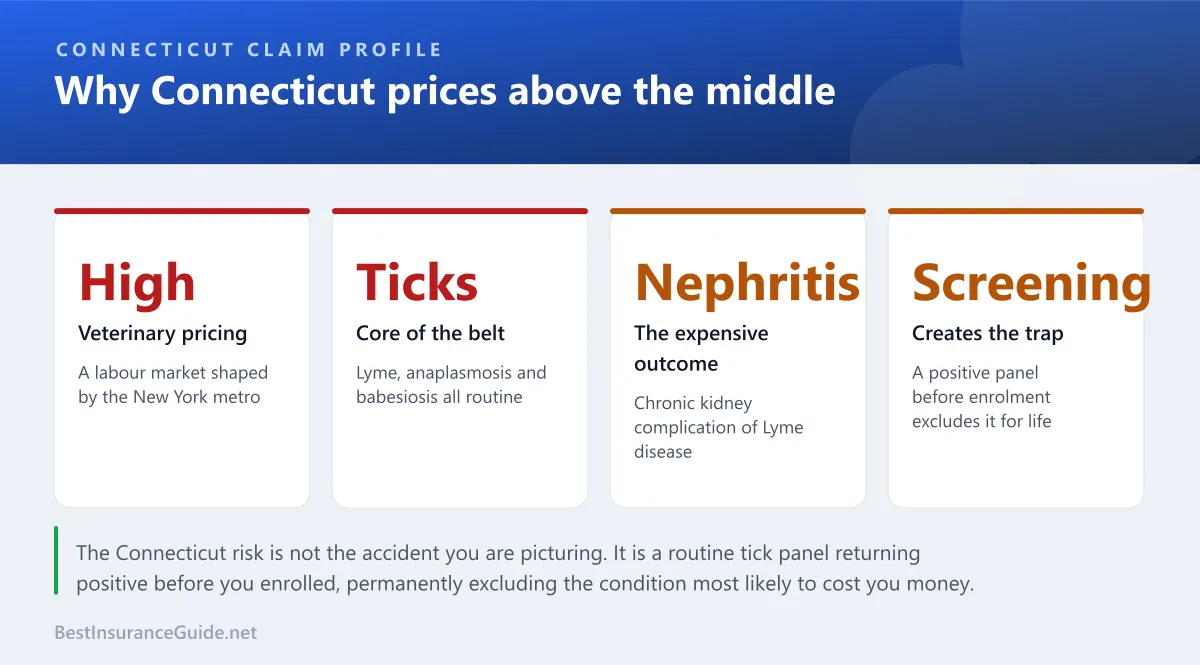
Veterinary pricing. Connecticut clinics compete for staff in a labour market shaped by the New York metro. Overheads and salaries run high, and Fairfield County in particular prices well above the state average. Quote the same dog in Greenwich and in the Quiet Corner and the numbers will differ noticeably.
Claim frequency. This is the part specific to Connecticut, and it is not marginal.
The tick problem
Lyme disease is named after Lyme, Connecticut. The state sits in the core of the Northeast tick belt, and canine exposure here is not an outdoors-adventure risk. It is a walking-in-the-garden risk.
Three things follow for anyone insuring a dog in Connecticut.
Tick-borne illness is common and it recurs. Lyme, anaplasmosis and babesiosis all appear regularly. Treatment for an acute case is usually manageable, but Lyme can progress to Lyme nephritis, a kidney complication that is genuinely serious, expensive to manage and sometimes fatal. That is the claim that justifies the policy.
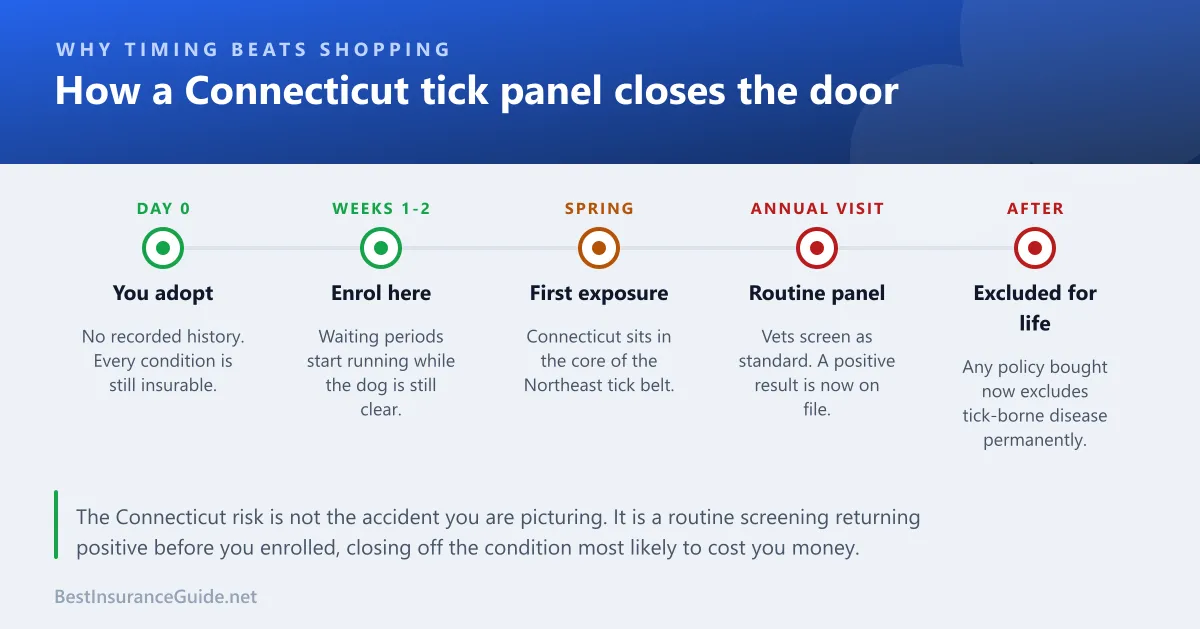
Testing is routine, which creates a pre-existing condition trap. Connecticut vets screen for tick-borne disease as a matter of course at annual visits. A dog that tests positive before you enrol has a documented pre-existing condition, and future treatment for it is excluded permanently by essentially every insurer.
This is the most important sentence in this article: in Connecticut, the cost of waiting to insure is not just the risk of an accident in the meantime. It is the substantial likelihood that a routine screening turns up a positive result and closes that door for the life of the dog.
Prevention is a wellness item, not covered treatment. Year-round tick preventives, the Lyme vaccine and annual screening are preventive care. Core insurance does not pay for them. A wellness rider does, against fixed allowances.
Worked example: Lyme nephritis in a five-year-old dog
Policy: $500 annual deductible, 80% reimbursement, $10,000 annual limit.
| Item | Cost |
|---|---|
| Initial workup, bloods and urinalysis | $640 |
| Tick panel and follow-up testing | $310 |
| Hospitalisation, four days with IV fluids | $3,200 |
| Internal medicine specialist consultation | $290 |
| Ongoing renal medication and diet, first year | $1,450 |
| Quarterly monitoring bloods | $780 |
| Total, first year | $6,670 |
| Less deductible | $500 |
| Reimbursed at 80% | $4,936 |
| Owner pays | $1,734 |
Note the shape of this claim: it is chronic rather than a single event. That has two implications for how you buy.
A per-condition deductible is worse than an annual one here. Chronic conditions that persist across policy years re-trigger a per-condition deductible each year in some designs. Read which type you are being sold.
Check the annual limit against ongoing management, not just the initial episode. Renal management continues, and a low cap that survives year one may not survive year three.
Other Connecticut claim patterns
Seasonal allergies and skin disease. New England humidity and a long pollen season make dermatology a recurring cost. Skin conditions are among the most common claims nationally and Connecticut is no exception.
Antifreeze and winter hazards. Ethylene glycol poisoning is a genuine winter emergency, and ice-melt products cause paw irritation and gastrointestinal upset when licked off.
Wildlife and outdoor exposure. Porcupine quills, skunk encounters and, in more rural areas, coyote injuries.
Foreign body ingestion. Not regional, but the single most common expensive emergency nationally, and worth remembering when setting limits.
What to compare before buying
Match the annual limit, the deductible and its type, the reimbursement percentage and the waiting periods across every quote before comparing price. Our pet insurance by state guide explains why these four decide almost everything.
Three Connecticut-specific leanings:
Take 90% reimbursement if you can. In a high-cost market the percentage matters more, because it is applied to bigger numbers. On the $6,670 claim above, the gap between 70% and 90% is over $1,200.
Prefer an annual deductible over a per-condition one. Chronic tick-borne complications are exactly the scenario where per-condition designs cost more over time.
Buy a high annual limit or an unlimited policy. Connecticut specialist care is expensive and chronic management accumulates.
Regulation
Pet insurance in Connecticut is overseen by the Connecticut Insurance Department as a property and casualty line, which is why it reimburses rather than operating a provider network. You can use any licensed vet.
Several states have adopted rules based on the NAIC Pet Insurance Model Act, standardising how waiting periods, pre-existing conditions and exam requirements must be disclosed. Adoption has moved quickly, so check the Department’s current position rather than assuming a specific protection is in force.
Whatever the regulatory position, read the pre-existing condition definition yourself. In a state where routine screening frequently produces positive results, that definition is doing more work than anywhere else in the contract.
If your dog has already tested positive
This is the situation a lot of Connecticut owners are actually in, and the honest answer is more nuanced than “you missed it.”
A positive titre is not automatically an excluded condition. Insurers distinguish between exposure and disease. Many Connecticut dogs carry antibodies from a past exposure that never caused illness and never required treatment. What matters is what is written in the clinical notes: a positive screening test with no symptoms and no treatment is a weaker basis for exclusion than a documented case of clinical Lyme disease.
Ask what the insurer will actually exclude, in writing, before you buy. Some will exclude tick-borne disease broadly. Some will exclude only the specific organism. Some will exclude nothing where there was no clinical illness. This varies more between insurers than almost any other underwriting question, and a broker who places these regularly will know which is which.
Curable conditions can come back onto cover. A number of insurers treat a resolved condition as insurable again after a symptom-free and treatment-free period, commonly twelve or eighteen months. That policy is not universal, and it usually excludes anything chronic, but for a single treated Lyme case that fully resolved it can matter enormously.
Everything else is still insurable. Even where tick-borne disease is excluded, the policy still covers foreign body surgery, cancer, orthopaedic injury, dental disease and every other claim. A Connecticut dog with a Lyme exclusion is still worth insuring, because the excluded condition is not the only expensive thing that can happen.
What prevention costs, and why it is not insurance
Connecticut owners spend more on tick prevention than owners almost anywhere else, and none of it is covered by a core policy.
| Preventive item | Typical annual cost |
|---|---|
| Year-round tick and flea preventive | $220 to $320 |
| Lyme vaccine, initial series then annual booster | $60 to $110 |
| Annual tick-borne disease screening panel | $50 to $90 |
| Total | $330 to $520 |
A wellness rider will reimburse part of that against fixed allowances. Whether it is worth buying comes down to arithmetic rather than principle: add the allowances your insurer publishes, subtract the rider premium, and buy it only if the result is positive for the care you would purchase anyway.
For most Connecticut owners the honest answer is that a rider roughly breaks even in a dog’s first year, when the puppy vaccination series and the neuter land alongside the tick preventives, and loses money thereafter. Our pet insurance by state guide sets out the same test in general terms.
The important thing is not to confuse the two products. The rider smooths a predictable few hundred dollars. The policy underneath it exists for the $6,000 year.
The mistakes that cost Connecticut owners money
Enrolling after the annual exam rather than before it. The single most expensive scheduling error available in this state.
Choosing a per-condition deductible because the premium looked lower. Tick complications and kidney disease are chronic. A per-condition deductible re-applies in ways an annual one does not, and by year three the cheaper policy has cost more.
Buying a $5,000 annual cap in Fairfield County. Local specialist pricing will find the top of that number faster than owners expect.
Assuming prescription diets are covered. Renal and urinary diets are a real ongoing cost in chronic cases, and many policies exclude food entirely or treat it as a wellness item. Ask specifically.
Letting an old policy lapse to save money. Your enrolment date is the asset. Lowering the reimbursement percentage or raising the deductible at renewal keeps it; cancelling destroys it permanently.
Cats, and the quieter Connecticut risks
Most of this article is about dogs, because dogs are the animals walking through tick habitat. Cats in Connecticut are cheaper to insure, often substantially, and their expensive claims look different: urinary blockage, chronic kidney disease in older cats, hyperthyroidism, dental disease and foreign body ingestion.
Outdoor cats in Connecticut do carry tick exposure, and they also carry trauma risk from vehicles and wildlife. Indoor cats avoid most of that, but a male cat with a urinary blockage is a genuine emergency with a four-figure bill and no warning, which is reason enough to insure one.
Multi-pet discounts are commonly available in the region of five to ten per cent per additional animal. Worth asking for, not worth switching insurer over.
Getting the quote right
Connecticut quotes move enough between insurers that shopping genuinely pays, but only if you are comparing the same thing.
Get three quotes at an identical annual limit, an identical annual deductible, an identical reimbursement percentage and the same species, breed and age. Then read the four things that are not on the quote page: the pre-existing condition definition, the orthopaedic waiting period, whether exam fees are reimbursed, and whether a chronic condition continues to be covered at each renewal.
Exam fees deserve particular attention here. A dog being monitored for tick-borne disease will rack up a lot of consultations, and insurers split roughly evenly on whether the consultation itself is reimbursable or only the diagnostics and treatment inside it. Across three years of monitoring that difference runs to several hundred dollars.
One last Connecticut-specific point. If you are moving into the state with an already-insured dog, do not switch insurers to get a better local price. Tell your existing insurer the new address and let them re-rate you. The premium will rise, because Connecticut vet costs are higher than most places, but you keep the enrolment date and every condition that has developed since you first enrolled stays covered. Switching converts all of it into pre-existing history on day one.
Comparable states
Connecticut sits in the core of the northeastern tick belt, and its neighbours share the problem. Maine carries comparable canine Lyme exposure with far less referral access, and Michigan and Minnesota show the same tick pressure against different vet markets and harder winters.
The short version
Connecticut is an expensive place to insure a pet, because vet pricing is high and tick-borne disease is common. Those same facts are the argument for insuring at all, and for insuring early.
The specific Connecticut risk is not the accident you are imagining. It is a routine tick panel coming back positive before you enrolled, permanently excluding the condition most likely to cost you money.
Buy a high annual limit, take the higher reimbursement percentage, choose an annual deductible over a per-condition one, and enrol before the first tick season rather than after it.
For lifetime cost expectations, see the pet insurance cost guide.