Pet Insurance for Rabbits: A Thin Market for an Expensive Animal
Rabbit insurance is a thin US market. What exotic policies cover, why GI stasis and dental disease dominate claims, and finding a rabbit-savvy vet.

Table of contents
Rabbits are the third most common companion animal in many households and close to invisible in the insurance market. That gap matters, because rabbits generate emergencies that arrive fast and cost real money.
The market is genuinely thin
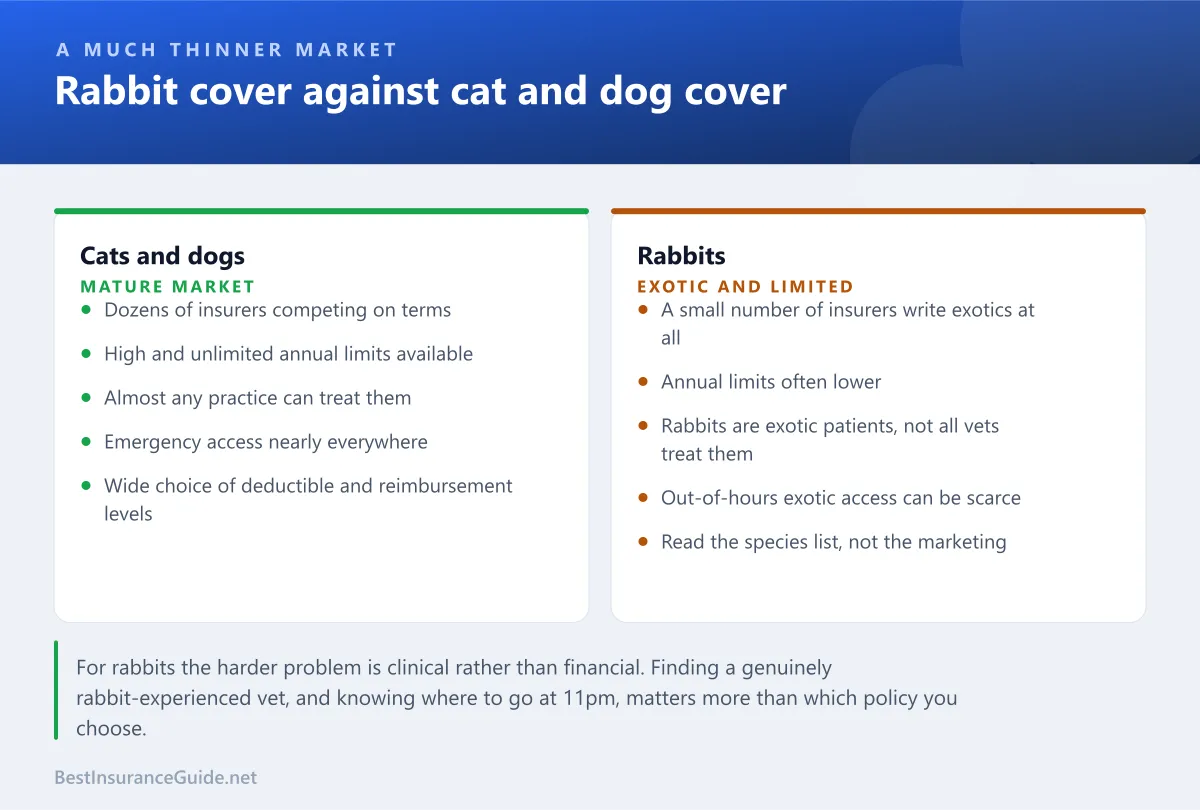
Most mainstream pet insurers in the United States write cats and dogs only. A small number offer exotic or small mammal cover that includes rabbits, and availability varies by state.
That has three consequences worth knowing before you start quoting.
Fewer options means less competition on terms. The spread between the available policies is wider than it is for cats and dogs, and you cannot assume the features you would expect from a mainstream dog policy are present.
Annual limits are often lower. Exotic policies frequently cap at levels below what a comparable dog policy would offer, which matters because rabbit surgery is not cheap.
Read the species list, not the marketing. Some policies described as covering exotics cover birds and reptiles but not rabbits, or cover rabbits only in certain states.
What rabbits actually claim for
The claim profile is genuinely different from cats and dogs, and it is dominated by two conditions.
Gastrointestinal stasis is the defining rabbit emergency. The digestive system slows or stops, and because rabbits cannot vomit and depend on continuous gut movement, it becomes life-threatening quickly. It is frequently secondary to something else: pain, dental disease, stress, dehydration or a diet with too little fibre.
A rabbit that stops eating or stops producing droppings is an emergency the same day, not the next morning. That is the single most important sentence in this article.
Dental disease is the other. Rabbit teeth grow continuously throughout life, and they are worn down by chewing fibrous food. Malocclusion, insufficient hay in the diet, or an injury can lead to overgrowth, sharp spurs that lacerate the cheek and tongue, and tooth root abscesses. Treatment usually means burring under anaesthesia, and it frequently recurs on a schedule for the rest of the animal’s life.
That recurrence is the reason the deductible type matters more for rabbits than for most species. An annual deductible handles a condition needing three procedures a year far better than a per-condition design.
Uterine adenocarcinoma in unspayed females is common enough that spaying is standard veterinary advice. The surgery is elective and therefore not covered; the cancer it prevents would be. That is the same trade as pyometra in dogs, covered in our guide to pet insurance that covers neutering.
Encephalitozoon cuniculi, a parasite that can cause neurological signs including head tilt, and which many rabbits carry asymptomatically.
Respiratory infection, often referred to as snuffles, which can become chronic.
Flystrike, a genuine emergency in warm weather where flies lay eggs on a soiled or immobile rabbit. It progresses within hours and is frequently fatal.
Fractures, because rabbit skeletons are light relative to their muscle mass and a struggling rabbit can injure its own spine.
Worked example: GI stasis with a dental cause
A four-year-old rabbit stops eating. Investigation finds dental spurs as the underlying trigger.
Policy: $250 annual deductible, 80% reimbursement, $5,000 annual limit.
| Item | Cost |
|---|---|
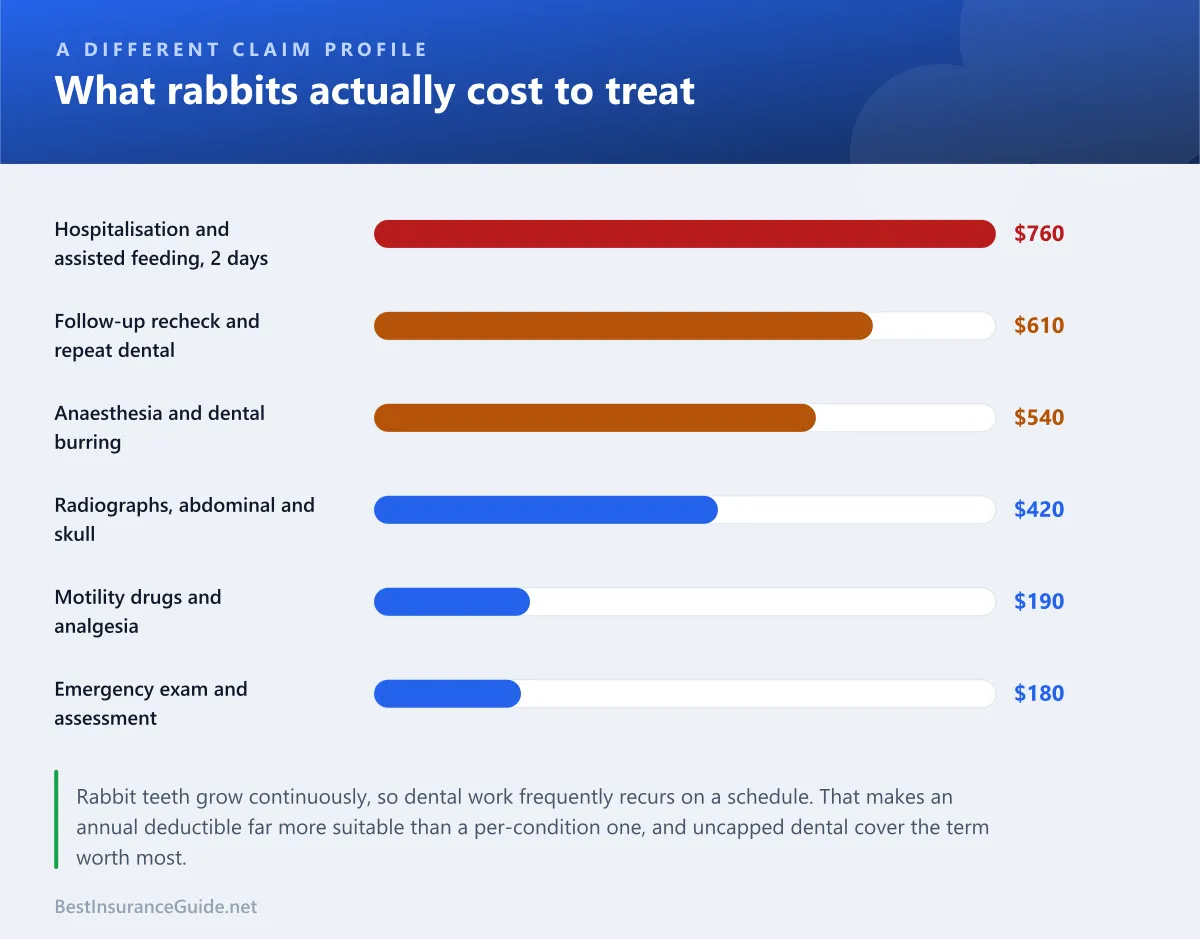
| Emergency exam and assessment | $180 |
| Radiographs, abdominal and skull | $420 |
| Hospitalisation, fluids and assisted feeding, two days | $760 |
| Anaesthesia and dental burring | $540 |
| Motility drugs and analgesia | $190 |
| Follow-up recheck and repeat dental in six months | $610 |
| Total | $2,700 |
| Less deductible | $250 |
| Reimbursed at 80% | $1,960 |
| Owner pays | $740 |
That is a substantial bill for a small animal, and it illustrates why the “rabbits are cheap pets” assumption fails. The dental element will also recur, which is where the annual limit and deductible structure earn their keep.
The bigger problem is finding a vet
For rabbits, this genuinely outranks the insurance question.
Rabbits are exotic patients. Not every veterinary practice treats them, and competence varies more than it does with cats and dogs. Rabbit anaesthesia carries higher risk and requires species-specific protocols. Drug choices differ, and several antibiotics that are routine in dogs are dangerous in rabbits.
Two practical consequences.
Find a rabbit-experienced vet before you need one. Ask specifically how many rabbits the practice sees, whether they anaesthetise rabbits routinely, and who covers out of hours. House Rabbit Society chapters and rabbit rescues maintain local recommendations and are worth asking.
Check emergency access. A general emergency clinic may stabilise a rabbit but may not have rabbit-experienced staff overnight. Knowing where to drive at 11pm is worth more than a slightly better policy.
Insurance reimburses whichever licensed vet you use, so there is no network to worry about. The constraint is clinical availability, not coverage.
Is a policy worth it for a rabbit?
The honest answer is that it is closer than for dogs, and it depends on three things.
The annual limit on offer. If the available exotic policies cap at a level barely above one serious episode, the protection is thinner than it looks.
Your local exotic vet pricing. Exotic consultations frequently cost more than standard small animal appointments, and referral options are limited.
Whether you would genuinely maintain a savings fund. For a healthy young rabbit, setting aside the premium can work. The test is whether the money would actually stay untouched, and whether you could absorb a $2,700 week before the fund had grown.
Two situations tilt clearly toward insuring. A rabbit with known dental issues faces recurring predictable costs, though be aware that anything already recorded is pre-existing and excluded. And a household with multiple rabbits faces multiplied exposure, since GI stasis and dental disease are not contagious but do arrive independently.
Buying well
The same four fields decide value here as anywhere: the annual limit, the deductible and whether it is annual or per condition, the reimbursement percentage, and the waiting periods.
Four rabbit-specific questions on top.
Is dental disease covered, and is it capped? This is the most important question for a rabbit policy. Some exotic policies sublimit dental or exclude recurring dental work.
Is the deductible annual rather than per condition? Recurring dental makes this decisive.
Are exotic consultation fees reimbursed? They are higher than standard fees and some policies cap the exam element.
What is the upper age limit for new policies? Rabbits live eight to twelve years with good care, and exotic policies sometimes cap enrolment earlier than dog policies do.
Enrol young, before anything reaches the clinical record. As with every species, the enrolment date is the most valuable thing about the policy.
Prevention that genuinely reduces claims
More than with dogs, rabbit health is driven by husbandry, and most of it is free.
Unlimited good hay is the single biggest factor. It wears the teeth and keeps the gut moving, which addresses both dominant claim categories at once.
Limited pellets and appropriate greens, rather than a muesli-style mix, which encourages selective feeding and dental problems.
Check for soiling daily in warm weather, because flystrike develops within hours.
Spay females, on veterinary advice, for the uterine cancer risk.
Watch appetite and droppings every day. A rabbit that has not eaten or produced droppings for twelve hours needs a vet, not observation.
The short version
Rabbit insurance exists but the US market is thin, annual limits are often lower, and not every policy described as exotic actually includes rabbits. Read the species list and the limits before comparing prices.
The claim profile is dominated by GI stasis and dental disease, both of which can recur, which makes an annual deductible and uncapped dental cover the two terms worth most.
The harder problem is clinical rather than financial: find a genuinely rabbit-experienced vet, and know where to go out of hours, before you need either.
And feed unlimited hay. It addresses the two most common claim categories more effectively than any policy does.
For how limits and deductibles interact generally, see the pet insurance cost guide.
Other small pets, briefly
Owners searching for rabbit cover are frequently asking about other small mammals too, and the position is broadly similar but thinner again.
Guinea pigs, ferrets, rats and chinchillas are covered by some exotic policies and excluded by others. Ferrets in particular have well-documented health issues, including adrenal disease and insulinoma, which are expensive and common enough that some insurers restrict them.
Birds and reptiles are written by a small number of insurers and the terms vary widely.
Species lists change, and a policy that covered a species last year may not this year.
The general rule holds across all of them: the market is thin, limits are lower, and finding a genuinely competent exotic vet matters more than the policy. For animals with a short lifespan or low expected veterinary cost, a dedicated savings fund is frequently the more sensible arrangement.
Rabbit emergencies, and knowing what counts
Because rabbits deteriorate quickly and hide illness, recognising an emergency matters more than for cats and dogs.
Not eating, or no droppings, for twelve hours. This is the one. GI stasis progresses fast and a rabbit that has stopped passing droppings needs a vet the same day.
Smaller or misshapen droppings over a day or two, which frequently precedes full stasis.
Sitting hunched, pressing the abdomen to the floor, or grinding teeth loudly. All indicate pain.
Head tilt or loss of balance, which can indicate E. cuniculi or an inner ear problem.
Laboured breathing or discharge from the nose, which suggests respiratory infection.
Any soiling around the rear in warm weather. Check daily, because flystrike develops within hours and is frequently fatal.
Sudden lameness or dragging a limb, since rabbits can fracture their own spine when struggling.
None of these is a wait-and-see situation. A rabbit that looks unwell is usually considerably more unwell than it appears, which is a direct consequence of being a prey species.
Insuring a rabbit well, in order
Enrol young, before anything reaches the clinical record. Dental abnormalities in particular are frequently noted at a first health check.
Read the species list and the state availability before comparing anything else.
Prioritise uncapped dental cover and an annual deductible. Those two terms carry most of the value for a rabbit.
Check the annual limit against a realistic bad year. A GI stasis episode with dental work and follow-up can approach $3,000 on its own.
Ask about exotic consultation fees, which run higher than standard small animal appointments and are sometimes capped separately.
Confirm the upper age limit, since rabbits live eight to twelve years with good care and exotic policies sometimes cap enrolment earlier than dog policies do.
Related reading
Cat insurance covers the other alternative to insuring a dog, in a market with far more choice. Pet insurance that starts immediately covers the waiting period question, which in a thin exotic market is where the options differ most.
A note on scope
Availability of rabbit and exotic cover varies by insurer and by state and changes over time, and the figures here are illustrative ranges rather than any particular company’s schedule. Exotic veterinary pricing also varies widely by region and by practice.
Clinical guidance, including diet, spaying and emergency signs, is for a rabbit-experienced veterinarian rather than an article. This site is independent and not affiliated with any insurer.