Do Vets Take Payment Plans? Rarely, and Here Is What to Do Instead
Most vets no longer offer in-house payment plans. Why, which practices still do, and seven realistic options when you cannot pay a vet bill today.

Table of contents
The question gets asked at counters every day, usually at the worst possible moment, and the honest answer is not the one people hope for.
Most veterinary practices no longer offer in-house payment plans. Understanding why makes the alternatives easier to navigate, because several of them are genuinely better than the thing you were originally asking for.
Why in-house plans mostly disappeared
Three things changed.
Practices cannot fund receivables. A veterinary practice is a small business with thin margins, significant equipment costs and a payroll. Letting clients pay $200 a month against a $3,000 bill means the practice carries that cost while still paying its staff and suppliers. Very few can absorb it at scale.
Offering credit carries obligations. Lending money, even informally, brings regulatory, administrative and collections burdens that a clinical business is not built for. Chasing unpaid balances is expensive and unpleasant, and historically the write-off rate was high.
Consolidation removed discretion. A large and growing share of practices, particularly emergency and specialty hospitals, are corporate-owned with standardised payment policies. The individual vet who might once have said “settle it when you can” often no longer has that authority.
None of that is a moral failing. It is the economics of a small business that cannot also be a bank.
Who still offers something
Not universal, but not extinct either.
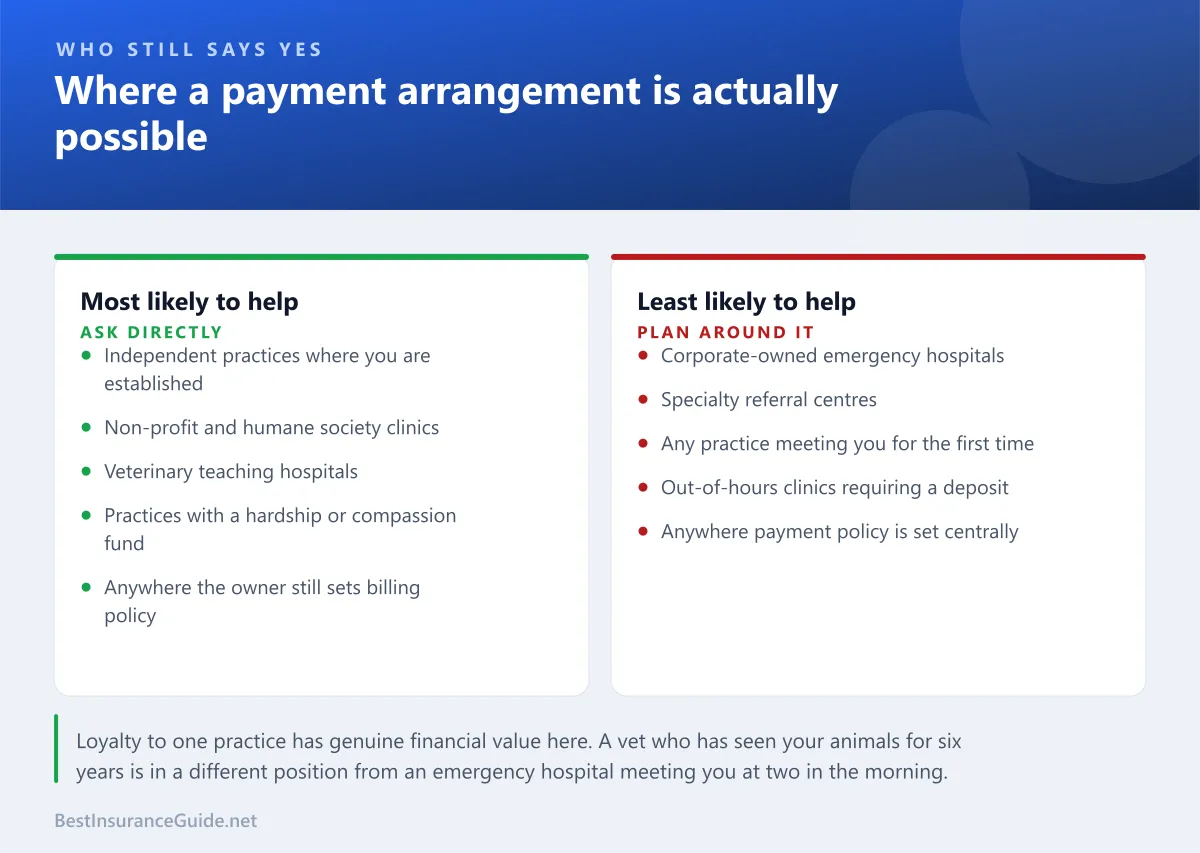
Independently owned practices where you are an established client. This is by far the most likely yes. A vet who has seen your animals for six years and knows you pay is in a different position from an emergency hospital meeting you at 2am. Loyalty to one practice has genuine financial value for exactly this reason.
Non-profit and humane society clinics. Many operate sliding-scale pricing or subsidised care, particularly for income-qualified clients, and their entire purpose is access.
Veterinary teaching hospitals. Some run assistance programmes or reduced-cost care through student clinics under supervision, and some have hardship funds.
Practices with a hardship or compassion fund. More common than people realise, usually funded by donations and not advertised. You have to ask.
Least likely: corporate-owned emergency and specialty hospitals, which typically require payment or approved financing before treatment begins.
How to ask, which matters
If you are going to ask, ask well. The approach changes the answer more than people expect.
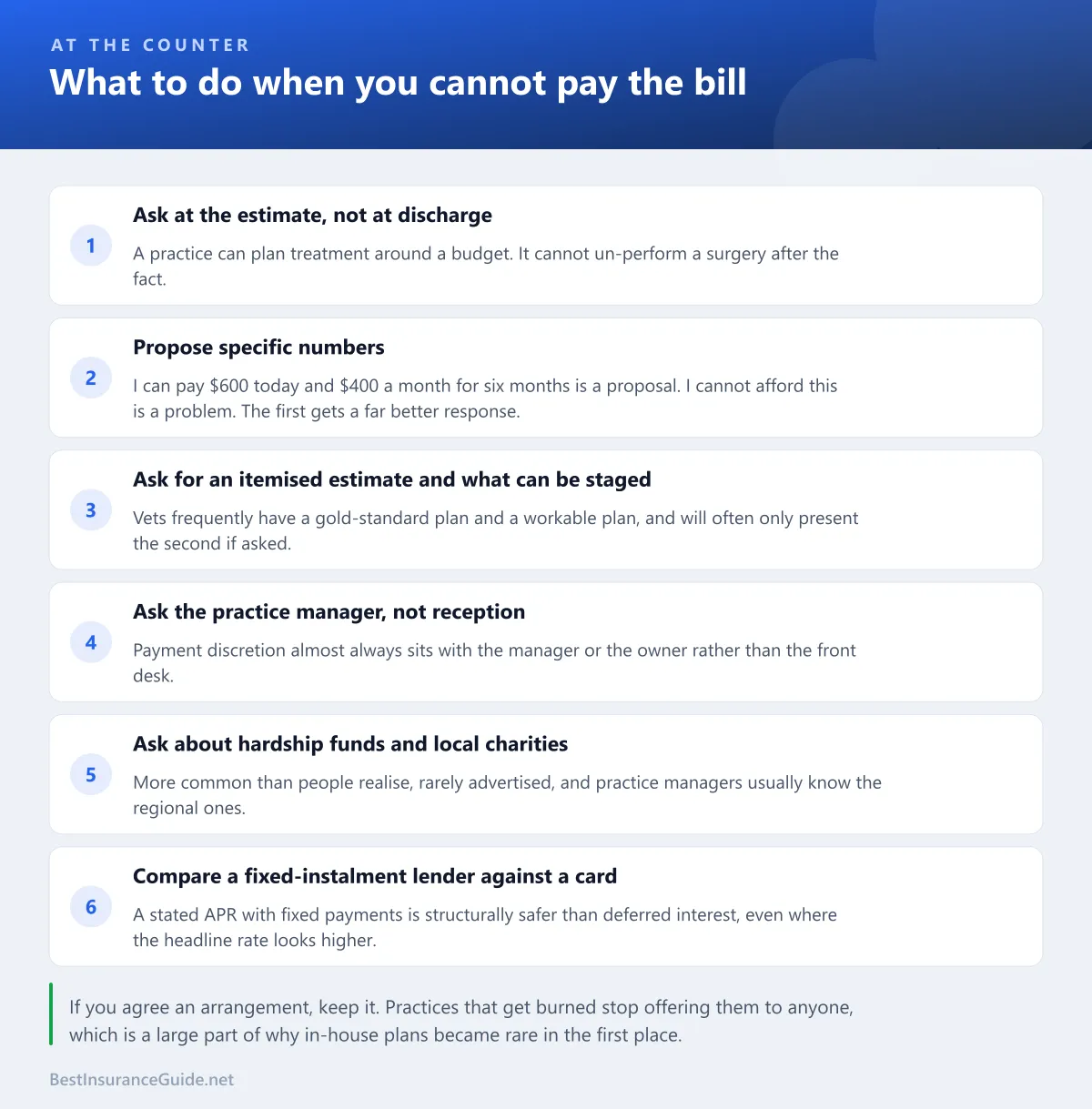
Ask early, not at discharge. Raise it when the estimate is produced, not after treatment is complete. A practice can plan around a budget; it cannot un-perform a surgery.
Be specific about what you can do. “I can pay $600 today and $400 a month for six months” is a proposal. “I can’t afford this” is a problem. Practices respond far better to the first.
Ask for an itemised estimate, and ask what is essential now versus what can be safely deferred or staged. Vets routinely have a gold-standard plan and a workable plan, and they will often only present the second if you ask.
Ask about the practice’s own options by name: hardship fund, staged treatment, payment arrangement, discount for immediate payment in full.
Ask the practice manager, not the receptionist. Payment discretion usually sits with the manager or owner.
Do not disappear. If you agree an arrangement, keep it. Practices that get burned stop offering them to anyone.
The seven realistic options
1. Ask for a staged treatment plan. Frequently the most useful and least used option. Diagnostics first, treatment decisions after, rather than committing to the whole pathway upfront. This is clinically legitimate in many cases and it spreads cost naturally.
2. Ask about a payment arrangement anyway. The worst outcome is no, and independently owned practices say yes more often than their published policy suggests.
3. Point-of-sale veterinary lenders. Several companies offer fixed-instalment loans at the practice, often with a soft credit check and decent approval rates for imperfect credit. A stated APR with fixed payments is structurally safer than a deferred interest card.
4. A veterinary or healthcare credit card. Widely accepted and genuinely useful, but most use deferred interest rather than true 0% APR, which behaves very differently if you miss the payoff date. Our guide to vet credit cards and how deferred interest works sets out the arithmetic, and it is worth reading before you sign anything at a counter.
5. Charitable assistance funds. National, regional and breed-specific funds assist with emergency costs, and many are underused. Most are income-qualified and require an application, so they fit planned treatment better than an overnight emergency. Practice managers often know the local ones and will point you at them if asked.
6. Non-profit, teaching hospital and municipal clinics. Substantially cheaper for many procedures, and for non-urgent care the saving can be larger than any financing arrangement would have achieved.
7. A credit union or personal loan. Frequently the cheapest borrowing available if your credit is reasonable, though slower to arrange.
What is generally not a good idea: putting a large balance on a standard high-APR credit card and paying the minimum, or a payday-style product. Both are more expensive than every option above.
When you genuinely cannot pay anything
Some situations are harder than a financing question, and it is worth being direct about them.
Veterinarians are generally not obliged to treat without payment, though most will stabilise an animal in acute distress and will not leave a suffering animal untreated. Many practices require a deposit before beginning work.
Say so early and plainly. A vet who knows your ceiling can propose treatment within it. A vet who discovers it at discharge cannot.
Ask about relinquishment as a last resort only if it is genuinely the alternative to non-treatment. Some shelters and rescues will accept an animal and fund treatment. This is a hard conversation and it is better had openly than avoided.
Ask about humane options honestly. Where a prognosis is poor and cost is prohibitive, a vet can discuss what is genuinely in the animal’s interest. That conversation is easier when finances are on the table rather than hidden.
The structure that prevents this
Everything above is what you do when the money is not there. The arrangement that stops the question arising has two parts, and it needs both.
Insurance reduces the size of the bill. A $5,000 emergency becomes a $1,400 one at 80% reimbursement after a $500 deductible.
A savings buffer covers the timing. Most pet insurance is reimbursement-based: you pay the practice and claim afterwards, typically receiving the money within days or weeks. That means insured owners still need funds on the day, which is precisely why so many people asking about payment plans already have a policy.
A small number of insurers and practices support direct payment to the vet, which removes the timing problem entirely. It is worth asking your insurer whether they offer it, and asking your practice whether they accept it, before you need either.
The combination that actually works is a policy for the size of the bill and roughly your deductible in accessible savings for the timing of it. Our pet insurance cost guide covers what cover costs across an animal’s life, and accident-only pet insurance covers the cheaper route for older animals that no longer qualify for full cover.
What to do about the bill afterwards
If treatment has happened and the balance is outstanding, the situation is different from asking beforehand, and the options change.
Engage immediately. Practices are far more accommodating with someone who calls than with someone who ignores statements. The first call is the one that determines how this goes.
Ask for an itemised statement and check it. Billing errors happen, duplicated line items happen, and a charge for something that was declined happens. Query anything you do not recognise before agreeing a repayment figure.
Propose a realistic monthly amount. Realistic means an amount you will still be paying in month six. Practices would rather have a small reliable payment than a large one that stops.
Ask whether they will hold off referring to collections while you pay. Most will if payments are actually arriving.
Get whatever you agree in writing, even if it is only an email confirming the amount and the dates.
Preventing the situation next time
Two habits do most of the work, and neither requires much money.
Build a buffer roughly equal to your deductible. For most people that is $250 to $1,000. It is not enough for a catastrophic bill, but it covers the deposit and the deductible while a claim is processed, which is the actual timing problem insured owners face.
Ask your practice and your insurer about direct payment now. A small number of insurers pay the practice directly, and a small number of practices accept it. Where both align, the timing problem disappears entirely. It takes two phone calls and it is worth making them before an emergency rather than during one.
Finally, stay with one practice where you can. Continuity of care is clinically better and it is the single strongest factor in whether a practice will work with you on a bill. That relationship has real financial value and it takes years to build, which is why it is worth protecting.
Questions worth asking before you need to
Five minutes of asking now removes most of the difficulty later, and none of these conversations are awkward when there is no bill on the table.
Does this practice accept direct payment from any pet insurers? A small number do, and where it aligns with your insurer the timing problem disappears entirely.
Does the practice have a hardship or compassion fund? Rarely advertised, more common than people assume.
What are your payment terms for a large planned procedure? Some practices that will not do open-ended plans will stage payments across a scheduled surgery.
Which local charities do you work with? Practice managers usually know the regional funds and which ones actually pay out.
What is your deposit policy for emergencies? Knowing the figure in advance is far better than discovering it at two in the morning.
Write the answers down somewhere you will find them. The point of asking now is that the person asking at the counter later is stressed, and stressed people do not negotiate well.
If the practice refers the debt
It happens, and knowing the sequence removes most of the fear from it.
A referral to collections is not immediate. Practices normally send statements and attempt contact first, and engaging at that stage almost always keeps the account with the practice.
Collections accounts can affect your credit. Medical and veterinary debt is treated differently from other consumer debt by the major credit bureaus, and the rules around reporting thresholds and waiting periods have changed in recent years. Ask what will actually be reported rather than assuming the worst.
You can still negotiate after referral. Collections agencies frequently settle for less than the full balance, particularly on older accounts, and a lump sum offer is often accepted. Get any settlement agreement in writing before paying.
Keep records of everything. Dates, names, amounts agreed and what was said. Disputes are resolved by whoever has the better paperwork.
None of this is pleasant, but it is manageable, and the outcome is far better for people who stay in contact than for people who stop opening the post.
The short version
Most vets no longer do payment plans, because a small clinical business cannot also be a lender. Independently owned practices where you are an established client are the most likely exception, and non-profit and teaching hospital clinics are built for exactly this.
If you need to ask, ask at the estimate rather than at discharge, propose specific numbers rather than describing a problem, and ask for an itemised plan showing what is essential now.
Then work through the real options: staged treatment, a point-of-sale instalment lender, a healthcare credit card read carefully for deferred interest, charitable funds, and non-profit clinics.
And afterwards, set up the structure that prevents the next one: insurance for the size of the bill, and enough accessible savings to cover the deductible while the claim is processed.