Can You Have Multiple Life Insurance Policies? Yes, and It Is Often Cheaper
You can hold as many life insurance policies as you can justify. How laddering cuts cost, plus insurable interest rules for insuring parents or anyone else.

Table of contents
Two questions come up constantly and they have very different answers.
Can I hold several policies on myself? Yes, easily, and doing so is often the cheaper approach.
Can I take out a policy on someone else? Only if two specific conditions are met, and one of them cannot be worked around.
Holding multiple policies on yourself
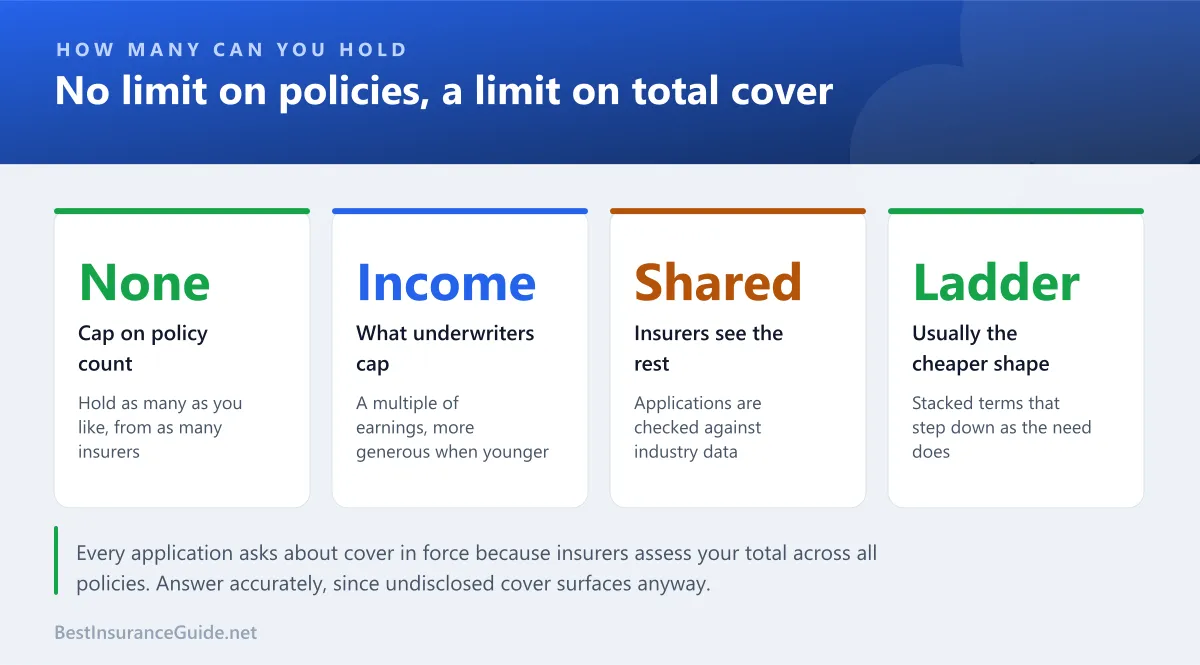
There is no legal limit. No rule caps the number of life insurance policies you can own, and nothing prevents you buying from several different insurers.
What does exist is a financial underwriting limit on the total. Insurers will not issue unlimited cover, because a death benefit wildly disproportionate to someone’s income creates the wrong incentives. They apply a multiple of income, generally more generous for younger applicants and tightening as you approach retirement, and they assess your total cover across every policy in force.
That is why every application asks about existing insurance. It is not a trick question, and it is not private: insurers share application data through the MIB, so undisclosed cover surfaces anyway. Answer it accurately.
Why several policies often beat one
Here is the part most people are never told: your need for life insurance is not constant. It is highest when the mortgage is largest and the children are youngest, and it falls steadily from there.
A single thirty-year policy insures the peak need for the whole thirty years. You pay for cover you stopped needing a decade in.
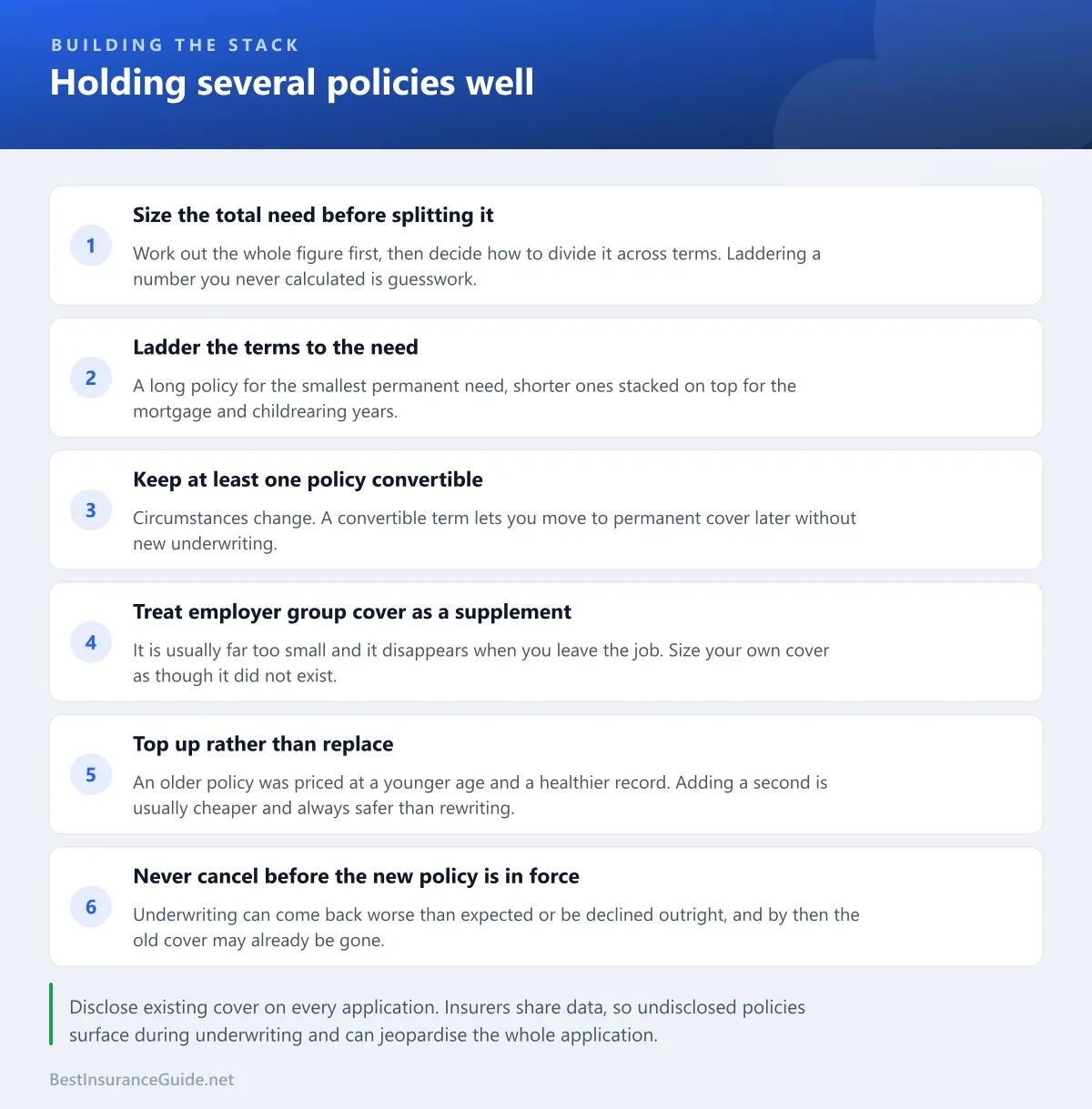
Laddering solves that. Buy several term policies of different lengths, stacked so the total benefit steps down as the need does.
Worked example: one policy against a ladder
A 35-year-old with two young children, a mortgage with 25 years to run, and a need that starts at $1 million.
Option A: a single 30-year, $1,000,000 term policy
| Amount | |
|---|---|
| Illustrative annual premium | $1,150 |
| Cover in year 1 | $1,000,000 |
| Cover in year 25 | $1,000,000 |
| Total paid over 30 years | $34,500 |
Option B: a ladder of three policies
| Policy | Term | Benefit | Illustrative annual premium |
|---|---|---|---|
| A | 30 years | $300,000 | $395 |
| B | 20 years | $350,000 | $285 |
| C | 10 years | $350,000 | $175 |
| $1,000,000 total | $855 while all three run |
| Period | Cover in force | Annual cost |
|---|---|---|
| Years 1 to 10 | $1,000,000 | $855 |
| Years 11 to 20 | $650,000 | $680 |
| Years 21 to 30 | $300,000 | $395 |
| Total paid over 30 years | About $19,300 |
Same protection in the years it was needed, roughly $15,000 less over the period. The cover falls as the mortgage shrinks and the children become independent, which is exactly what should happen.
The trade-off is real: if your circumstances do not follow the expected path, a later child or a new mortgage, you may want cover you have let expire, and you will be older and possibly less healthy when you buy it back. A useful hedge is to make sure at least one policy in the ladder is convertible.
Our guide to life insurance basics covers the DIME method for working out what the starting number should be.
Other reasons to hold more than one
You already have employer cover. Group life through work is genuinely valuable and usually far too small, often one or two times salary. It also disappears when you leave the job. Treat it as a supplement and hold your own policy underneath it, sized as if the group cover did not exist.
Different money for different jobs. Some people prefer a policy earmarked for the mortgage held by one insurer and family income cover held by another, so beneficiaries can be set differently and claims settle independently.
Business cover alongside personal cover. Key person insurance and buy-sell funding are business assets with business beneficiaries. They should not be confused with the policy protecting your family.
Topping up rather than replacing. If your need rises, adding a second policy is often cheaper and always safer than cancelling an old one and rewriting a larger one. The old policy was priced at a younger age and a healthier record, and that pricing is worth keeping.
That last point deserves emphasis. Never cancel an existing policy before a new one is issued and in force. Underwriting can come back worse than expected, or be declined outright, and by then the old cover may be gone.
Insuring someone else: the two conditions
Now the harder question. Can you take a life insurance policy out on anyone? No, and the reason is straightforward once stated.
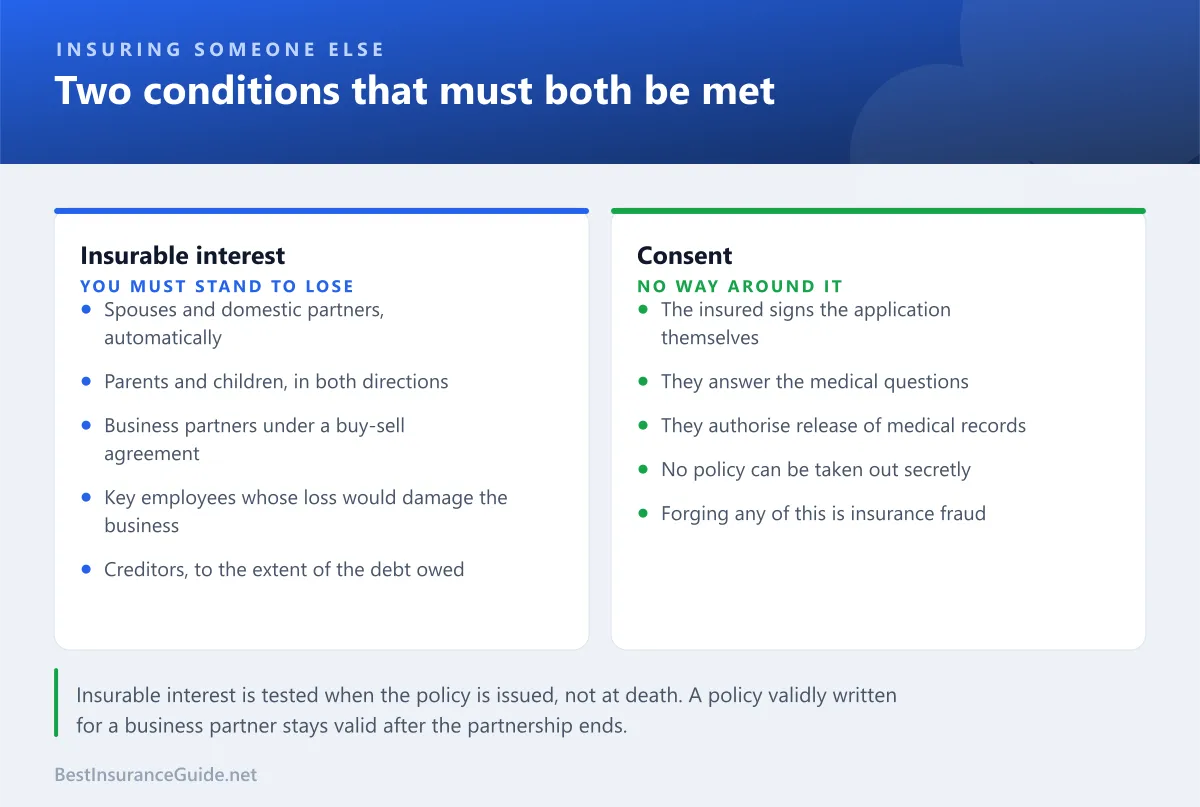
Two conditions must both be satisfied.
Insurable interest
You must stand to suffer a genuine loss, usually financial, if that person dies. Without it, a life insurance policy is a wager on a stranger’s death, which is both uninsurable and, historically, the reason these rules exist.
Relationships that generally establish insurable interest:
Spouses and domestic partners. Automatic.
Parents insuring minor children, and adult children insuring parents where there is financial dependence, caregiving responsibility, or exposure to funeral and final expenses.
Business partners, through buy-sell agreements, where a partner’s death would force you to buy out their share or damage the business.
Key employees, where the business would suffer a measurable loss.
Creditors, to the extent of the debt owed.
Relationships that generally do not: friends, neighbours, colleagues with no business relationship, celebrities, and estranged relatives with no financial connection.
Insurable interest is tested at the time the policy is issued, not at death. A policy validly issued to a business partner remains valid after the partnership ends.
Consent
The person being insured must know and agree. They sign the application, answer the medical questions, and usually complete an exam or authorise release of their medical records.
There is no route around this. You cannot insure someone secretly, and attempting to do so by forging a signature or misrepresenting the applicant is insurance fraud.
The practical upshot for most people is reassuring: nobody can quietly take out a policy on you either.
Can I get life insurance on my parents?
This is the most common version of the question, and the answer is usually yes.
Insurable interest is generally straightforward. If you would be responsible for funeral costs, if you provide or receive financial support, if you would inherit debt secured against a shared property, or if you are a caregiver whose position changes on their death, that is sufficient. Funeral and final expense costs alone satisfy most insurers.
Consent is the part that requires an actual conversation. Your parent has to agree, sign, and participate in underwriting. This is often the harder step socially, and it helps to frame it accurately: the policy exists so that their death does not create a financial problem for the family, and it costs them nothing.
You can be the owner, the payer and the beneficiary simultaneously, which is usually the cleanest structure. It also avoids the three-party ownership problem that can create gift tax complications, which our guide to life insurance and taxes covers.
For older parents, the realistic products are final expense or guaranteed issue whole life: smaller benefits, typically $5,000 to $50,000, simplified or no medical underwriting, and designed for exactly this purpose.
Can you get life insurance with cancer?
Often yes, and the honest answer depends on three things: the type, the stage, and how long ago.
During active treatment, traditional fully underwritten cover is usually postponed or declined. Insurers generally want to see treatment completed and a period of stability.
In remission, it becomes a question of how long and what kind. Some cancers with excellent prognoses can be underwritten relatively soon after treatment ends, sometimes at standard or near-standard rates. Others require several years in remission, and some are rated permanently. Early-stage cancers treated successfully are viewed very differently from advanced or recurrent disease.
At any time, two options remain available:
Guaranteed issue whole life. No medical questions at all, acceptance guaranteed within age limits. The trade-offs are significant: benefits are small, premiums are high per dollar of cover, and there is a graded death benefit meaning that death from natural causes in the first two or three years returns the premiums paid plus interest rather than the full benefit. Accidental death is usually covered in full from day one.
Simplified issue. A short set of health questions, no exam. Cheaper than guaranteed issue and more likely to accept a history of illness than full underwriting, but the questions can still exclude a recent diagnosis.
Two practical notes. Group life through an employer is often guaranteed issue up to a limit, which makes it disproportionately valuable to anyone with a health history. Take the maximum offered. And if you already hold a policy, do not let it lapse, because it was underwritten before the diagnosis and cannot be replaced on the same terms.
Working with a broker who places impaired-risk cases regularly matters here more than anywhere else in insurance. Underwriting appetite for specific conditions varies enormously between insurers, and a decline from one is not a decline from all.
The short version
You can hold as many life insurance policies as you can financially justify, from as many insurers as you like. Laddering several terms of different lengths usually costs substantially less than one large long policy, because it matches cover to a need that declines.
Disclose existing cover honestly on every application, and never cancel an old policy until the new one is issued and in force.
You can only insure someone else if you have an insurable interest and they consent. Parents almost always qualify on the first count; the second requires a conversation rather than paperwork.
A cancer history narrows the options but rarely closes them. Remission, guaranteed issue and employer group cover are all routes, and an impaired-risk broker is worth the call.
For working out the number in the first place, start with life insurance basics, and if you are weighing permanent cover, term versus whole life sets out where the money goes.