Motorcycle Courier Insurance: What Delivery Riders Need
Personal motorcycle policies exclude paid delivery. What a courier endorsement covers, where platform cover stops, and what a denied claim actually costs.

Table of contents
The most expensive assumption in delivery riding is that your insurance follows you into work. It doesn’t, and the moment anyone checks is the moment after a crash.
Personal motorcycle policies almost universally exclude carrying goods or passengers for payment. The wording varies (business use, livery, hire and reward, commercial use) but the effect is identical: the policy stops responding while you’re working. Riders find this out when a claim is denied, and the denial frequently arrives alongside a cancellation and a mark on the record that makes the next policy harder to buy.
Here’s what actually applies to paid delivery on a motorcycle: the three policy tiers, where platform cover starts and stops, and what an operation running more than one rider is expected to carry.
Three very different policies
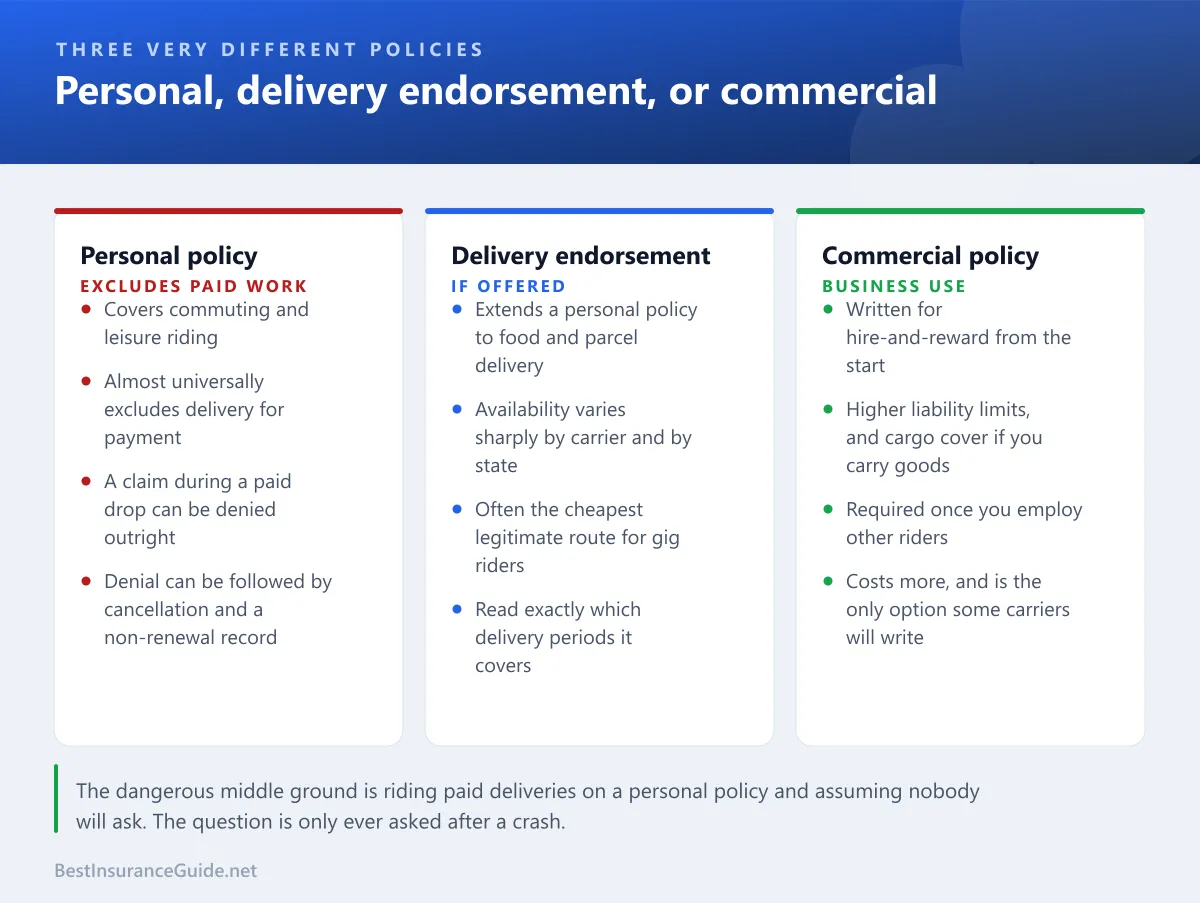
The middle column is where most individual riders should start, because it’s the cheapest legitimate route. The catch is availability: delivery and rideshare endorsements are offered inconsistently, varying by carrier and state, and the motorcycle versions are considerably rarer than the car ones. Several major carriers that will happily add a delivery endorsement to an auto policy won’t add one to a motorcycle policy at all.
Ask the question directly and get it in writing: “Does this policy cover me while I’m delivering food or parcels for payment?” Vague reassurance from a call centre isn’t cover. The endorsement either appears on your declarations page or it doesn’t exist.
Worked example: what a denied claim actually costs
A rider on a personal policy takes a left-turn collision while carrying an order. Not at fault, but the other driver is uninsured.
| Item | Cost | Personal policy | With delivery endorsement |
|---|---|---|---|
| Motorcycle, total loss | $8,400 | Denied | $7,400 after deductible |
| Rider’s medical, ER and physio | $11,200 | Denied under UM | $11,200 |
| Lost earnings, 7 weeks | $6,300 | $0 | $0 (needs separate cover) |
| Recovered | $0 | $18,600 |
Then the second bill arrives. The carrier cancels for material misrepresentation rather than simply non-renewing. That distinction matters:
| Consequence | Effect |
|---|---|
| Cancellation on record | Disclosed on every future application |
| Replacement policy premium | Roughly 40–70% higher for 3 years |
| Carriers willing to quote | Materially fewer |
| Estimated three-year cost | $1,400 to $2,600 extra |
The endorsement, where available, would have cost roughly $180 to $400 a year.
If your carrier won’t write one, the options are switching to a carrier that will, or moving to a commercial policy. Riding uncovered isn’t a third option. It’s an uninsured gamble on the busiest riding you do.
Where gig platform cover actually stops
If you ride for a delivery platform you’re covered by a patchwork rather than a policy, and the seams are where people fall through.
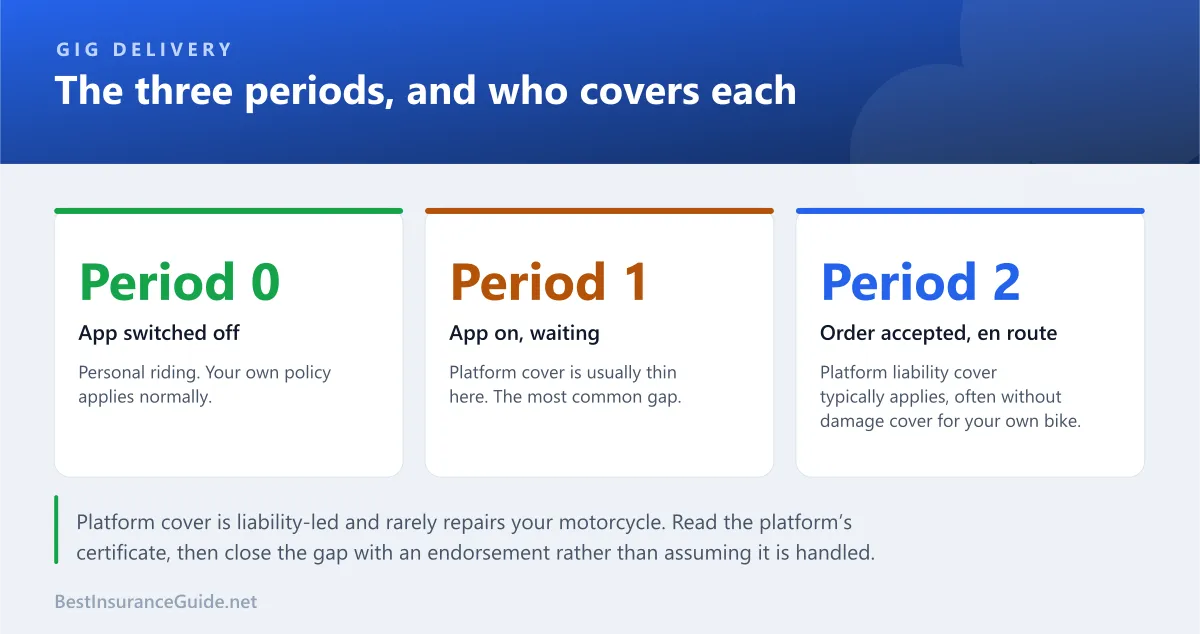
Two structural points.
It’s liability-led. Platform insurance exists primarily to protect third parties, the person you might hit, and to protect the platform. It’s generally not there to repair your motorcycle. Some platforms offer limited collision cover contingent on you carrying your own comprehensive and collision, a condition riders regularly miss.
Period 1 is the gap. The window where the app is on and you’re waiting for an order is the thinnest part of most platform policies, often with much lower limits than Period 2, or nothing meaningful at all. It’s also, for most riders, a substantial share of total road time.
Worked example: the same crash in three periods
Identical single-vehicle accident. Rider’s fault, $5,900 damage to the bike, $3,400 in medical costs.
| Period | What’s happening | Platform cover | Your recovery |
|---|---|---|---|
| 0 | App off, riding home | None, and none needed | Personal policy responds in full |
| 1 | App on, waiting for an order | Low-limit liability only, no collision | $0 for your bike |
| 2 | Order accepted, en route | Liability, plus contingent collision if you carry comp and collision | $5,900 less a $1,000 platform deductible |
Same rider, same crash, same day. The recovery ranges from everything to nothing depending on which screen was showing when it happened.
Read the actual certificate of insurance the platform publishes rather than the summary on the help page. Then close the gap with an endorsement rather than assuming somebody’s handled it.
Multi-apping compounds this. Running two or three platforms at once creates genuine ambiguity about which cover applies at any moment, and insurers resolve ambiguity slowly and unhelpfully. Your own endorsement is the only thing that removes the argument.
A note on terminology
“Motorcycle courier insurance” and “hire and reward insurance” are more common in British usage, where the courier market is larger and the product well-defined. Searches for those terms often surface UK guidance and UK pricing.
In the United States the equivalent concepts exist under different names (business use, livery, commercial auto, delivery endorsement) and the market is structured around commercial auto policies and gig-platform endorsements rather than a distinct “courier insurance” product line. If you’re in the US reading advice quoting monthly premiums in pounds, it isn’t describing your market.
The underlying principle transfers exactly, though. A personal policy doesn’t cover paid delivery in either country.
What a courier business is asked to carry
Once you stop being one rider on an app and start running an operation, taking contracts, employing riders, carrying goods for clients, the requirements change shape.
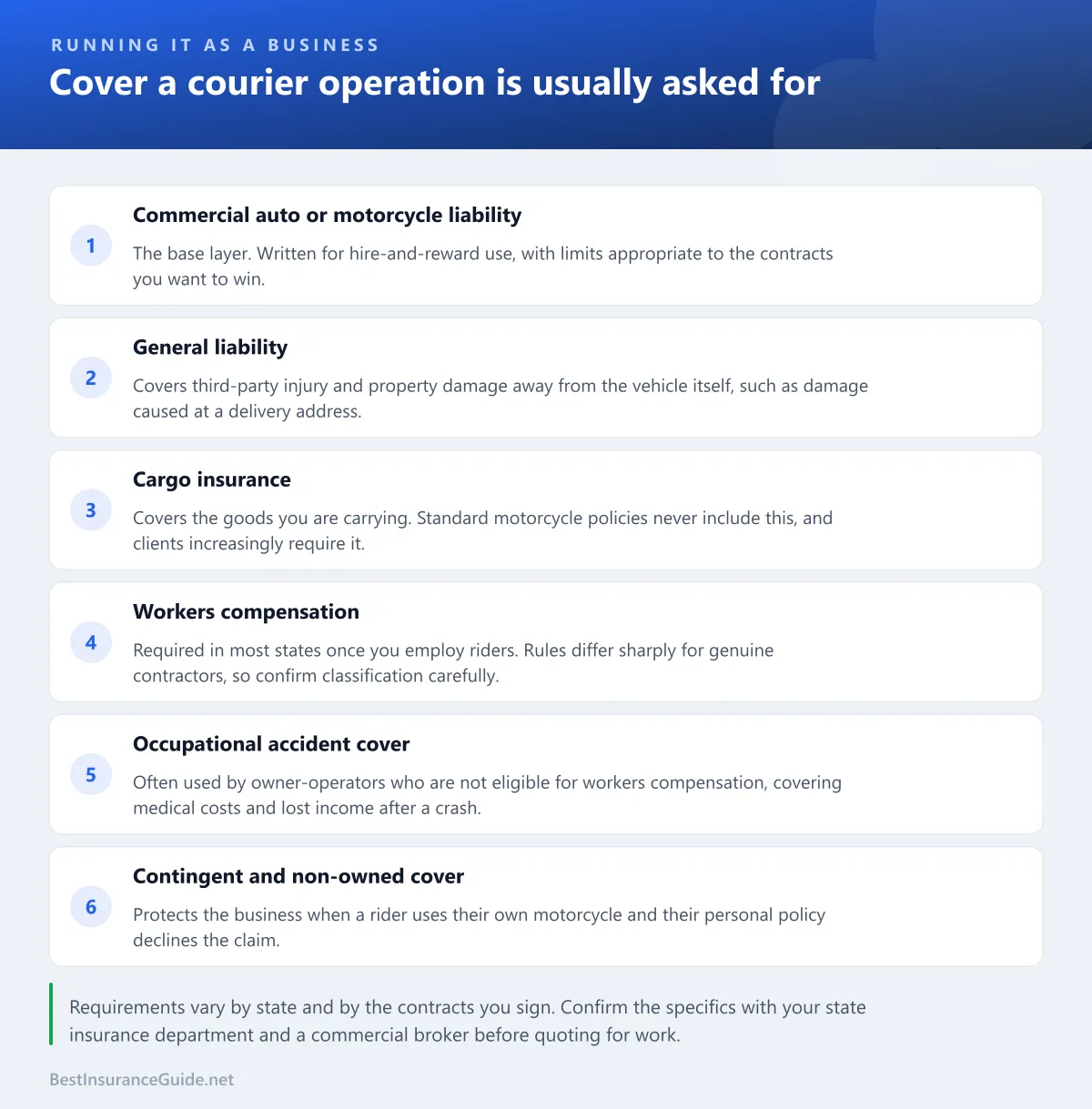
The three that generate the most confusion:
Cargo insurance is separate and increasingly demanded. No motorcycle policy of any kind covers the goods you’re carrying. Deliver pharmaceuticals, legal documents, medical samples or anything of value and clients will ask for a cargo certificate before contracting with you, with the limit specified in the contract.
Worker classification is where courier businesses get hurt. Whether your riders are employees or genuine independent contractors determines whether you need workers compensation, and states apply different tests. Getting it wrong is expensive in two directions at once: an uninsured injury claim, plus penalties for misclassification. Worth professional advice rather than a judgement call.
Contingent and non-owned cover is the one people forget. If a rider uses their own motorcycle and their own personal policy declines a claim because they were working, the injured third party looks to your business. Non-owned cover is what responds.
Worked example: rough annual cost of a three-rider operation
Illustrative only, since rates vary enormously by state, contracts and claims history.
| Cover | Typical annual range |
|---|---|
| Commercial motorcycle liability, 3 units | $4,200 – $9,000 |
| General liability | $600 – $1,400 |
| Cargo, $25,000 limit | $700 – $1,600 |
| Workers compensation, 3 riders | $3,000 – $8,500 |
| Non-owned and hired | $400 – $900 |
| Total | $8,900 – $21,400 |
The spread is wide because worker classification, state and the limits your contracts demand move it more than anything else. Get a commercial broker to quote against your actual contracts rather than working from a figure like this.
Practical steps for an individual rider
- Find the exclusion in your current policy. Search the document for “business”, “livery”, “delivery” or “for a fee”. Read it before you need to.
- Ask your carrier the direct question and get the answer in writing.
- If an endorsement is available, price it. Normally far cheaper than a commercial policy.
- If it isn’t, shop carriers that write delivery endorsements for motorcycles in your state before defaulting to commercial.
- Read the platform’s certificate and identify what happens in Period 1 specifically.
- Confirm your own comprehensive and collision, since some platform cover is contingent on it.
- Keep the endorsement on your declarations page where an adjuster can see it immediately.
Practical steps for an operation
- Settle worker classification first. It determines the workers compensation question and everything downstream.
- Match commercial liability limits to your contracts, not to the state minimum.
- Add cargo cover at the limit your largest client requires.
- Add non-owned and hired cover if riders use their own machines.
- Verify each rider’s own policy annually and keep certificates on file.
- Confirm requirements with your state insurance department and a commercial broker, because they vary meaningfully.
Our business insurance checklist covers the general commercial cover an operation needs alongside the vehicle-specific items above.
Read your exclusions this week
Personal motorcycle insurance excludes paid delivery. That’s not a technicality. It’s the reason claims get denied, and as the first example shows, the denial usually costs more than the crash.
Open your policy document and search for “business use”. It’ll be there. Then decide whether you want an endorsement, a different carrier, or a commercial policy, because those are the three honest options and riding uncovered isn’t one of them.
The question “am I covered while I’m working” has a documented answer sitting in a PDF you already own. Find it before someone else does.