Motorcycle Insurance in Colorado: Filtering, Hail and Mountain Roads
Colorado motorcycle insurance requirements, the lane filtering law, hail and comprehensive cover, and why mountain riding changes the coverage you need.

Table of contents

Colorado gives riders more genuinely good roads than almost any state, and three specific things that should shape a policy: a new filtering law, an exceptional hail exposure, and terrain that turns ordinary crashes into remote ones.
What the state requires
Colorado requires liability insurance to register and ride, at minimum limits of:
- $25,000 bodily injury per injured person
- $50,000 bodily injury per accident
- $15,000 property damage
Written 25/50/15. The property damage figure in particular is low against modern vehicle values, and a single at-fault collision with a newer car can exceed it.
Helmets are required for riders and passengers under 18. There is no universal helmet law. Eye protection is required for all riders unless the motorcycle has a windscreen.
The filtering law
Colorado enacted a limited lane filtering law, which permits a rider to pass stopped traffic under defined conditions rather than the general lane splitting permitted in California.
The conditions are precise and they matter, because filtering outside them is not protected. Broadly they involve traffic being stopped rather than moving slowly, the motorcycle travelling at a low speed while filtering, adequate room to pass safely, and restrictions relating to the road itself.
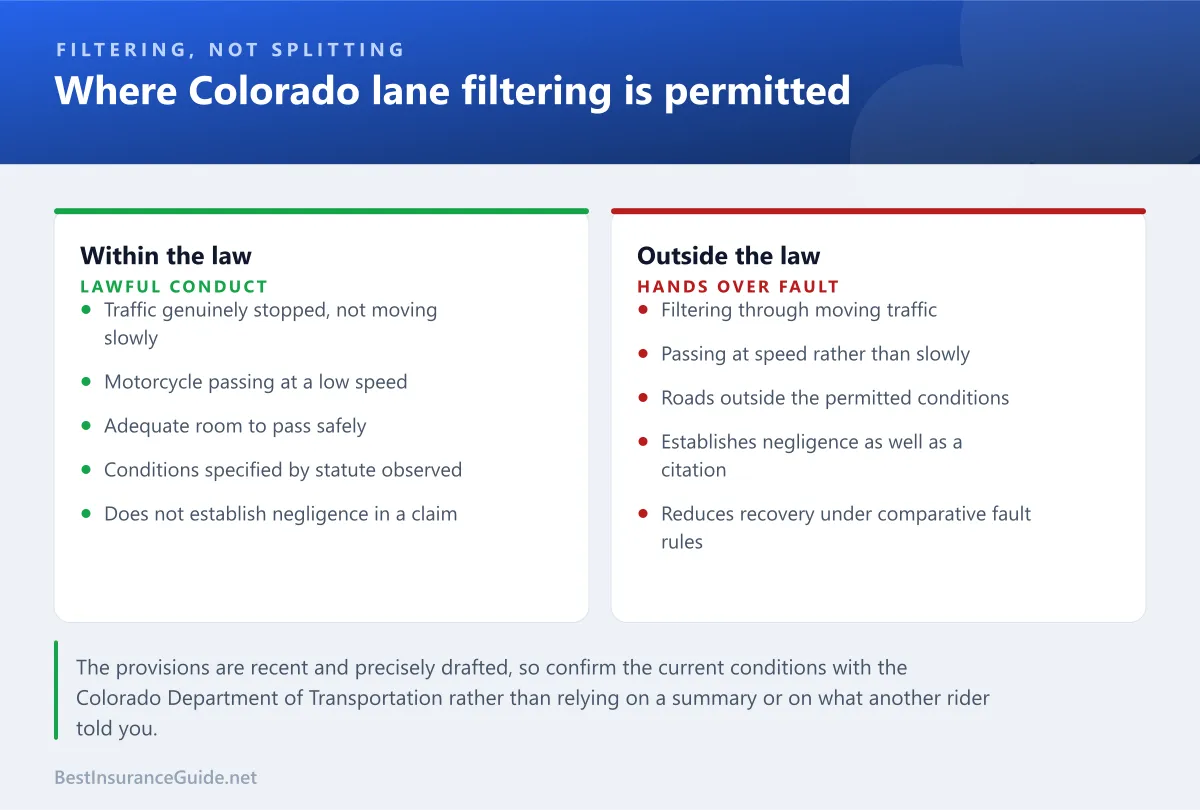
The insurance significance is not the citation. It is fault apportionment.
Colorado applies modified comparative negligence to injury claims. If you are found partly responsible for a crash, your recovery is reduced by your share of fault, and above a threshold share you recover nothing at all.
Filtering within the law is lawful conduct and does not establish negligence. Filtering outside it, in moving traffic or at speed, gives the other party’s insurer a straightforward argument that you contributed to the crash. On a claim worth six figures, a shift in apportionment is worth more than any premium difference.
Because the rules are specific and were recently introduced, confirm the current conditions with the Colorado Department of Transportation or the Division of Motor Vehicles rather than relying on a summary.
Hail, and why comprehensive matters more here
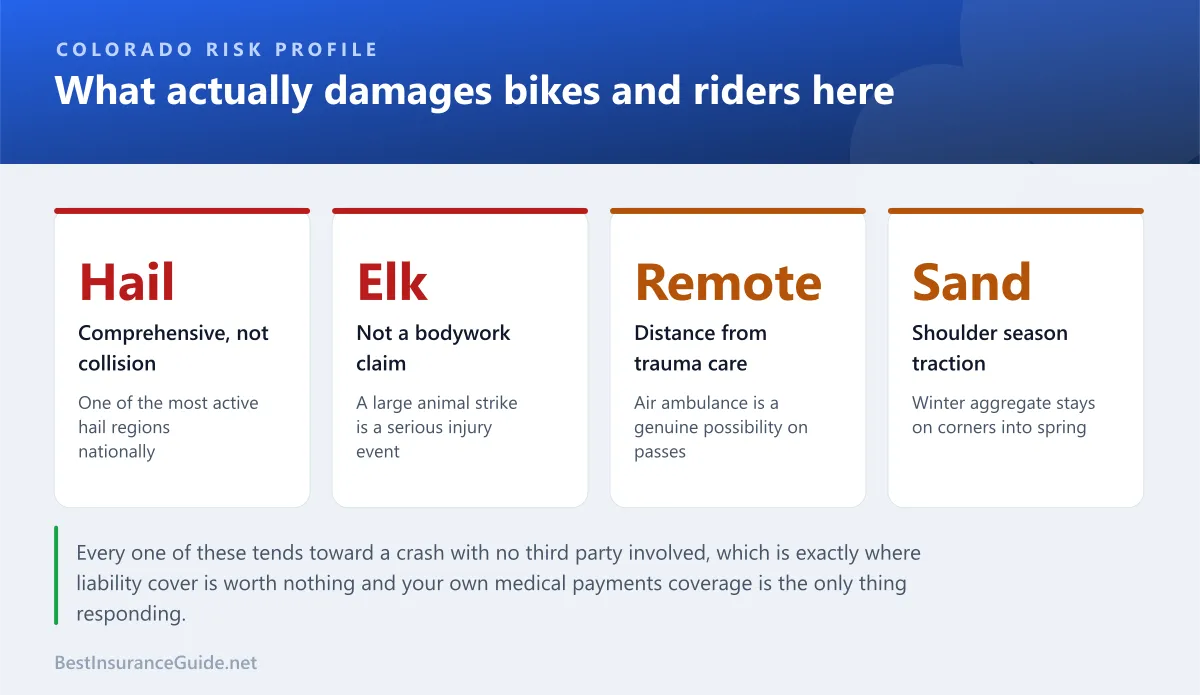
Colorado sits in one of the most active hail regions in the United States, and the Front Range takes the worst of it.
A car in a hailstorm gets dented. A motorcycle parked outside gets damaged bodywork, cracked lenses, a ruined screen, a dented tank and a pitted paint finish, and on a bike where the finish is much of the value, that adds up quickly.
Hail is a comprehensive claim, not collision. Comprehensive is generally the cheaper of the two physical damage coverages and it also covers theft, fire, vandalism and animal strikes.
For a Colorado rider, comprehensive is doing considerably more work than it does in most states, and dropping it to save money on a bike parked outside is a poor trade.
Mountain riding changes the calculation
Colorado’s best riding is also its most remote, and two consequences follow.
Wildlife strikes. Deer and elk are present near roads across much of the state, and an elk strike on a motorcycle is a serious injury event rather than a bodywork claim. Damage to the bike is comprehensive; your injuries are a different question entirely.
Distance from help. A crash on a pass is a long way from a trauma centre, and air ambulance transport is a genuine possibility. That is a medical cost, and how it is paid depends on what you carry.
Colorado is a fault state, so in a single-vehicle crash or an animal strike there is no third party to claim against. What responds is your own medical payments coverage and your health insurance.
That makes medical payments meaningfully more valuable to a Colorado rider than the premium suggests, and it is worth buying at a level that reflects mountain riding rather than the minimum on offer.
What to carry above the minimum
Uninsured and underinsured motorist coverage. Insurers must offer it and obtain a written rejection to leave it off. Do not reject it. A driver carrying Colorado minimums has $25,000 of bodily injury cover, which a serious motorcycle injury exhausts immediately.
Medical payments coverage at a meaningful level, for the single-vehicle and remote-crash scenarios.
Comprehensive, for hail, theft and animal strikes, and specifically do not drop it on a bike stored outside.
Collision if the bike has value or is financed.
Custom parts and accessories. Standard policies cap aftermarket parts low. Our guide to custom motorcycle insurance covers scheduling and agreed value.
Worked example: an elk strike on a mountain road
A single-vehicle crash after an elk enters the road. No other party involved.
| Item | Amount | Which coverage |
|---|---|---|
| Bike damage, written off | $9,400 | Comprehensive, less deductible |
| Air ambulance transport | $38,000 | Medical payments, then health plan |
| Emergency and orthopaedic surgery | $74,000 | Medical payments, then health plan |
| Rehabilitation | $19,000 | Health plan |
| Total | $140,400 |
There is no at-fault driver, no liability claim and no uninsured motorist claim, because no other vehicle was involved. Every dollar of the medical side runs through your own coverage.
That single table is the argument for buying medical payments properly in Colorado rather than treating it as an afterthought.
The season, and storage
Colorado has two seasons depending on elevation. Front Range riding continues for much of the year; high country roads close and passes are seasonal.
If your bike is genuinely stored for months, ask about a lay-up or storage arrangement: keep comprehensive against theft, fire and hail, reduce or suspend collision and liability, restore full cover in spring. That preserves continuous coverage, which is itself a rated factor, and keeps the hail protection in force during a season when storms still occur.
Cancelling outright breaks continuous coverage and raises your next premium, which usually exceeds the saving.
What moves a Colorado premium
Front Range against the rest. Denver, Boulder, Colorado Springs and Fort Collins price above the Western Slope and Eastern Plains.
Bike type, with sport bikes well above cruisers and touring machines.
Rider age and experience, with a steep youth curve.
Hail exposure, which affects comprehensive pricing along the Front Range specifically.
Theft rates, which are meaningful in the Denver metro.
Storage, since garaged bikes cost less, are stolen less and are not hailed on.
Safety course completion, which produces a discount with most insurers.
The short version
Colorado requires 25/50/15 liability, with helmets for riders under 18 and eye protection for everyone without a windscreen.
Three things make it distinctive. Limited lane filtering is now permitted under precise conditions, and staying inside them protects your fault apportionment as well as your licence. Hail makes comprehensive coverage unusually valuable, particularly for a bike parked outside on the Front Range. And mountain riding produces remote single-vehicle crashes where no third party exists to claim against, which puts the weight on your own medical payments coverage.
Carry liability well above the minimum, do not decline uninsured motorist cover, keep comprehensive, and buy medical payments at a level that reflects where you actually ride.
For how other states compare, see motorcycle insurance by state.
Adventure and dual-sport riding
Colorado has an unusually large adventure and dual-sport population, and those bikes raise questions a standard motorcycle policy answers badly.
Off-road use is frequently excluded or limited. Standard motorcycle policies are written for road use. Riding on trails, forest service roads and unmaintained tracks may fall outside the policy depending on the wording, and some insurers exclude competition and organised off-road events entirely.
Ask specifically how your insurer treats unpaved and off-highway riding, because “adventure bike” is a marketing category rather than an insurance one.
Luggage and equipment. Panniers, top boxes, crash bars, auxiliary lighting, navigation and camping equipment can represent a substantial value, and standard accessory limits are low. Schedule them.
Recovery is not covered. Roadside assistance on a standard policy generally means a paved road. A bike down a forest service road twenty miles from pavement is a recovery problem your policy will not solve, and specialist off-road recovery cover exists for exactly this.
Trailering. If you trailer the bike to a trailhead, damage while trailered may fall under your auto policy, the trailer’s cover, or nowhere at all. Confirm which before you find out.
Comparing quotes properly in Colorado
Match five fields across every quote before comparing price: bodily injury liability, property damage, uninsured and underinsured motorist limits, comprehensive deductible and collision deductible.
Then ask four Colorado-specific questions.
How is hail treated, and is there a separate deductible for it? Some insurers apply a distinct wind and hail deductible, occasionally as a percentage rather than a flat amount, which behaves very differently on a claim.
Is there a lay-up or storage arrangement, and does comprehensive stay in force during it? For a bike stored through a Front Range spring, hail cover during storage matters.
How is off-road or unpaved use treated?
What is the custom parts and accessories limit, and can it be raised?
Our guide to comparing insurance quotes the right way covers the general method. The Colorado-specific point is that comprehensive terms deserve as much attention here as liability limits, because hail and wildlife make it the coverage most likely to be used.
Shoulder season riding, and what the roads do
Colorado riders get more of the year than the elevation suggests, and the shoulder seasons carry a specific hazard that produces a lot of single-vehicle claims.
Traction sand and gravel. Colorado uses sand and aggregate on winter roads, and it stays on the surface well into spring. Corners that were clean in October are covered in loose material in April, and it collects exactly where a bike wants to be, on the inside of bends and at intersections.
Freeze-thaw damage. Potholes and edge breaks appear over winter and are not repaired immediately.
Afternoon storms in summer. Front Range weather turns quickly, and a dry ride out can become a hail-and-water ride home. That is both a crash risk and, for a parked bike, a comprehensive claim.
Sudden altitude weather. Passes can be twenty degrees colder and wet when the Front Range is dry. Hypothermia impairs judgement in the same way heat does in Arizona, and the failure mode is the same: a single-vehicle crash that looks like rider error.
All of these are covered as accidents. The point is not coverage, it is that Colorado produces more no-third-party crashes than states with flatter roads and gentler weather, and that is precisely the scenario where your own medical payments coverage is the only thing responding.
A note on figures
Premium and cost figures in this article are illustrative rather than quotes, chosen to show the relative weight of coverage decisions. Actual pricing depends on your postcode, machine, riding record, age and coverage selections.
Confirm Colorado’s current lane filtering conditions, helmet rules and minimum limits with the state rather than relying on any summary, since the filtering provisions are recent and precisely drafted.
Comparable states
Colorado’s limited lane filtering is shared with Arizona. Its hail exposure for a parked bike has no close parallel among the states covered here, though Ohio shares the long lay-up season and the decision about whether to keep cover through the winter.
A note on scope and sources
Colorado’s minimum financial responsibility requirements, helmet and eye protection rules, and lane filtering conditions are set by statute and administered by the Colorado Division of Motor Vehicles and the Department of Transportation, with insurance regulated by the Colorado Division of Insurance.
The lane filtering provisions in particular are recent and precisely drafted, so confirm the current conditions with the state rather than relying on any summary. Premium and cost figures here are illustrative rather than quotes. Nothing here is legal advice, and this site is independent and not affiliated with any insurer.