Business Insurance Checklist: Every Policy a Small Business Needs
General liability isn't enough. The core policies, the gaps small businesses forget, what an uninsured claim costs, and typical price ranges.

Table of contents
Most small businesses buy general liability, tick the box, and assume they’re covered.
They’re covered for one thing: physical harm to other people and their property. That leaves out professional errors, employee injuries, vehicle use, income lost while you can’t trade, and data breaches, which between them account for a large share of what actually goes wrong.
Here’s the full picture, what each policy does, and what the gaps cost when they surface.
The foundation
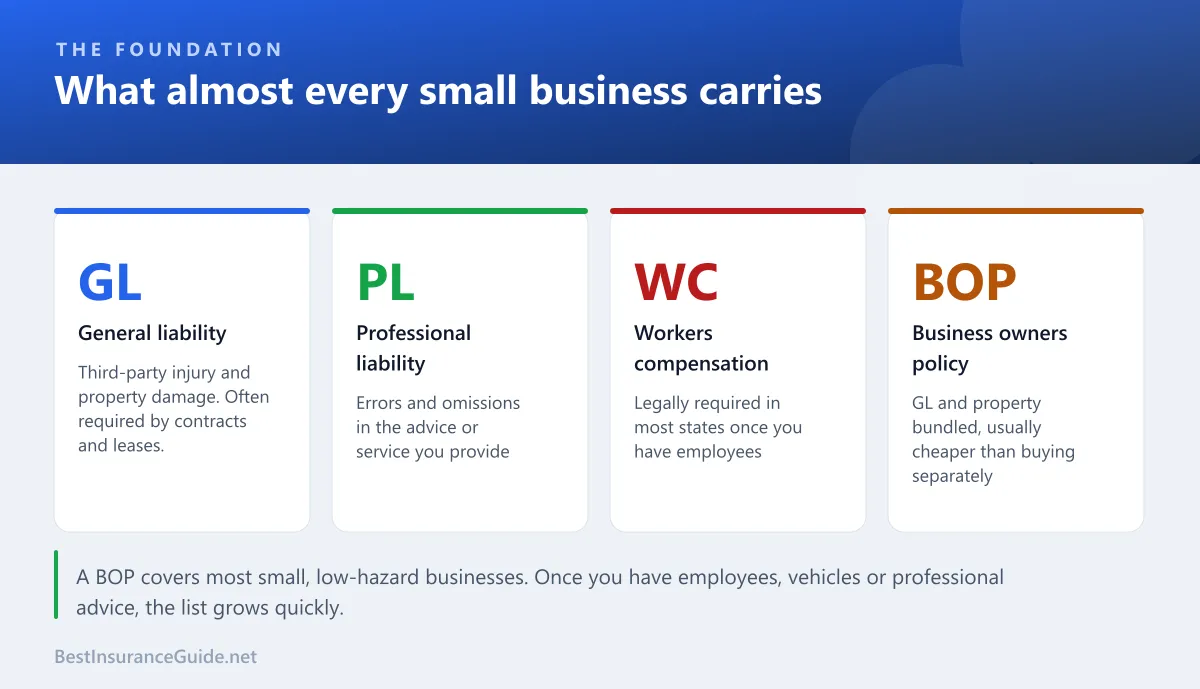
A Business Owner’s Policy bundles general liability and commercial property, usually cheaper than buying them separately. It’s the sensible starting point for most small, low-hazard businesses: consultancies, retail shops, small offices.
Once you have employees, vehicles, or you give professional advice, the list grows past what a BOP holds.
The pair people confuse
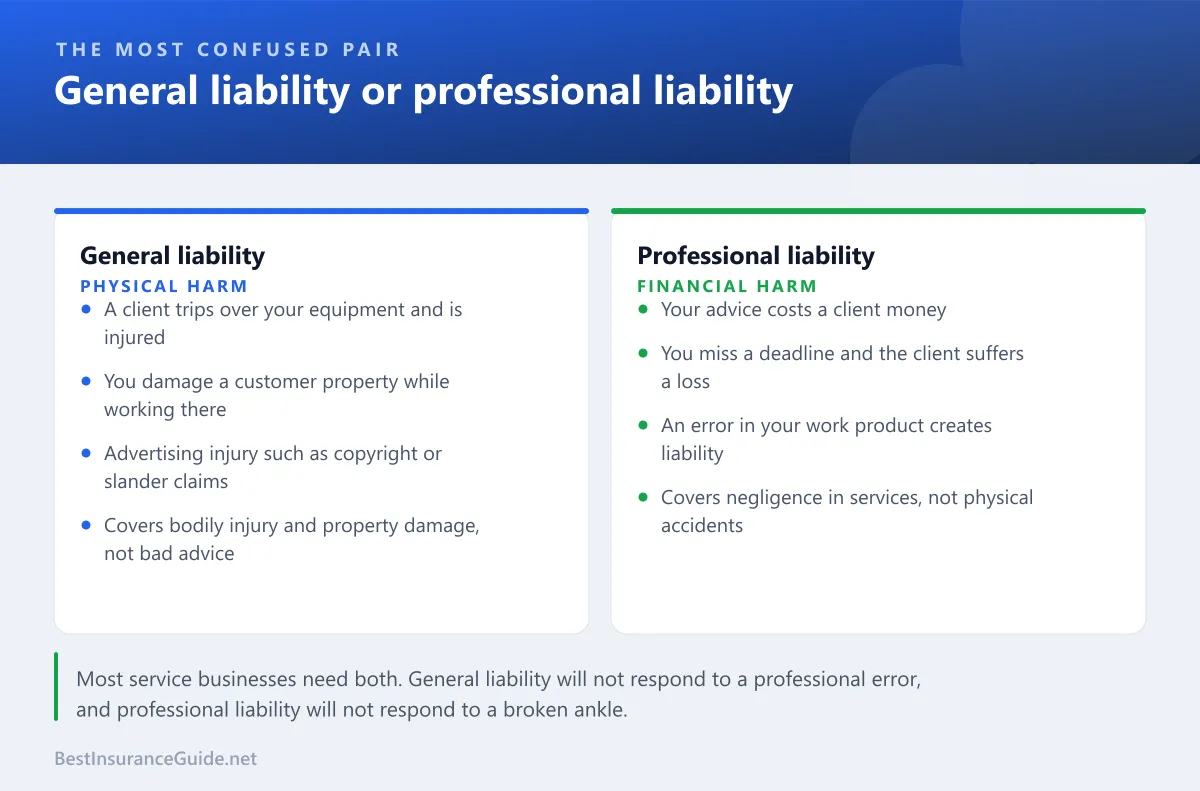
This distinction costs businesses real money, because they buy one and assume it does both jobs.
Worked example: two claims, one policy
A small marketing agency holds general liability only, at $1M/$2M limits.
| Claim | What happened | GL responds? | Cost to the business |
|---|---|---|---|
| Client trips over a cable at a workshop, fractures wrist | Bodily injury on premises | Yes | $0, GL pays $28,000 |
| Missed a campaign deadline, client loses a launch window, sues for $85,000 | Financial loss from professional error | No | $85,000 plus defence |
General liability won’t respond to the second claim under any reading of the policy. It isn’t a coverage dispute, it’s simply not what the product does.
Professional liability for an agency that size typically runs $800 to $1,800 a year. The uninsured claim was $85,000 plus roughly $30,000 in defence costs before anyone reached a settlement.
Workers compensation
Legally required in most states from your first employee, with the threshold and the treatment of contractors varying by state.
It covers medical costs and lost wages for work injuries, and in exchange employees generally give up the right to sue you for those injuries. That trade is the point of the system, and it’s why operating without it exposes you on both sides at once.
Worked example: an uninsured injury
A three-person contracting business in a state requiring cover from the first employee. The owner classifies all three as contractors, incorrectly. One falls from a ladder.
| Item | Cost |
|---|---|
| Emergency care, surgery, six weeks of physio | $84,000 |
| Lost wages, 11 weeks | $9,900 |
| State penalty for failure to carry cover | $18,000 |
| Legal costs, employee sues directly with no WC immunity | $37,000 |
| Total exposure | $148,900 |
The workers compensation premium they avoided was roughly $7,400 a year.
Worker classification is where small businesses get hurt most often, and states apply different tests. If you’re relying on contractor status for people who look like employees, that’s worth professional advice rather than a judgement call.
The gaps businesses forget
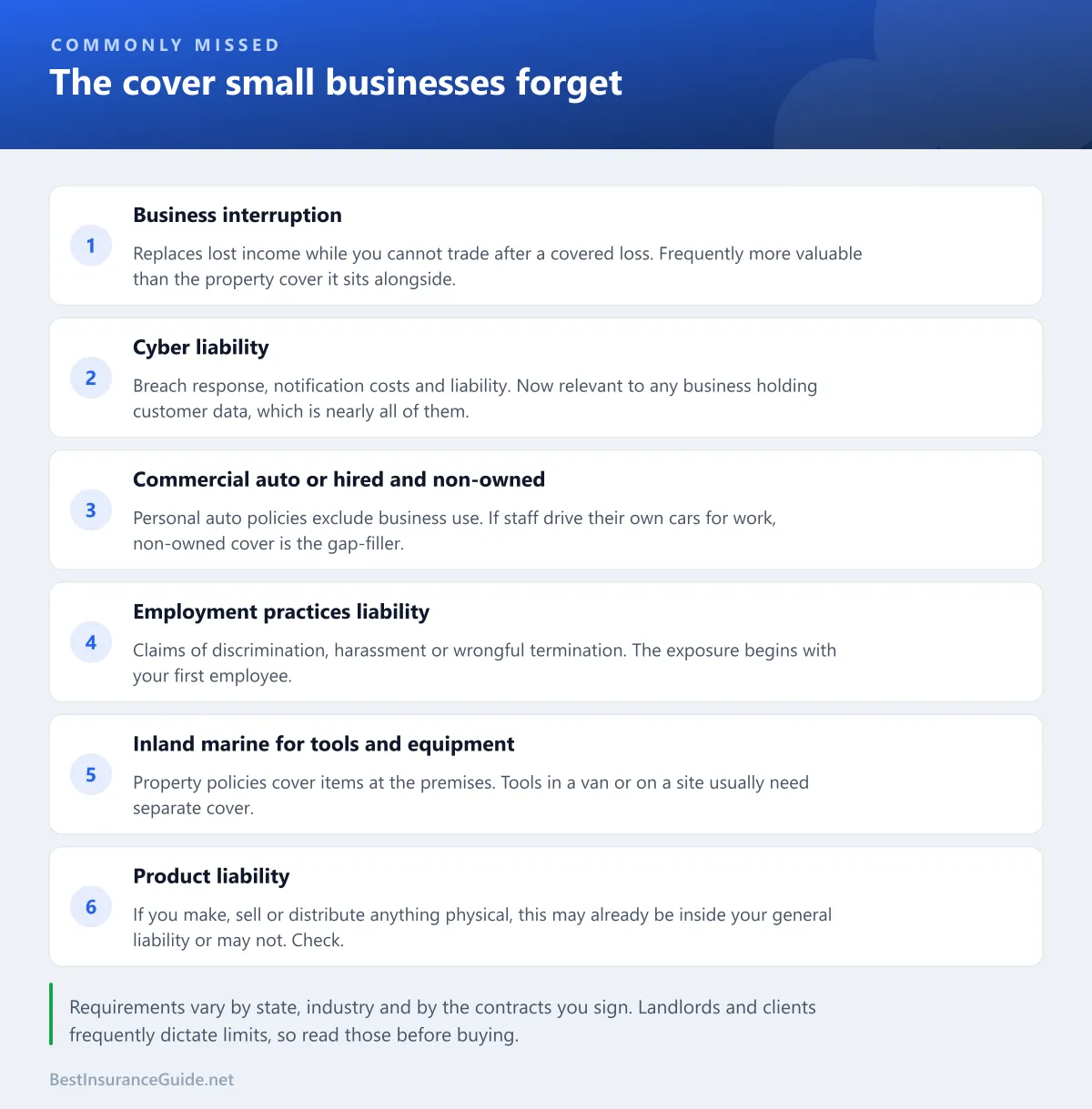
Three of those deserve expanding.
Business interruption is frequently worth more than the property cover it sits beside.
Worked example: fire at a restaurant
A kitchen fire. Property damage is covered. The restaurant is closed four months.
| Amount | |
|---|---|
| Property damage, covered by the BOP | $180,000 |
| Lost gross profit over four months | $146,000 |
| Rent, still payable | $32,000 |
| Retained key staff wages | $41,000 |
| Income loss, uncovered without BI | $219,000 |
The building was repaired and the business closed anyway, because four months without income killed it. Business interruption cover for a restaurant that size typically adds $900 to $2,200 a year.
Cyber liability now applies to essentially any business holding customer data, which is nearly all of them. It covers breach response, mandatory notification, credit monitoring, regulatory fines and third-party liability. Notification costs alone frequently run $8 to $20 per affected record before anything else happens.
Hired and non-owned auto catches service businesses. Personal auto policies exclude business use. If an employee drives their own car to a client site and causes an accident, their personal insurer may decline and the injured party looks to your business. Non-owned cover is usually $300 to $700 a year and closes that gap entirely.
What it costs
Rough ranges for a small, low-hazard business. Real pricing moves enormously with industry, revenue, payroll, claims history and the limits your contracts demand.
| Cover | Typical annual range |
|---|---|
| Business Owner’s Policy (GL + property) | $500 – $1,500 |
| Professional liability / E&O | $600 – $2,000 |
| Workers compensation | 0.5% – 10%+ of payroll, by classification |
| Commercial auto, per vehicle | $1,200 – $2,600 |
| Hired and non-owned auto | $300 – $700 |
| Cyber liability, $1M limit | $700 – $2,500 |
| Employment practices liability | $800 – $3,000 |
| Umbrella, $1M excess | $500 – $1,200 |
The umbrella deserves a note. It sits above your other policies and extends their limits, and it’s usually the cheapest liability protection per dollar of cover available. Once you have GL, auto and employer’s liability underneath it, a $1M umbrella at around $700 is generally better value than raising each underlying limit separately.
Contracts usually decide this, not statute
The practical driver of what you buy is rarely the law. It’s the documents you sign.
Commercial leases routinely require general liability at specified limits with the landlord named as additional insured. Client contracts, particularly with larger companies, specify professional liability limits, sometimes cyber, and often require a certificate before work starts. Loan agreements can require property cover and key-person life insurance.
Worked example: winning the contract you can’t insure
A five-person IT consultancy bids for work with a mid-sized manufacturer. The contract requires $2M professional liability, $1M cyber, and a waiver of subrogation.
| Held before | Required | Cost to upgrade | |
|---|---|---|---|
| Professional liability | $1M | $2M | +$640/year |
| Cyber liability | None | $1M | +$1,150/year |
| Waiver of subrogation endorsement | No | Yes | +$150/year |
| Total | +$1,940/year |
The contract was worth $210,000 annually. The insurance upgrade cost under 1% of it.
Read the insurance clause before you bid, not after you’ve won. Insurers can take weeks to place cyber cover, and losing a contract over a delayed certificate is an avoidable and infuriating way to lose work.
Home-based businesses
Standard home insurance handles this badly, and people don’t usually find out until they claim.
Business property inside the home is typically capped low, often around $2,500. Business liability is excluded entirely, so a client injured at your home office isn’t covered. Business use of a vehicle is excluded from the personal auto policy.
A home business endorsement covers modest exposures cheaply. Beyond that you need a proper BOP. The trigger is usually clients visiting, holding meaningful equipment, or holding stock.
Reviewing it
Business insurance goes stale faster than personal insurance, because businesses change faster than households.
Review when you hire your first employee, add a vehicle, sign a lease, take on a materially larger client, add a service line, or cross a revenue threshold that changes your rating. Otherwise annually at renewal.
The specific thing to check each year is whether your limits still match your contracts and your revenue. A $1M general liability limit set when you turned over $200,000 is thin at $2 million, and nobody will tell you that.
For the vehicle side, if you or your staff make deliveries, our guide to motorcycle courier insurance covers the business-use exclusion in detail and it applies equally to cars.
Where to start
Nothing yet? Get a BOP quote, plus professional liability if you advise or provide a service. That’s the base.
Have employees? Workers compensation, and confirm your state’s classification rules before assuming contractors are exempt.
Sign contracts? Read the insurance clause in each one and make sure your certificates match. For most small businesses that’s what actually determines the programme.
And check any insurer’s complaint index and financial strength before buying, using the free tools in our comparison guide. A commercial claim is where you find out whether you bought well.