Go Auto Insurance: Who It's For and What to Check First
GoAuto writes budget car insurance in eight states. Who it suits, what minimum limits really leave you carrying, and how to vet any cheap insurer properly.

Table of contents

If you’re reading about GoAuto, you’re probably in one of two situations. Either you just got quoted and you’re checking the company is real before handing over a card number, or the mainstream insurers have stopped returning your calls and you’re working out what’s left.
Both are fair. Here’s an honest look, and then the part that matters more than which company you pick: how to check any cheap insurer, and what a rock-bottom policy actually leaves sitting on your shoulders.
We’re an independent publisher. We’re not affiliated with GoAuto or any insurer, we’re not an agent, and we don’t sell insurance. Check current details with the company or your state department of insurance.
Where it operates
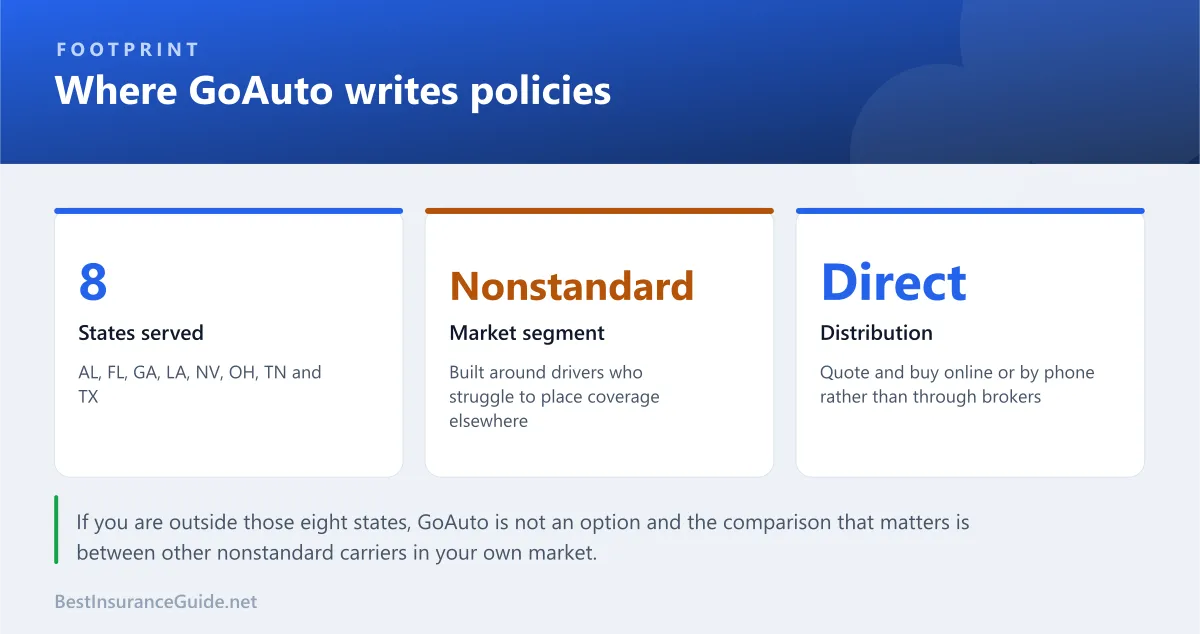
Eight states, and that’s the first filter. If you’re outside Alabama, Florida, Georgia, Louisiana, Nevada, Ohio, Tennessee or Texas, the question answers itself.
The company is built for the nonstandard segment and sells direct. Its marketing leans hard on low monthly figures and on hitting state minimum requirements as cheaply as possible, with payment structures aimed at people who can’t put six months down up front.
That’s a real market meeting a real need, and there’s nothing disreputable about it. It does mean the product is designed around a price point, and knowing what a price point buys is most of what you need here.
What “nonstandard” means
Insurers sort drivers into rough tiers. Preferred gets the best rates from the biggest companies. Standard gets ordinary rates. Nonstandard is everyone the first two have priced out or turned away.
You can land there for reasons that have very little to do with how you drive:
- A gap in coverage, even a two-week one, because you sold a car and didn’t immediately buy another
- A recent at-fault accident, or a couple of speeding tickets
- Being young. Or being older and coming back after years without a policy
- A thin or damaged credit file, in states where credit-based insurance scores are allowed
- Driving something mainstream insurers think is expensive to repair
None of that makes you uninsurable. It makes you costlier to insure, and it routes you toward companies that specialise in pricing it.
The consequence worth noticing: nonstandard policies get sold at state minimum limits, because that’s what produces the advertised monthly figure. Which means the decision that actually matters isn’t which nonstandard company you pick. It’s what limits you buy from them.
What minimum limits leave you carrying
Louisiana works as the example, since it’s GoAuto’s home market and its minimums are typical of the low end.
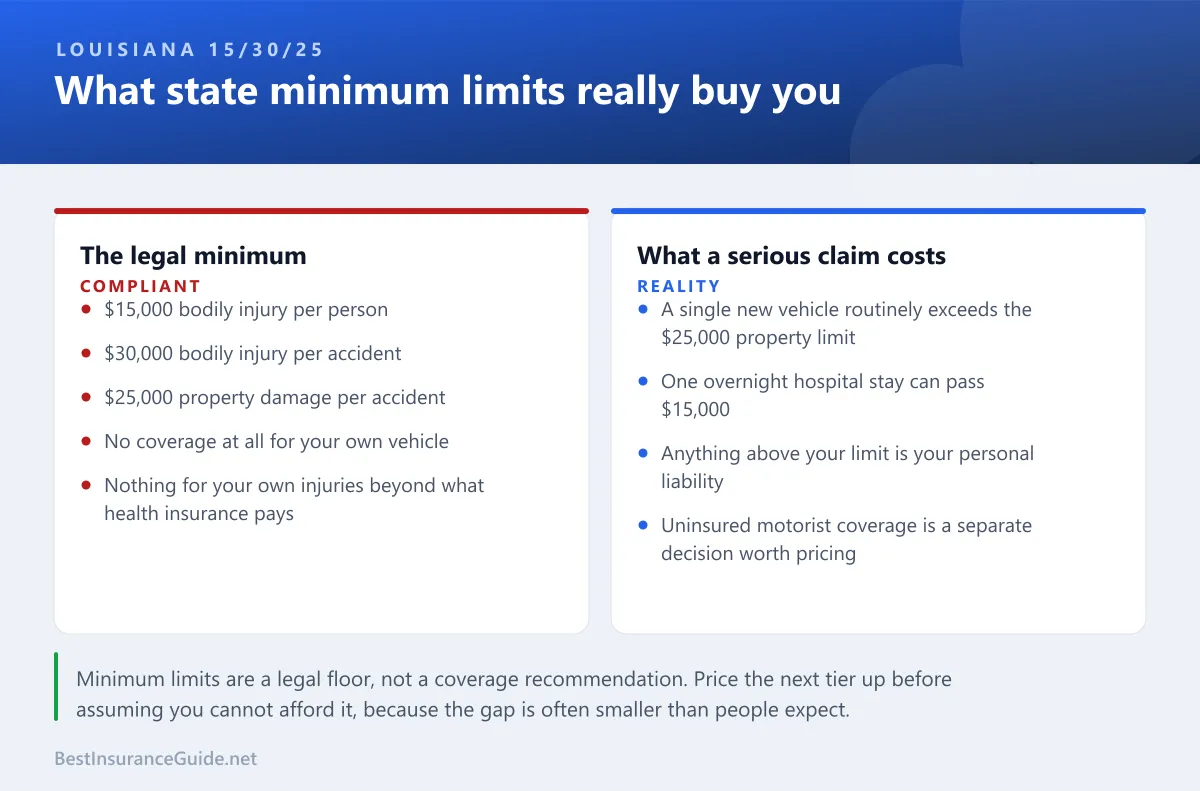
Sit with the right-hand column for a second. That $25,000 property damage limit was written for a vehicle market that no longer exists. New vehicles have averaged well north of $45,000 for several years. Total someone’s SUV and the limit runs out around the halfway mark.
Worked example: a fairly ordinary collision
Not a dramatic one. A driver on 15/30/25 limits runs a red light and hits a four-year-old crossover carrying two people. One goes to hospital overnight with a concussion and a broken collarbone.
| Item | Actual cost | Policy pays | You owe |
|---|---|---|---|
| Crossover, total loss | $28,400 | $25,000 | $3,400 |
| Driver: ER, imaging, overnight, ortho follow-up | $22,600 | $15,000 | $7,600 |
| Passenger: ER and treatment | $4,100 | $4,100 | $0 |
| Rental car during settlement | $1,150 | $0 | $1,150 |
| Total | $56,250 | $44,100 | $12,150 |
Twelve thousand dollars, from an accident with no fatalities, no permanent injury and no exotic vehicles. That figure is a personal debt and it can be pursued against your wages for years.
Now the comparison that matters:
| Limits | Typical annual premium | Would this claim be covered? |
|---|---|---|
| 15/30/25 | $1,690 | No, $12,150 shortfall |
| 50/100/50 | $1,905 | Yes, fully |
| 100/300/100 | $2,080 | Yes, with room to spare |
Going from minimum limits to 50/100/50 costs about $215 a year, roughly $18 a month, and it covers this entire claim. The reason the jump is so cheap is that the probability of a catastrophic accident barely changes between the two. Only the ceiling does, and ceilings are cheap to raise.
Get both quoted before you assume you can’t afford it.
And price uninsured motorist cover separately. Louisiana has one of the highest uninsured driver rates in the country, and several other GoAuto states aren’t far behind. Minimum-limits policies usually leave it out, which means in the single most likely bad scenario, being hit by someone with no insurance, you recover nothing at all.
Checking any cheap insurer
The brand matters less than the homework. Run these on GoAuto, on its competitors, and on anyone quoting a number that seems too good.
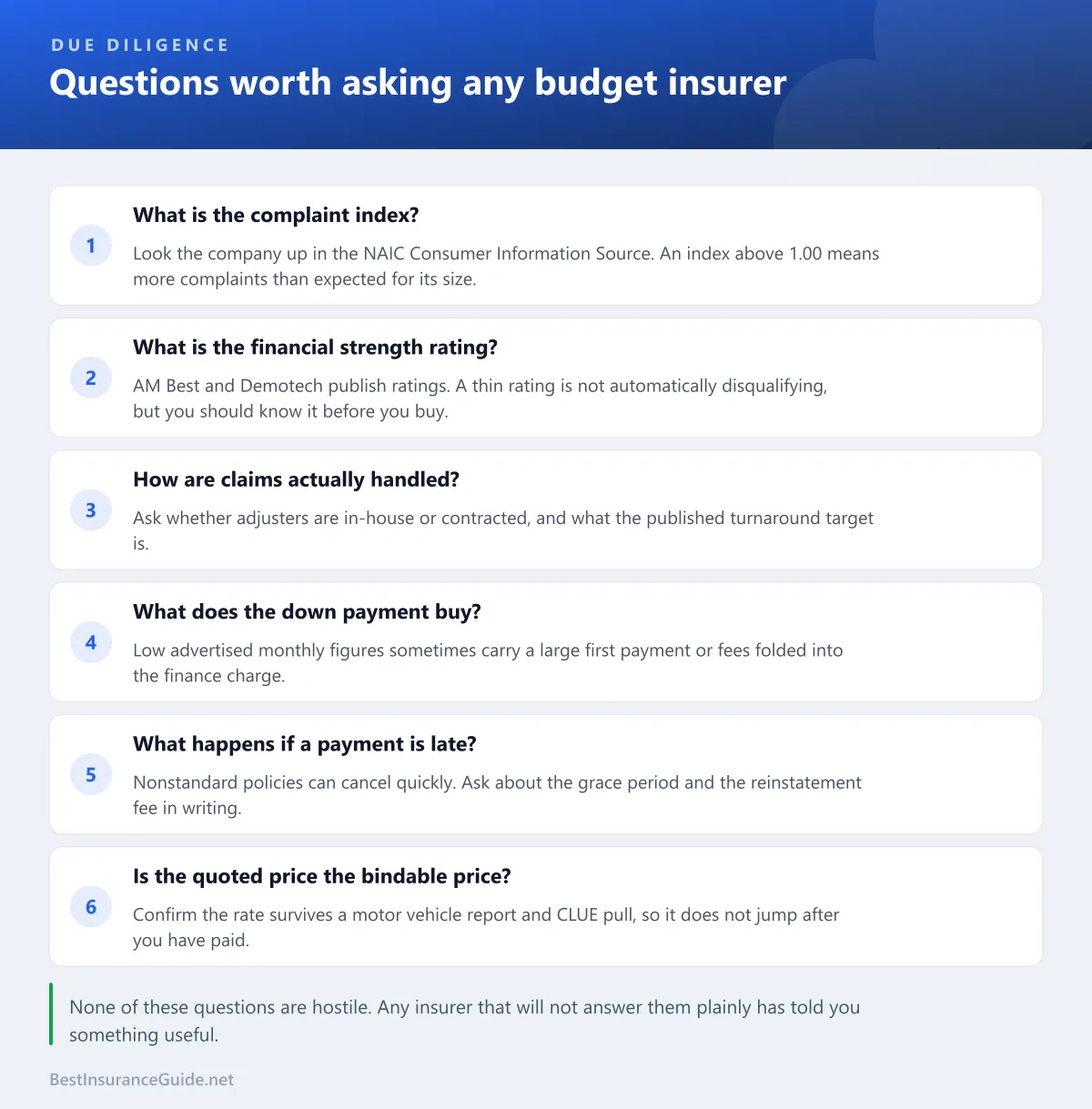
Two of those do most of the work.
The complaint index is the best free tool in insurance and hardly anyone uses it. The NAIC Consumer Information Source publishes one for every licensed insurer. It normalises complaint volume against market share, so a small regional carrier and a national giant compare fairly. 1.00 is exactly average for a company that size. Well above 1.00 tells you complaints are running disproportionate. This matters more in the nonstandard market than anywhere else, because claims service varies enormously down here.
The advertised monthly figure often isn’t the monthly cost.
Worked example: two quotes that look identical
Both advertise “from $89 a month.” Same driver, same coverage, same state.
| Carrier X | Carrier Y | |
|---|---|---|
| Advertised monthly | $89 | $89 |
| Down payment | $310 | $95 |
| Monthly instalments | 5 × $89 | 5 × $89 |
| Instalment fee | $9 per payment | $3 per payment |
| Policy fee | $65 | $25 |
| SR-22 filing fee, if needed | $45 | $25 |
| Six-month total | $910 | $605 |
Same headline. $305 apart over six months, or $610 a year. None of that is hidden or improper, it’s all disclosed. It’s just disclosed somewhere nobody reads, in a place the comparison sites don’t surface.
Ask every carrier for the total six-month or twelve-month cost with every fee included, and compare that number. It’s the only figure that means anything.
The trap worth knowing about
There’s one dynamic specific to this market that catches people, and it starts small.
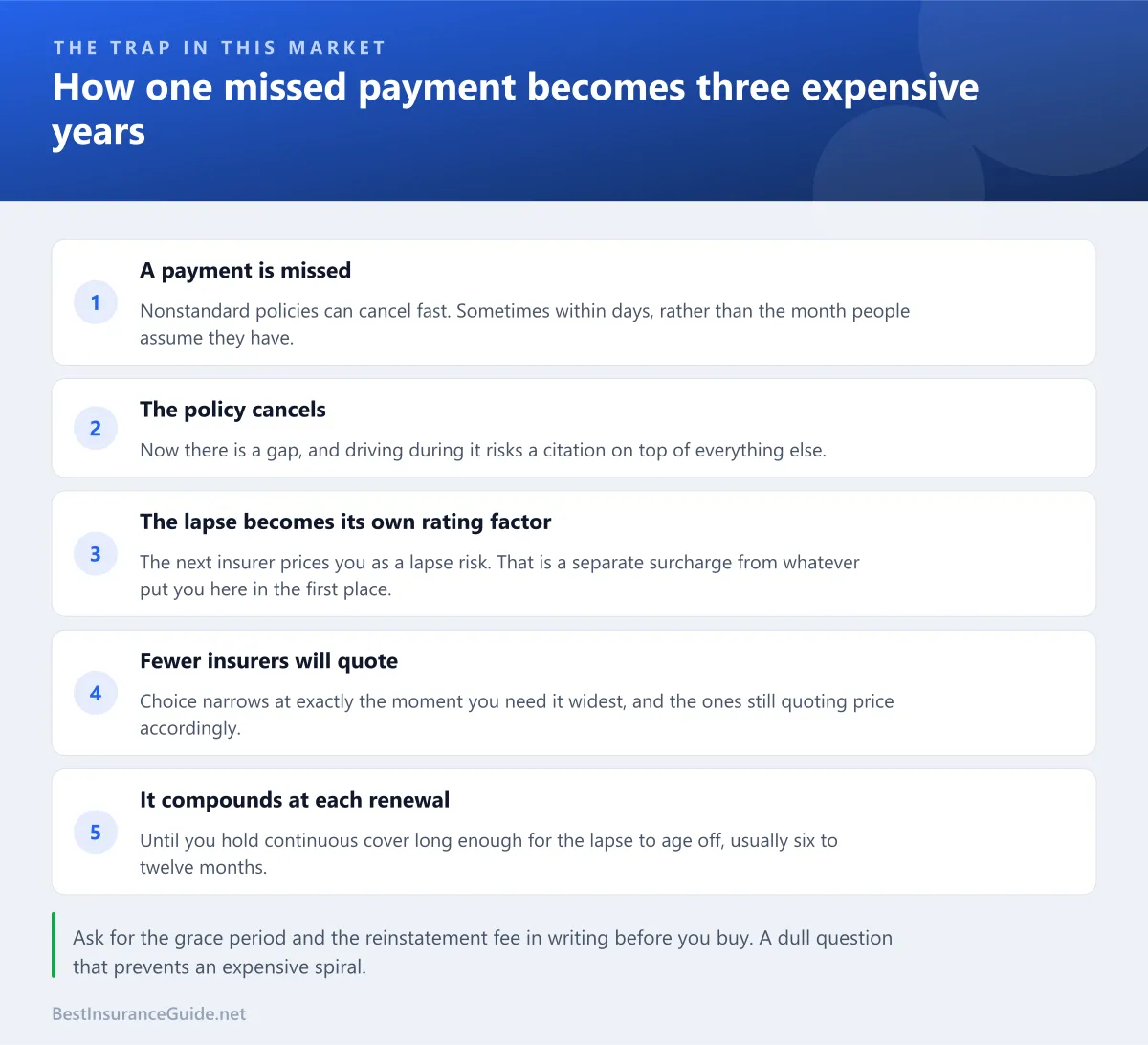
I’ve seen this cycle play out more than once, and it almost never starts with anything dramatic. It starts with a bad month.
Worked example: what one missed payment costs
A driver paying $1,690 a year misses a payment in March after an unexpected car repair.
- Policy cancels 12 days later. Reinstatement fee: $85
- She drives uninsured for 9 days while sorting it out
- The lapse now shows on her record. At renewal, the lapse surcharge adds 18%: $1,690 → $1,994
- Two carriers who previously quoted her now decline entirely
- Year two, lapse still within the lookback window, roughly +11%: about $1,850 against the $1,600 she’d otherwise be paying
- Two-year cost of one missed payment: roughly $640, on top of the $85 fee
The original missed payment was $141.
So ask two dull questions before you buy, and get the answers in writing: what’s the grace period, and what does reinstatement cost? Then put the payment date somewhere immovable. If the autopay fee is smaller than the reinstatement fee, and it nearly always is, take the autopay.
Nonstandard is meant to be temporary
Most of what put you here expires on a schedule:
| Factor | Typically stops affecting rates after |
|---|---|
| Speeding ticket or minor violation | 3 years |
| At-fault accident | 3 to 5 years |
| Coverage lapse | 6 to 12 months of continuous cover |
| DUI | 5 to 10 years, state dependent |
| Thin credit file | Improves gradually as the file builds |
Which makes the single most valuable thing you can do right now a calendar reminder.
Worked example: the graduation nobody tells you about
A driver enters the nonstandard market in 2023 after an at-fault accident, paying $2,340 a year. He renews without shopping for three years, because the renewal notice arrives and the price is roughly what he expects.
In 2026 the accident finally ages off his record. His nonstandard carrier reprices him to $2,050. He accepts it.
Had he re-quoted with mainstream carriers that year, his profile, now clean and with three years of continuous coverage, would have placed him around $1,310. He carries on paying $740 a year too much, and will keep doing so until something prompts him to check.
Nobody sends that prompt. The carrier has no reason to, and the mainstream insurers don’t know he exists.
Re-quote at every renewal, and specifically re-quote with mainstream carriers once you pass the anniversary of whatever moved you down here. Our guide to comparing quotes properly covers running that comparison so it means something, and car insurance for young drivers goes deeper if age is what’s pushing your rate up.