What Is Hazard Insurance on a Mortgage? And Is It the Same as Homeowners?
What is hazard insurance on a mortgage? It is the dwelling coverage inside your homeowners policy. How the two relate, what lenders require, and escrow.

Table of contents
If you are buying a house, at some point a document will demand proof of hazard insurance and you will wonder whether you were supposed to buy something you did not buy.
You almost certainly were not. Hazard insurance is not a product you shop for. It is a part of the policy you already have, and lenders use the older, narrower word because the narrower thing is all they care about.
The short answer
Hazard insurance is the dwelling coverage inside a homeowners policy. It pays to repair or rebuild the physical structure of your home after a covered peril: fire, wind, hail, lightning, falling trees, vandalism and the rest of the named list.
Homeowners insurance is the whole package. It contains the hazard portion plus everything else you need as a person who lives there rather than as a bank that lent against it.
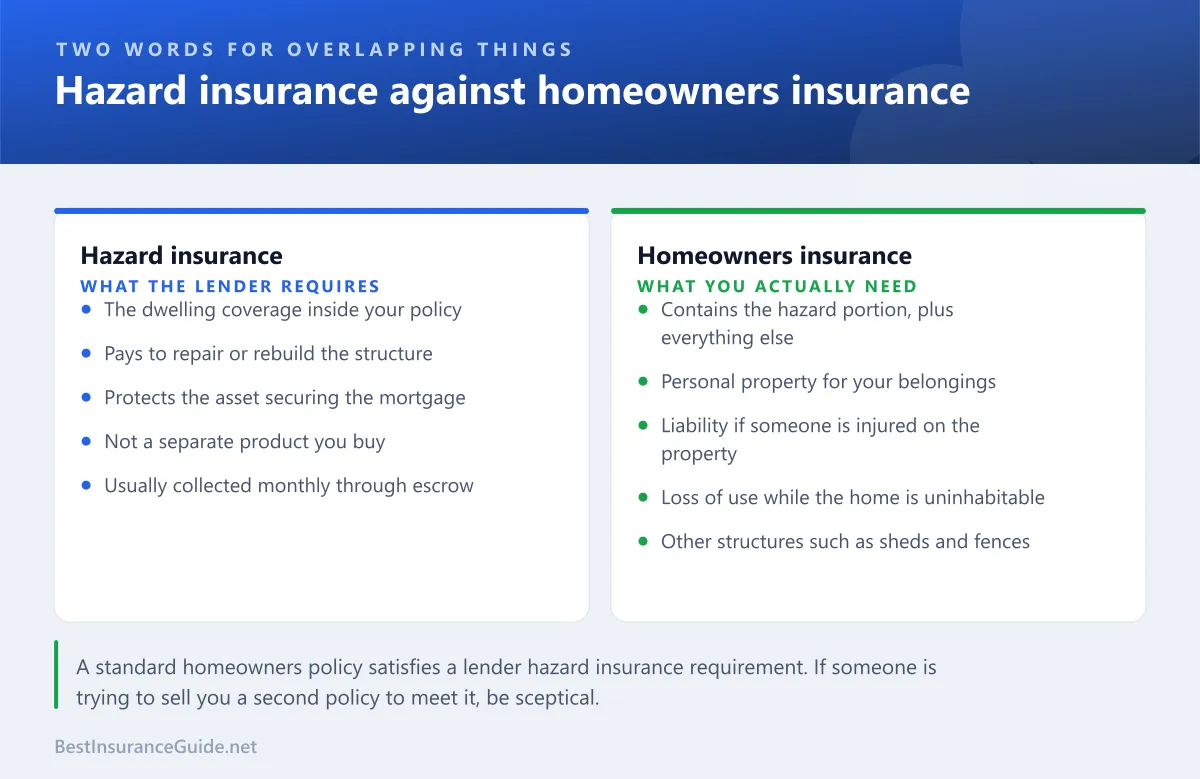
So when the closing paperwork asks for hazard insurance, a normal homeowners policy answers it. You do not need a second document, and you should be suspicious of anyone trying to sell you one.
Why lenders use that word
A mortgage lender’s exposure is very specific. They have money out against a building. If the building burns down, their security is gone.
They have no interest in your sofa, your liability if the postman slips on the path, or the hotel you stay in while the place is rebuilt. Those matter enormously to you and not at all to them. So their requirement is written around the structure alone.
That is the entire reason for the terminology gap. It is not a different kind of insurance. It is a different point of view on the same policy.
What a homeowners policy is actually made of
It helps to see the parts, because once you have, the lender’s language stops being confusing.
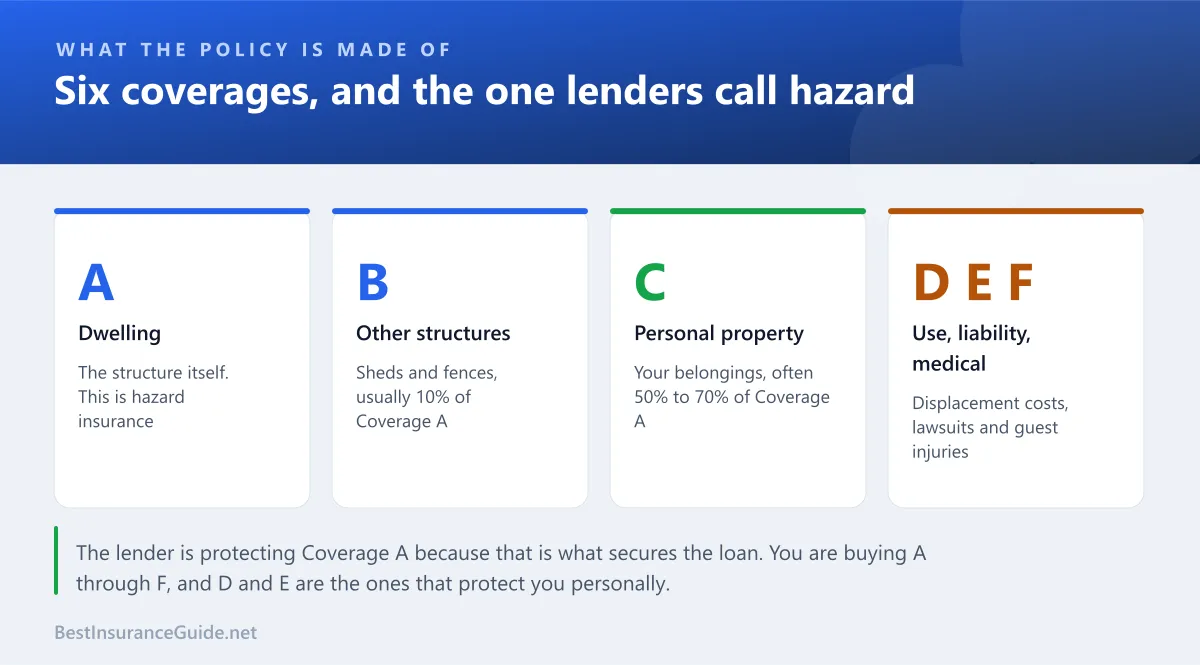
Coverage A, Dwelling. The house itself, plus anything attached: garage, deck, built-in appliances. This is hazard insurance.
Coverage B, Other structures. Detached items, so a shed, a fence, a standalone garage. Usually set automatically at 10% of Coverage A.
Coverage C, Personal property. Everything you own inside. Usually 50% to 70% of Coverage A by default.
Coverage D, Loss of use. Somewhere to live while the house is uninhabitable, plus the extra costs of being displaced.
Coverage E, Personal liability. If someone is hurt on your property or you damage someone else’s, this pays their costs and your legal defence.
Coverage F, Medical payments to others. A small no-fault amount for minor guest injuries.
The lender’s requirement touches A. You are buying A through F. Our guide to what home insurance actually covers goes through each of these in detail with worked claim examples.
The number that trips people up
Lenders sometimes phrase the requirement as “coverage at least equal to the loan amount,” and that sentence has cost a lot of homeowners a lot of money.
The right figure for Coverage A is replacement cost: what it would cost to rebuild this house, at today’s labour and materials prices, on the land you already own. That is not the purchase price, and it is not the market value, because neither of those figures excludes the land.
Worked example: the same house, three different numbers
| Figure | What it includes | |
|---|---|---|
| Market value | $610,000 | House, land, location, school district |
| Loan balance | $488,000 | Whatever you happened to borrow |
| Rebuild cost | $372,000 | Materials, labour, permits, debris removal |
Insuring this house to $610,000 means paying premium on $238,000 of land value that cannot burn down. Insuring it to $488,000 because that is what the lender asked for still overshoots by $116,000.
It runs the other way in cheaper markets. A house that sells for $180,000 in an area with high construction costs might need $290,000 to rebuild, and a policy written to the loan balance would leave the owner six figures short after a total loss.
Ask your insurer for their replacement cost estimate and check the assumptions behind it: square footage, finish quality, roof material and any custom work. That number, not the sale price, is what should be on the declarations page.
Escrow, and why the bill sometimes moves
Most lenders collect hazard insurance monthly alongside the mortgage payment and hold it in escrow, then pay the insurer annually on your behalf.
This is convenient and it obscures the cost. Two things follow.
Your monthly payment changes when the premium changes, even though the loan itself has not. An escrow analysis once a year reconciles what was collected against what was paid, and the resulting adjustment can move a payment by a noticeable amount.
And because you never write the cheque, it is easy to go years without shopping the policy. Premiums have risen sharply across most of the country, and an escrowed policy renewing on autopilot is one of the more expensive habits in personal finance. Our piece on insurance rate trends covers what has been driving those increases and how to tell a market rise from a problem with your own file.
You can shop it whenever you like. You send the new declarations page to the servicer, they update escrow, and the payment adjusts.
Force-placed insurance
If your policy lapses, is cancelled, or the lender never receives proof of it, they will buy cover themselves and add it to your loan.
This is worth avoiding with some energy. Lender-placed policies are typically several times the cost of a policy you arrange, and they cover the structure only. Your belongings, your liability and your living costs are not in it. You are paying more for less, and the “less” is the part that protects you personally rather than the bank.
It happens more often through administration than neglect: a policy switched insurers, the new declarations page never reached the servicer, and a notice went to an old address. If you change insurers, confirm in writing that the servicer received the new evidence.
What hazard insurance does not cover
The exclusions are the same as any homeowners policy, and two of them matter enough that lenders often require separate cover.
Flood. Excluded everywhere. If the property sits in a designated flood zone, the lender will require a separate flood policy, usually through the National Flood Insurance Program. Note that the zone determination is theirs, not yours, and it can be appealed if you believe it is wrong.
Earthquake. Excluded everywhere. A separate policy or endorsement, with its own deductible structure that is usually a percentage of the dwelling limit rather than a flat amount.
Also outside the policy: ordinary wear, maintenance failures, pest damage, and gradual leaks. Those are homeowner problems, not insurance events.
Before you close, or before you renew
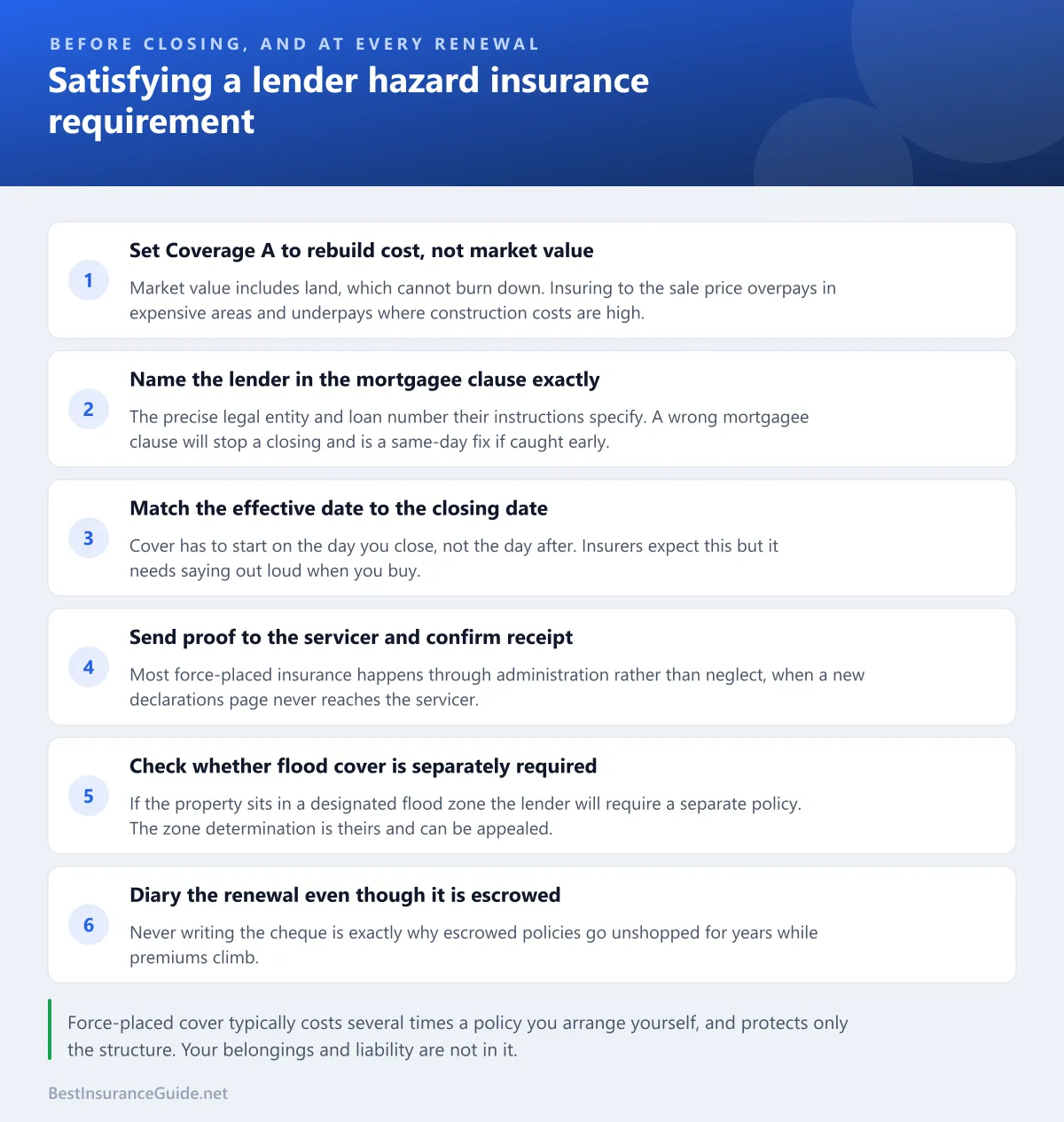
Two of those are the ones that actually go wrong.
The mortgagee clause. The lender must be named on the policy, with the exact legal entity and loan number their instructions specify. A policy that is perfect in every other way will be rejected at closing over a wrong mortgagee clause, and it is a same-day fix if you catch it early.
The effective date. Cover has to start on the closing date, not the day after. Insurers are used to this, but it needs saying out loud when you buy.
The short version
Hazard insurance is not separate from homeowners insurance. It is the dwelling portion of it, and it is the only portion your lender is protecting. Buy a normal homeowners policy, set Coverage A to the cost of rebuilding rather than the price you paid or the amount you borrowed, name the lender correctly, and send the proof to the servicer.
Then shop it every couple of years even though it is escrowed, because that is the single most reliable way to stop an autopilot premium quietly becoming the most expensive line in your mortgage payment.
If you are quoting now, how to compare insurance quotes explains which five fields have to match before two prices mean anything, and getting an accurate Allstate homeowners quote walks through the inputs that most often move a number between quote and underwriting.