Pet Insurance in Maine: The Highest Tick Burden and the Fewest Specialists
Pet insurance in Maine has to handle the country's heaviest tick exposure and limited specialist access. What to buy and why enrolling early matters most.

Table of contents

Maine is the clearest case in the country for insuring a dog early, and the reason has nothing to do with price.
What sets the price
Pet insurance reimburses a share of your actual vet bill, so premiums follow local veterinary costs.
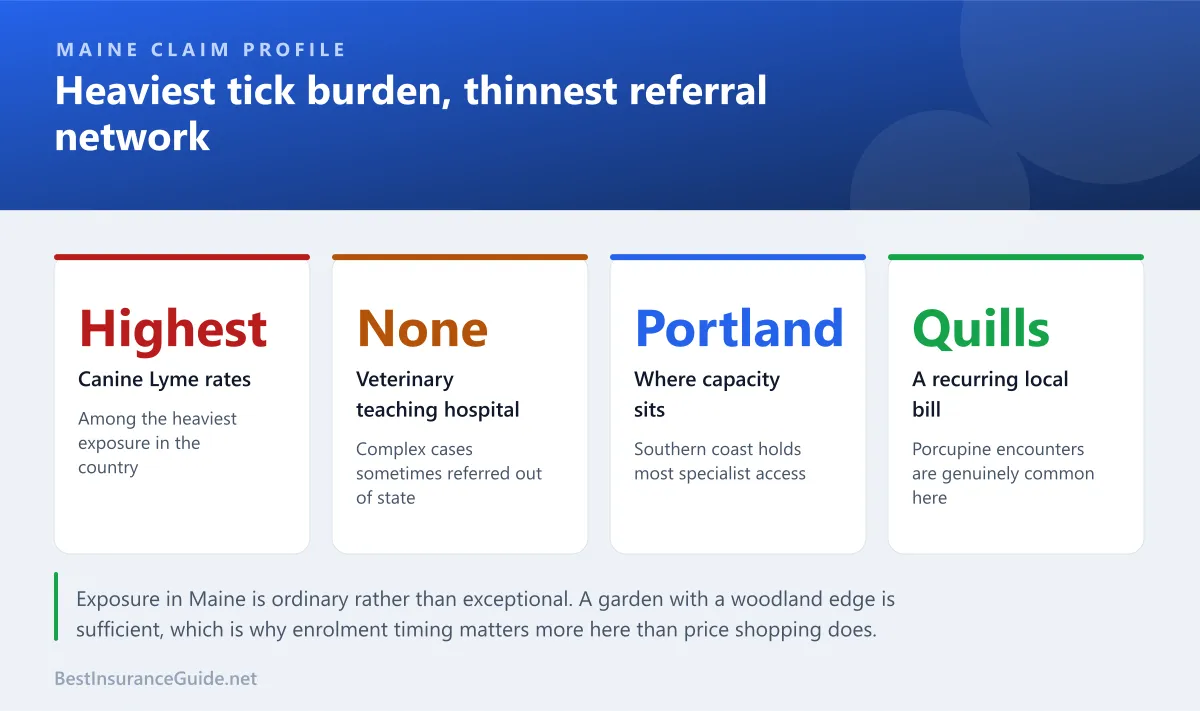
Portland and the southern coast price highest, following clinic overheads and the concentration of what specialist capacity the state has.
Northern and eastern Maine quote lower, tracking lower local practice pricing and a thinner referral market.
Maine sits around the middle nationally overall: below the Boston-adjacent markets to the south, above the rural Midwest. Our pet insurance by state guide covers why the ZIP code rather than the state line is the real rating factor.
The tick problem, which is not marginal here
Maine consistently records among the highest canine Lyme disease rates in the United States. The blacklegged tick is established across most of the state, and exposure is an ordinary fact of having a dog rather than a consequence of adventurous hiking. A garden with a woodland edge is sufficient.
Anaplasmosis travels with it, and appears frequently on the same panels.
Three consequences run through everything else in this article.
Treatment is covered; prevention is not. An acute Lyme or anaplasmosis case is a covered illness. Year-round tick preventives, the Lyme vaccine and annual screening are wellness items that core insurance does not touch.
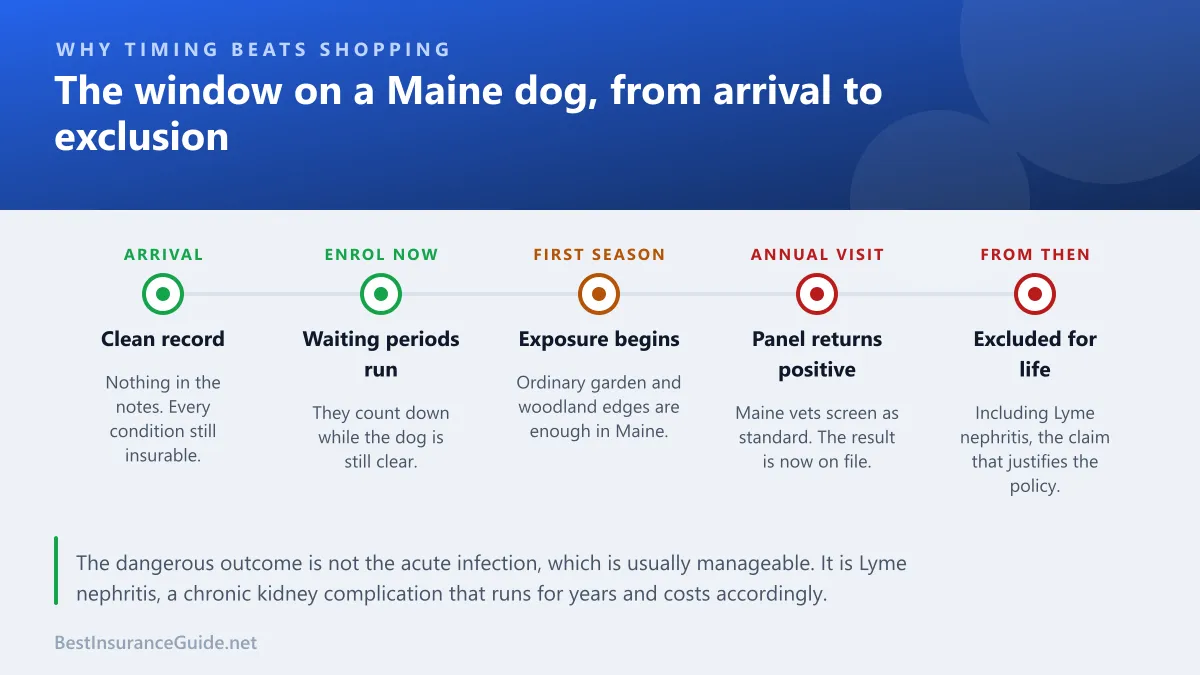
The expensive outcome is Lyme nephritis, a chronic kidney complication that is uncommon relative to simple infections but serious, long-running and costly. That is the scenario the policy genuinely exists for.
Routine screening closes the door. Maine vets test for tick-borne disease as a matter of course. A positive result recorded before you enrol excludes that condition permanently with essentially every insurer, whether or not the dog was ever ill.
That last point is why timing matters more in Maine than shopping does.
Worked example: Lyme nephritis, managed over two years
Policy: $500 annual deductible, 80% reimbursement, $10,000 annual limit.
| Item | Year one | Year two |
|---|---|---|
| Workup, bloods, urinalysis, tick panel | $760 | — |
| Hospitalisation with IV fluids | $2,900 | $1,400 |
| Internal medicine consultations | $320 | $290 |
| Renal medication and prescription diet | $1,340 | $1,410 |
| Quarterly monitoring bloods | $780 | $820 |
| Total | $6,100 | $3,920 |
| Less deductible | $500 | $500 |
| Reimbursed at 80% | $4,480 | $2,736 |
| Owner pays | $1,620 | $1,184 |
Two features of that table drive the buying advice below. The claim spans policy years, which makes the deductible type important. And prescription diets are a genuine ongoing cost that a meaningful number of policies exclude as food.
The rest of the Maine profile
Hard winters. Antifreeze poisoning is time-critical and expensive, and treatment is covered as toxin ingestion. Road salt causes paw irritation and gastrointestinal upset. Ice produces cruciate ligament tears and soft tissue injuries, which brings the orthopaedic waiting period into play: commonly six or twelve months on cruciate and hip conditions rather than the few days covering ordinary accidents.
Wildlife encounters. Porcupine quills are a genuinely common Maine claim, and quill removal under sedation is a recurring bill. Skunk, and in some areas larger wildlife, feature too.
Water hazards. Blue-green algae on Maine lakes and ponds in summer, rapidly dangerous and covered as toxin ingestion. Coastal dogs add saltwater ingestion and, occasionally, fish hook injuries.
Foreign body ingestion, the most common expensive emergency nationally and no less common here.
The access question
Maine has no veterinary teaching hospital, and referral capacity is concentrated around Portland. For much of the state, a complex case means a long drive, and some cases are referred out of state entirely.
Two implications for how you buy.
Travel is not covered. Pet insurance reimburses veterinary treatment, not fuel, accommodation or time. In a state this large with this few referral centres, that cost is real and sits outside every policy.
Buy a limit that survives referral pricing. A specialist workup is not priced like a rural general practice visit. A $5,000 annual cap that looks generous against local pricing can be thin once a case escalates.
How to buy in Maine
Match four fields before comparing any premium: the annual limit, the deductible and whether it is annual or per condition, the reimbursement percentage, and the waiting periods.
Four Maine leanings, in order of importance.
Enrol before the first tick season. Nothing else in this article matters as much.
Prefer an annual deductible. Chronic tick complications and renal management span years, which is exactly where per-condition designs cost more.
Confirm prescription diets and chronic conditions carry across renewals. Renal diets are a substantial ongoing cost, and a small number of policies treat a condition as pre-existing at each anniversary, which makes them close to useless for anything chronic.
Check the orthopaedic waiting period before winter.
Vaccines, prevention and wellness riders
Core pet insurance covers neither vaccines nor neutering, and does not cover tick preventives. All are preventive or elective.
Maine’s preventive load is heavy and, unusually, close to mandatory in practical terms:
| Preventive item | Typical annual cost |
|---|---|
| Year-round tick and flea preventive | $220 to $320 |
| Lyme vaccine, series then annual booster | $60 to $110 |
| Annual tick-borne disease screening | $50 to $90 |
| Core vaccinations and boosters | $90 to $160 |
Every Maine owner should be carrying most of that regardless of whether they insure. Whether a wellness rider is worth buying is arithmetic: total the published allowances, subtract the rider premium, and buy only if the result is positive for care you would purchase anyway. It tends to break even in a puppy’s first year and lose money afterwards.
Do not confuse the products. The rider smooths a few hundred predictable dollars. The policy underneath is for the $6,100 year.
Regulation
Pet insurance in Maine is regulated by the Maine Bureau of Insurance as a property and casualty line rather than as health insurance. That is why it reimburses rather than operating a network, so any licensed vet works, including out-of-state referral centres.
A growing number of states have adopted rules based on the NAIC Pet Insurance Model Act, standardising how waiting periods, pre-existing conditions and exam requirements are disclosed. Check the Bureau’s current position rather than assuming.
Read the pre-existing condition definition yourself in any case. In a state where routine screening frequently returns positive results, that clause is doing more work than anywhere else in the contract.
The mistakes that cost Maine owners money
Waiting until after the annual tick panel. The single most expensive scheduling error available in this state.
Choosing a per-condition deductible because it quoted lower. Chronic renal management is precisely what that design punishes.
Assuming prescription diets are covered. Ask specifically.
Buying a low annual limit because local pricing is modest. Referral pricing is not local pricing.
Cancelling as the premium rises with age. Raise the deductible or lower the reimbursement percentage instead. Both preserve the enrolment date, which in Maine is worth more than in almost any other state.
A note on the figures
Premiums and treatment costs here are illustrative, drawn from typical ranges rather than any single insurer’s rate filing. Actual pricing depends on your ZIP code, the species, breed and age of the animal, and the limits chosen, and veterinary charges differ between general practice and referral centres. Quote your own circumstances and read the policy wording rather than the summary.
Insuring an older dog you already have
Plenty of Maine owners come to this after years without cover, and the options narrow with age without closing entirely.
Most insurers cap new accident and illness policies somewhere between ten and fourteen depending on the company and sometimes the breed. Above that, accident-only cover is often still available.
Everything in the notes is excluded, and for a Maine dog of eight or nine that has been screened annually, tick-borne disease is very likely on that list. Read the proposed exclusions before paying anything, because the value of the policy is entirely what remains.
Accident-only cover is underrated here. It costs considerably less, it cannot be undermined by a long medical history, and it covers the fracture, the laceration, the porcupine encounter and the road accident. For an older Maine dog with tick history already recorded, it is frequently the honest recommendation.
Compare against self-insuring. With extensive exclusions, putting the premium into a dedicated account can genuinely be better. The test is whether you would leave the money alone, and whether you could absorb a bad month before the fund had grown.
Worked example: the same dog, two enrolment ages
| Enrolled at 12 weeks | Enrolled at 9 years | |
|---|---|---|
| Accident and illness available | Yes | Sometimes, with exclusions |
| Tick-borne disease covered | Yes | Almost certainly not |
| Indicative monthly premium | $40 | $101 |
| Orthopaedic waiting period | Runs while healthy | Runs while already at risk |
| Practical value | High | Depends entirely on the exclusions |
That table is the argument for enrolling early, and in Maine it is stronger than in almost any other state.
A note on figures and sources
Premiums and treatment costs in this article are illustrative, drawn from typical ranges rather than any single insurer’s rate filing. Actual pricing depends on your ZIP code, the species, breed and age of the animal, and the limits chosen, and charges differ between general practice and out-of-state referral centres.
Tick distribution and canine disease prevalence shift year to year. The Companion Animal Parasite Council publishes regularly updated county-level prevalence maps for Lyme, anaplasmosis and ehrlichiosis, and Maine’s own public health surveillance tracks tick expansion across the state. Both are more current than any article, and your own veterinarian will know what is actually presenting locally.
Quote your own postcode and read the policy wording rather than the marketing summary before relying on any figure here.
Multi-pet households
Multi-pet discounts of roughly five to ten per cent per additional animal are widely available. Ask for it, but never delay an enrolment to arrange one, because in Maine the enrolment date is worth considerably more than any discount.
Enrol each animal separately and early. In a state where routine screening frequently returns positive tick panels, the difference between insuring at ten weeks and at ten months is the difference between a policy that covers the expensive condition and one that never will.
Comparable states
Maine pairs heavy canine Lyme exposure with limited referral access. Connecticut carries the tick burden with far better access and much higher prices, while Iowa shows the access problem without the tick pressure. Minnesota sits closest on both.
The short version
Maine carries among the heaviest canine tick burdens in the country and has limited referral capacity to deal with what follows. Those two facts together make it a strong state for insuring a pet and a very unforgiving one for delaying.
The risk is not the accident you are imagining. It is a routine tick panel returning positive before you enrolled, permanently excluding the condition most likely to cost you money.
Enrol before the first tick season, choose an annual deductible, confirm chronic conditions and prescription diets are covered across renewals, and buy a limit that survives referral pricing rather than local pricing.
For lifetime costs and how premiums climb with age, see the pet insurance cost guide.