Pet Insurance in Louisiana: Heartworm Country and Hurricane Season
Pet insurance in Louisiana: the country's heaviest heartworm belt, year-round parasites, and what a policy does and does not do in hurricane season.

Table of contents
Louisiana asks two different things of a pet owner. One is a year-round parasite problem that insurance handles well. The other is an annual evacuation risk that insurance does not touch at all.
What sets the price
Pet insurance reimburses a share of your actual vet bill, so the premium follows local veterinary pricing rather than anything about your animal.
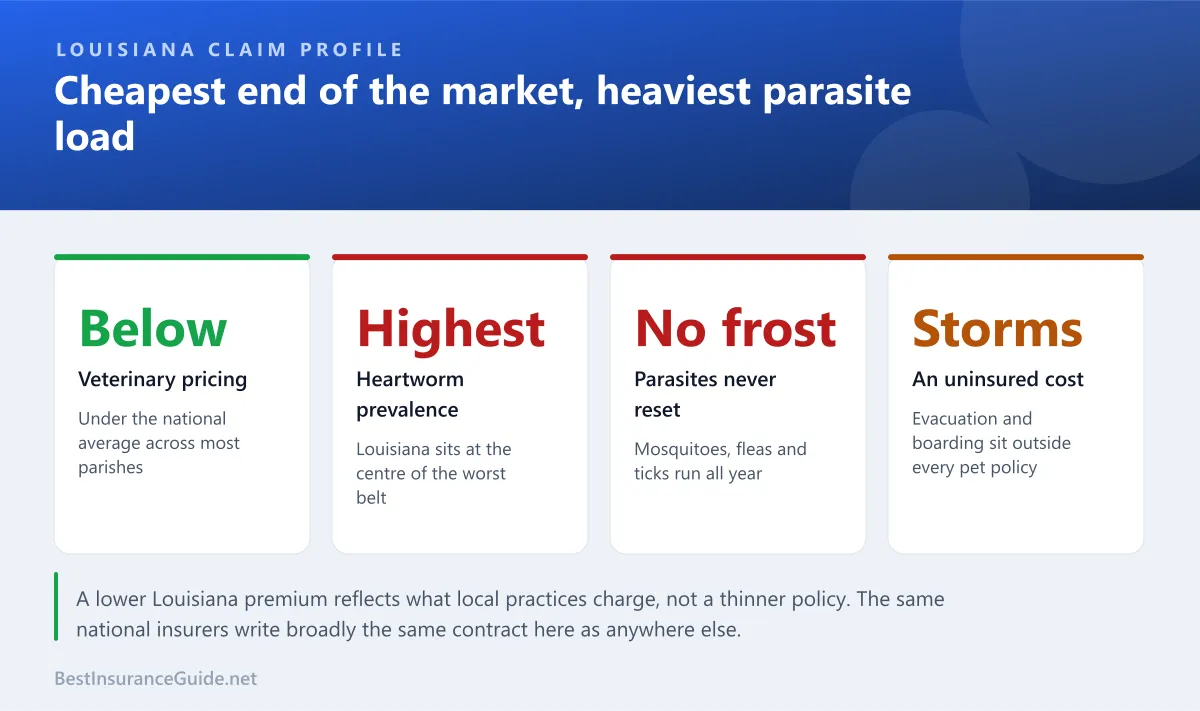
Louisiana veterinary pricing runs below the national average, which is the main reason quotes here sit toward the cheaper end. That is a cost-of-care difference rather than a coverage difference: the same national insurers write broadly the same contract in Louisiana as in Connecticut.
New Orleans and Baton Rouge price above rural parishes, following clinic overheads and the concentration of emergency and referral capacity. LSU’s veterinary teaching hospital in Baton Rouge provides genuine specialist access, and where referral care is available more cases escalate to it.
Rural parishes are cheapest, with the trade being longer drives to specialist care.
Our pet insurance by state guide covers why the spread inside a state routinely exceeds the difference between two states.
Heartworm, at the centre of the worst belt in the country
Louisiana sits at the heart of the region with the highest canine heartworm prevalence in the United States. Mosquito activity is effectively continuous, so the transmission window is not a season here, it is the whole calendar.
The insurance position is worth stating plainly, because it is the single most misunderstood thing about pet insurance in the South:
Prevention is not covered. Monthly heartworm preventive is a wellness item that core insurance does not pay for.
Treatment is covered, provided the dog was clear at enrolment and past the waiting period.
A dog that arrives positive is excluded for that condition permanently, by essentially every insurer.
That last point matters enormously in Louisiana, where rescue and shelter intake positivity rates are meaningfully higher than the national average. If you are adopting, the sequence is: adopt, test, treat if needed, gather the records, then insure. Doing it the other way around converts a treatable condition into an uninsurable one.
Worked example: adulticide heartworm treatment
A four-year-old dog diagnosed at routine screening. Policy: $500 annual deductible, 80% reimbursement.
| Item | Cost |
|---|---|
| Diagnostic testing and confirmation | $200 |
| Chest radiographs and bloodwork | $460 |
| Doxycycline and pre-treatment stabilisation | $250 |
| Staged melarsomine injections | $1,140 |
| Hospitalisation and monitoring across the series | $620 |
| Follow-up testing at six and nine months | $280 |
| Total | $2,950 |
| Less deductible | $500 |
| Reimbursed at 80% | $1,960 |
| Owner pays | $990 |
Treatment runs across months, so it can straddle a policy anniversary and a second deductible. Prevention costs a small fraction of this and remains the correct answer; insurance is the backstop for the dose that was missed or the rescue that arrived positive.
The rest of the year-round problem
With no meaningful frost, Louisiana’s parasite pressure never resets.
Flea allergy dermatitis is the most common chronic claim in the Gulf South. Continuous flea pressure produces recurring skin disease, secondary infections and repeated consultations. It is chronic, and that drives one specific buying decision: take an annual deductible rather than a per-condition one. A per-condition design looks cheaper on the quote and costs more across three years with a chronically itchy dog.
Tick-borne illness here skews toward ehrlichiosis and Rocky Mountain spotted fever rather than the Lyme disease that dominates the Northeast. Both are covered as illness, and both appear on panels Louisiana vets run routinely, which creates the same pre-existing condition trap.
Intestinal parasites. Hookworm burdens in warm, humid soil are high, and hookworm in particular can cause serious anaemia in puppies.
Leptospirosis. Louisiana’s combination of standing water, flooding and rodent populations sustains lepto well, and urban New Orleans is no exception. It attacks kidneys and liver, and severe cases mean hospitalisation, aggressive fluid therapy and sometimes dialysis referral. Treatment is covered; the vaccine is preventive and is not.
Heat injury. Louisiana summers combine heat and humidity in a way that makes heat stroke genuinely dangerous, and brachycephalic breeds are heavily over-represented. Severe cases are multi-day intensive care admissions.
Snake bites. Cottonmouths, copperheads, rattlesnakes and coral snakes are all present. Antivenom is expensive, frequently multiple vials, alongside hospitalisation. Covered as an accident.
Water hazards. Blue-green algae on slow water in summer, and drowning or exhaustion injuries in bayou and river country.
Hurricane season, and the gap insurance leaves
This is the part where owners reasonably expect pet insurance to help and it does not.
Injuries are covered. Lacerations from debris, fractures, trauma and toxin exposure during or after a storm are all accidents and claimable.
Displacement is not. Boarding your animals while you are out of the house, emergency transport, evacuation costs and relocation sit entirely outside pet insurance. Those belong to the loss-of-use section of a homeowners or renters policy, and our renters insurance guide covers how those costs are handled.
Lost or missing animals are generally not covered either, though a small number of policies include a modest advertising and reward benefit.
Since 2006, federal law has required state and local emergency plans to account for household pets and service animals in evacuation planning, which changed the picture considerably from where it stood before. But planning that exists at the emergency-management level is not the same as a policy that reimburses you, and the practical arrangements are still yours to make.
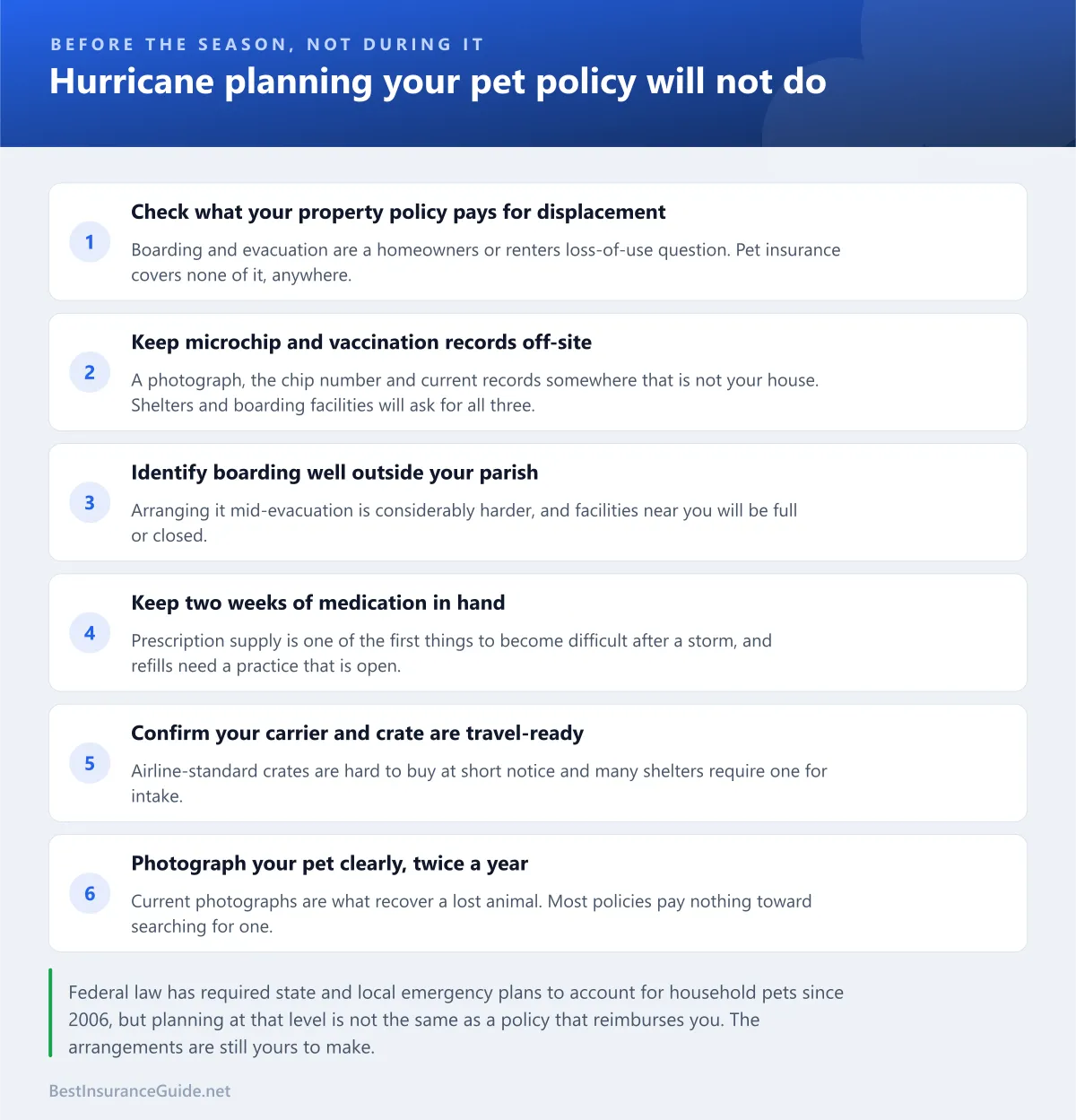
Three things worth doing before the season rather than during it. Confirm what your homeowners or renters policy pays for displacement, because that is the policy that covers boarding. Keep a current photograph, the microchip number and vaccination records somewhere accessible that is not your house. And identify a boarding facility or a friend well outside your parish in advance, because arranging it mid-evacuation is considerably harder.
How to buy in Louisiana
Match four fields across every quote before comparing a premium: the annual limit, the deductible and whether it is annual or per condition, the reimbursement percentage, and the waiting periods.
Three Louisiana leanings.
Prefer an annual deductible, strongly. Flea allergy dermatitis, chronic skin infections and tick-borne disease are all recurring here.
A moderate annual limit goes further. Because Louisiana vet costs are lower, a $10,000 limit stretches noticeably further than the same limit in a high-cost metro. That is a genuine advantage of insuring here.
Check whether exam fees are reimbursed. A dog with chronic skin disease generates a long run of consultations, and insurers split roughly evenly on whether the consultation itself is claimable. Across a few years that runs to several hundred dollars.
Vaccines, prevention and wellness riders
Core pet insurance covers neither vaccines nor neutering, and it does not cover heartworm, flea or tick prevention. All are preventive or elective.
Louisiana’s preventive load is among the heaviest in the country:
| Preventive item | Typical annual cost |
|---|---|
| Year-round heartworm prevention | $120 to $220 |
| Year-round flea and tick prevention | $200 to $320 |
| Annual heartworm and tick-borne disease testing | $60 to $110 |
| Leptospirosis vaccine and core boosters | $110 to $190 |
| Total | $490 to $840 |
Every Louisiana owner should be carrying most of that whether or not they insure. Whether a wellness rider is worth buying is arithmetic rather than principle: total the insurer’s published allowances, subtract the rider premium, and buy only if the result is positive for care you would purchase anyway. It tends to come out ahead in a puppy’s first year, when the vaccination series and the neuter land alongside everything above, and to lose money afterwards.
Do not confuse the two products. The rider smooths a predictable few hundred dollars. The policy underneath is for the $3,000 heartworm treatment or the $7,000 foreign body surgery.
Regulation
Pet insurance in Louisiana is regulated by the Louisiana Department of Insurance as a property and casualty line rather than as health insurance. That structure is why it reimburses you after the fact and why there is no provider network: any licensed vet works, including LSU.
A growing number of states have adopted rules based on the NAIC Pet Insurance Model Act, standardising how waiting periods, pre-existing condition definitions and exam requirements are disclosed. Adoption has been moving quickly, so check the Department’s current position rather than assuming a particular protection applies.
Read the pre-existing condition definition yourself regardless. It varies more between insurers than any other term and it decides most declined claims.
The mistakes that cost Louisiana owners money
Enrolling after the annual heartworm test. Louisiana vets test annually as standard, and a positive result on file closes that condition permanently.
Insuring a rescue before testing. Test and treat first if you want any chance of heartworm remaining insurable.
Choosing a per-condition deductible. Chronic skin disease is the single most likely recurring claim in this state.
Assuming pet insurance covers evacuation. It does not, anywhere. Check your homeowners or renters loss-of-use cover instead.
Skipping prevention because there is a policy. Insurance does not pay for prevention, and prevention is dramatically cheaper than every treatment described above.
Cancelling as premiums rise with age. Raise the deductible or lower the reimbursement percentage instead. Both keep the enrolment date, which is the asset you have been paying to build.
Cats in Louisiana
Cats cost substantially less to insure than dogs here, and their expensive claims differ: urinary blockage, chronic kidney disease in older cats, hyperthyroidism, dental disease and foreign body ingestion.
Two Louisiana notes. Feline heartworm exists and is harder to manage than the canine form, because the adulticide protocol used in dogs is not safe in cats; prevention carries more weight for that reason and remains a wellness item. And outdoor cats in the warm months carry heavy flea burdens and abscesses from fight wounds, both common claims.
A male cat with a urinary blockage is a genuine emergency with a four-figure bill and no warning, which justifies cover on a strictly indoor cat by itself.
A note on figures and sources
Premium and treatment figures here are illustrative, drawn from typical ranges rather than any single insurer’s rates. Actual pricing depends on your ZIP code, the species, breed and age of the animal, and the limits chosen, and veterinary charges differ meaningfully between practices in the same parish.
Heartworm and tick-borne disease prevalence shift over time. The American Heartworm Society and the Companion Animal Parasite Council both publish regularly updated county-level prevalence maps, and both are more current than any article. Your own veterinarian remains the best guide to what is actually presenting locally.
Comparable states
Louisiana’s parasite burden is shared along the Gulf and its evacuation exposure is not. Alabama and Florida carry comparable year-round parasite pressure, and Florida shares the annual storm planning problem that no pet policy answers.
The short version
Louisiana is comparatively cheap to insure a pet in and genuinely demanding to keep a pet healthy in, because there is no winter to interrupt the parasite cycle and the state sits at the centre of the country’s worst heartworm belt.
Treatment is covered for heartworm, tick-borne illness, leptospirosis, heat injury and snake bites. Prevention for none of them. And nothing in a pet policy covers hurricane evacuation or boarding, which is a homeowners or renters question you should settle before the season.
Buy an annual deductible, check whether exam fees are reimbursed, enrol before the next annual heartworm test, and keep paying for prevention regardless.
For lifetime cost expectations and how premiums climb with age, see the pet insurance cost guide.