Mart Insurance: What People Are Actually Searching For
There's no single Mart Insurance company. What the name refers to, how agency types differ, and a ten-minute check that works on any local agency.

Table of contents

If you searched for “mart insurance” expecting to find a company, the reason you found something confusing is simple. There isn’t one.
There’s no national insurer by that name. What exists is a scattering of unrelated local agencies that happen to share a word, and a search engine lumping them together. Which means the useful question isn’t “is Mart Insurance any good,” because that question has no answer. It’s “how do I evaluate the local agency I’m actually looking at.”
Both are covered below. First what the name refers to, then the part that transfers to any agency anywhere.
What the name actually refers to
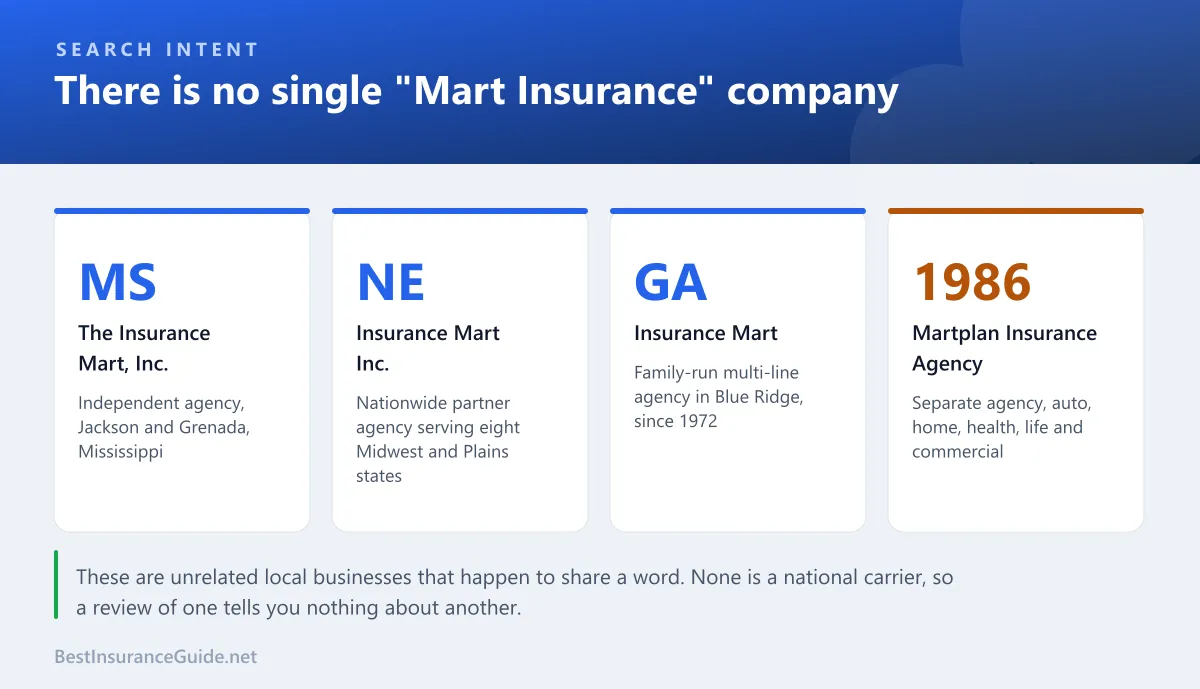
These are separate businesses with separate owners, separate carrier relationships and separate service records. They’re not branches of anything. The word “mart” in an agency name is a marketing choice from an era when it signalled “we carry several brands, like a store,” the same instinct behind names like Insurance Depot or Insurance Center.
So if you’re researching one, search the specific legal name plus the city. A general search keeps mixing them, and any review you read may be about a business a thousand miles from the one you mean.
There’s a second reason people land here: confusion with retailer-branded insurance. Large retailers in various countries have offered own-brand policies, and shoppers sometimes half-remember a “mart” connection. In the United States no major retailer currently underwrites its own home or auto insurance. Where retailer-branded policies exist, they’re white-labelled products from conventional insurers.
Agency, broker, carrier: who holds your policy
This trips up more people than it should, and it matters when something goes wrong.
The carrier, sometimes called the underwriter, takes the risk, sets the rate and pays claims. Nationwide, Travelers, Progressive and so on.
The agency sells and services the policy. It’s your point of contact. It doesn’t pay your claim.
Buy from an agency called Insurance Mart and your policy is with whichever carrier they placed you with. The agency’s job is choosing well among the carriers it represents and helping you when you claim. The carrier’s job is paying.
Which means judging an agency means judging two things: which carriers it can access, and how well it serves you.
Worked example: same agency, three carriers
An independent agency quotes one customer across the carriers it’s appointed by. Identical coverage, same day.
| Carrier | Annual premium | NAIC complaint index | AM Best |
|---|---|---|---|
| Carrier 1 | $1,880 | 0.68 | A |
| Carrier 2 | $1,740 | 2.94 | B++ |
| Carrier 3 | $2,090 | 0.51 | A+ |
The agency is the same in all three rows. The experience you’d have at claim time is not. A good agent walks you through exactly this table and explains why they’d recommend Carrier 1 over the cheapest option.
An agent who only shows you the $1,740 figure isn’t necessarily doing anything wrong, but they’re leaving the most useful part of their job undone.
Three ways to buy the same policy
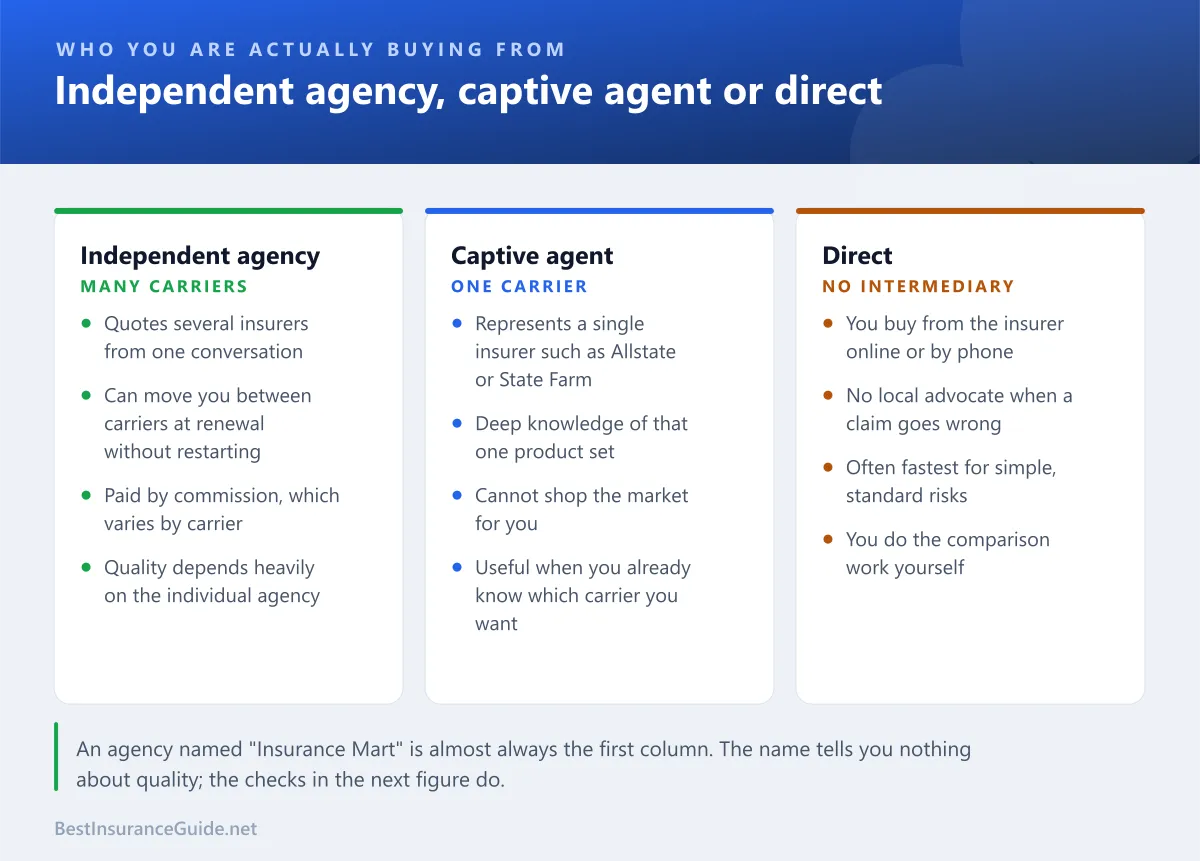
An agency with “Mart” in the name is almost always the first column: independent, representing several carriers.
That model has an advantage people underrate. At renewal, when your carrier raises rates, an independent agency can move you to another carrier without you restarting the whole shopping process.
Worked example: ten years of renewals
A homeowner in a hardening market, comparing two paths.
| Detail | Stays put, renews annually | Independent agency re-markets each year |
|---|---|---|
| Year 1 | $1,900 | $1,900 |
| Year 3 | $2,340 | $2,110 (moved carrier once) |
| Year 6 | $3,020 | $2,480 (moved again) |
| Year 10 | $3,880 | $2,990 |
| Ten-year total | $27,400 | $23,100 |
$4,300 over a decade, and not because the agency found magic rates. It’s because they removed the friction that causes most people to accept increases they’d never accept if switching were easy.
The corresponding weakness is that quality varies enormously. A captive agent for a large insurer works inside a system with training standards and oversight. An independent agency is a small business, exactly as good as the people in it. Which is why the verification below matters more here than anywhere.
How to verify any local agency in ten minutes
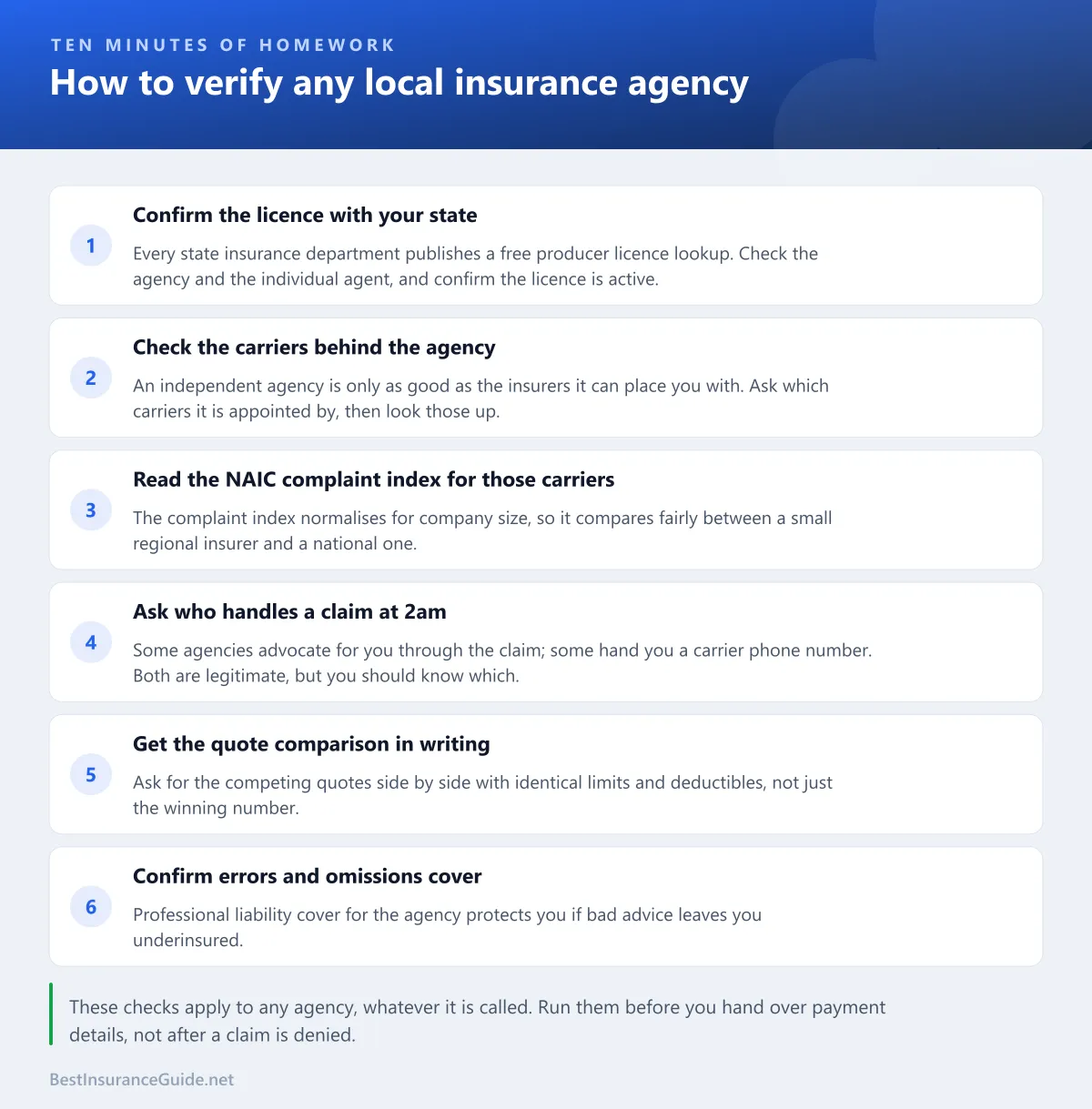
Three of those deserve a note.
The licence lookup is free and fast. Every state insurance department runs one. Search the agency and the named agent, confirm the licence is active, and confirm it covers the line you’re buying. Property and casualty is a different licence from life and health. If a licence has lapsed, or the person you’re dealing with isn’t on it, stop there.
Ask which carriers the agency is appointed by, then research those. This separates a useful independent agency from a nominal one. An agency with access to eight carriers can genuinely shop for you. An agency with two is a captive agent without the training. Once you have the names, run each through the NAIC Consumer Information Source, because the number that matters at claim time attaches to the carrier, not the agency.
Ask who handles the claim. Some independent agencies advocate for you through a disputed claim: they know the adjuster, they escalate, they push. Others hand you an 800 number and step back. Both are legitimate business models, both are priced into the same premium, and you should know which you’re buying. Ask directly: “if my claim is denied, what do you do?”
What a good agency is worth
There’s a fair question underneath all this. In a market where you can buy auto insurance on your phone in four minutes, why use an agency at all?
For a simple risk, one car, renting a flat, nothing unusual, often you shouldn’t. Direct is faster and the advice premium buys little.
Agencies earn their place when the risk stops being simple:
- A home with something unusual about it: a wood stove, a pool, a detached workshop, an older roof, a short-term rental arrangement
- A small business, or any commercial activity run from home
- A claims history making placement genuinely hard
- Something needing scheduling: jewellery, art, a collector vehicle, a custom motorcycle
- Enough assets to need an umbrella policy sitting correctly over the underlying limits
Worked example: where the advice pays for itself
A homeowner with a detached workshop, a wood-burning stove and $34,000 of tools bought a policy online because it was $240 cheaper.
| Item | Online policy | What an agent would have flagged |
|---|---|---|
| Other structures limit | 10% default, $31,000 | Workshop rebuild alone is $48,000 |
| Wood stove | Not declared | Undeclared solid fuel can void a fire claim |
| Tools | Under standard contents | Business tools need a separate schedule |
| Annual saving | $240 | |
| Potential uncovered exposure | $50,000+ |
None of those questions appear on a standard online quote form. That’s the entire case for an agent, and it only applies when the risk actually has features worth asking about.
For a straightforward risk, our guides to insurance basics and comparing quotes properly will get you there on your own.
Vetting any local agency in ten minutes
The name on the door tells you very little. These checks tell you most of what matters, and none of them take long.
Confirm the licence. Every state insurance department publishes a licensee lookup. Search the agency and the individual agent. An unlicensed or lapsed producer is a hard stop.
Check for disciplinary actions in the same database. Departments publish enforcement actions, and they are the most reliable signal available.
Ask which insurers they represent. An independent agency should name several. A captive agent represents one, which is fine if you know it, and a problem if you assumed otherwise.
Ask how they are paid. Commission from the insurer is normal and not a concern in itself. What matters is whether they will tell you plainly.
Check the insurer’s financial strength, not just the agency’s reputation. AM Best and similar ratings are published, and a well-run agency placing you with a weak carrier is still a problem.
Look at the complaint index. The NAIC publishes complaint ratios by insurer, which is a far better guide than online reviews of the agency.
Worked example: what the checks surfaced
| Check | Result |
|---|---|
| State licence lookup | Active, individual agent licensed |
| Disciplinary record | None |
| Carriers represented | Four, all rated A- or better |
| NAIC complaint index | Below average for two, above for one |
| Outcome | Placed with one of the two lower-complaint carriers |
Fifteen minutes of public-record checking produced a better decision than any amount of reading reviews.
Finally, get the quote in writing with the coverage detail attached, not just a monthly figure. A price without the limits behind it is not a quote, and comparing two of them tells you nothing. Our guide to comparing insurance quotes sets out the fields that have to match.
Independent agent, captive agent or direct
Understanding which of the three you are dealing with explains most of what happens in the conversation.
Independent agents represent several insurers and can place you with whichever fits. They are useful when your situation is unusual, when you need several policies coordinated, or when you have been declined elsewhere. They are paid commission by whichever insurer they place you with.
Captive agents represent one insurer. Their advice within that insurer’s products can be excellent, but they cannot tell you that a competitor would be cheaper. Nothing dishonest about it; just know the boundary.
Direct insurers have no agent at all. You deal with the company online or by phone. Often the lowest price for a straightforward risk, and the least helpful when something about your situation is complicated.
Brokers legally represent you rather than the insurer, a distinction that matters more in commercial lines than in personal ones.
Worked example: matching the channel to the need
| Situation | Best channel |
|---|---|
| Clean record, standard car and home | Direct, or an independent for bundling |
| Prior claims, an SR-22, or a decline | Independent with nonstandard markets |
| Older or unusual property | Independent |
| Small business with several policies | Independent or broker |
| Simple renters policy | Direct |
None of these channels is better in general. They are better at different things, and the mismatch, taking a complicated risk to a direct insurer or a simple one to a full-service agency, is what produces frustration on both sides.
Related reading
For the underlying decisions any agency will ask you about, insurance guide 101 covers the four numbers worth knowing about every policy you own. How to compare insurance quotes covers what has to match before two numbers from two agencies mean anything.
What to do with this
“Mart insurance” isn’t a company. It’s a name shared by several unrelated local agencies, which is why searching for it produces a muddle rather than an answer.
If you’re looking at one, search its full legal name and city so you’re reading about the right business. Then run the checks that apply to any agency anywhere: verify the state licence, find out which carriers it represents, check those carriers’ complaint indexes, and ask plainly what happens when a claim is disputed.
The name on the door tells you nothing. Ten minutes of verification tells you most of what you need.