Landscaping Business Insurance: The Damage You Do to Other People's Property
The coverages a landscaping business needs, why care custody and control matters, herbicide and pesticide exposure, equipment cover and seasonal payroll.

Table of contents

Landscaping has an unusual risk profile: almost all of the work happens on property the business does not own, using equipment designed to move things at speed, frequently applying chemicals. Each of those points at a coverage that general liability does not straightforwardly provide.
The care, custody and control problem
This is the gap most landscapers do not know they have.
Most general liability policies exclude damage to property in your care, custody or control.
That exclusion exists to stop general liability functioning as a warranty on your own work, and it is entirely standard. The difficulty for a landscaper is that the client’s grounds are the thing you are working on, which puts a great deal of your activity inside the exclusion.
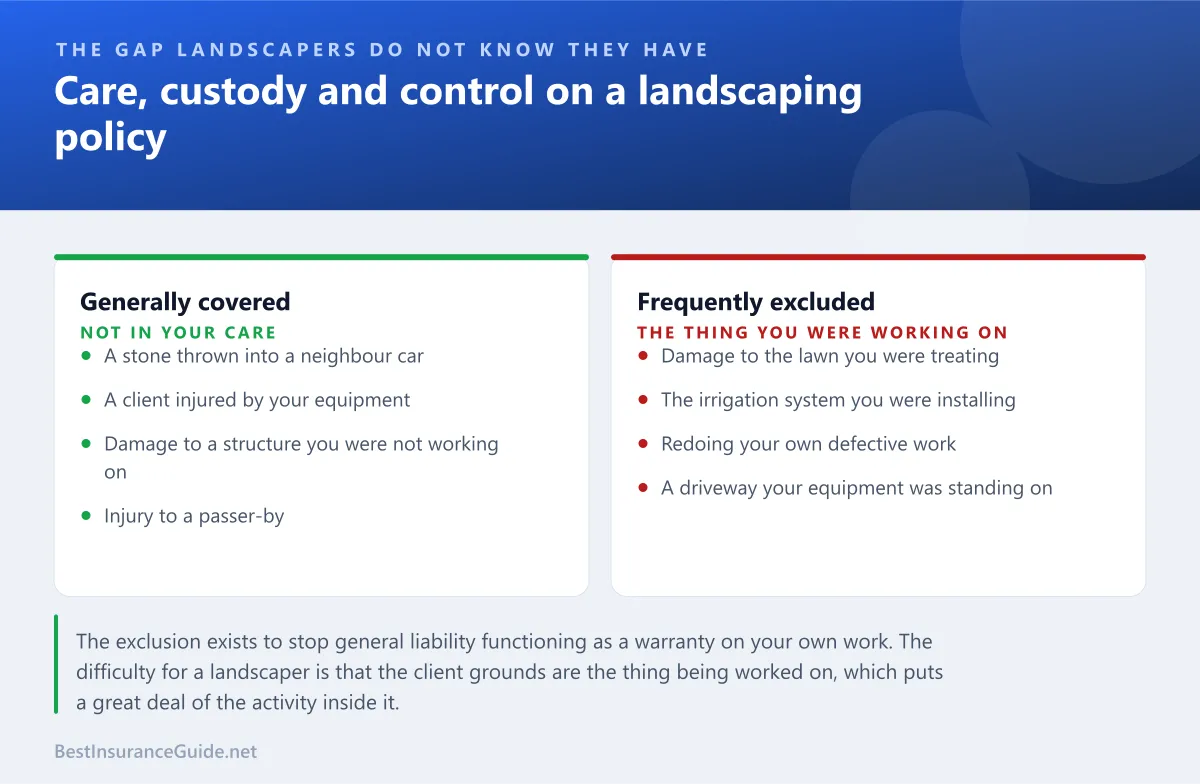
Generally covered: a stone thrown by a mower into a neighbour’s car, a client injured by your equipment, damage to a structure you were not working on, an injury to a passer-by.
Frequently not covered: damage to the lawn you were treating, damage to the irrigation system you were installing, the cost of redoing your own defective work, damage to a client’s driveway your equipment was standing on.
Three ways this is addressed, and they are not equivalent.
Some policies narrow the exclusion, and the wording differs between carriers. Ask specifically how yours reads.
Care, custody and control coverage can be added by endorsement with some carriers, at a limit.
Contractual clarity, agreeing with the client what you are responsible for, which reduces disputes without insuring anything.
The practical instruction is to ask your broker directly: what happens if I damage the property I am working on? The answer varies and it is not what most landscapers assume.
Chemicals, and the pollution exclusion
If you apply herbicides, pesticides or fertilisers, this is the second gap.
Standard general liability policies carry a pollution exclusion, and it is drafted broadly enough that chemical application can fall within it. Damage to a neighbour’s plants from drift, harm to a pet, contamination of a water feature, or injury from a misapplication may all be argued into it.
Specific herbicide and pesticide coverage addresses this, either as an endorsement carving back the exclusion or as a separate policy.
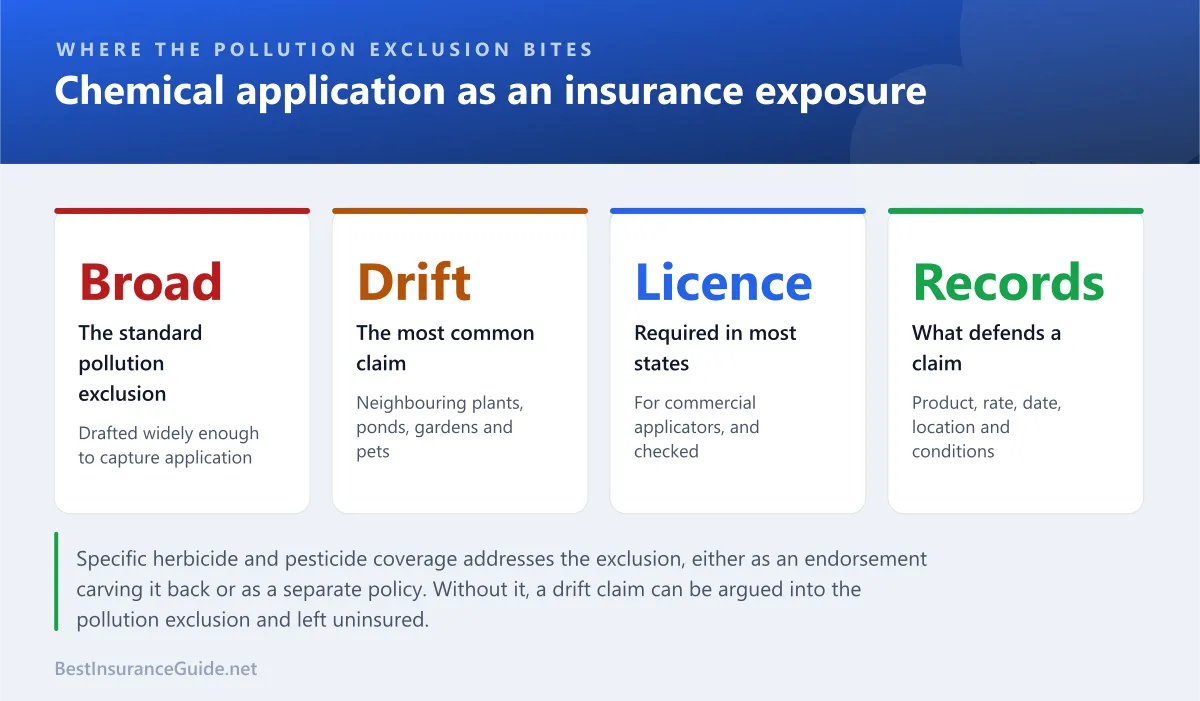
Four things go alongside it.
Licensing. Most states license commercial applicators, and operating without the licence is both a regulatory problem and an insurance one.
Records. What was applied, where, at what rate, on what date, under what conditions. This is a regulatory requirement in many states and it is the defence to a drift claim.
Notification. Where required, notifying neighbours and posting signage.
Weather judgement. Drift claims turn on whether application in the conditions was reasonable, and a record of the wind conditions at the time is worth keeping.
Equipment, which is always on a trailer
The property side of a landscaping business barely touches the premises.
Commercial property covers property at the described location. Mowers, blowers, trimmers, chippers, aerators, hand tools and the trailers themselves spend their working lives elsewhere.
Inland marine covers equipment in transit and at job sites, and for a landscaper it is the main property coverage rather than an addition.
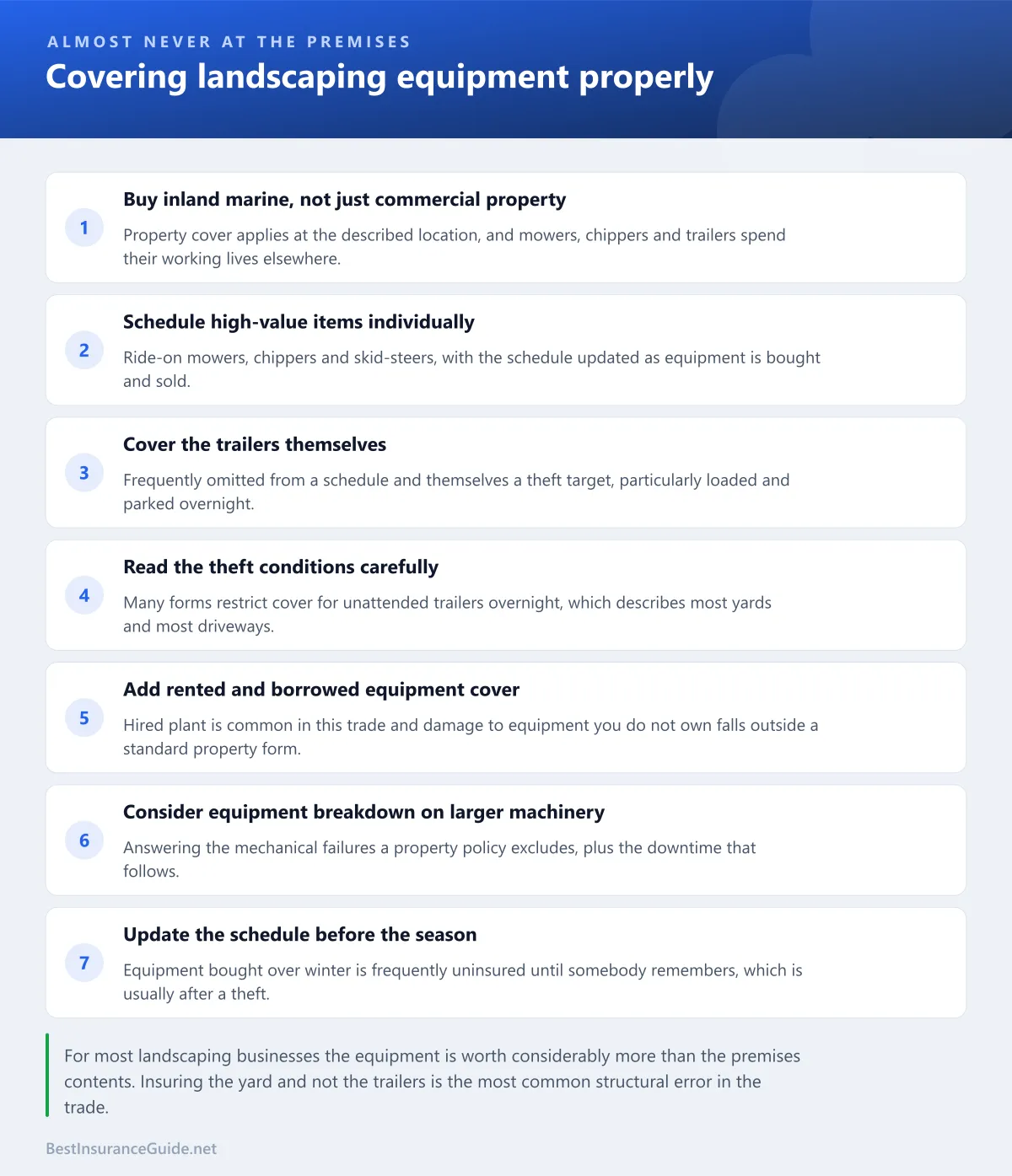
Four points to specify.
Schedule high-value items individually, particularly ride-on mowers, chippers and skid-steers, and keep the schedule current as equipment is bought and sold.
Cover the trailers, which are frequently omitted and are themselves a theft target.
Read the theft conditions, since many forms restrict cover for unattended trailers overnight, and a loaded trailer parked at home or at a yard is exactly that.
Add rented and borrowed equipment cover, since hired plant is common in this trade and damage to it falls outside a standard property form.
Consider equipment breakdown for larger machinery, which answers mechanical failure the property policy excludes.
The seasonal payroll problem
Landscaping payroll is highly seasonal and that interacts badly with how workers compensation is priced and audited.
The policy is written on estimated payroll and audited on actual payroll by classification at the end of the term.
Seasonal and part-time staff count toward most state coverage thresholds, which means a business that is below the threshold in February is frequently above it in June.
Classification splits matter. Landscaping, tree work, chemical application, snow removal and clerical work carry different rates, and a business doing all of them needs the split maintained rather than estimated.
Uninsured subcontractors are added to your payroll at audit where certificates cannot be produced for the period they worked. In a trade that subcontracts tree work, hardscaping and irrigation routinely, this is the largest audit exposure.
Two habits: maintain the classification split through the season, and collect a certificate from every subcontractor covering the actual period worked rather than merely the date it was issued.
Snow removal, which is a different business
Many landscapers add snow and ice removal in winter, and it is not simply more of the same work.
Slip and fall liability is the dominant exposure, and claims arise months after the work, frequently from people with no relationship to your client.
Some general liability policies exclude or restrict snow and ice removal, which means it must be declared. A landscaper who added winter work and did not tell the insurer may be uninsured for it.
Contracts matter more here than anywhere. Whether you are responsible for monitoring conditions, what triggers a service visit, and what the client is responsible for between visits all determine liability.
Records are the defence. Dated logs of every visit, what was cleared, what was applied and the conditions at the time. This is the single most useful risk management practice in the whole trade.
Building the programme
General liability, with the care custody and control position understood rather than assumed.
Herbicide and pesticide coverage, if you apply chemicals.
Commercial auto, plus hired and non-owned auto for staff using their own vehicles.
Inland marine, for equipment, trailers and rented plant.
Workers compensation, with an accurate seasonal classification split.
Business income, which for a seasonal business needs sizing against the season rather than the year.
A commercial umbrella, sized against contract requirements, which our guide to business umbrella insurance covers.
Snow and ice removal declared, if you do it.
The short version
A landscaping business faces three exposures general liability does not straightforwardly answer: damage to the property you are working on, which frequently falls into the care custody and control exclusion; chemical application, which the pollution exclusion can capture; and equipment, which lives on a trailer rather than at the premises.
The first is a wording question to put to your broker directly. The second needs specific herbicide and pesticide coverage alongside licensing and application records. The third needs inland marine with the trailers scheduled and the theft conditions read.
Workers compensation is complicated by seasonal payroll, and the largest audit exposure is uninsured subcontractors being added to your payroll at your classification rate.
And if you plough snow in winter, declare it, contract for it carefully, and keep a dated log of every visit.
For trade-specific cover generally, see business insurance by trade, and for the excess layer, business umbrella insurance.
The claims that actually happen
Five recur across the trade, and each points at a different part of the programme.
A stone thrown by a mower. Into a parked car, a window, a conservatory or occasionally a person. General liability answers it where the damaged property is not in your care, which a neighbour’s car is and a client’s own window may not be.
Tree work going wrong. A limb through a roof, a fence or a vehicle. Tree work carries a different and higher classification for both liability and workers compensation, and a general landscaping policy may not contemplate it. Declare it.
Chemical drift. Damage to a neighbour’s plants, a vegetable garden, an ornamental pond or a pet. This is where the pollution exclusion becomes decisive.
Irrigation and utility strikes. Cutting an irrigation line, a cable or a gas service while digging. Utility damage claims are expensive and frequently sit inside the care custody and control question.
Slip and fall on a treated or cleared surface. In winter, on snow and ice work; in summer, on a wet or freshly treated area.
Worked example: one afternoon, three coverages
A crew mowing a commercial property throws a stone into a client’s parked van, a crew member injures a hand on a trimmer, and a trailer is stolen from the kerb.
| Loss | Answered by |
|---|---|
| Damage to the client van | General liability, subject to care custody and control wording |
| The crew member injury | Workers compensation |
| The stolen trailer and equipment | Inland marine, subject to theft conditions |
| Hire cost of replacement equipment | Inland marine, if the extension is present |
| Lost revenue while re-equipping | Business income, if carried |
One afternoon, five lines, and only the first is the coverage most landscapers think about.
Two things to do before the season
Update the equipment schedule. Equipment bought over winter is frequently uninsured until somebody remembers, and the theft season starts when the trailers start going out.
Confirm the snow and ice position if you plough, in writing, and confirm the general liability policy contemplates it rather than assuming continuity from last year.
What contracts require
Commercial landscaping work brings its own set of contractual requirements, and they are more demanding than residential work.
Property managers and commercial landlords require $1,000,000 general liability with additional insured status, evidence of workers compensation, and frequently an umbrella.
Municipalities and school districts publish their own schedules, check certificates properly, and frequently require higher limits than a small operator expects.
General contractors on development sites require completed operations coverage, waivers of subrogation and primary and non-contributory wording.
Homeowners associations increasingly require the same package as a commercial client.
Two things follow. Price the insurance into the bid rather than absorbing it from margin, and read the indemnity clause as well as the insurance clause, because some contracts require the contractor to indemnify the client for matters no policy would cover.
Two questions for a broker
What happens if I damage the property I am working on? The care custody and control wording differs between carriers and the answer is not what most landscapers assume.
Am I covered for chemical application, and is snow and ice removal declared? Both sit at the edge of a standard general liability policy and both need confirming in writing rather than assuming.
The programme, summarised
General liability, with the care custody and control wording understood in writing rather than assumed.
Herbicide and pesticide coverage, if you apply anything, alongside the applicator licence and dated application records.
Inland marine, covering equipment, trailers and hired plant, with high-value items scheduled and the theft conditions read.
Commercial auto, plus hired and non-owned for staff using their own vehicles.
Workers compensation, with the classification split maintained through the season rather than reconstructed at audit.
Business income, sized against the season rather than the calendar year.
Snow and ice removal declared, with dated service logs, if you do winter work.
An umbrella, sized against the highest contract requirement you bid for.
Related reading
Catering business insurance covers the other trade here whose equipment lives in a vehicle and whose liability happens on a client’s premises. Start-up business insurance costs covers what a new operation should budget and which coverage to buy first.
A note on scope
Nothing here is legal advice. Applicator licensing, chemical application record-keeping requirements, worker classification tests and workers compensation thresholds are set by state law and vary considerably.
Your state department of agriculture or environmental agency publishes applicator licensing and record requirements, your state workers compensation authority publishes coverage thresholds, and your policy wording and endorsement schedule are the authoritative statement of what you hold. This site is independent and not affiliated with any insurer.