Can I Get Life Insurance on My Parents? Yes, With Two Conditions
How to buy life insurance on a parent, the insurable interest and consent requirements, what it costs at older ages, and which product suits which need.

Table of contents

This is a common question with a straightforward answer and two absolute requirements attached. Getting both right is most of the exercise.
The two conditions
Insurable interest. You must have a legitimate financial interest in your parent’s continued life, meaning you would suffer financially from their death. It must exist when the policy is taken out.
Consent. Your parent must know about the policy, sign the application, answer the health questions truthfully and take part in any medical examination.
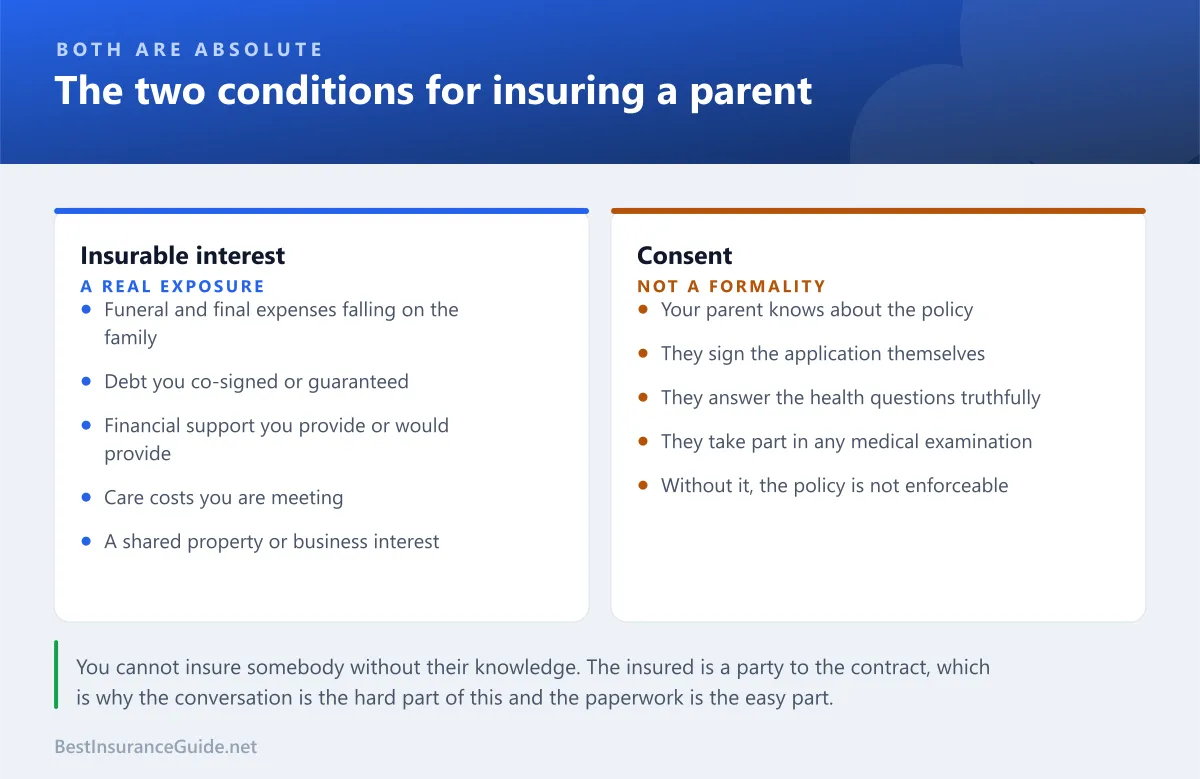
Neither is negotiable, and the consent requirement is the one people ask about most. You cannot take out a policy on somebody without their knowledge. The insured is a party to the contract, and a policy issued without valid consent is not enforceable.
For an adult child insuring a parent, insurable interest is usually straightforward. It commonly arises from:
Funeral and final expenses, which fall on the family in practice whoever is formally liable.
Debts you have co-signed or guaranteed, which pass to you rather than to the estate.
Financial support you provide, or would have to provide to a surviving parent.
Care costs you are meeting or would meet.
A shared property or business interest.
Estate costs on an illiquid estate you would inherit.
Why people do it
Four reasons account for most policies of this kind.
Funeral costs. A funeral is a substantial expense arriving with no notice, and it is the most common motivation. A small final expense policy covers it.
Debt that survives. A jointly held mortgage, a co-signed loan, or a reverse mortgage balance where a surviving family member wants to keep the property.
Replacing support. Where a parent supports a dependent sibling, a grandchild, or a surviving spouse with limited income.
Estate liquidity. Where the estate is concentrated in property or a business and the heirs would otherwise have to sell quickly to meet costs.
Note what is not on that list: buying a policy on a healthy, independent parent as an investment. Insurable interest exists for a reason and it is the financial exposure, not the opportunity.
What it costs, and why
Life insurance prices on age and health, and both move against you here.
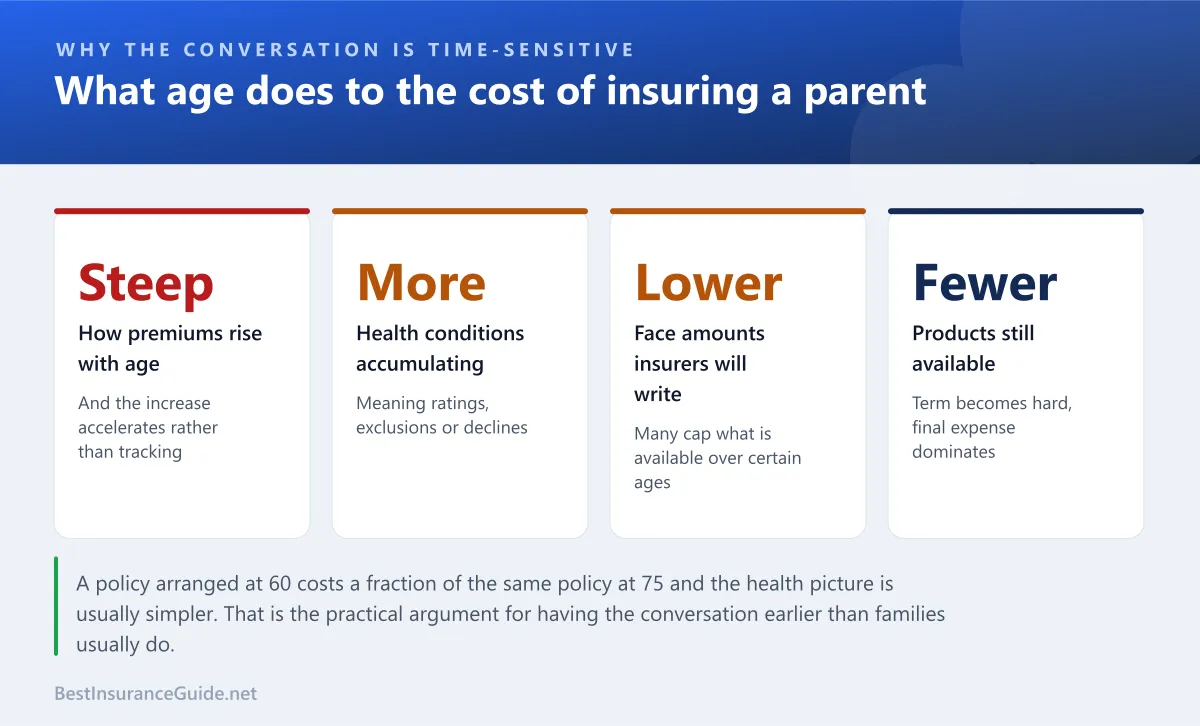
Premiums rise steeply with age, and the increase accelerates. The same face amount costs a multiple at 70 of what it costs at 50.
Health conditions accumulate, which means ratings, exclusions or declines become more likely.
Face amounts available reduce with age, with many insurers capping what they will write over certain ages.
Product availability narrows. Fully underwritten term becomes hard to obtain at older ages and the market shifts toward permanent and final expense products.
The practical implication is that the conversation is worth having earlier than families usually have it. A policy arranged at 60 costs a fraction of the same policy arranged at 75, and the health picture is usually simpler.
Which product
Three options, matched to three different needs.
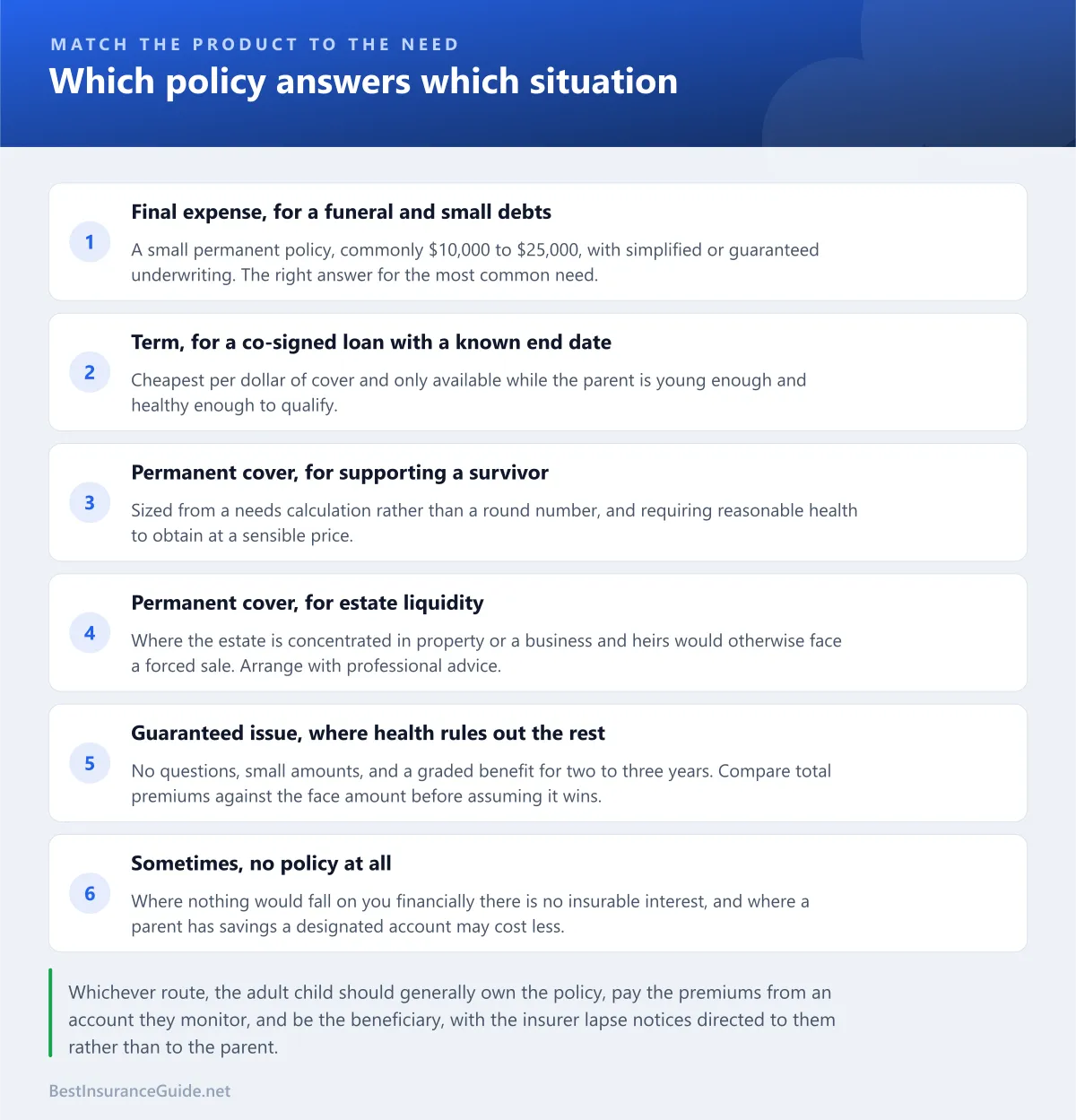
Final expense insurance. A small permanent policy, commonly $10,000 to $25,000, designed to cover a funeral and small debts. Simplified or guaranteed underwriting, affordable premiums, and it does not expire. This is the right answer for the most common need.
Fully underwritten permanent cover, for larger needs such as estate liquidity or supporting a dependent survivor. More expensive, requires reasonable health, and provides a meaningful face amount.
Term insurance, which works only where the need genuinely expires and the parent is young enough and healthy enough to qualify. Cheapest per dollar of cover, and it becomes hard to obtain past a certain age.
Guaranteed issue where health rules out the others. No questions, small amounts, and a graded death benefit for the first two or three years during which a non-accidental death returns premiums plus interest rather than the face amount.
Worked example: matching product to need
| Need | Suitable product |
|---|---|
| Funeral and settling small debts | Final expense, $15,000 to $25,000 |
| Clearing a co-signed loan | Term, if health permits, sized to the balance |
| Supporting a surviving parent | Permanent cover, sized from a needs calculation |
| Estate liquidity on an illiquid estate | Permanent cover, arranged with professional advice |
| Parent in poor health, immediate need | Guaranteed issue, understanding the graded period |
Structuring it properly
Who owns, pays and benefits matters, and the sensible arrangement is usually the same.
The adult child should own the policy. Ownership carries control: over beneficiary designations, over lapses, and over any changes. An adult child funding a policy owned by the parent has no control over it.
The adult child should pay the premiums, directly, from an account they monitor. Policies lapse when nobody notices a missed payment, and a lapse on an older insured is frequently unrecoverable.
The adult child should be the beneficiary, where they hold the insurable interest, which keeps the proceeds out of the estate and out of probate.
Siblings should be involved before rather than after. Where several children share the costs and expectations, an unclear arrangement produces conflict at exactly the wrong moment. Agree who owns, who pays and who benefits, and write it down.
Tell your parent what the policy is for. Consent is a legal requirement, and a conversation about funeral costs and estate arrangements is a better basis for it than a form to sign.
Applying well
Get the health picture straight first. Current conditions, medications, recent hospitalisations, and any surgery. This determines which market you are in before you approach anybody.
Use an independent broker with experience of older applicants. Underwriting for older ages and impaired health varies enormously between insurers, and the spread between the best and worst outcome for the same applicant is large.
Do not apply blind. A decline is recorded and is asked about afterwards.
Compare the guaranteed issue option against a simplified issue one, because a parent who can answer the health questions acceptably will do considerably better on a simplified issue product than on a guaranteed issue one.
Check what the graded benefit period means if guaranteed issue is the route, and confirm what happens if death occurs within it.
Set up the payments so they cannot fail, on an account you check, with the insurer’s lapse notice going to you rather than to your parent.
The short version
You can insure a parent provided you have an insurable interest and they consent. Both requirements are absolute, and a policy without consent is not valid.
The most common need is funeral and final expenses, and the product that answers it is a small permanent final expense policy. Larger needs — clearing co-signed debt, supporting a survivor, estate liquidity — call for term or permanent cover sized from an actual calculation.
Cost rises steeply with age and health complicates it, so the conversation is worth having earlier than families usually have it.
Structure it so the adult child owns the policy, pays the premiums from an account they monitor, and is the beneficiary. And involve siblings before rather than after.
For the underlying decision, see is life insurance worth it, and for health-related underwriting, life insurance with cancer.
The conversation, which is the hard part
The mechanics of insuring a parent are straightforward. The conversation frequently is not, and avoiding it is why families end up with nothing in place.
Three framings that tend to work better than the direct one.
Start with the funeral, not the policy. Most people have a view about what they want and an awareness that it costs money. A conversation about arrangements naturally reaches the question of how it is paid for.
Start with the paperwork. Where the will is, who the executor is, what accounts exist, whether there is an existing policy nobody knows about. Insurance is one item on that list rather than the subject of the conversation.
Start with your own affairs. Telling a parent what you have arranged for your own family, and asking whether they have done the same, is considerably easier than asking them to sign an application.
Two things to avoid. Do not present it as a financial arrangement that benefits you, even though the beneficiary designation will say so, because the purpose is meeting costs that would otherwise fall on the family. And do not do it without siblings knowing, because a policy discovered later looks very different from one agreed in advance.
What to check on an existing parent policy
Many parents already hold something, frequently forgotten.
An old whole life policy from decades ago, possibly with meaningful cash value and a small death benefit.
A funeral plan or burial policy, which may be assigned to a funeral home.
Employer or retiree group life, which sometimes continues in reduced form after retirement.
Mortgage protection cover, tied to a loan that may since have been repaid.
Fraternal or union policies, which are common in older generations and frequently unrecorded.
For each one, check that it is in force, that the beneficiary designation is current, and that somebody other than the policyholder knows it exists. Where a policy cannot be traced, most states operate a policy locator service through the insurance department or the NAIC.
Two things to establish first
What already exists. Old whole life policies, burial plans, retiree group cover, mortgage protection and fraternal or union policies are all common in older generations and frequently forgotten. Check each is in force, that the beneficiary designation is current, and that somebody other than the policyholder knows about it.
What the actual exposure is. A funeral is a five-figure cost arriving without notice; a co-signed loan is whatever the balance is; supporting a surviving parent is a calculation. Sizing the need before shopping prevents both underbuying and being sold something larger than the situation requires.
Both are conversations rather than applications, and both are considerably easier to have earlier than later.
Getting the paperwork right
Four practical details decide whether the policy does what the family intended.
Ownership documented properly. The application distinguishes between the insured, the owner and the payer, and these should be filled in deliberately rather than by default.
A beneficiary and a contingent beneficiary, both named, and reviewed if family circumstances change.
Payments from an account the adult child monitors, with the insurer’s lapse notices directed to that person. A policy on an older insured that lapses unnoticed is usually unrecoverable.
A written note of what exists and where, kept with the family’s other documents and shared with siblings. The most common failure with policies of this kind is not a denied claim; it is a policy nobody remembered.
When it is not the right answer
Three situations where a policy is not the solution, and something else is.
Where the only concern is a funeral and the parent has savings. A designated account, or a prepaid funeral arrangement, may cost less than years of premiums on a small policy. Compare the total premiums against the benefit before assuming insurance wins.
Where the parent is already in very poor health and only guaranteed issue is available. Total premiums over a few years can approach the small face amount, and the graded benefit period means an early death returns premiums rather than the benefit. Sometimes saving the same money is straightforwardly better.
Where there is no insurable interest. If nothing would fall on you financially, there is nothing to insure, and an application would not be valid in any case.
The honest position is that insuring a parent is worth doing where a real cost would land on the family and the parent is healthy enough for a sensibly priced product. Outside that, the answer is frequently a savings account and a conversation.
Related reading
Two questions follow directly. How long life insurance takes to pay out covers what the family actually experiences at claim time, which is the whole point of arranging cover for final expenses. Life insurance with cancer covers the options where a parent’s health has already narrowed them.
A note on scope
Nothing here is financial, tax or legal advice. Insurable interest rules, consent requirements, product availability and tax treatment vary by state and change over time, and estate and probate consequences depend on individual circumstances.
Your state insurance department and the NAIC publish consumer guidance on life insurance, and a licensed independent broker and, where an estate is involved, a qualified adviser are the appropriate sources for a personal situation. This site is independent and not affiliated with any insurer.