Catering Business Insurance: Six Policies for a Business That Moves
The coverages a catering business needs, why liquor liability matters most, equipment in transit, venue requirements and foodborne illness exposure.

Table of contents
Catering is an unusual small business because almost none of the risk sits where the business does. The food travels, the equipment travels, the staff travel, and the liability happens in somebody else’s building.
The six policies
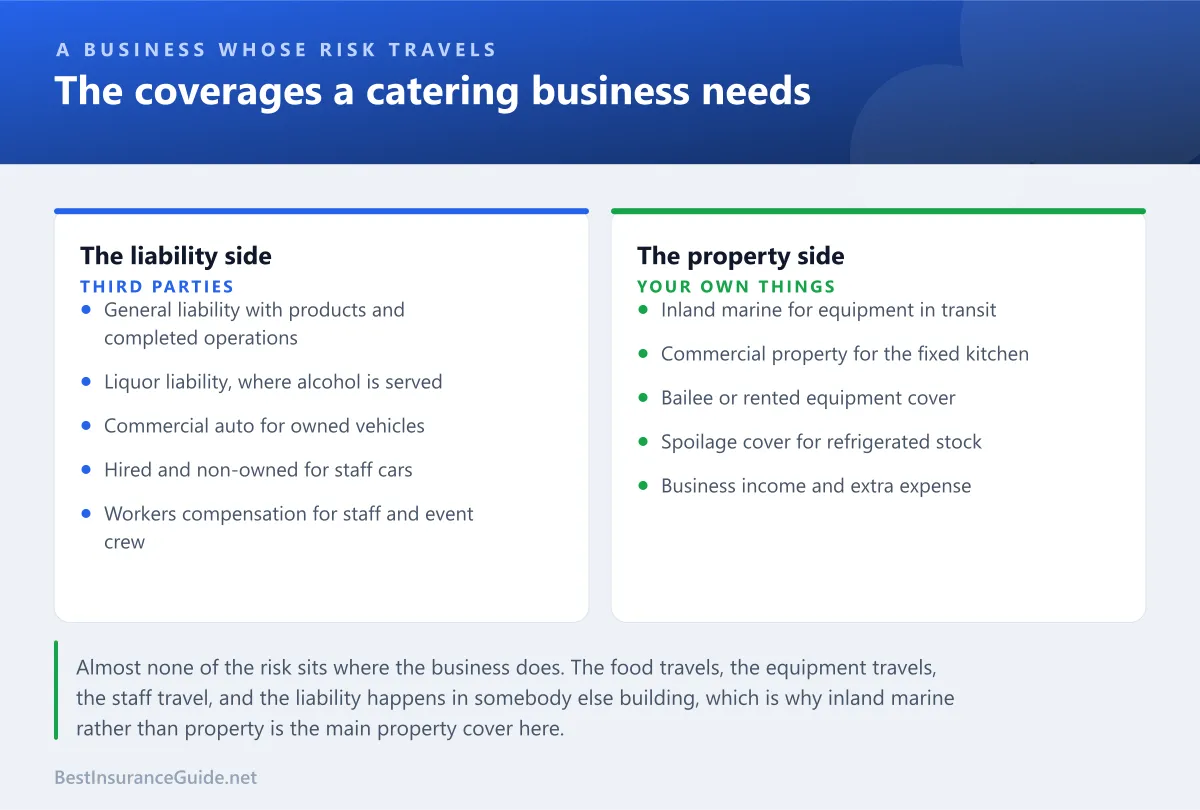
General liability, including products and completed operations, which is what responds to somebody made ill by your food or injured at your setup.
Liquor liability, where alcohol is served, which general liability excludes for anyone in the business of serving it.
Commercial auto, for owned vehicles, plus hired and non-owned auto for staff using their own cars.
Inland marine, for equipment in transit and at temporary locations, which the property policy does not follow.
Commercial property, for the kitchen, storage and anything at the fixed premises.
Workers compensation, wherever there are employees, and in catering that frequently includes casual and event staff.
Two more worth adding: business income cover, and spoilage cover for refrigerated stock lost to a power failure or equipment breakdown.
Liquor liability, which is the one
If your business serves alcohol, this is the most consequential coverage you will buy and the one most likely to be missing.
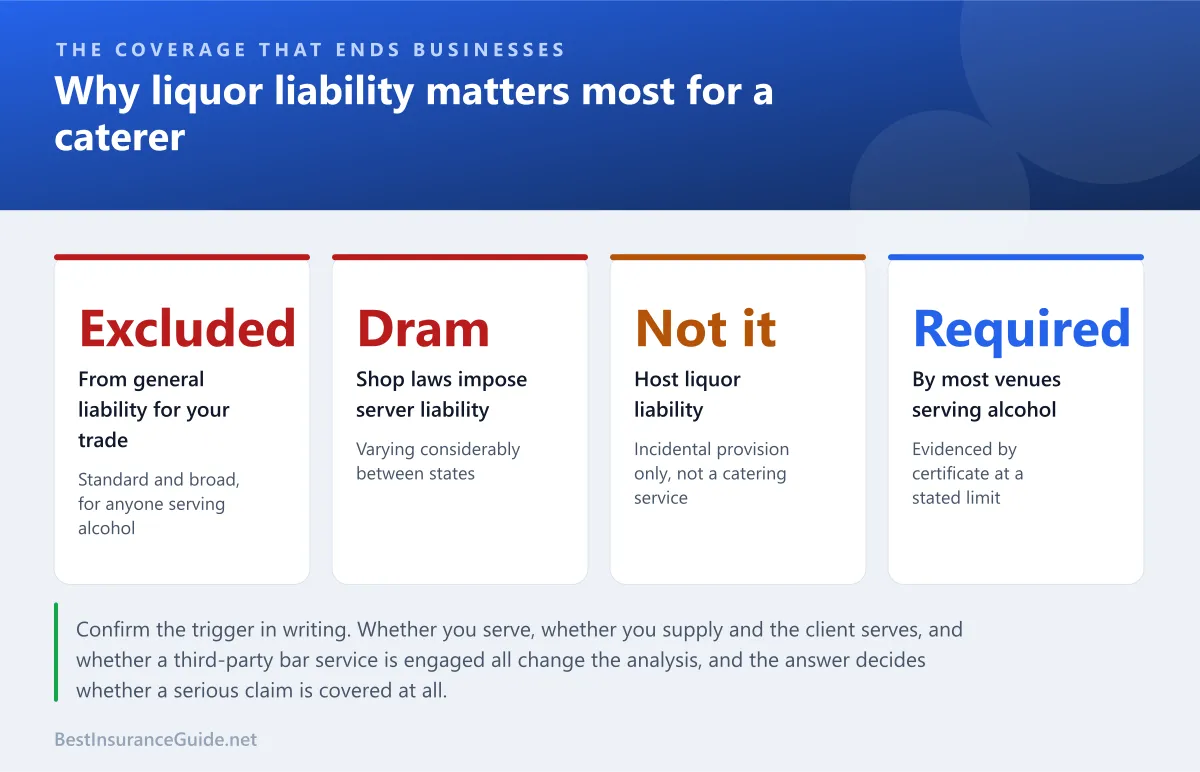
General liability excludes liquor liability for any business in the business of manufacturing, distributing, selling or serving alcohol. That exclusion is standard and it is broad.
Dram shop laws in many states impose liability on the server where somebody is over-served and then causes injury, most commonly in a vehicle crash. Those claims are among the largest in hospitality, and the rules vary considerably between states.
Host liquor liability is not the same thing. Some general liability policies include limited host liquor cover for a business that occasionally provides alcohol incidentally. A caterer serving alcohol as part of its service is not incidental and is not covered by it.
Three practical points.
Confirm the trigger. Whether you serve, whether you supply and the client serves, and whether a third-party bar service is engaged all change the analysis. Get it in writing.
Train and document. Responsible service training for staff is both a genuine risk reduction and an underwriting positive, and documented training is what defends a claim.
Check what venues require. Many will not admit a caterer serving alcohol without evidence of liquor liability at a stated limit.
Food, and the claim nobody plans for
Products and completed operations coverage within general liability is what responds to a foodborne illness claim.
Four things matter.
Confirm products and completed operations is included rather than assumed. It is a distinct part of the policy and can be restricted or excluded.
Understand the aggregate. Products and completed operations frequently carries its own aggregate limit, separate from the general aggregate, and an event affecting many guests exhausts it quickly.
Allergen incidents are a growing exposure, and documented ingredient records, labelling and staff briefing are the defence.
Keep records. Supplier invoices, temperature logs, preparation records and dated cleaning schedules. A claim months later is defended on records made at the time, and a caterer without them is defending on memory.
Product recall and contamination cover is a separate product, worth considering for larger operations, covering the cost of recall and the resulting business interruption rather than third-party injury.
Equipment, which is always somewhere else
This is the most commonly missing coverage in catering and the arithmetic is stark.
A commercial property policy covers property at the described premises. Ovens, warmers, chafing dishes, refrigeration, china, glassware, linen, marquees and audio equipment are frequently worth more than the fixed premises contents, and they spend most of their working life in a van or in a venue.
Inland marine covers property in transit and at temporary locations. For a caterer this is not an add-on; it is the main property coverage.
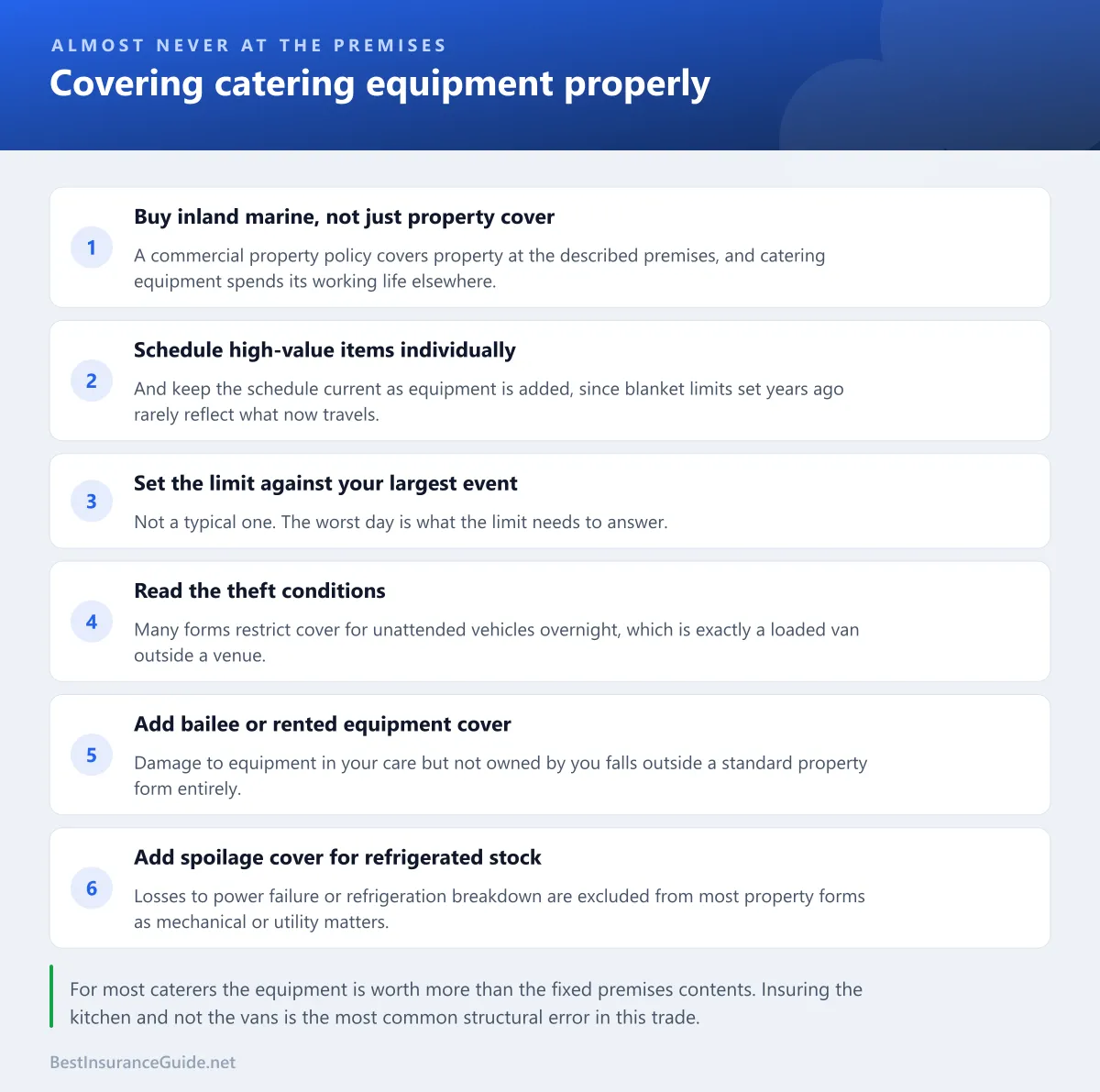
Three things to specify.
Schedule high-value items individually, and keep the schedule current as equipment is added.
Set the blanket limit against what actually travels, on your largest event rather than a typical one.
Check theft conditions, since many forms restrict cover for unattended vehicles overnight and a van left loaded outside a venue is exactly that situation.
Rented and borrowed equipment needs specific attention, since damage to equipment in your care but not owned by you falls outside a standard property form and needs bailee or rented equipment cover.
Venue requirements
Most catering contracts arrive with an insurance schedule attached, and the requirements are consistent.
$1,000,000 general liability per occurrence, with $2,000,000 aggregate.
The venue named as additional insured, which is an endorsement with a cost.
Liquor liability at a stated limit, where alcohol is served.
Workers compensation, evidenced by certificate.
Commercial auto, evidenced by certificate.
A certificate of insurance in advance, frequently with specific wording, and frequently required days before the event.
Two practical habits. Keep a standard certificate request process with your broker, since certificates are needed constantly and delay costs bookings. And read the indemnity clause as well as the insurance clause, because some venue contracts require the caterer to indemnify the venue for matters beyond what any policy would cover.
Staff, and the classification question
Catering runs on casual and event staff, which makes worker classification a live issue.
Event staff engaged directly are usually employees for workers compensation purposes regardless of what the paperwork calls them, and the tests applied look at control and integration rather than at labels.
Staffing agency workers should be covered by the agency, evidenced by certificate, and the agreement should say so explicitly.
Subcontracted services, including bar services, entertainment and equipment providers, need their own certificates on file before the event.
The exposure is the same as in construction: an uninsured worker injured on your job can become your responsibility, and the remedy is a folder of current certificates.
The short version
A catering business needs six policies because its risk moves: general liability with products cover for the food, liquor liability where alcohol is served, commercial auto plus hired and non-owned for the driving, inland marine for equipment in transit, property for the fixed kitchen, and workers compensation for the staff.
Liquor liability is the one that matters most and the one most likely to be missing, because general liability excludes it for any business in the business of serving alcohol, and dram shop claims are among the largest in hospitality.
Inland marine is the coverage caterers most often lack, because the property policy covers the premises and the equipment is almost never there.
And collect certificates from every staffing agency, bar service and subcontractor before the event, because an uninsured worker injured at your event becomes your problem.
For the excess layer, see business umbrella insurance, and for trade-specific cover generally, business insurance by trade.
Events with unusual exposures
Some jobs carry risks a standard catering programme does not anticipate, and they are worth flagging to a broker before accepting the booking.
Outdoor events with marquees and temporary structures. Wind is the exposure, and a collapsing structure is a serious liability claim. Confirm who is responsible for the structure and that they carry cover for it.
Cooking with open flame or gas at a venue. Fire damage to somebody else’s building is a large claim and some venue contracts allocate it entirely to the caterer.
Events at private residences, where the host’s homeowners policy is not a substitute for your own cover and where access, parking and equipment security are all less controlled.
Multi-day events and festivals, where equipment is left on site overnight and the theft conditions in your inland marine form become decisive.
Events with entertainment or activities you have subcontracted, where a certificate from the provider is essential.
Weddings and high-value private events, where cancellation and non-appearance exposures exist and where reputational consequences of a failure are disproportionate.
Worked example: what a marquee event requires
| Exposure | Answered by |
|---|---|
| A guest injured by the food | General liability, products cover |
| A guest over-served and injured later | Liquor liability |
| The marquee failing in wind | The structure provider policy, evidenced by certificate |
| Your equipment stolen overnight | Inland marine, subject to theft conditions |
| A staff member injured setting up | Workers compensation |
| Your van damaging the venue driveway | Commercial auto |
One event, six coverages, and only two of them are the ones caterers usually think about first.
Two things to set up properly
A standing certificate process with your broker. Venues require certificates constantly, frequently with specific wording and named parties, and frequently at short notice. Agreeing a turnaround and a template with your broker removes a recurring source of lost bookings.
A subcontractor and staffing certificate file, current, covering every provider you use: staffing agencies, bar services, equipment hire, entertainment and transport. An uninsured worker injured at your event becomes your problem, and this file is the whole defence.
What to ask a broker
Does my general liability include products and completed operations, and what is that aggregate?
Do I have liquor liability, and does it match how I actually serve alcohol?
Does my inland marine limit reflect my largest event rather than a typical one, and what are the theft conditions on an unattended vehicle?
Am I covered for equipment I rent or borrow?
Do I have spoilage cover for refrigerated stock?
Is my hired and non-owned auto adequate for the way event staff actually drive?
Six questions, and most catering businesses can answer two of them.
What drives the cost for a caterer
Whether alcohol is served, and how. This is the single largest factor, and the difference between serving, supplying and subcontracting a bar service changes both the rating and the exposure.
Annual revenue and the number of events, driving general liability.
Payroll by classification, including event staff, driving workers compensation.
The value and type of equipment that travels, driving inland marine, and specifically whether high-value items are scheduled.
The vehicles and how they are used, driving commercial auto, plus whether staff use their own cars.
Loss history, including any prior foodborne illness or liquor-related claim, which affects availability as much as price.
Documented training and procedures, including responsible alcohol service, food safety and allergen management, which are underwriting positives as well as genuine risk reduction.
The order to build it in
General liability with products and completed operations first, since it is what every venue requires and what answers a foodborne illness claim.
Liquor liability immediately after, if alcohol is served in any form, because general liability excludes it for your trade.
Inland marine next, because the equipment is the business and it is almost never at the premises.
Commercial auto and hired and non-owned, from the first delivery.
Workers compensation, including event and casual staff.
Then business income and spoilage, and an umbrella sized against the highest venue requirement you expect to face.
Two more things worth knowing
Spoilage cover is cheap and specific. Refrigerated stock lost to a power failure or a refrigeration breakdown is excluded from most property forms as a mechanical or utility matter, and a spoilage endorsement closes it for very little.
Cancellation exposure is real for event businesses. Where a booking is cancelled through no fault of yours, or where you cannot perform, the financial consequence falls outside the standard programme entirely. Event cancellation cover exists, is bought per event or on a blanket basis, and is worth pricing for any caterer with a concentrated calendar of large bookings.
Related reading
Landscaping business insurance covers the other trade in this guide that works on somebody else’s property with equipment that is rarely at base, and shares the inland marine problem almost exactly. Business insurance for sole proprietors covers the position for a one-person operation without employees.
A note on scope
Nothing here is legal advice. Dram shop liability, worker classification tests, licensing requirements for alcohol service and food safety obligations are set by state and local law and vary considerably.
Your state insurance department publishes commercial guidance, your state alcohol regulator publishes service requirements, and your local health authority publishes food safety obligations. Your policy wording, endorsement schedule and the insurance clause in each venue contract are the authoritative statement of what you hold and what you must hold. This site is independent and not affiliated with any insurer.