Box Truck Insurance: What It Costs and What Actually Drives the Price
What box truck insurance covers, how radius of operation and cargo drive the price, the filings you may need, and how to compare commercial quotes properly.

Table of contents

Box truck insurance is not one policy and it is not priced on the truck. Understanding what it is actually made of explains why two quotes for what looks like the same vehicle can differ by a factor of three.
What the package is made of
A box truck operation typically needs five separate coverages, quoted separately and frequently placed with different carriers.
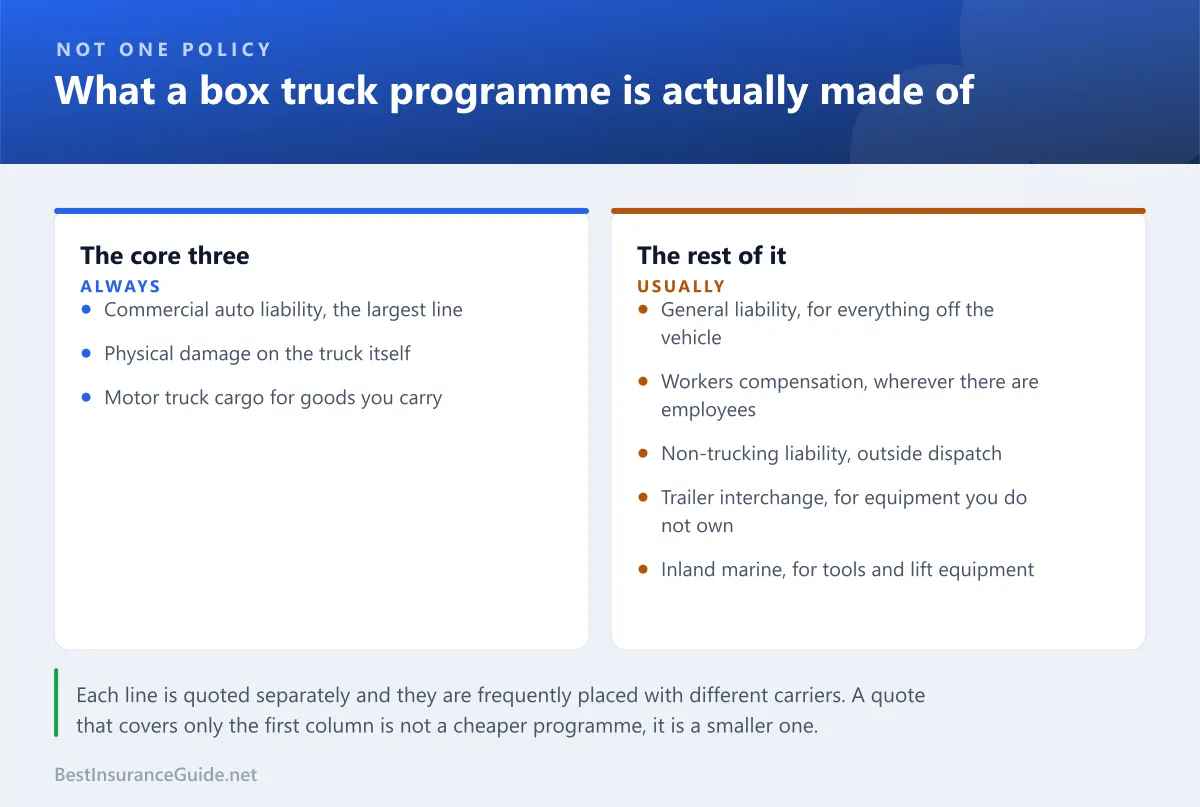
Commercial auto liability. Injuries and property damage you cause to other people. The largest line and the one that carries any regulatory minimum.
Physical damage, meaning comprehensive and collision on the truck itself. Optional unless a lender or lessor requires it, which they usually do.
Motor truck cargo. Goods you are carrying for other people. Not included in the auto policy and frequently required by the shippers or brokers you work with.
General liability. Everything that is not the vehicle: injuries at a loading dock, damage at a delivery site, contractual exposures.
Workers compensation, wherever you have employees, which in most states is mandatory rather than optional.
Two more that are commonly added: non-trucking liability or bobtail cover for use outside dispatch, and trailer interchange if you pull equipment you do not own.
What actually drives the price
The truck matters far less than people expect. Six factors do most of the work.
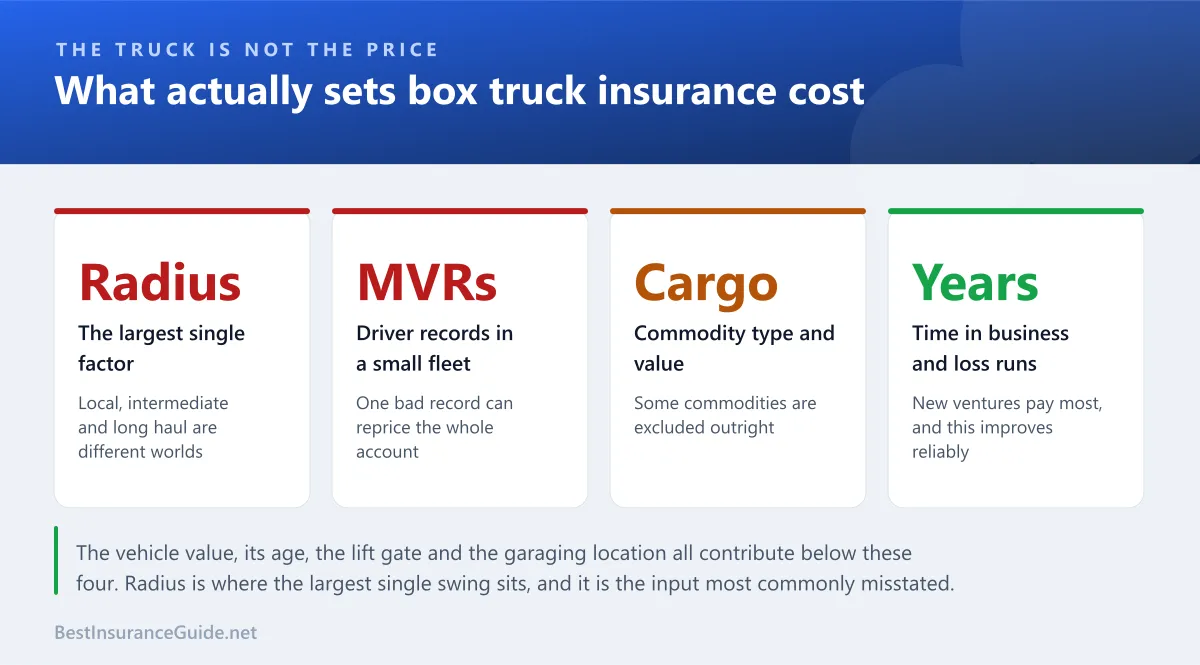
Radius of operation. The single largest factor. Local work within a small radius is priced very differently from regional work, which is priced very differently from long haul. More highway miles means higher severity, and severity is what commercial auto pricing is built on.
Driver records. In a small operation the individual records dominate. One driver with a recent serious violation can move the whole account.
Cargo type. Ordinary dry goods rate very differently from electronics, alcohol, pharmaceuticals, temperature-controlled loads or anything hazardous. Some commodities are excluded outright from standard cargo forms.
Operating authority. Running under your own authority is priced differently from leasing onto somebody else’s, because the liability structure differs.
Years in business and loss history. New ventures pay substantially more, and this is the factor that improves most reliably over time.
Limits and deductibles, including the physical damage deductible, which on a truck is usually a larger figure than people expect.
Below those, the vehicle’s value, its age, whether it has a lift gate, garaging location and annual mileage all contribute.
Radius, in more detail
Because this is the largest lever, it is worth being precise about it.
Carriers typically band radius into something like local, intermediate and long haul, and the bands matter more than the exact mileage. Crossing from one band into the next changes the rate materially.
Three practical points.
Quote the radius you actually operate. Understating it to get a better rate is misrepresentation, and a serious claim outside your stated radius invites a coverage dispute at exactly the wrong moment.
If most of your work is local and occasional work is regional, say so and ask how the carrier handles it. Some will write the local band with a provision for occasional longer trips.
If you are expanding, tell the carrier before you start rather than at renewal. A mid-term change is straightforward; a claim outside your declared operations is not.
Cargo cover, and what it excludes
Motor truck cargo is the line that surprises new operators most.
It is separate from the auto policy and has to be bought deliberately.
Limits are typically stated per vehicle, and shippers or brokers frequently specify a minimum, commonly $100,000, before they will tender freight to you.
Exclusions matter more than the limit. Standard forms commonly exclude or restrict live animals, high-value electronics, alcohol, tobacco, pharmaceuticals, artwork, money and securities, and anything hazardous. Temperature-controlled cargo generally needs a specific endorsement, and reefer breakdown is a separate consideration again.
Theft conditions apply. Many forms restrict cover for unattended vehicles or require specific security measures, and an overnight theft from an unsecured lot is where cargo claims most often run into difficulty.
Deductibles are usually higher than on personal lines, commonly $1,000 to $2,500.
Worked example: a cargo claim against the exclusions
A load with a declared value of $86,000, stolen from an unsecured overnight lot.
| Compliant with the security condition | Not compliant | |
|---|---|---|
| Cargo limit | $100,000 | $100,000 |
| Loss | $86,000 | $86,000 |
| Deductible | $2,500 | n/a |
| Paid | $83,500 | Likely disputed or denied |
The limit was adequate in both columns. What decided the outcome was a condition in the policy about where the vehicle was parked, which is the sort of thing nobody reads until it matters.
Filings and compliance
This is where box truck operators most often get caught out, and the requirements depend on weight, geography and what you carry.
A USDOT number is required for many commercial vehicles, with the thresholds set federally and separately by several states.
Operating authority is required for for-hire interstate carriage.
Form MCS-90 is a federal endorsement required of certain interstate motor carriers. It is important to understand what it is: a guarantee to the public that a judgment will be paid up to a statutory minimum, not additional coverage for you. If the insurer pays under an MCS-90 in circumstances the policy would not otherwise cover, they are entitled to recover it from you.
State filings such as Form E and Form H apply for intrastate authority in several states.
Hours of service, driver qualification files and vehicle inspection records are compliance obligations rather than insurance ones, and they matter to insurance because carriers underwrite on them and because a claim frequently turns on them.
None of that is optional and none of it is guesswork. The Federal Motor Carrier Safety Administration and your state authority publish the current thresholds, which change.
Reducing what you pay
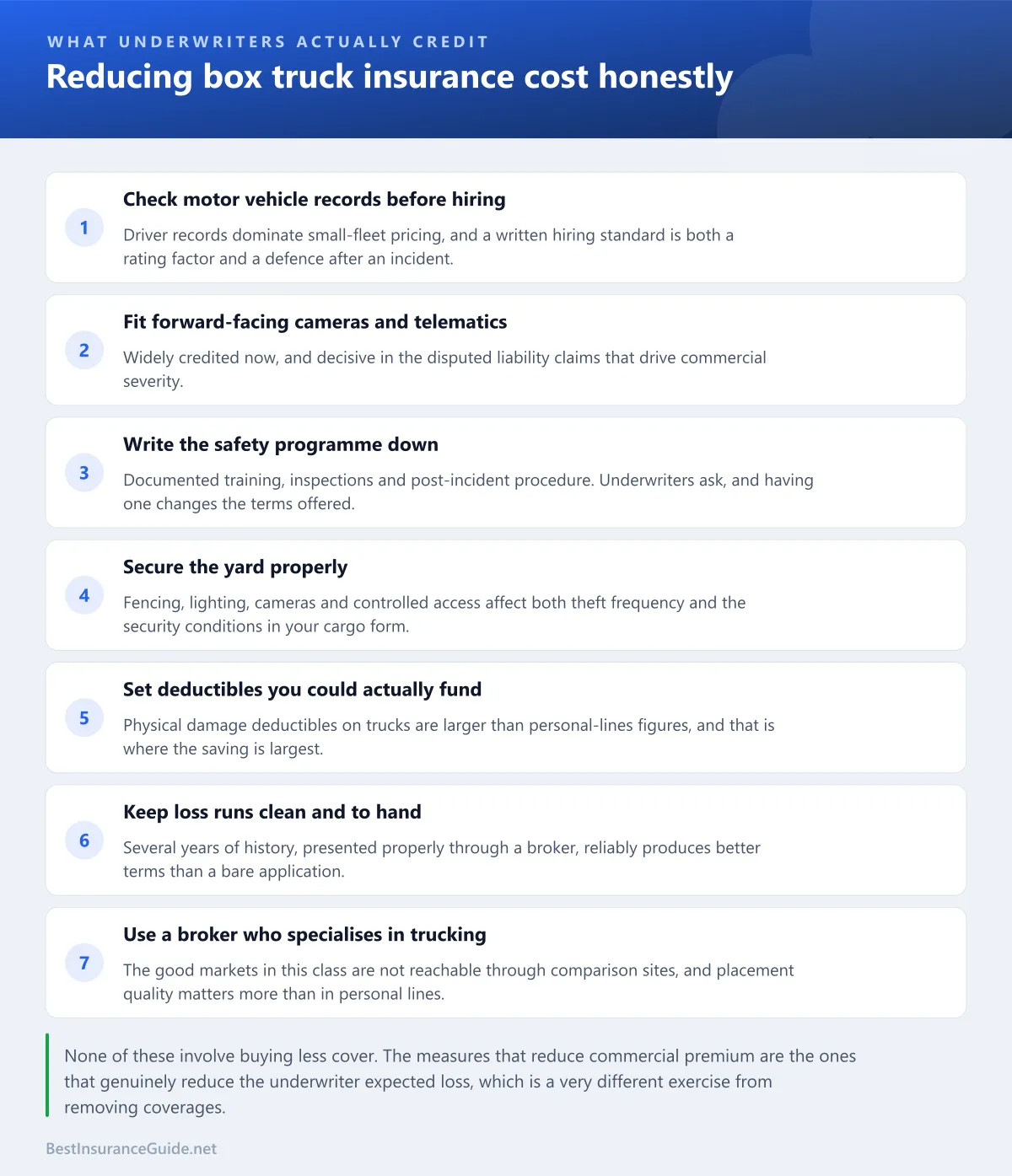
Hire carefully and document it. Driver records dominate small-fleet pricing, and a written hiring standard with motor vehicle record checks is both a rating factor and a defence.
Fit cameras and telematics. Forward-facing cameras in particular are now widely credited by carriers, and they resolve disputed liability claims decisively, which is where commercial auto severity actually comes from.
Run a written safety programme. Documented training, inspections and incident review. Underwriters ask, and the difference between having one and not is real.
Secure the yard. Fencing, lighting, cameras and controlled access affect both theft frequency and cargo terms.
Choose deductibles you could actually fund, and consider a higher physical damage deductible if your cash position supports it, since that is where the saving is largest.
Keep the loss runs clean and available. Carriers want several years of loss history, and a well-presented submission from a broker who knows the account gets better terms than a bare application.
Use a broker who specialises in trucking. This is not a market where price comparison sites reach the good markets.
The short version
Box truck insurance is a package: commercial auto liability, physical damage, motor truck cargo, general liability and workers compensation, quoted separately and frequently placed with different carriers.
The price is driven by radius of operation, driver records, cargo type, operating authority and years in business, far more than by the truck itself. Radius is the largest single lever and the one most commonly misstated.
Cargo cover is separate, its exclusions matter more than its limit, and its security conditions are where claims are lost.
And the filing requirements are set by federal and state authorities rather than by your insurer, so confirm them at source rather than assuming.
For the wider picture on trade-specific cover, see business insurance by trade, and for what to have in place generally, the business insurance checklist.
Owner-operator against fleet
The structure of the operation changes the whole placement, and two situations dominate.
Leased onto somebody else’s authority. The motor carrier’s policy provides the primary auto liability while you are under dispatch. What you need is non-trucking liability, sometimes called bobtail cover, for use outside dispatch, plus physical damage on your own truck and usually occupational accident cover in place of workers compensation. This is a much cheaper package and it has a specific gap: the moment between loads, when neither policy is obviously responding, is where disputes arise.
Running under your own authority. You carry the primary auto liability at the federal minimum or above, the cargo cover, the general liability and the filings. Substantially more expensive and substantially more control.
Operators frequently move from the first to the second, and the insurance cost of that transition surprises them. It is worth quoting the second structure before committing to it rather than after.
Worked example: the same truck, two structures
| Leased on | Own authority | |
|---|---|---|
| Primary auto liability | Carrier provides | You carry it |
| Non-trucking liability | Required | Not applicable |
| Motor truck cargo | Sometimes carrier provides | You carry it |
| General liability | Usually not required | Usually required |
| Federal filings | Carrier holds them | You hold them |
| Relative annual cost | Low | Several times higher |
Neither is wrong. The mistake is budgeting for the first while planning the second.
What underwriters actually look at
A submission is not a form. Five things decide the terms you are offered.
The loss runs. Several years of claims history from prior carriers, which is the single most important document in the file.
Driver motor vehicle records, for every driver, current.
The written safety programme, if one exists. Documented hiring standards, training, inspection routines and post-incident procedure.
The radius and commodity description, and whether it is consistent with what the operation obviously does.
Equipment condition and age, including whether cameras and telematics are fitted.
A well-presented submission from a broker who knows the trucking market reliably produces better terms than the same risk submitted bare, and the difference is large enough to be worth the effort.
Common gaps in a box truck programme
Five things are routinely missing when an operator brings an existing programme for review.
Tools and equipment in the truck, which sit on inland marine rather than on the auto or cargo policy. Lift gates, pallet jacks, straps, dollies and hand tools are frequently uninsured.
Trailer interchange cover, for equipment you pull but do not own, which the interchange agreement usually requires you to carry.
Business income cover, which pays while a damaged truck is off the road. For a single-truck operation this is the difference between a bad month and an insolvency.
Employment practices and hiring exposures, which sit outside the trucking policies entirely and which grow as soon as you have employees.
Adequate uninsured motorist cover, which commercial operators frequently reduce to the minimum without thinking, in an environment where they spend far more time on the road than a personal driver does.
Two checks worth doing at renewal
Reconcile the vehicle and driver schedules against reality. Trucks sold and drivers departed sit on schedules for years and cost money the whole time.
Reconcile the radius and commodity description against what the business now does. Operations drift, and a description written when the business started is frequently the thing a coverage dispute turns on three years later.
Related reading
Commercial auto insurance cost covers how vehicle-based commercial pricing works more generally, including the hired and non-owned gap. Business umbrella insurance covers the excess layer above a trucking programme, where contract requirements usually sit.
A note on scope
Coverage forms, cargo exclusions, filing requirements and regulatory thresholds vary by state and by carrier and change over time. Figures here are illustrative rather than quotes, and commercial pricing varies enormously by operation.
The Federal Motor Carrier Safety Administration publishes federal registration, authority and financial responsibility requirements, and your state transport and insurance authorities publish state filings. Your own policy wording and endorsement schedule are the authoritative statement of what you hold. This site is independent and not affiliated with any insurer.