Is Whole Life Insurance a Good Investment? Usually Not, and Sometimes Yes
How whole life insurance works as a savings vehicle, what the costs actually are, where it genuinely fits, and why term plus investing usually wins.

Table of contents

This question deserves a straight answer rather than either of the usual ones. Whole life insurance is not a scam, and it is not a good investment for most of the people who are sold it.
What it actually is
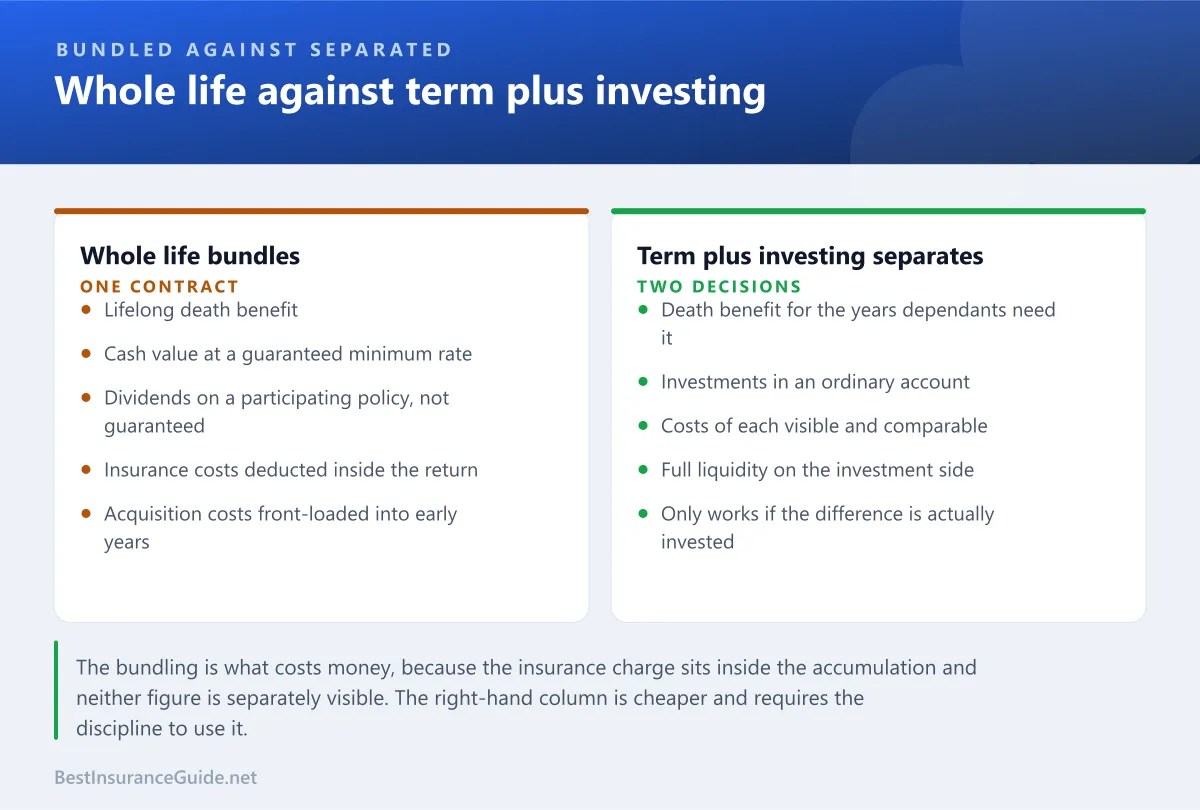
Whole life is two products in one contract.
A death benefit that lasts your whole life rather than a fixed term, provided premiums are paid.
A cash value account that accumulates at a guaranteed minimum rate, and on a participating policy may receive dividends.
The premium is level for life and is substantially higher than term insurance for the same death benefit, because it is funding both parts.
Why it usually loses the comparison
The case against whole life as an investment is not that the insurer is being dishonest. It is arithmetic.
Costs are front-loaded. Commission and acquisition costs come out of early premiums, which is why cash value in the first few years is small and frequently zero. An investment that starts from a large negative position needs a long time to catch up.
Insurance costs are inside the return. Every year, part of the premium pays for the death benefit. That is a real service and it is also a drag on the accumulation, and it is not separately visible.
Guaranteed rates are conservative. The guarantee is genuine and it is priced like a guarantee, which means low.
Dividends are not guaranteed. Illustrations frequently project dividends that are neither promised nor contractual, and comparing an illustrated figure against a market return is comparing a projection against a projection.
Liquidity is poor early on. Accessing your own money in the first years means either a loan with interest or a surrender at a loss.
Worked example: term plus investing against whole life
A healthy 35-year-old wanting $500,000 of death benefit.
| Whole life | Term plus investing | |
|---|---|---|
| Annual outlay | $5,400 | $420 term premium |
| Amount available to invest separately | $0 | $4,980 |
| Death benefit at 45 | $500,000 | $500,000 term, plus investments |
| Death benefit at 70 | $500,000 | Term expired, investments accumulated |
| Access to funds at 45 | Loan or surrender, with costs | Ordinary account access |
| Cost transparency | Bundled and hard to see | Fully visible |
The figures are illustrative and the structure is the point. The second column separates the two jobs, which makes each one cheaper and both of them visible.
The honest caveat is that the second column only works if the difference is actually invested. For a household that would spend it instead, the forced-saving argument has some real weight, though an automatic transfer to an investment account achieves the same discipline at far lower cost.
Where it genuinely earns its place
There are real cases, and they share a feature: a need that lasts for life rather than for a term.
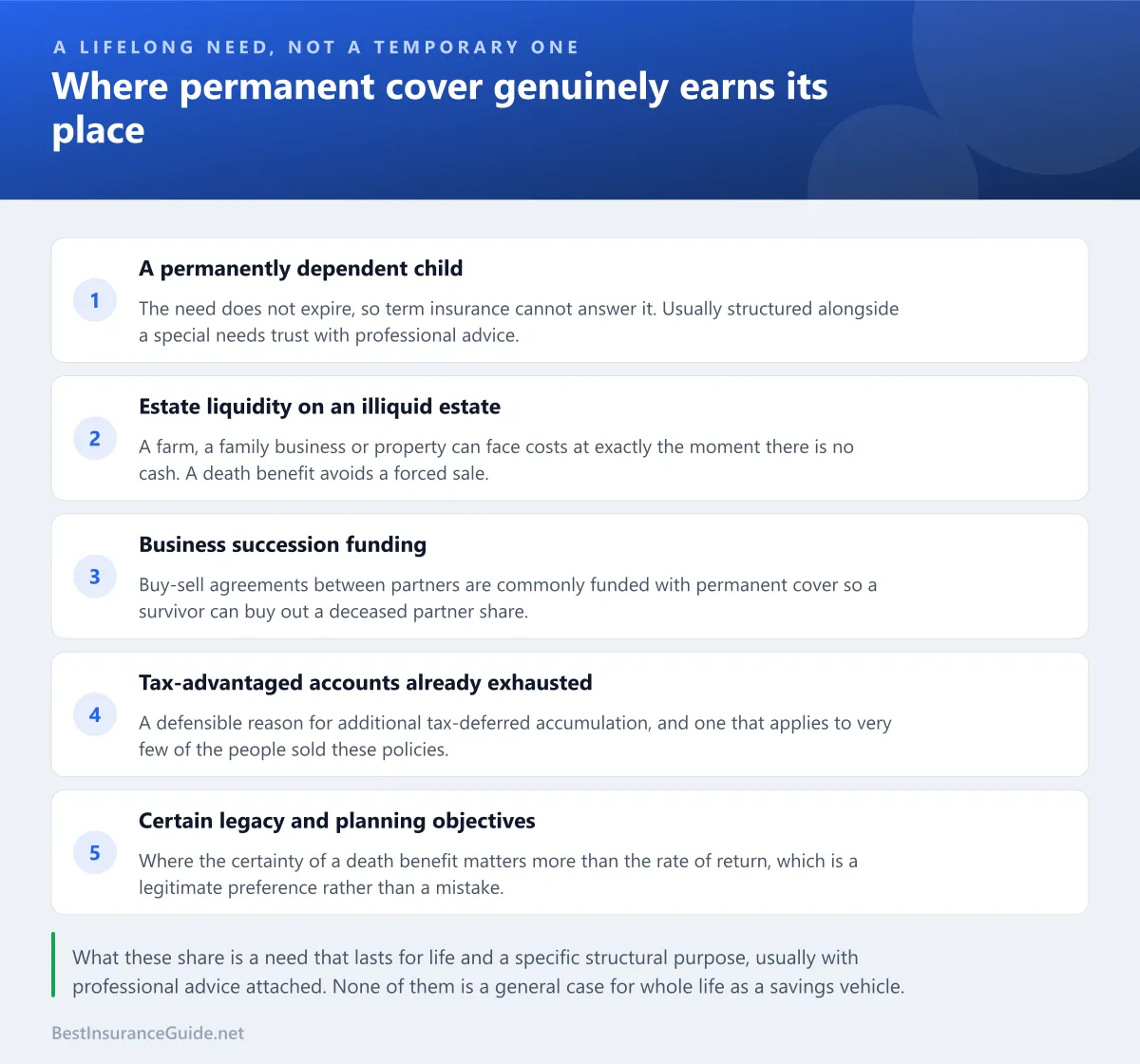
A permanently dependent child. A person with a lifelong disability will need support after their parents die, whenever that happens. Term insurance expires; the need does not. This is the clearest case and it is usually structured alongside a special needs trust.
Estate liquidity. A large estate concentrated in illiquid assets — a farm, a family business, property — may face costs and taxes that require cash at exactly the moment there is none. A permanent policy provides that liquidity without forcing a sale.
Business succession funding. Buy-sell agreements between partners are commonly funded with permanent life insurance so that a surviving partner can buy out a deceased partner’s share.
Someone who has exhausted other tax-advantaged accounts and is looking for additional tax-deferred accumulation, having already filled the more efficient options.
Certain estate and legacy planning objectives, where the certainty of a death benefit matters more than the rate of return.
Note what those have in common: a specific structural purpose, usually with professional advice attached, and never “it is a good way to save”.
Reading an illustration
If you are shown a whole life illustration, four things are worth doing.
Find the guaranteed column. Every illustration has one, and it is usually much less impressive than the projected column beside it. The guaranteed column is what you are actually contracted to receive.
Identify what is not guaranteed, which is generally the dividend assumption doing most of the work in the projection.
Look at the surrender values in years one to ten, which is where the front-loaded costs show up plainly.
Ask for the internal rate of return on the guaranteed column at year 20 and year 30. That is the comparison figure, and it is frequently not volunteered.
None of that is hostile. It is reading the document that describes what you are buying.
If you already own one
Do not cancel impulsively. That is genuinely important advice and it cuts against the usual internet response.
Surrender values in early years are poor, so cancelling a young policy crystallises the worst of the costs with none of the benefit.
Replacing cover later is not guaranteed. Health changes, and a policy you can no longer qualify for cannot be bought back at any price.
Gains above your cost basis are taxable on surrender.
A reduced paid-up option may exist, converting the policy to a smaller death benefit with no further premiums, which is frequently better than surrendering.
A 1035 exchange can move value into a different policy without an immediate tax event, though it should not be done on the recommendation of somebody earning a commission on the new contract.
Get the in-force illustration, understand what you have, and take advice from somebody paid for advice rather than for the sale.
The short version
Whole life insurance bundles lifelong protection with a savings account, and the bundling has a cost that is real and largely invisible. For most households, buying term insurance for the years dependants need protecting and investing the difference separately produces both cheaper protection and better accumulation.
It genuinely fits where the need is lifelong rather than temporary: a permanently dependent child, estate liquidity for an illiquid estate, business succession funding, and certain planning situations. Those cases are real and they are a minority of sales.
If you are being shown an illustration, read the guaranteed column rather than the projected one, and look at the surrender values in the first decade.
And if you already hold a policy, do not cancel it on impulse. Get the in-force illustration first and take independent advice.
For the direct comparison, see term versus whole life insurance, and for whether you need cover at all, is life insurance worth it.
Policy loans, and what they actually do
Borrowing against cash value is presented as a major advantage and it deserves precision.
A policy loan is not a withdrawal. The insurer lends against the policy and the cash value stays in place, continuing to be credited.
It is not taxed as income while the policy remains in force, which is a genuine feature.
It accrues interest, at a rate set in the contract, and unpaid interest is generally added to the loan.
It reduces the death benefit by the outstanding balance if unpaid at death.
A lapse with a large loan outstanding can create a taxable event, because the loan is then treated as a distribution. This is the trap in the feature: a policy that lapses with a substantial loan can produce a tax bill on money the policyholder never received in cash.
The honest summary is that policy loans are a real liquidity feature with a real risk attached, and they are frequently presented with the first half only.
What to ask before buying
Show me the guaranteed column. Then read only that column while forming a view.
What is the surrender value in years one, three, five and ten?
What internal rate of return does the guaranteed column produce at year 20 and year 30?
What is the dividend assumption in the projection, and what has the actual dividend scale done over the past twenty years?
What is your commission on this policy, and what would it be on a term policy with the same death benefit?
What happens if I cannot pay a premium in year four?
Those six questions produce a much clearer picture than any amount of general reading, and a good adviser will answer all of them without discomfort.
The forced-savings argument, weighed honestly
The strongest defence of whole life is behavioural rather than financial, and it deserves a fair hearing.
The claim is that a required annual premium enforces a discipline that a voluntary investment contribution does not, and that many people who intend to invest the difference never do.
Two things are true about that.
The behavioural point is real. Households do underinvest, and a contractual obligation is stickier than an intention.
The cost of the discipline is high. An automatic monthly transfer into a low-cost investment account achieves the same commitment with none of the front-loaded acquisition costs, none of the surrender penalties, and full transparency about what is being paid for.
The honest conclusion is that the behavioural problem is genuine and whole life is an expensive solution to it. If the discipline is what you need, automate the transfer and buy term.
Two things to do before signing anything
Get a term quote for the same death benefit, from the same adviser, and put the two premiums side by side. That single comparison reframes the conversation more effectively than any argument.
Ask what happens in year four if money is tight. Whole life premiums are contractual. The answer to that question, and how comfortable the adviser is answering it, tells you a great deal.
Where the confusion usually starts
Two framings do most of the damage, and recognising them makes the conversation easier.
“It builds cash value.” True, and incomplete. Cash value builds slowly, from a starting position depressed by front-loaded costs, at a conservative guaranteed rate. Presenting accumulation without presenting the early surrender values is presenting half the picture.
“You get your money back.” Also true eventually, and it is worth asking over what period and at what implied rate of return. Money returned after twenty years without growth is not a neutral outcome; it is a real loss to inflation.
Neither framing is dishonest. Both are incomplete in the same direction, and the correction in both cases is the guaranteed column and the year-by-year surrender values.
The one-line summary for each situation
A household with young children and a mortgage. Term insurance, sized from a needs calculation, invested difference. Whole life is an expensive way to solve a temporary problem.
A household with a permanently dependent child. Permanent cover is appropriate, and it should be arranged alongside a special needs trust with professional advice, because a benefit paid directly can affect means-tested support.
A business owner with partners. Permanent cover funding a buy-sell agreement is standard practice and works well.
An estate concentrated in property or a business. Permanent cover providing liquidity is a genuine solution to a genuine problem.
Someone who has filled every tax-advantaged account and wants more tax-deferred accumulation. A defensible reason, and one that applies to very few of the people to whom whole life is actually sold.
Everybody else. Buy term, automate the investment, and revisit in five years.
Related reading
Two adjacent products are worth understanding before deciding. Indexed universal life sits between term and whole life and is considerably more complex than either. AD&D insurance is frequently sold alongside both and is not life insurance at all, which is worth knowing before it appears in an illustration as a benefit.
A note on scope
Nothing here is financial, tax or investment advice. Policy structures, guaranteed rates, dividend practices and tax treatment vary between insurers and jurisdictions and change over time, and the figures used are illustrative rather than quotes.
Your state insurance department and the NAIC publish buyer guides for life insurance products, and the in-force illustration for any policy you hold is the authoritative statement of its guaranteed and projected values. A licensed adviser paid for advice rather than for product sales is the appropriate source for a personal recommendation. This site is independent and not affiliated with any insurer.