How Long Does Life Insurance Take to Pay Out? Usually Weeks, Sometimes Years
How long a life insurance claim takes, what the contestability period does, the documents needed, the common causes of delay and how to avoid them.

Table of contents

For a straightforward claim on an established policy, the answer is usually thirty to sixty days and frequently less. Everything that makes it longer is predictable, and most of it can be prevented years in advance.
The normal timeline
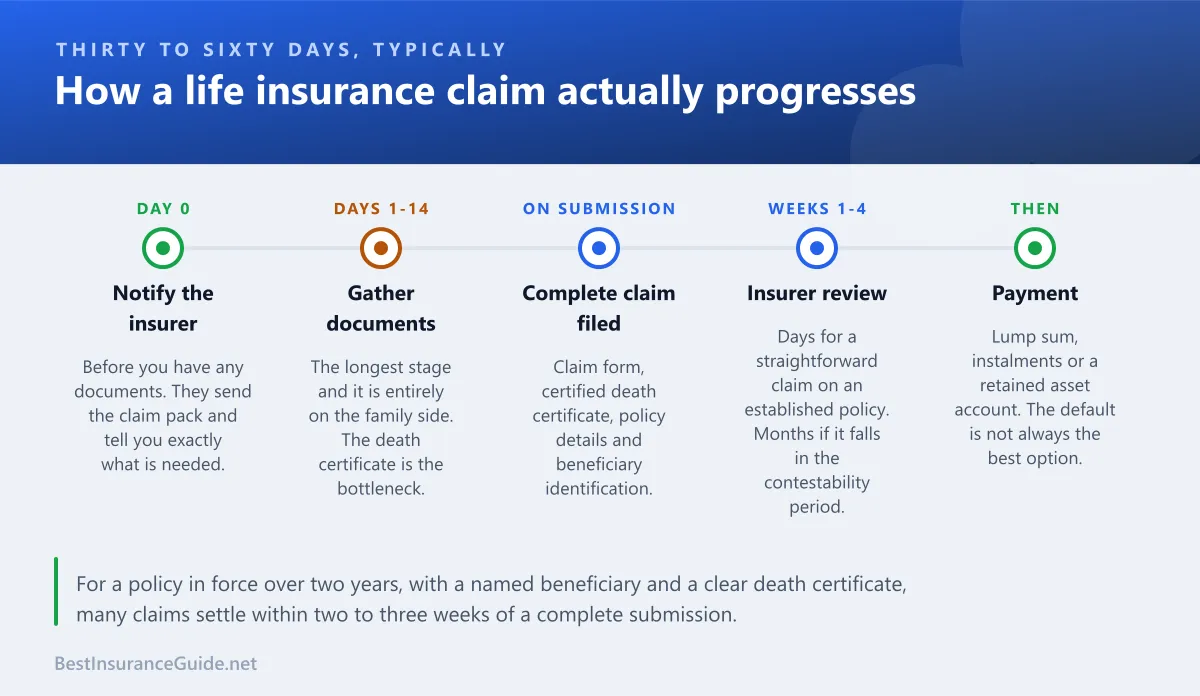
Notify the insurer. Immediately. A phone call or online notification starts the process, and the insurer sends the claim pack.
Gather the documents. Usually the longest stage, and it is entirely on the family’s side. The death certificate is the bottleneck.
Submit the claim. Complete claim form, certified death certificate, policy details, beneficiary identification.
Insurer review. Days to a few weeks for a straightforward claim on an established policy.
Payment. Commonly by cheque, electronic transfer, or into a retained asset account.
For a policy in force for more than two years, with a named beneficiary, a clear death certificate and complete paperwork, thirty to sixty days from submission is typical and many settle within two to three weeks.
The contestability period
This is the single largest determinant of whether a claim is fast or slow.
For roughly two years after a policy is issued, the insurer may investigate the original application and deny a claim if there was a material misstatement.
A death during that period triggers a review. The insurer will typically request medical records, which takes time regardless of what they show, and the claim can extend to several months even when it is ultimately paid in full.
Three things worth knowing.
It applies to the policy, not to your age. A policy reinstated after a lapse, or materially altered, may start a new contestability period, which catches people.
It is about materiality. Not every omission voids a policy. A misstatement must generally be material to the underwriting decision.
Truthful applications survive it. The entire risk is created at application. Answering fully and accurately, including the questions that feel intrusive, is what makes this period a formality rather than a problem.
The suicide exclusion runs on a similar clock, commonly two years, during which the policy returns premiums rather than the face amount.
What actually causes delay
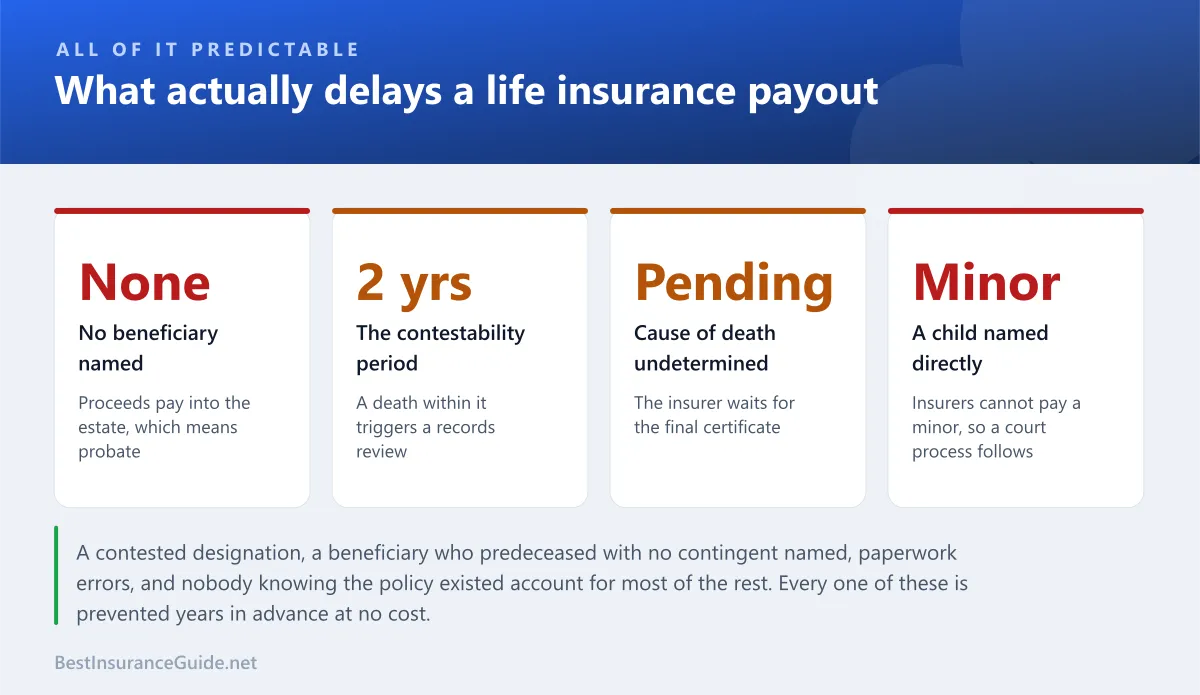
No named beneficiary. Proceeds pay into the estate, which means probate. This adds months, exposes the money to estate costs and creditors, and is entirely avoidable.
A beneficiary who predeceased, with no contingent named. Same outcome.
A death within the contestability period, as above.
A death certificate showing a pending or undetermined cause, which is common where an autopsy or investigation is involved. The insurer generally cannot proceed until the final certificate is issued, and that can take months.
A contested designation, typically an ex-partner named on an old policy, or a dispute between family members. This moves the money into a legal process.
A minor named directly as beneficiary, since insurers generally cannot pay a minor. Proceeds go into a court-supervised arrangement, which is slow and inflexible.
Simple paperwork problems: an unsigned form, a photocopied rather than certified death certificate, a name that does not match, missing identification.
Nobody knowing the policy existed, which is more common than it should be and results in unclaimed benefits.
What families can do in advance
Almost every delay above is prevented years earlier, at no cost.
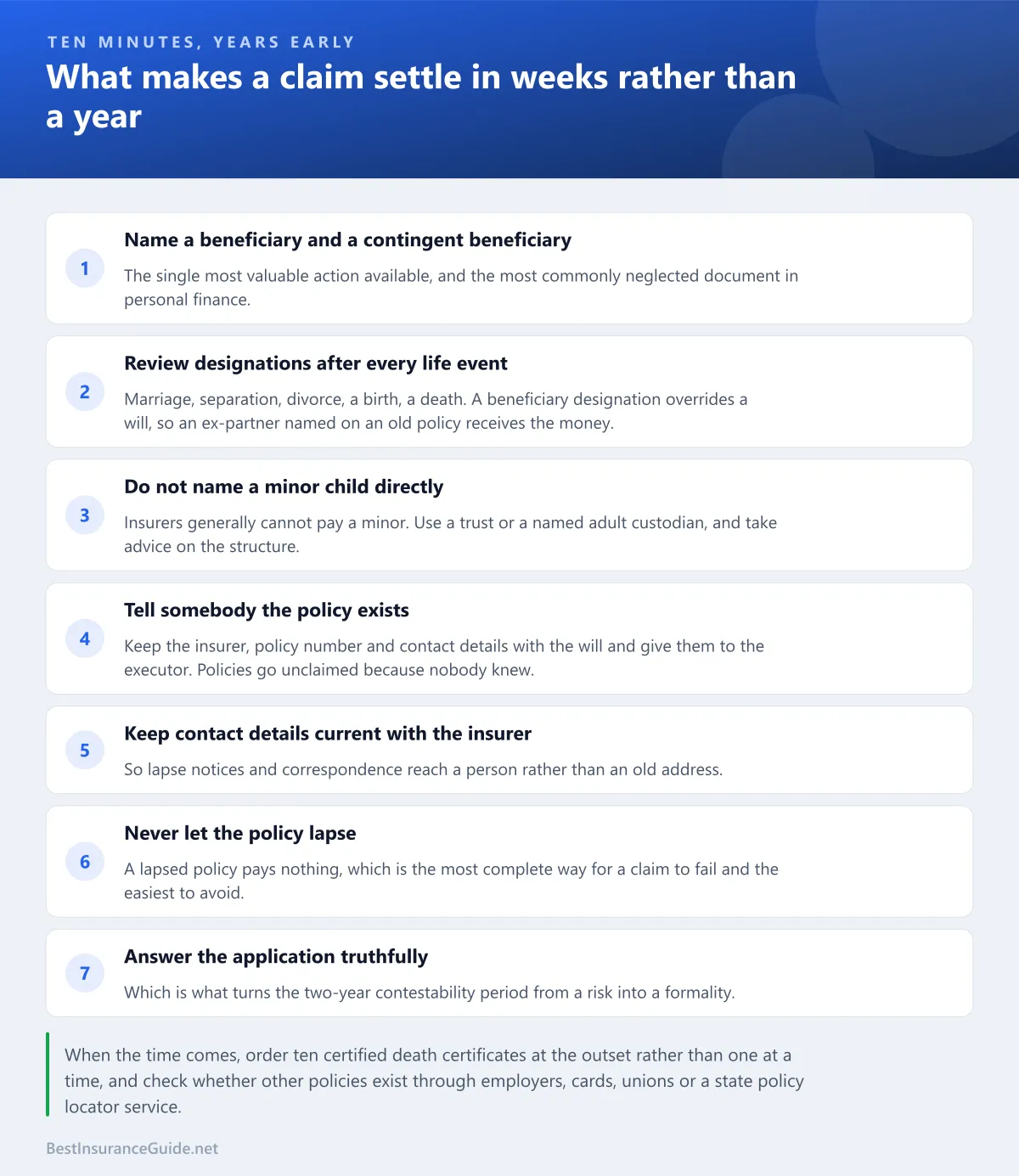
Name a beneficiary, and a contingent beneficiary. The single most valuable action, and the most commonly neglected document in personal finance.
Review designations after every life event. Marriage, separation, divorce, a birth, a death. A beneficiary designation overrides a will, so an ex-partner named on an old policy receives the money regardless of what the will says.
Do not name a minor child directly. Use a trust or a named adult custodian, and take advice on the structure.
Tell somebody the policy exists. Keep the insurer, policy number and contact details with the will, and tell the executor. Unclaimed policies exist mostly because nobody knew.
Keep the contact details current with the insurer, so lapse notices and correspondence reach somebody.
Never let the policy lapse. A lapsed policy pays nothing, and this is the most complete way for a claim to fail.
Answer the application truthfully, which is what makes the contestability period a non-event.
Making a claim efficiently
Notify the insurer early, before you have all the documents. They will tell you exactly what is needed and send the forms.
Order multiple certified death certificates. You will need them for the insurer, the bank, the pension provider, the registry and others. Ordering ten at the outset is cheaper and faster than ordering them one at a time.
Check whether more than one policy exists. Employer group life, a mortgage-linked policy, an accidental death benefit on a card or a membership, and older individual policies are all commonly forgotten. Where a policy cannot be traced, most states operate a life insurance policy locator service through the insurance department or the NAIC.
Ask about the payment options. Lump sum, instalments, or a retained asset account. Retained asset accounts are legitimate and pay interest, and they are not a bank account; understand what you are agreeing to before defaulting into one.
Ask about interest on delayed payment. Many states require insurers to pay interest from the date of death where settlement takes longer than a stated period, and it is not always volunteered.
Keep a record of every contact, with dates and names, which is what resolves a claim that stalls.
Escalate through the state insurance department if a claim is unreasonably delayed. They handle complaints about claims handling and the process is free.
Worked example: two claims, same policy
| Prepared | Unprepared | |
|---|---|---|
| Beneficiary named and current | Yes | Lapsed to the estate |
| Family knew the policy existed | Yes | Found months later |
| Death certificates ordered | Ten at the outset | One, reordered repeatedly |
| Policy age | Eight years | Eight years |
| Time to payment | About three weeks | Over a year, through probate |
The policy was identical. The difference is entirely paperwork done or not done in advance.
The short version
A straightforward life insurance claim on a policy over two years old commonly settles in thirty to sixty days, and often faster.
The delays are predictable: no named beneficiary, a death within the two-year contestability period, a death certificate with an undetermined cause, a contested designation, a minor named directly, or nobody knowing the policy existed.
Almost all of that is prevented years in advance by naming a beneficiary and a contingent, reviewing the designations after every life event, not naming a minor directly, telling somebody the policy exists, and never letting it lapse.
When claiming, notify early, order plenty of certified death certificates, look for policies the deceased may have held elsewhere, and ask about interest on any delayed payment.
For the tax treatment of proceeds, see life insurance and taxes, and for the fundamentals, life insurance basics.
The payment options, and choosing well
Most insurers offer several ways to receive the money, and the default is not always the best one.
Lump sum. The whole benefit at once. Simple, and it puts the decision about what to do with it in the beneficiary’s hands.
Retained asset account. The insurer holds the money in an interest-bearing account and issues a chequebook or card. These are legitimate and they pay interest, and they are not bank deposits and are not insured in the same way. Some beneficiaries default into one without realising they had a choice.
Instalments over a fixed period, or a lifetime income option, which converts the benefit into a stream of payments.
Interest-only, with the principal retained and paid later.
Two practical points. A grieving beneficiary should not make an irreversible financial decision quickly, and a lump sum in an ordinary insured account while decisions are made is usually the safest default. And the tax treatment differs: the death benefit itself is generally not income-taxable, while interest earned on it usually is.
If a claim is delayed or denied
Ask what is outstanding, specifically, and get it in writing. Most stalled claims are stalled on one missing item.
Ask whether the claim is within the contestability period, which explains most reviews and is not itself a denial.
Ask about statutory interest, since many states require insurers to pay interest from the date of death where settlement exceeds a stated period.
Keep a written record of every call: date, name, what was said.
Escalate to the state insurance department, which handles complaints about claims handling free of charge and publishes the outcomes. This is effective and underused.
Take legal advice where a denial is based on alleged misrepresentation and you believe the application was accurate, because these are resolvable and the burden is on the insurer to show materiality.
Two things to do now, for the people who will claim
Check the beneficiary designation on every policy you hold, including employer group cover, and add a contingent beneficiary where there is none. This is the single largest determinant of whether a claim takes three weeks or a year, and it takes ten minutes.
Write down where everything is. Insurer, policy number, contact details, and where the documents live, kept with the will and given to the executor. Policies go unclaimed mostly because nobody knew they existed, and no amount of efficiency at the insurer’s end fixes that.
Neither costs anything, and between them they prevent most of the delays described above.
What the beneficiary should expect
For somebody about to make a claim, a realistic picture helps.
The insurer will not chase you. The claim starts when the beneficiary notifies them, and nothing happens before that.
The death certificate is the bottleneck, and its issue time depends on the jurisdiction and on whether a cause has been determined.
A request for medical records is not an accusation. Within the contestability period it is routine, and most such claims are paid in full.
Interest may be payable from the date of death where settlement exceeds a statutory period, and it is frequently not volunteered.
Nothing needs to be decided quickly about how to receive or use the money. A lump sum into an ordinary insured account, with decisions deferred, is a reasonable default for anybody in the weeks after a death.
Finding a policy nobody can locate
Where a death has occurred and the family believes a policy existed but cannot find it, several routes are worth trying in order.
Search the paperwork for premium notices, statements, and payments to insurers on bank records over several years.
Check employer records, including former employers, for group life and any retiree continuation.
Contact any professional body, union or fraternal organisation the person belonged to, which frequently carried small group policies.
Use the NAIC life insurance policy locator service, a free national service that forwards a request to participating insurers.
Check your state unclaimed property office, since matured or unclaimed benefits are eventually turned over to the state and remain claimable.
Check with the state insurance department, several of which operate their own locator services.
None of these are fast, and all of them are considerably easier than they would have been if somebody had written down what existed while the policyholder was alive. That is the argument for doing it now.
Related reading
The single largest determinant of a fast claim is the designation, and what a contingent beneficiary is covers how to review every account that carries one in a single sitting. For the underlying decision about whether to hold cover at all, is life insurance worth it works through the needs calculation.
A note on scope
Nothing here is financial, tax or legal advice. Claim timelines, contestability and suicide exclusion periods, interest requirements on delayed payments and probate consequences vary by state and by policy and change over time.
Your state insurance department publishes consumer guidance on life insurance claims and handles complaints about claims handling, and the NAIC operates a life insurance policy locator service. Your own policy documents are the authoritative statement of the terms that apply. This site is independent and not affiliated with any insurer.