Do You Pay Taxes on Life Insurance? Usually Not, With Five Exceptions
Life insurance death benefits are usually income-tax free. When they are not: interest, estate tax, transfer for value, policy loans and surrendered cash value.

Table of contents

The good news arrives first, and it is genuinely good: a life insurance death benefit is normally received free of federal income tax.
Someone dies, the insurer pays the named beneficiary, and that money is not reported as income. It is one of the cleanest tax outcomes available in personal finance, and it is a large part of why life insurance works as well as it does.
The exceptions are narrow, but each one catches people, and two of them are entirely avoidable with paperwork.
The default rule
A death benefit paid to a named beneficiary is excluded from gross income. The beneficiary does not report it, does not pay income tax on it, and does not need to do anything special to receive it that way.
This holds regardless of the size of the benefit and regardless of the relationship between the insured and the beneficiary. A $2 million payout to a spouse and a $50,000 payout to a friend are treated the same way for income tax purposes.
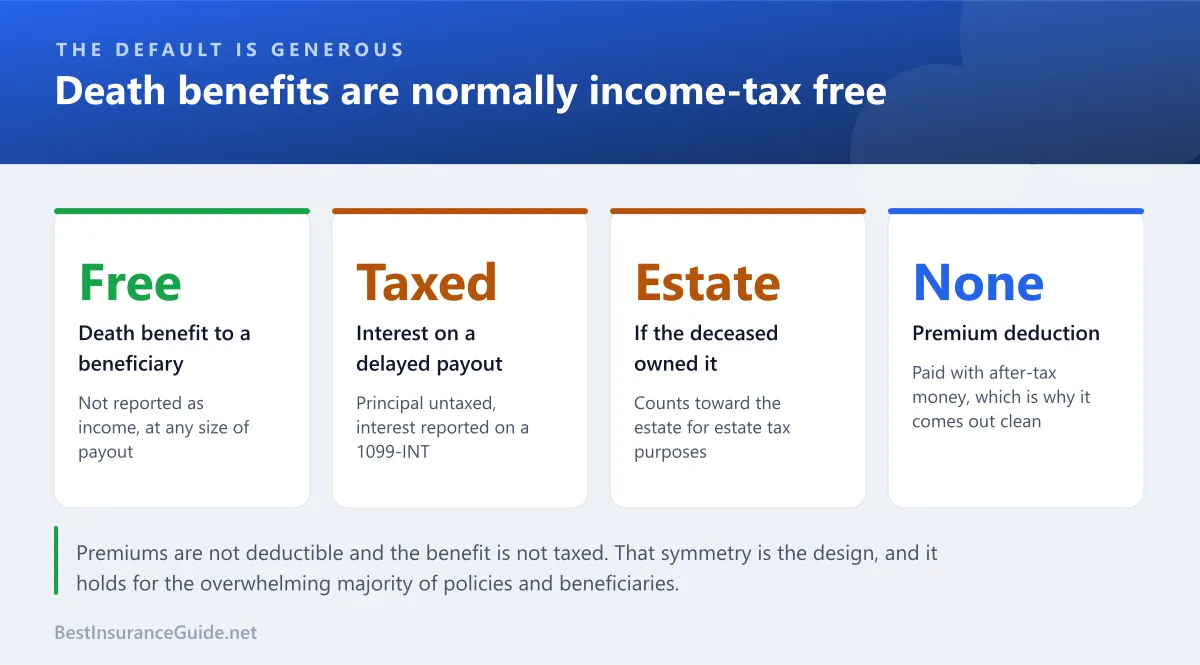
Premiums, correspondingly, are not deductible for an individual buying personal cover. You pay with after-tax money and the benefit comes out untaxed. That symmetry is the design.
Now the five exceptions.
Exception 1: interest on a delayed payout
This is the most common one by a distance, and the amounts are usually small enough that people are simply surprised by the form rather than harmed by it.
If the insurer holds the money between the date of death and the date of payment, or if the beneficiary chooses to receive the benefit in instalments or leaves it in an interest-bearing account with the insurer, the interest is taxable. The principal is not.
Worked example: a benefit paid four months later
| Amount | Taxable? | |
|---|---|---|
| Death benefit | $500,000 | No |
| Interest accrued while the claim was processed | $4,100 | Yes |
| Total received | $504,100 | $4,100 taxable |
The beneficiary receives a 1099-INT for the $4,100 and reports it as interest income.
The same applies more significantly to settlement options. Choosing to take $500,000 over twenty years rather than as a lump sum means each payment contains principal and interest, and the interest part is taxable every year.
Exception 2: estate tax
This is the exception that matters most for larger estates, and it is the one that good planning removes entirely.
If the deceased owned the policy, the death benefit is included in the value of their estate for estate tax purposes. Not income tax, estate tax. Those are different systems with different thresholds.
Ownership here means holding what the rules call incidents of ownership: the right to change the beneficiary, to borrow against the policy, to surrender it, or to assign it. Simply being the insured is not the same as owning it.
For most families this changes nothing, because the federal estate tax exemption is high enough that only a small share of estates are affected. Two situations make it live:
A large estate. Where the total estate approaches or exceeds the federal exemption, a seven-figure policy can be the thing that pushes it over.
A state estate or inheritance tax. Several states impose their own, and some thresholds are considerably lower than the federal one. Inheritance taxes in particular can apply based on the relationship of the recipient rather than the size of the estate.
The standard fix is an irrevocable life insurance trust. The trust owns the policy, so the insured never holds incidents of ownership and the proceeds sit outside the estate. Setting one up correctly matters, and transferring an existing policy into a trust carries a three-year lookback: die within three years of the transfer and it comes back into the estate anyway.
This is firmly territory for an estate attorney rather than a website.
Exception 3: transfer for value
Less common, more surprising when it lands.
If a life insurance policy is sold or transferred in exchange for something of value, the death benefit can lose its tax-free status. The recipient is then taxed on the amount above what they paid plus subsequent premiums.
This catches people in business contexts most often: buy-sell agreements restructured without advice, policies moved between business partners, or life settlements where a policy is sold to a third party.
There are safe harbours. Transfers to the insured, to a partner of the insured, to a partnership in which the insured is a partner, or to a corporation in which the insured is a shareholder or officer generally preserve the exclusion. Which is precisely why business buy-sell arrangements need to be structured deliberately rather than improvised.
Exception 4: cash value taken during life
Everything above concerns the death benefit. Permanent policies also build cash value, and that has its own rules.
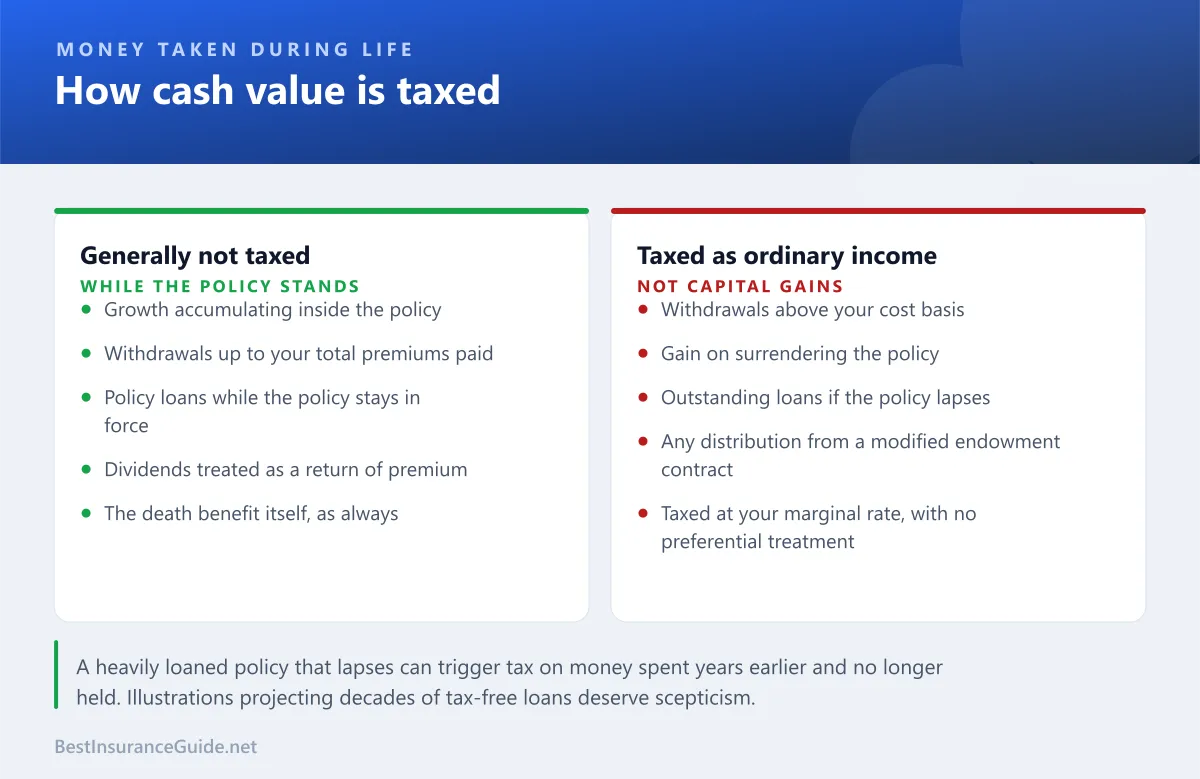
Growth inside the policy is tax-deferred. Nothing is reported while it accumulates.
Withdrawals up to your basis are tax free. Basis is the total premiums you have paid. Take out less than you put in and there is no tax.
Withdrawals above basis are taxed as ordinary income. Not capital gains. Ordinary income, at your marginal rate.
Loans are generally not taxable while the policy stays in force, because borrowing is not income. This is the mechanism behind most “tax-free income from life insurance” marketing.
Surrendering the policy triggers tax on the gain. The amount received above basis is ordinary income in that year.
Worked example: surrendering a whole life policy after 22 years
| Amount | |
|---|---|
| Total premiums paid over 22 years | $79,200 |
| Cash surrender value | $104,600 |
| Cost basis | $79,200 |
| Taxable gain | $25,400 |
| Taxed as | Ordinary income |
Note what this is not. It is not a capital gain, so no preferential rate applies. For a higher earner that $25,400 can be taxed at a meaningfully higher rate than an equivalent investment gain would have been.
Our comparison of term versus whole life insurance works through where the money actually goes in a permanent policy, which is worth understanding before treating cash value as an investment account.
The loan trap worth knowing about
The dangerous version of the loan rule is this: if a policy with a large outstanding loan lapses or is surrendered, the loan is treated as if it were received, and the gain becomes immediately taxable.
That can produce a tax bill on money the policyholder spent years earlier and no longer has, at exactly the moment the policy has collapsed. It is the reason heavily loaned policies need monitoring rather than neglect, and why illustrations projecting decades of tax-free loans deserve scepticism.
Modified endowment contracts are a related trap. If a policy is funded faster than certain limits allow, it becomes an MEC, and the tax ordering flips: withdrawals come out of gains first rather than basis first, and loans become taxable. A policy can be pushed into MEC status by overfunding it, and once classified it does not revert.
Exception 5: employer-provided cover above $50,000
Group term life insurance provided by an employer is tax free to the employee up to $50,000 of cover. Above that, the cost of the additional insurance is treated as imputed income and added to taxable wages.
This is why a payslip sometimes shows a small life insurance figure in the earnings column that you never received as cash. It is the taxable value of employer-provided cover above the threshold, calculated from an IRS table based on age.
The amounts are usually modest. It is worth understanding rather than worrying about.
The paperwork that prevents most problems
Two administrative failures cause more tax and probate trouble than all the exceptions above combined.
Name a beneficiary, and name a contingent one. A policy with no living named beneficiary pays to the estate, and money paid to an estate goes through probate, becomes available to creditors, and loses the clean direct transfer that makes life insurance work. Naming a contingent beneficiary costs nothing and covers the case where the primary predeceases.
Avoid three-party ownership. If the owner, the insured and the beneficiary are three different people, the death benefit can be treated as a gift from the owner to the beneficiary, potentially creating a gift tax issue on top of everything else. The usual arrangement, where the insured owns the policy or a trust does, avoids this entirely.
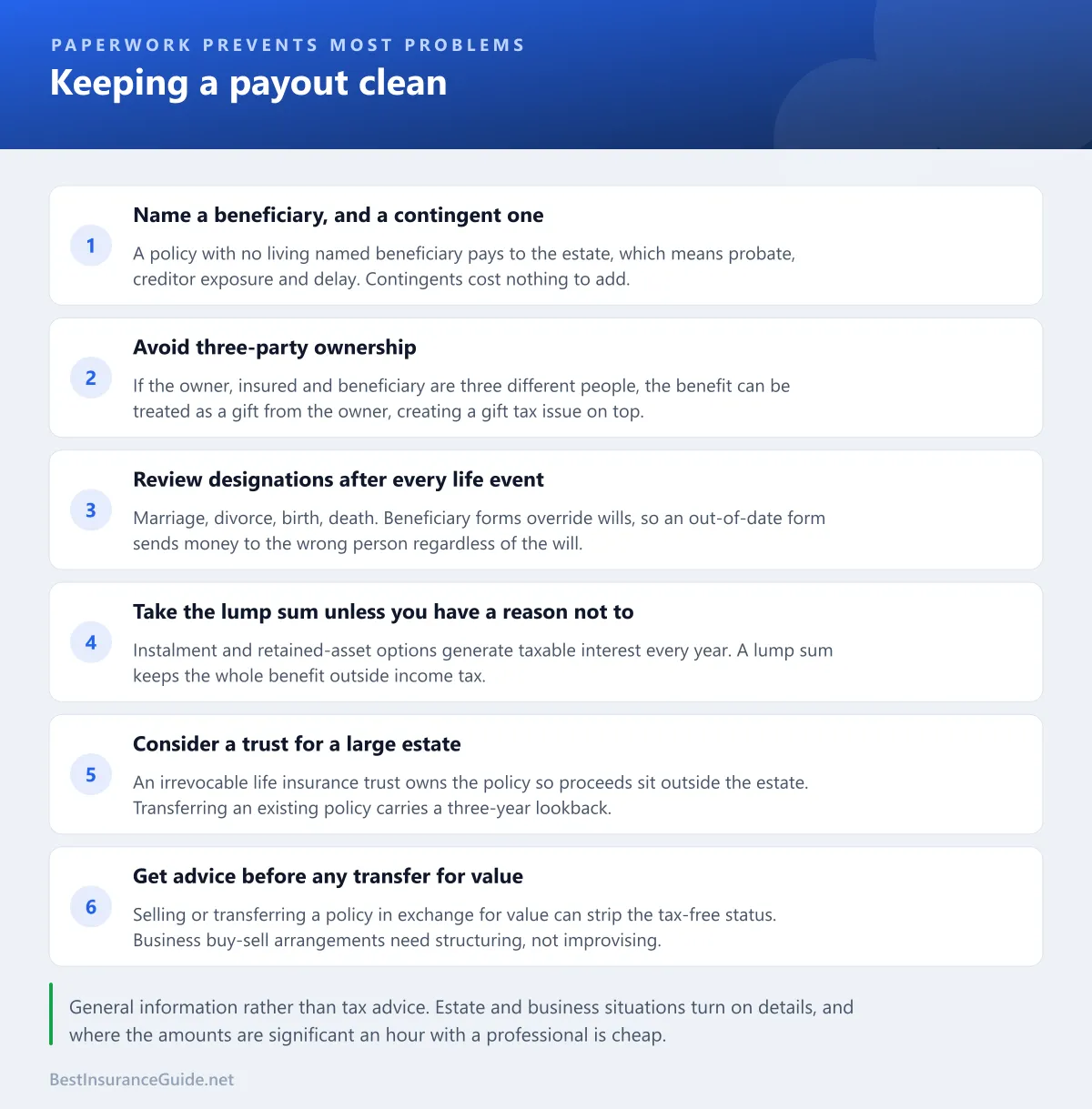
Review beneficiary designations after every marriage, divorce, birth and death. Beneficiary designations override wills, so an out-of-date form sends the money to the wrong person regardless of what the will says. This is not rare. It is one of the most common ways life insurance fails to do its job.
The short version
You do not pay income tax on a life insurance death benefit. That is the rule, and it holds for the overwhelming majority of policies and beneficiaries.
Tax appears in five places: interest paid on top of the benefit, estate tax where the deceased owned the policy and the estate is large, policies transferred for value, cash value withdrawn or surrendered above basis during life, and employer cover above $50,000.
Two things prevent most problems: keep beneficiary designations current with a named contingent, and do not let the owner, insured and beneficiary be three different people.
This is general information rather than tax advice, and the estate and business situations in particular turn on details. If the amounts are significant, an hour with a tax professional or estate attorney is cheap relative to what is at stake.
For sizing a policy in the first place, life insurance basics covers the DIME method and what delay actually costs.