How Long Does It Take to Get Car Insurance? Minutes, If You Are Ready
Car insurance can start within the hour. What you need before you begin, what causes delays, and how same-day cover works when you are buying a car.

Table of contents
For most people the honest answer is fifteen minutes, and the fifteen minutes is mostly spent looking for information you could have gathered beforehand.
The realistic timeline
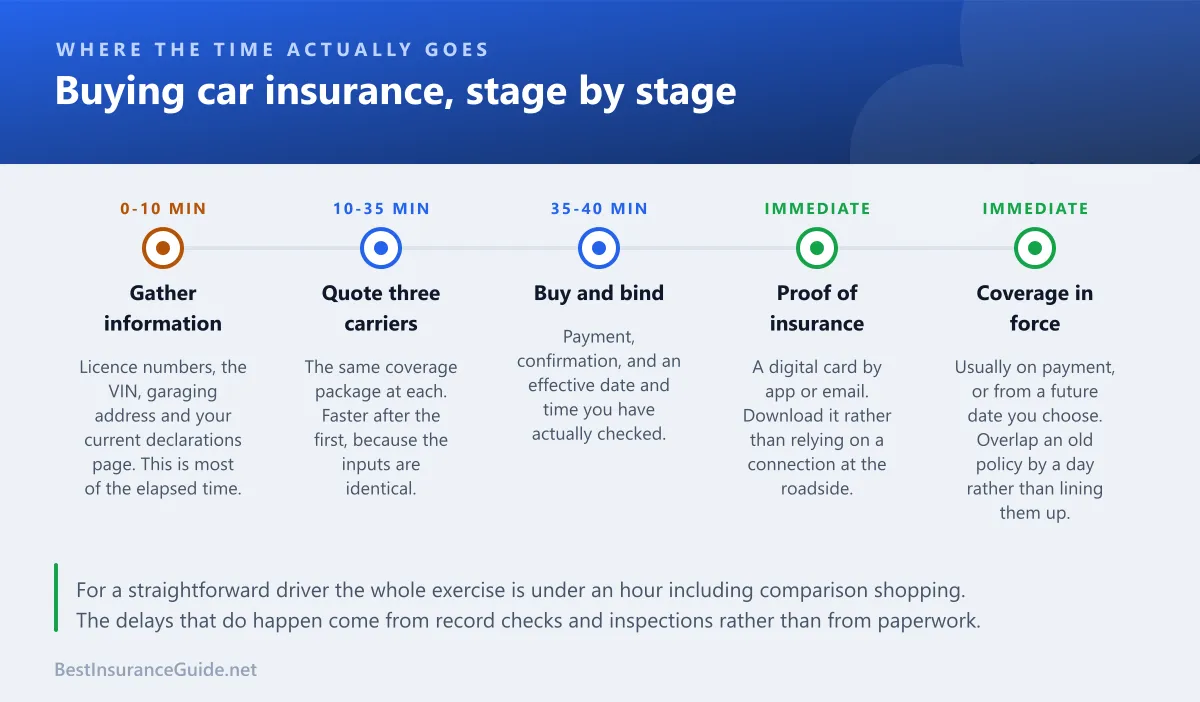
Gathering information: five to ten minutes, and this is where the time actually goes.
Quoting: five to fifteen minutes per insurer, less if you are re-quoting the same package.
Buying and binding: two to five minutes, once you have decided.
Proof of insurance: immediate, digitally, in most cases.
Coverage in force: immediately or from a date you choose.
The total for a straightforward driver who has the information ready is well under half an hour, including comparing three carriers.
What to have ready
The single most useful thing you can do is assemble this before starting, because every one of these interrupts the process if you have to go and find it.
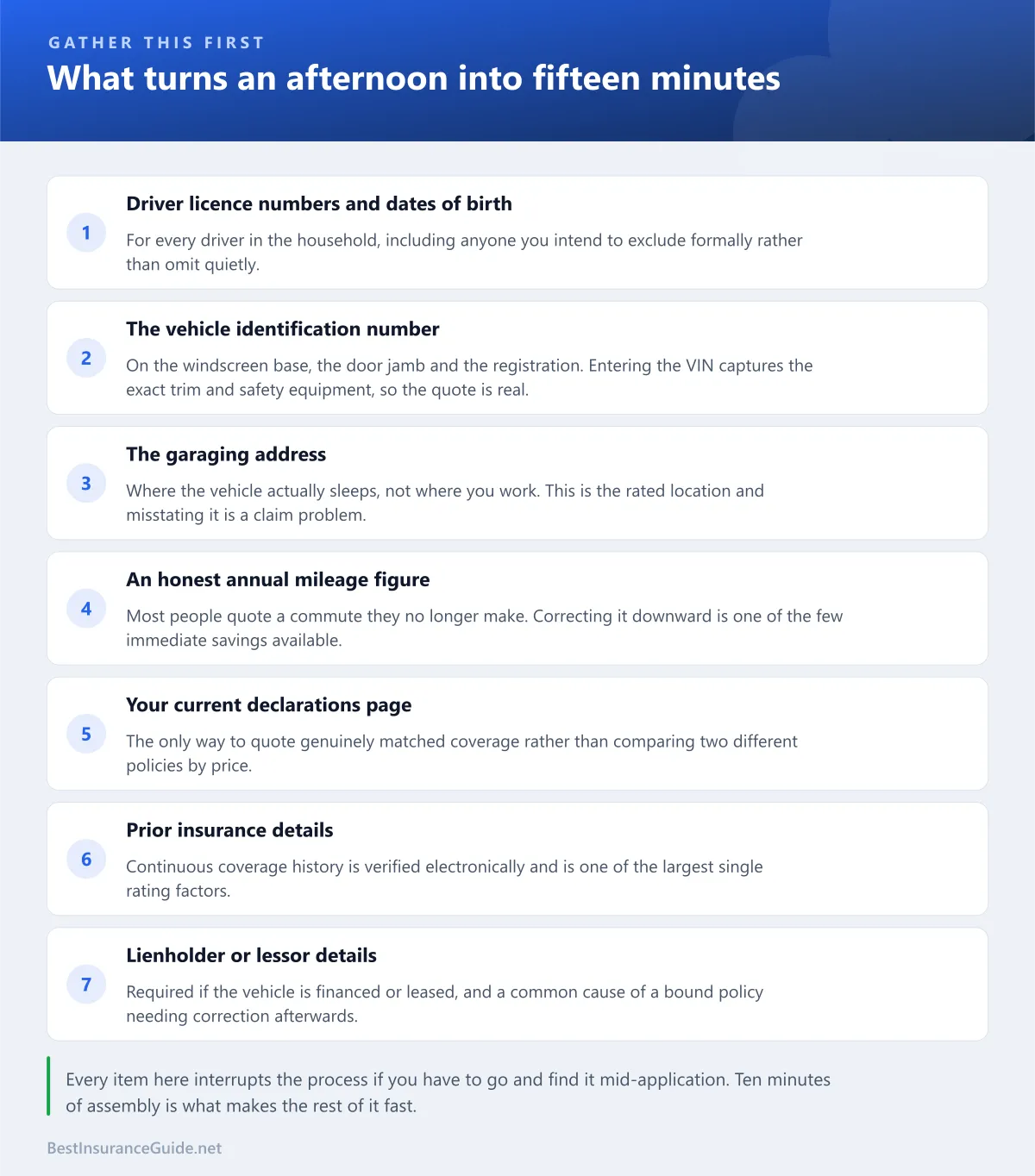
Driver licence numbers for every driver to be listed, including household members.
Dates of birth for the same.
The vehicle identification number, which is on the dashboard at the base of the windscreen, on the door jamb, and on the registration document. Entering the VIN rather than the make and model produces a far more accurate quote because it captures the exact trim and safety equipment.
The garaging address, meaning where the vehicle actually sleeps, not where you work.
Annual mileage, estimated honestly. Most people overstate it out of habit and some understate it to save money, and both cause problems later.
Your current declarations page, if you have one, which is the only way to quote matched coverage rather than guesswork.
Prior insurance details, since continuous coverage history affects the price and insurers verify it.
A payment method.
Lienholder or lessor details, if the vehicle is financed or leased, because they must be listed.
Where the delays come from
Same-day cover is normal. When it does not happen, it is almost always one of these.
A discrepancy between what you entered and what the databases show. Insurers check driving records, prior claims and prior insurance electronically. A violation you forgot, a claim you did not think counted, or a lapse you had not registered all trigger a review.
A gap in prior coverage. This does not usually stop a policy being issued, but it changes the price and sometimes moves you to a different carrier within the same group.
A driving record requiring underwriting review. A recent serious violation, multiple at-fault claims, or an SR-22 requirement all move the application out of the automated path.
A vehicle inspection requirement. Some insurers require a photo inspection before adding comprehensive and collision, particularly on an older vehicle, a rebuilt title, or a vehicle with prior damage. This is usually done through an app now and takes minutes, but it is a step.
A high-value or unusual vehicle, which may need an agreed value and a specialist carrier.
Payment or identity verification, which occasionally holds a policy for a short period.
A newly licensed driver in the household, which frequently requires manual review.
Buying a car today
This is the most common reason people ask the question, and the answer is that it is routine.
Most existing policies extend automatic coverage to a newly acquired vehicle for a stated period, commonly somewhere between four and thirty days depending on the insurer and whether you already carry comprehensive and collision. That grace period exists precisely so you can drive off the lot.
Three cautions on relying on it.
It is not universal and the period varies. Check your own policy rather than assuming.
Replacement and additional vehicles are sometimes treated differently. A car replacing one on the policy often inherits the same coverage; an additional car sometimes only gets liability.
You still have to tell the insurer, within the period, or the coverage lapses retroactively on the new vehicle.
If you have no existing policy, you need cover in force before you drive, and the dealership will want proof. Buying it on the phone or in an app from the dealer’s desk is completely standard and takes a few minutes if the information is ready.
Effective dates, and the gap nobody notices
Two details cause more problems than the whole rest of the process.
Coverage starts at a specific time, not just a date. If a new policy is effective from 12:01am tomorrow and the old one ended at 12:01am today, there is a day with no cover in it. Overlap by a day rather than trying to line them up exactly. Insurers refund unused premium, so the overlap costs almost nothing.
Never cancel the old policy before the new one is confirmed in force. Our guide to how to switch car insurance sets out the sequence, and the reason it matters is that even a one-day gap counts as a lapse on your record for years.
Making it faster next time
Quote the same package everywhere. Write down the liability limits, the uninsured and underinsured motorist limits, the deductibles and any state-specific elections, and use that exact specification at every insurer. It saves time and it is the only way the comparison means anything.
Keep a note of your VIN and licence numbers somewhere reachable from your phone.
Save your declarations page as a PDF rather than hunting for it annually.
Use an independent agent if your situation is unusual, because they will place it once rather than you applying repeatedly and being declined.
The short version
For a straightforward driver, car insurance takes about fifteen minutes to buy and can be in force immediately, with digital proof issued straight away.
The time goes into gathering information rather than into the insurer’s process, so assembling the licence numbers, the VIN, the garaging address and your current declarations page first is what makes it fast.
Delays come from record discrepancies, coverage gaps, vehicle inspections and newly licensed drivers rather than from any inherent slowness in the system.
And when you switch, overlap the policies by a day rather than lining them up exactly. The refund is trivial and the lapse is not.
For the switching sequence in full, see how to switch car insurance, and for what the coverages actually do, auto insurance discounts.
Situations that take longer, and how long
Not every application runs in fifteen minutes. Five situations reliably take more, and knowing which one applies saves a great deal of frustration.
A newly licensed driver in the household. Frequently requires manual review, and the quote returned online may not be the price. Expect a call and allow a day.
An SR-22 or FR-44 requirement. The policy itself can be bound quickly, but the filing has to reach the state and the state has to process it. Electronic filing is usually quick; some states take several business days. Our guide to non-owner SR-22 insurance covers the sequence.
A vehicle needing photo inspection. Common on older vehicles, rebuilt titles, or where comprehensive and collision are being added to a car the insurer has not seen. Usually done through an app in minutes, but the coverage may be liability-only until it is completed.
A rebuilt or salvage title. Many insurers decline these outright and the ones that write them frequently restrict comprehensive and collision. Expect to work through an independent agent and allow several days.
A record with recent serious violations. Moves the application out of the automated path entirely and into underwriting, which is a conversation rather than a form.
Worked example: two applications, same afternoon
| Straightforward driver | Newly licensed teen added | |
|---|---|---|
| Gathering information | 8 minutes | 12 minutes |
| Quoting three carriers | 25 minutes | 25 minutes, prices indicative |
| Underwriting review | None | Callback next working day |
| Coverage in force | Immediately | Next day, backdated where permitted |
| Proof of insurance | Immediate, digital | After the review completes |
The difference is not the paperwork. It is whether a human has to look at the file.
Getting proof of insurance
Most states now accept a digital insurance card on a phone, and most insurers issue one the moment a policy is bound.
Three practical points.
Download it rather than relying on the app, because the app needs a connection and roadside is exactly where you may not have one. A screenshot or a saved PDF works.
Keep a paper copy in the vehicle as well, since a phone with a dead battery is not proof of anything.
Check the effective date on the card rather than assuming. If you bought cover for a future date, the card will say so, and it is not proof of current coverage until that date arrives.
Buying at the right moment
Timing affects the price as well as the speed, and two habits are worth adopting.
Quote in advance rather than on the day. Several insurers offer a discount for buying a policy some days before it takes effect, commonly seven to ten days, on the basis that planning ahead correlates with lower risk. That is free money for anyone whose renewal date is known.
Do not wait for the renewal notice to shop. By the time it arrives you have days rather than weeks, which pushes people into accepting the increase. Diarise the renewal a month ahead instead.
What a fast application should not skip
Speed is worth having and there are three things not to rush.
The coverage specification. Write down the liability limits, the uninsured and underinsured motorist limits, the deductibles and any state-specific elections before you start, and use that exact package everywhere. A fifteen-minute purchase of the wrong policy is not a good outcome.
The household disclosure. Every licensed driver in the household should be listed or formally excluded. Omitting somebody to save money is the most common route to a denied claim.
The garaging address. Where the vehicle actually sleeps, not where you would prefer it to be rated. A misstated address is a claim problem rather than a saving.
If you are in a hurry right now
Have the VIN, the licence numbers and a payment method open before you start any quote. Everything else can be estimated and corrected; those three cannot.
Quote one insurer to establish a baseline, then two more against that exact package. Twenty-five minutes total.
Bind the policy with an effective time you have confirmed, not a date you assumed. Ask specifically whether cover starts on payment or at a later hour.
Download the digital card immediately and save it outside the app.
Correct anything you estimated within the week, particularly the mileage and any driver you were unsure about. A quick purchase with a rough figure is fine; leaving the rough figure in place for a year is not.
Related reading
Zero down car insurance covers what a low first payment actually buys when cover is needed immediately. Car insurance without a car covers the situation where cover is needed but there is no vehicle to attach it to yet.
A note on scope
Timelines, grace periods for newly acquired vehicles, inspection requirements and effective date rules vary between insurers and between states, and change over time. Nothing here is a statement of any particular insurer’s process.
Your state insurance department publishes consumer guidance on proof of insurance requirements and cancellation rules, and your own policy documents state the grace period that applies to a newly acquired vehicle. This site is independent and not affiliated with any insurer.