Car Insurance in Kentucky: The State Where You Choose Your Own Legal System
Kentucky car insurance requirements, how the no-fault choice works, personal injury protection, the tort rejection form, and how to compare quotes.

Table of contents

Kentucky is one of a small handful of states that lets a driver choose which liability system they want to live under. The choice is made on a form most people never see, and it changes what a serious injury claim is worth.
What the state requires
| Coverage | Kentucky minimum |
|---|---|
| Bodily injury liability, per person | $25,000 |
| Bodily injury liability, per accident | $50,000 |
| Property damage liability | $25,000 |
| Personal injury protection | Statutory basic limit |
| Uninsured and underinsured motorist | Must be offered, may be rejected in writing |
The choice nobody explains
Kentucky operates a choice no-fault system, and this is the part worth understanding properly.
By default, you are in the no-fault system. Your own personal injury protection pays your medical expenses, a portion of lost wages and certain other costs first, regardless of who caused the crash. In exchange, your right to sue the at-fault driver for pain and suffering is limited by a threshold based on medical expense or the seriousness of the injury.
You may reject no-fault in writing. Doing so restores an unrestricted right to sue the at-fault driver for pain and suffering, with no threshold to clear.
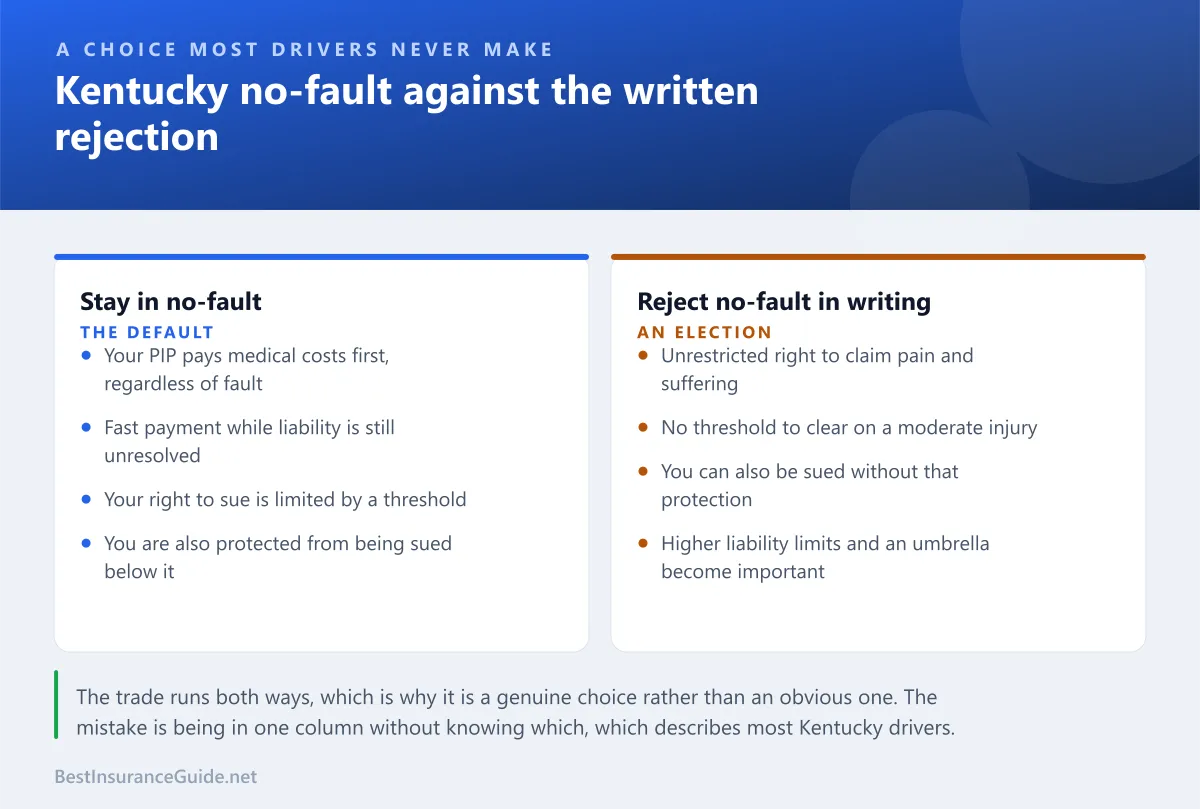
The trade runs in both directions, which is why it is a genuine choice rather than an obvious one.
Staying in no-fault gives you quick payment of medical costs regardless of fault, and protection from being sued for pain and suffering below the threshold. It limits what you can recover in a moderate injury.
Rejecting no-fault gives you an unrestricted right to recover pain and suffering, and removes the reciprocal protection: you can also be sued without a threshold standing between you and a claim.
Two things to note. The rejection is a formal written election, filed with the state, and it applies to you rather than to a particular policy. And most Kentucky drivers have never made an active decision either way, which means they are in the default system without having chosen it.
Whether the election makes sense depends on your circumstances, your assets and your liability limits, and it is a question worth putting to a licensed agent or an attorney rather than deciding from an article.
Personal injury protection, practically
PIP is where most Kentucky injury costs are actually paid, and the basic statutory limit is modest.
It covers medical expenses, a portion of lost wages, replacement services such as help around the house, and funeral costs, up to the limit and regardless of fault.
Additional PIP is usually available above the basic limit and is inexpensive. For a household without generous health cover or without disability income protection, raising it is one of the better-value adjustments on a Kentucky policy.
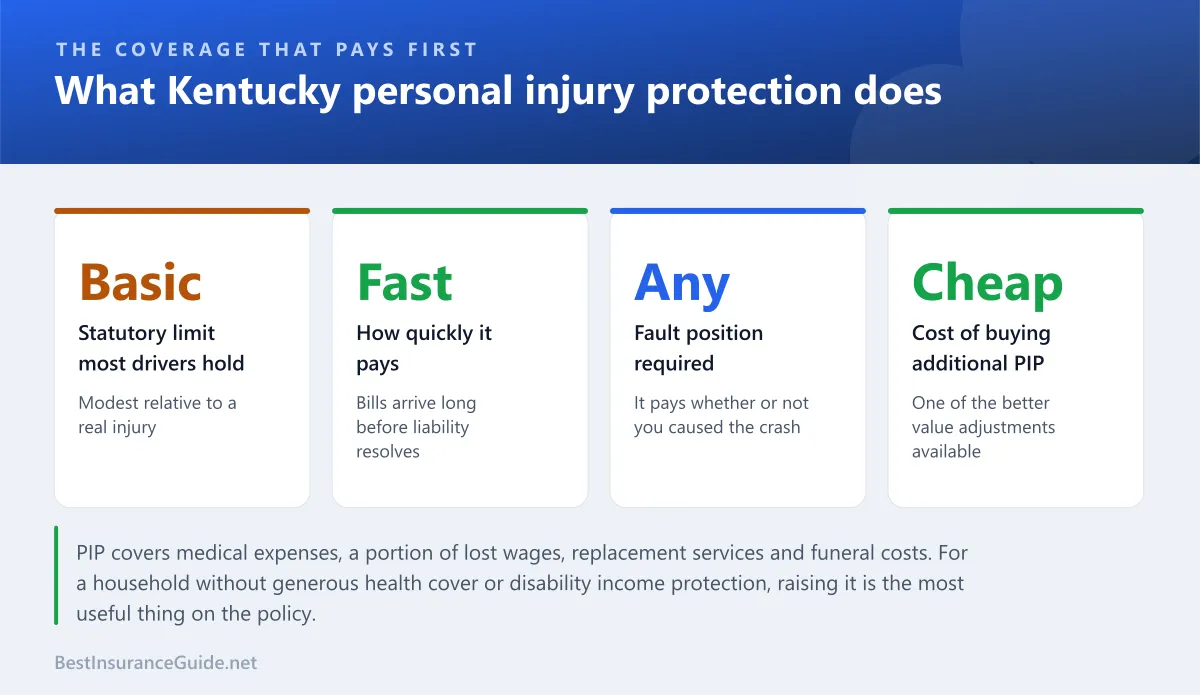
It pays quickly, which is the practical benefit of the no-fault structure. Medical bills after a crash arrive long before any liability claim resolves, and PIP is what meets them.
The uninsured driver problem
Kentucky records a meaningful uninsured driver rate, and uninsured and underinsured motorist cover are both optional here.
Uninsured motorist answers a driver with nothing. Underinsured motorist answers a driver with too little, which is the far larger group given 25/50 minimums.
Worked example: a minimum-limit driver
Injuries and lost income of $135,000.
| With $100,000 UIM | Without UIM | |
|---|---|---|
| At-fault driver’s limit | $25,000 | $25,000 |
| Their insurer pays | $25,000 | $25,000 |
| Your PIP pays | Basic limit | Basic limit |
| Your underinsured motorist pays | Up to $100,000 | $0 |
| Recovered | Around $125,000 plus PIP | Around $25,000 plus PIP |
Underinsured motorist cover at a useful limit costs a small fraction of a Kentucky policy, and it is routinely rejected on a form nobody reads carefully.
Comprehensive, and why it matters here
Kentucky stacks several comprehensive exposures.
Deer collisions, which Kentucky records at a high rate, peaking in autumn. In most wordings a deer strike is comprehensive rather than collision, which matters at renewal.
Hail and wind, particularly in the west of the state.
Falling trees, in a heavily wooded state after storms.
Flooding, both riverine along the Ohio and its tributaries and flash flooding in the eastern hills, which has produced severe events. A flooded vehicle is almost always a total loss.
Theft and vandalism, concentrated in Louisville and Lexington.
On any vehicle worth keeping, comprehensive is one of the better-value lines on a Kentucky policy.
What moves a Kentucky quote
Your record, dominating for three to five years.
Your county and ZIP code. Louisville and Lexington rate above the rest of the state, and the rural-to-urban spread is wide.
Continuous coverage, where a lapse is the most expensive avoidable item on any quote.
The vehicle, specifically repair cost, theft rate and safety record.
Annual mileage, which in a rural state is frequently underestimated.
Coverage choices, including PIP level, liability limits, UM and UIM elections and deductibles.
What to carry
Liability at 100/300/100 or higher.
Additional PIP above the basic statutory limit.
Uninsured and underinsured motorist at matching limits, rather than the rejection form.
Comprehensive, on any vehicle worth keeping.
Collision, on any vehicle you could not comfortably replace.
An umbrella policy above the auto liability if you have assets, which matters more if you have rejected no-fault and can therefore be sued without a threshold.
The short version
Kentucky is a choice no-fault state, and the choice is the most consequential thing on the policy. By default your PIP pays your injury costs first and a threshold limits what you can sue for; rejecting no-fault in writing removes that limit in both directions.
Most Kentucky drivers have never made that decision actively. Whether to make it is a question for a licensed agent or an attorney, but knowing it exists is the starting point.
Beyond that, raise the PIP above the statutory basic limit, carry uninsured and underinsured motorist rather than rejecting them, and keep comprehensive in a state with this much deer, water and weather.
For what happens after a crash that was not your fault, see car accident not your fault, and for the full discount list, auto insurance discounts.
How the choice interacts with everything else
The no-fault election is not made in isolation, and three other decisions on the policy change what it means.
Your liability limits. Rejecting no-fault means you can be sued for pain and suffering without a threshold standing in the way. A driver who has made that election and carries 25/50 liability has increased their own exposure without increasing their protection, which is the worst combination available.
Your PIP level. Staying in no-fault makes your own PIP the primary source of injury payment, which argues for buying above the basic statutory limit. Rejecting no-fault does not remove PIP, but it changes the balance of where recovery comes from.
Your umbrella policy. Anyone who has rejected no-fault and has assets should treat an umbrella as close to mandatory, because the reciprocal exposure is real.
The honest summary is that the election is a package decision rather than a single toggle, and the version that goes wrong is the one made unconsciously.
Worked example: two Kentucky drivers, same crash
Both suffer soft tissue injuries with $16,000 of treatment and no permanent impairment, caused by another driver.
| In no-fault | Rejected no-fault | |
|---|---|---|
| PIP pays medical, regardless of fault | Yes | Yes |
| Claim for pain and suffering | Only above the threshold | Available without threshold |
| Exposure to being sued in the reverse case | Limited by threshold | Unrestricted |
| Sensible liability limits | 100/300/100 | Higher, plus umbrella |
Neither column is wrong. The mistake is being in one of them without knowing which.
Kentucky regions, and what changes between them
Louisville rates highest on frequency, theft and repair cost, with a meaningful ZIP code spread inside the metro.
Lexington sits close behind, with a university population affecting the young driver market.
Northern Kentucky, in the Cincinnati orbit, rates on metro frequency while sitting under Kentucky law, which is a combination worth checking carefully when comparing quotes against Ohio neighbours.
Eastern Kentucky rates lowest on frequency and carries significant flood exposure, steep terrain and longer emergency response distances.
Western Kentucky carries the state’s heaviest severe convective storm and tornado exposure.
After a crash in Kentucky
Report to your own insurer immediately, since PIP is the first payer and delay delays the payments.
Get medical attention the same day if there is any question of injury.
Photograph the scene before vehicles move: positions, damage on both vehicles, road markings, signage, skid marks, weather and light.
Get the police report number and photograph the other driver’s documents rather than transcribing them.
Collect witness contact details, which decides contested fault far more often than argument.
Say nothing about fault at the scene or to the other insurer.
Keep every medical record and receipt, including mileage to appointments and any paid help at home, because the smaller PIP categories are claimed only by people who kept the paperwork.
Two Kentucky checks worth doing this year
Find out which system you are actually in. Most Kentucky drivers have never made an active decision about the no-fault election and are in the default without knowing it. Ask your agent directly, and ask what the reciprocal exposure looks like given your liability limits.
Check whether uninsured and underinsured motorist cover appear on your declarations page at all. Both are optional in Kentucky and both are commonly rejected on a form signed years earlier, carried forward silently through renewals. Adding them back is a phone call and a modest adjustment.
Where Kentucky drivers overpay
Leaving PIP at the statutory basic limit, when additional PIP is inexpensive and is the coverage that actually pays first.
Rejecting underinsured motorist cover, which answers the most common serious scenario in a 25/50 state.
Carrying minimum liability while having rejected no-fault, which increases exposure without increasing protection and is the worst available combination.
Dropping comprehensive in a state with this much deer, flooding, wind and falling timber.
Keeping collision on a vehicle that no longer justifies it, where the annual premium plus deductible approaches the car’s value.
Never re-shopping, where the spread between carriers on the same driver is frequently several hundred dollars a year.
When to re-quote
Every two years as a baseline, and immediately after a move, a household change, a vehicle change, a violation ageing off the record at three to five years, or any renewal that arrived materially higher without an obvious cause.
Each time, write the whole package down first: the liability limits, the PIP level, the uninsured and underinsured motorist elections and the deductibles. Then quote that exact specification with three carriers including an independent agent. In Kentucky, also confirm that the tort election has carried across correctly, because it attaches to you rather than to a particular policy and a change of carrier is exactly the moment paperwork goes astray.
How neighbouring states differ
Kentucky’s choice no-fault system is rare, and the alternatives sit close by.
Pennsylvania offers the other well-known version of a choice, through its full and limited tort election. Kansas is a straightforward no-fault state with no election at all. Missouri and Alabama are at-fault states at opposite ends of the fault-allocation spectrum.
A note on scope
Premium figures here are illustrative rather than quotes, and Kentucky pricing varies substantially by county, driving record, vehicle, coverage selected and individual insurer. The no-fault election, PIP limits and statutory minimums are set by Kentucky law and change over time.
The Kentucky Department of Insurance publishes the current requirements, consumer guidance and complaint records for licensed insurers, and the NAIC publishes comparative data by state. Nothing here is legal advice, and the tort election in particular is a decision to take with a licensed professional. This site is independent and not affiliated with any insurer.