Car Insurance in Kansas: A No-Fault State That Nobody Calls One
Kansas car insurance requirements including personal injury protection, uninsured motorist cover, hail exposure, and how to compare quotes properly.

Table of contents

Kansas is a no-fault state, and a striking number of Kansas drivers do not know it. That single fact changes which lines on the policy matter and how the limits should be set.
What the state requires
| Coverage | Kansas minimum |
|---|---|
| Bodily injury liability, per person | $25,000 |
| Bodily injury liability, per accident | $50,000 |
| Property damage liability | $25,000 |
| Uninsured and underinsured motorist | Matching bodily injury limits |
| Personal injury protection | Statutory minimums, several categories |
Two of those lines are unusual.
Uninsured and underinsured motorist cover is mandatory, at limits matching your liability rather than at a separate floor. Most states only require insurers to offer it.
Personal injury protection is mandatory, and it is the reason Kansas is a no-fault state.
How no-fault actually works here
The name causes more confusion than it removes, so it is worth being precise.
No-fault does not mean nobody is at fault. It means your own policy pays your injury costs first, regardless of who caused the crash. Fault still determines who pays for the vehicles, and fault still matters above the injury threshold.
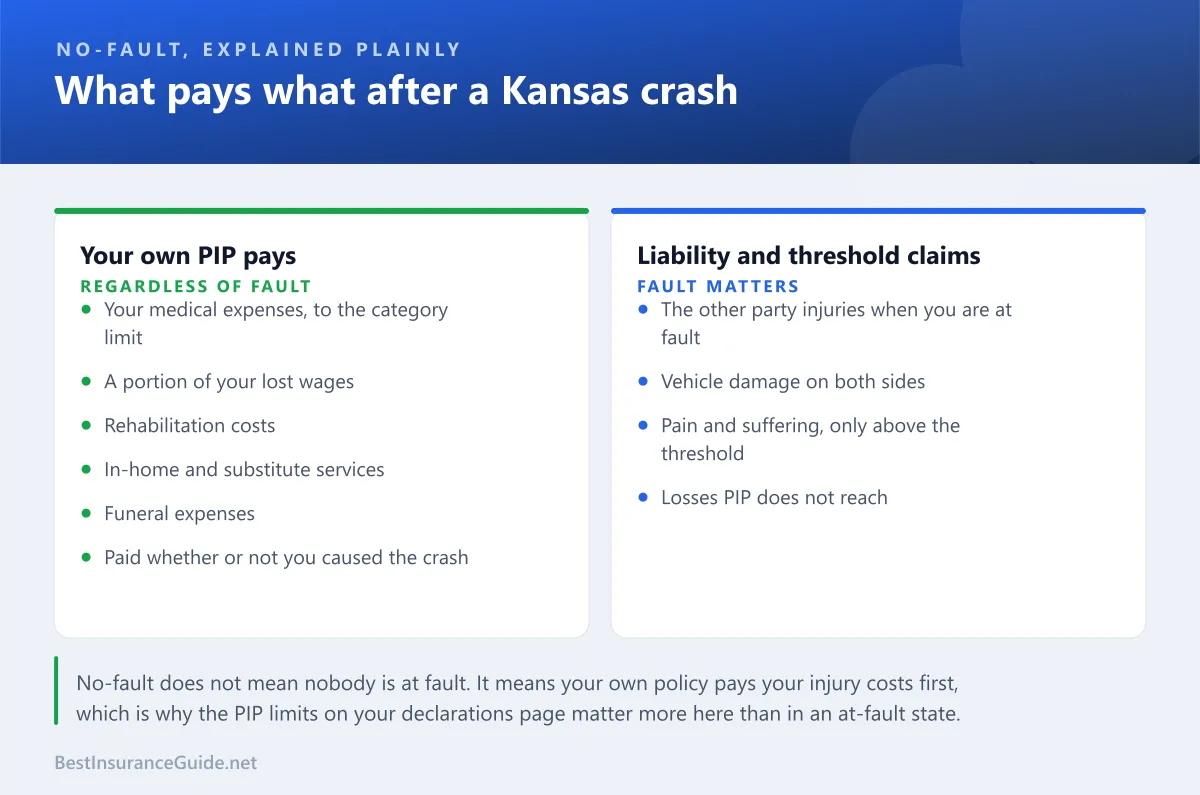
PIP pays medical expenses, a portion of lost wages, rehabilitation, in-home and substitute services, and funeral expenses, up to the statutory limits for each category. It pays whether the crash was your fault or not.
Liability pays the other party’s injuries and property damage when you are at fault.
Above the threshold, you may still pursue the at-fault driver for pain and suffering and for losses PIP does not cover. Below it, that claim is barred.
Two practical consequences follow.
Your own PIP limits matter more than you think. They are the coverage that actually pays your medical bills after a crash, and the statutory minimums are modest relative to what a serious injury costs. Buying above the minimum is inexpensive and directly useful.
Coordination with health insurance is worth understanding. PIP generally pays first in Kansas, which affects deductibles and network rules on the health side. It is worth knowing your position before you need it rather than during.
Worked example: a moderate injury
Medical expenses of $28,000 and eight weeks off work.
| Minimum PIP | Increased PIP | |
|---|---|---|
| Medical expenses covered by PIP | Statutory minimum only | Substantially more |
| Wage loss covered | Capped monthly, capped duration | Higher monthly cap |
| Balance falling to health insurance | Large | Smaller |
| Balance falling to you | Deductibles and coinsurance | Less |
| Claim against at-fault driver | Only above the threshold | Only above the threshold |
The premium difference between minimum and increased PIP is small. The difference in what lands on your own health plan and your own bank account is not.
The hail problem
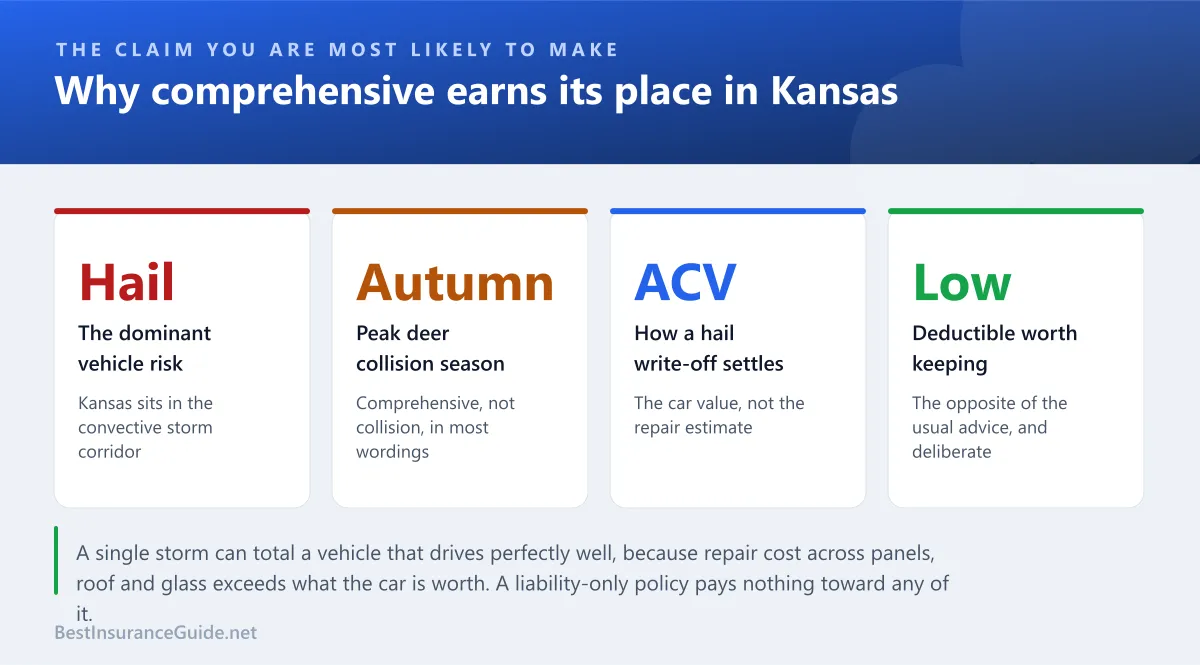
Kansas sits in the severe convective storm corridor and hail is the dominant vehicle risk in the state.
Hail damage is comprehensive, not collision. A liability-only policy pays nothing toward it, and a single storm can total a car that drives perfectly well because the repair cost across panels, roof and glass exceeds the vehicle’s actual cash value.
Three practical points.
Be careful raising the comprehensive deductible, because in Kansas that is the claim you are most likely to make.
Covered parking is worth real money, both in claims avoided and occasionally in a discount.
Photograph the vehicle before storm season, so pre-existing damage is not deducted from a later settlement.
Beyond hail, comprehensive also carries deer collisions, which Kansas records in quantity and which peak in autumn, along with wind damage, flooding, theft and vandalism.
What moves a Kansas quote
Your record, dominating the rating for three to five years.
Where you park it. Wichita, Kansas City and Topeka rate above the rural counties. A driver in the Kansas City metro should note that the state line matters: Kansas and Missouri set different requirements and are rated separately, so moving a short distance changes the whole structure of the policy.
Continuous coverage, where a lapse is the most expensive avoidable item on any quote.
The vehicle, specifically repair cost, theft rate and safety record rather than purchase price.
Annual mileage, which in a state with long rural distances is frequently higher than drivers estimate.
Coverage choices, including PIP limits, liability limits, UM and UIM limits and deductibles.
What to carry
Liability at 100/300/100 or higher, because the state minimum does not replace a modern vehicle or fund a serious injury.
Uninsured and underinsured motorist, which you must carry, at limits matching the raised liability rather than the floor.
PIP above the statutory minimum, which is the most Kansas-specific advice on this page and among the cheapest improvements available.
Comprehensive, without hesitation, on any vehicle worth keeping.
Collision, on any vehicle you could not comfortably replace.
Rental reimbursement, because a regional hail event fills every body shop in the state for months.
An umbrella policy above the auto liability if you have assets.
The short version
Kansas is a no-fault state, which means your own personal injury protection pays your medical costs and part of your lost income first, regardless of fault. The statutory minimums are modest and raising them is inexpensive, and that is the single most useful adjustment most Kansas drivers can make.
Uninsured and underinsured motorist cover is mandatory here at limits matching your liability, so raising the liability raises the protection on both sides at once.
And comprehensive is not really optional in hail country. It is the coverage that answers the risk Kansas is actually known for.
For what happens when a crash was not your fault, see car accident not your fault, and for the discount list, auto insurance discounts.
Setting the PIP limits properly
Since Kansas PIP is the coverage that actually pays your injury costs, it is worth spending a moment on how it is structured rather than treating it as a single number.
Kansas PIP is written in categories, each with its own limit: medical expenses, work loss, rehabilitation, in-home services, substitute services and funeral expenses. A claim draws on the relevant category rather than on one pooled figure, which means a single low category can bind the whole coverage even where the others are untouched.
Three questions decide whether the statutory minimum is enough for your household.
How good is your health insurance? A household with a high-deductible health plan is relying on PIP to bridge a large gap before the health plan engages meaningfully. A household with rich employer coverage needs less from it.
What happens to your income if you cannot work for two months? The work loss category is capped monthly and by duration. If you have no short-term disability cover, this is the line that keeps the household solvent, and it is inexpensive to raise.
Who runs the house if you cannot? The in-home and substitute services categories are small and are the most consistently forgotten. For a household with young children and a single available adult, they matter more than the headline medical figure.
Worked example: eight weeks off work
A household with a high-deductible health plan and no disability cover.
| Statutory minimum PIP | Increased PIP | |
|---|---|---|
| Medical bills before health plan engages | Largely on you | Largely covered |
| Weekly work loss benefit | Low monthly cap | Higher cap |
| In-home and substitute services | Minimal | Meaningful |
| Out-of-pocket over eight weeks | Several thousand | Considerably less |
The additional premium for a materially better PIP package on a Kansas policy is typically small. It is the most Kansas-specific saving available and it goes in the opposite direction from the usual advice, because here spending slightly more is the efficient move.
Kansas regions, and what changes between them
The Kansas City metro rates highest on frequency, with the important complication that the metro spans two states. Kansas and Missouri set different requirements and are rated separately, so a move across the line changes the entire structure of the policy rather than just the price.
Wichita carries high frequency and a significant hail history.
Topeka and Lawrence sit below the two larger metros, with Lawrence’s student population affecting the young driver market.
Western Kansas rates lowest on frequency and highest on severity, driven by higher speeds, long distances, deer collisions and longer emergency response times.
After a crash in Kansas
Because PIP pays first, the sequence differs slightly from an at-fault state.
Report to your own insurer immediately, because your own policy is the one paying your medical costs. This is not optional and delaying it delays the payments.
Get medical attention the same day if there is any question of injury. A gap between the crash and the first medical record is the most common argument against an injury claim, and it also delays PIP.
Keep every medical record and receipt, including mileage to appointments, prescriptions and any paid help around the house. The smaller PIP categories are claimed only by people who kept the paperwork.
Document income loss properly, with employer confirmation of hours and rate.
Photograph the scene before vehicles move, and get the police report number.
Understand the threshold before assuming a claim against the at-fault driver is available. Below it, PIP is the whole of your injury recovery.
Two Kansas checks worth doing this year
Look at the PIP section of your declarations page, not just the headline limit. Kansas PIP is written in separate categories and a single low category can bind the coverage even where the others are untouched. The work loss and substitute services lines are the ones households most often find inadequate, and both are inexpensive to raise.
Confirm your uninsured and underinsured motorist limits match your raised liability limits. Kansas requires them to match, so raising the liability raises both sides at once. A driver who raised liability at some point and never revisited the policy may find the UM line was written at an older figure.
Where Kansas drivers overpay
Leaving PIP at the statutory minimum while carrying a high-deductible health plan, which is the most common gap in the state.
Carrying minimum liability, where the step up to 100/300/100 costs far less than most drivers expect and raises the mandatory UM cover with it.
Dropping comprehensive to save money in hail country, or raising the comprehensive deductible too far, which works against the claim they are most likely to make.
Keeping collision on a vehicle whose actual cash value no longer justifies it.
Never re-shopping, where the spread between carriers on an identical driver is frequently several hundred dollars a year.
When to re-quote
Every two years as a baseline, and immediately after a move, a household change, a vehicle change, a violation ageing off the record at three to five years, or any renewal that arrived materially higher without an obvious cause.
Each time, write down the whole package first: the liability limits, the matching uninsured and underinsured motorist limits, every PIP category and the deductibles. Then quote that exact specification with three carriers, including an independent agent who can reach regional insurers that do not advertise nationally. In a state where PIP is structured in categories, a quote that matched only the headline limit has not matched the policy.
How neighbouring states differ
Kansas is a no-fault state, which several of its neighbours are not.
Missouri is at-fault and uses pure comparative fault, which matters for anybody in the Kansas City metro, where crossing the state line changes the whole structure of a policy. Oklahoma and Arkansas are both at-fault, and Kentucky is the nearest state that offers a choice between the two systems.
A note on scope
Premium figures here are illustrative rather than quotes, and Kansas pricing varies substantially by ZIP code, driving record, vehicle, coverage selected and individual insurer. Statutory minimums, PIP categories and limits, and the injury threshold are set by Kansas law and change over time.
The Kansas Insurance Department publishes the current requirements, consumer guidance and complaint records for licensed insurers, and the NAIC publishes comparative data by state. Nothing here is legal advice. This site is independent and not affiliated with any insurer.