Car Insurance in PA: The Lowest Minimums and the Biggest Election
Pennsylvania car insurance requirements, the full tort and limited tort election, stacked uninsured motorist cover, regional pricing and how to compare quotes.

Table of contents

Pennsylvania asks every driver to make a decision most of them do not know they are making, and it sets its statutory minimums so low that the decision matters more than it would elsewhere.
What the state requires
| Coverage | Pennsylvania minimum |
|---|---|
| Bodily injury liability, per person | $15,000 |
| Bodily injury liability, per accident | $30,000 |
| Property damage liability | $5,000 |
| Medical benefits | $5,000 |
Those are among the lowest minimums in the country and it is worth being blunt about what they mean.
$5,000 of property damage liability will not repair a modern vehicle after a moderate collision, let alone replace one. A driver carrying that limit who writes off somebody’s car is personally liable for the difference.
$15,000 per person of bodily injury is a fraction of what a serious injury costs.
$5,000 of medical benefits covers an emergency department visit and some imaging.
The practical consequence runs both ways. Your own minimum-limit policy protects you badly, and the drivers around you are frequently carrying the same thin limits, which is why the uninsured and underinsured motorist lines matter so much here.
The tort election
This is the Pennsylvania decision, and it appears on every declarations page in the state.
Full tort preserves your unrestricted right to claim against an at-fault driver for pain and suffering, alongside medical costs and lost income.
Limited tort gives that right up unless your injury meets a serious injury threshold. Medical costs and lost income remain recoverable; pain and suffering does not, below the threshold.
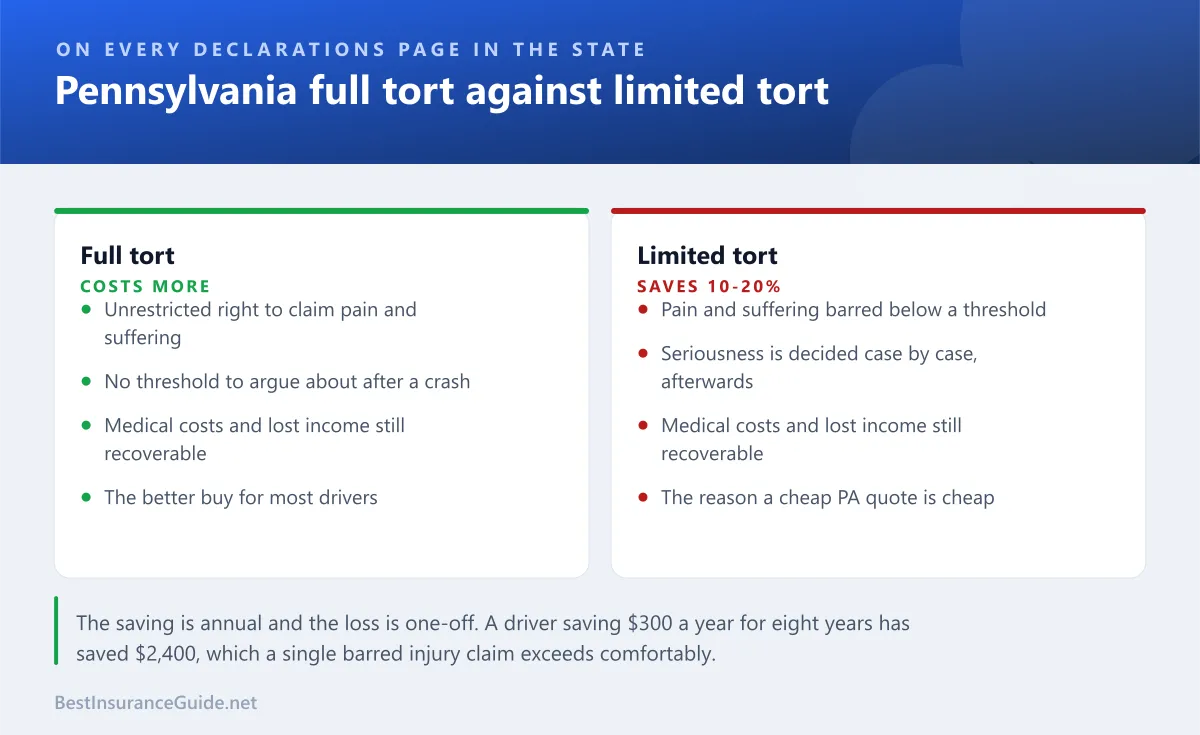
The saving from limited tort is commonly 10% to 20% of the premium. What it gives up is typically the largest component of an injury claim, and whether an injury clears the threshold is a legal question decided case by case rather than something you can predict when choosing.
For most drivers full tort is the better buy. It is not universal, and the right answer depends on your circumstances, your assets and your health cover, which makes it a question for a licensed agent rather than a comparison page.
What matters is that the choice is made deliberately. A cheap Pennsylvania quote will have made it for you.
Our guide to car insurance in Philadelphia works through the election in the state’s most expensive market, where the trade is sharpest.
Stacking, which almost nobody asks about
Pennsylvania permits stacked uninsured and underinsured motorist coverage, and in a multi-vehicle household it multiplies the limit available.
Unstacked applies the per-vehicle limit once.
Stacked multiplies it by the number of vehicles on the policy. Three vehicles at $100,000 gives $300,000 available.
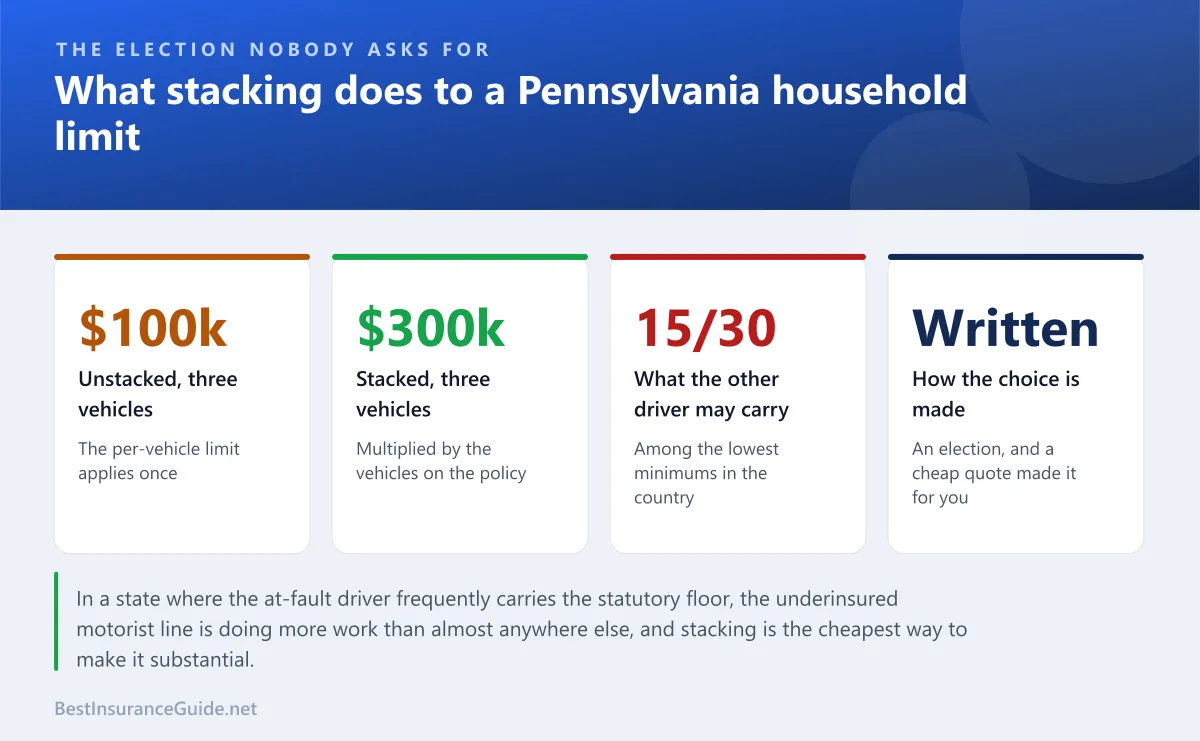
In a state whose minimum limits are 15/30, the underinsured motorist line is doing more work than almost anywhere else, and stacking is the cheapest way to make it substantial. Like the tort election it is a written choice, and like the tort election the cheaper quote has already made it.
Worked example: a serious injury against minimum limits
Injuries and lost income of $240,000, at-fault driver carrying Pennsylvania minimums.
| Stacked UIM, three vehicles | Unstacked UIM | UIM rejected | |
|---|---|---|---|
| At-fault driver’s insurer pays | $15,000 | $15,000 | $15,000 |
| Your underinsured motorist cover | Up to $300,000 | Up to $100,000 | $0 |
| Recovered | $240,000 | $115,000 | $15,000 |
The premium spread across those three columns is a few hundred dollars a year.
The regional spread
Pennsylvania has one of the widest internal premium ranges in the country.
Philadelphia is the most expensive territory in the state by a distance, driven by frequency, theft, uninsured density and repair costs.
Pittsburgh and Allegheny County rate well above the state average while sitting substantially below Philadelphia.
The Lehigh Valley, Harrisburg and Scranton sit in the middle.
Rural central and northern Pennsylvania rates well below the national average on frequency, while carrying the state’s heaviest deer collision exposure.
A driver moving between those bands will see a very large change with no change to their record or their vehicle.
The comprehensive case
Pennsylvania stacks several comprehensive exposures.
Deer collisions, which Pennsylvania records among the highest in the country, peaking in autumn. Comprehensive rather than collision in most wordings.
Winter losses, including ice damage and objects falling from other vehicles. Losing control on ice is a collision claim and generally at-fault.
Flooding, both riverine along the Susquehanna, Delaware and Ohio systems and flash flooding from tropical remnants.
Falling trees, in a heavily forested state.
Hail and wind.
Theft and vandalism, concentrated in Philadelphia and Pittsburgh.
What to carry in Pennsylvania
Full tort, unless you have a specific reason and have taken advice.
Liability far above 15/30/5. Around 100/300/100 is the sensible floor, and the step up from the Pennsylvania minimum is one of the largest protection improvements available anywhere in the country for a modest premium, precisely because the starting point is so low.
Stacked uninsured and underinsured motorist cover at limits matching the liability.
Medical benefits above the $5,000 statutory minimum, which is inexpensive and meets the first bills.
Comprehensive, on any vehicle worth keeping.
Collision, on any vehicle you could not comfortably replace.
An umbrella policy above the auto liability if you have assets.
The short version
Pennsylvania sets among the lowest liability minimums in the country, which means a minimum-limit policy protects you badly and the drivers around you carry very little. Both problems point at the same answer: raise your own limits, and carry stacked underinsured motorist cover.
The tort election is the decision that most affects what a serious injury claim pays. Limited tort saves roughly 10% to 20% and gives up the right to claim pain and suffering below a threshold nobody can predict in advance.
Make both choices deliberately, because a cheap quote in this state has already made them for you.
For the state’s most expensive market, see car insurance quotes in Philadelphia, and for switching without creating a gap, how to switch car insurance.
The Pennsylvania coverages beyond the headline
Three lines on a Pennsylvania policy do more than their premium suggests, and all three are optional.
Income loss benefits. Pennsylvania policies can include cover for lost earnings following a crash, paid regardless of fault, and it is inexpensive. For a household without short-term disability cover this is the line that keeps the mortgage paid.
Funeral benefit and accidental death benefit, small sums paid quickly and without the delays attaching to a liability claim.
Extraordinary medical benefits, an optional high-limit medical coverage available in Pennsylvania for catastrophic injury, which sits far above the $5,000 statutory medical benefit and costs very little because the trigger is rare.
The pattern is consistent: Pennsylvania sets very low mandatory floors and makes the genuinely useful protection optional. A cheap Pennsylvania policy is cheap because all of it was declined.
Worked example: what the statutory floor leaves behind
An at-fault driver on Pennsylvania minimums causes $150,000 of injuries and writes off a $34,000 vehicle.
| Minimum limits | 100/300/100 | |
|---|---|---|
| Bodily injury paid | $30,000 maximum | $150,000 |
| Property damage paid | $5,000 | $34,000 |
| Paid by the insurer | $35,000 | $184,000 |
| Owed personally | $149,000 | $0 |
The premium difference between those two columns in Pennsylvania is commonly in the region of $250 to $450 a year.
When to re-quote in Pennsylvania
Every two years as a baseline, and immediately after a move, especially between territories, a household change, a vehicle change, a violation ageing off the record at three to five years, or any renewal that arrived materially higher without an obvious cause.
Each time, write the package down first: the tort election, the liability limits, whether the uninsured and underinsured motorist cover is stacked, the medical benefit level, the income loss election and the deductibles. Then quote that exact specification across three carriers including an independent agent.
The tort election in particular has to be matched explicitly. A quote that quietly assumed limited tort is not pricing the same product, and comparing it against a full tort policy is the most common way Pennsylvania drivers mislead themselves about what they are saving.
Pennsylvania regions, in practical terms
The state’s internal spread is wide enough that the advice changes with the territory.
In Philadelphia, the priorities are full tort, stacked underinsured motorist cover and comprehensive, because theft, uninsured density and injury claim costs are all at their highest. Our guide to car insurance quotes in Philadelphia covers the metro specifically.
In Pittsburgh and Allegheny County, similar priorities at a lower price point, with winter weather and hillside flooding adding to the comprehensive case.
In the Lehigh Valley, Harrisburg and Scranton corridors, commuting mileage becomes a larger part of the rating and is worth checking against reality.
In rural central and northern Pennsylvania, deer collisions dominate. Comprehensive is the coverage that answers them, and a driver economising by dropping it has removed the protection against the most likely claim they will make.
Across every territory the same two elections apply, and both are made on paper rather than at the scene: the tort election and the stacking election.
When to re-quote
Every two years as a baseline, and immediately after a move between territories, a household change, a vehicle change, a violation ageing off the record, or any renewal that arrived materially higher without an obvious cause. Quote the identical package each time, tort election included.
Two Pennsylvania checks worth doing this month
Find the tort election on your declarations page. It is stated explicitly, and a great many drivers discover they are on limited tort without ever having chosen it. Changing it is a phone call and takes effect prospectively, which is why doing it now rather than after a crash is the entire point.
Find whether your uninsured and underinsured motorist cover is stacked, and at what limit. In a state whose drivers are frequently carrying 15/30, that line is what answers a serious injury, and stacking is the cheapest way to make it substantial.
Both take five minutes and neither requires shopping anything.
Where Pennsylvania drivers overpay, and where they underinsure
The overpaying is ordinary: a stale mileage figure, no bundling, a lapse in the record, and never re-shopping.
The underinsuring is structural, because Pennsylvania’s mandatory floors are so low that almost everything useful is optional. Liability at 15/30/5, medical benefits at $5,000, no required uninsured motorist cover, income loss optional, extraordinary medical benefits optional, and stacking optional.
A Pennsylvania policy assembled entirely from the mandatory minimum is legal and close to useless, and it is exactly what the cheapest quote in the state describes.
How other choice states compare
Pennsylvania’s tort election is one of two well-known versions of a choice system.
Kentucky offers the other: drivers are in the no-fault system by default and may reject it in writing, keeping an unrestricted right to sue. Kansas is a straightforward no-fault state with no election. Connecticut mandates uninsured and underinsured cover and offers conversion coverage, which answers the same underinsured-driver problem that stacking answers here.
A note on scope
Premium figures and savings percentages here are illustrative rather than quotes, and Pennsylvania pricing varies enormously by territory, driving record, vehicle, coverage selected and individual insurer. The tort election, stacking rules and statutory minimums are set by Pennsylvania law and change over time.
The Pennsylvania Insurance Department publishes the current requirements, consumer guidance on the tort election and complaint records for licensed insurers, and the NAIC publishes comparative data by state. Nothing here is legal advice, and the tort election is a decision to take with a licensed professional. This site is independent and not affiliated with any insurer.