How Much Is Car Insurance for a 16-Year-Old? And How to Halve It
What adding a sixteen-year-old driver costs, why the increase is so large, and the discounts and structural choices that genuinely reduce it.

Table of contents

Adding a sixteen-year-old is the largest single premium event most households ever experience. There is no version of it that is cheap, and there is a large difference between doing it well and doing it badly.
What it costs
Adding a sixteen-year-old to a family policy commonly increases the household premium by somewhere between 50% and 150%, with enormous variation by state, vehicle and insurer.
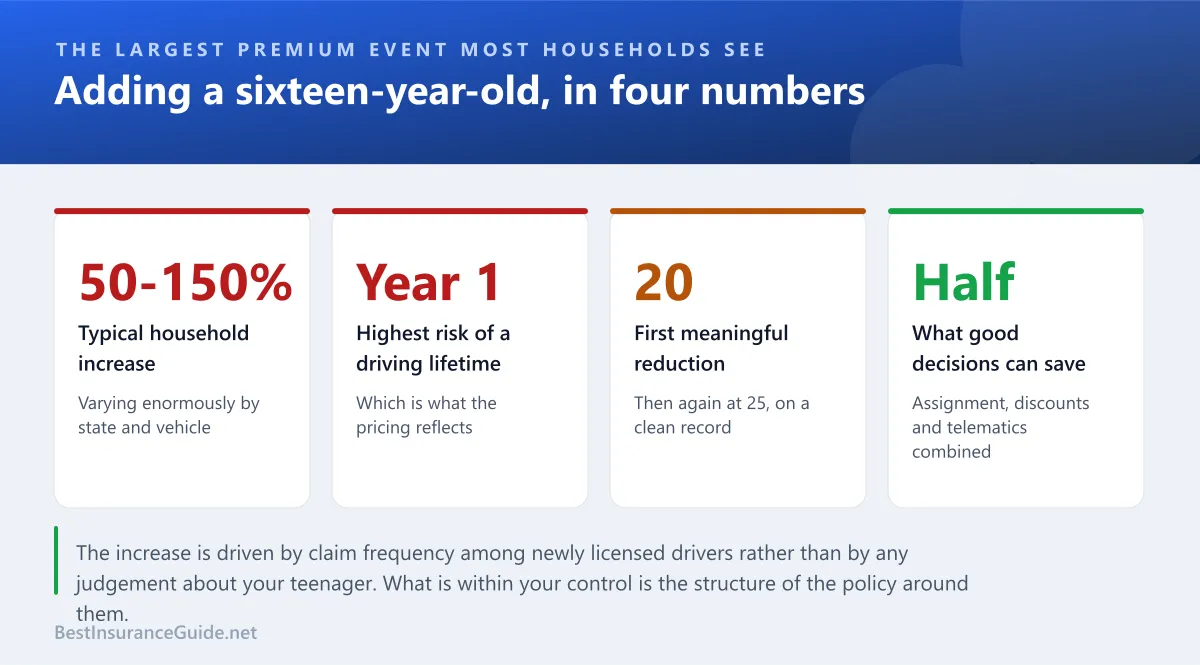
The reason is claim frequency rather than any judgement about your particular teenager. Newly licensed drivers crash at several times the rate of experienced ones, and the first year after licensing is the highest-risk period of an entire driving lifetime. Pricing follows the data.
Three things make the range so wide.
Your state, where both the underlying claim costs and the rules on rating young drivers vary considerably.
The vehicle they will drive, and specifically its repair cost, power and safety record.
Your insurer, which matters more here than almost anywhere else, because carriers weight young drivers very differently.
Add them, do not buy them their own
This is the single most consequential structural decision and the answer is nearly always the same.
Adding a teenager to the family policy is almost always cheaper, frequently dramatically so, than buying them a standalone policy.
A standalone policy loses the multi-vehicle discount, the multi-policy discount, the household’s claims history and the parent’s rating, and prices a driver with no record at all as a standalone risk.
The exception is narrow: a young adult living independently at a different address with their own vehicle, where the household policy would not properly reflect the risk anyway.
Two related points.
Do not omit them from the policy. A licensed driver in the household who is not disclosed is a serious problem at claim time and a straightforward route to a denied claim or a cancelled policy.
A permit holder is usually covered under a parent’s policy without separate rating, but this varies, and they must generally be added once licensed. Ask rather than assume.
Which vehicle
The car matters almost as much as the driver, and the intuition people bring to it is frequently wrong.
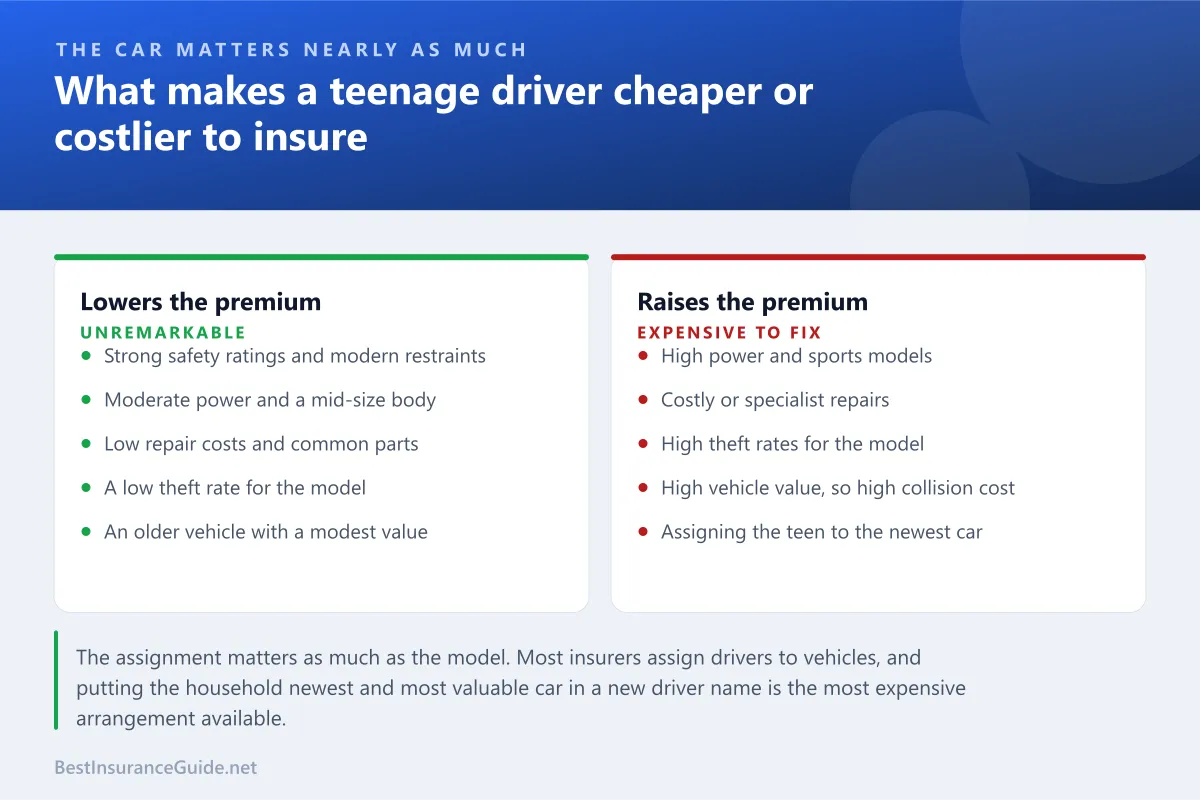
What lowers the premium: strong safety ratings, moderate power, low repair costs, common parts, a low theft rate, and an older vehicle with a lower value.
What raises it: high power, sports models, expensive or difficult repairs, high theft rates, and high vehicle value.
Two structural points that matter more than the model.
Assign the teenager to the least expensive vehicle in the household. Most insurers assign drivers to vehicles, and the assignment affects the price. Putting the newest and most valuable car in a young driver’s name is the most expensive available arrangement.
Consider whether collision is worth carrying on an older vehicle they drive. If the car is worth $4,000 and the collision premium plus deductible approaches that, the coverage has stopped earning its place. Keep comprehensive, which is cheap.
The discounts that actually apply
Young drivers attract more discounts than any other group, and most households claim only some of them.
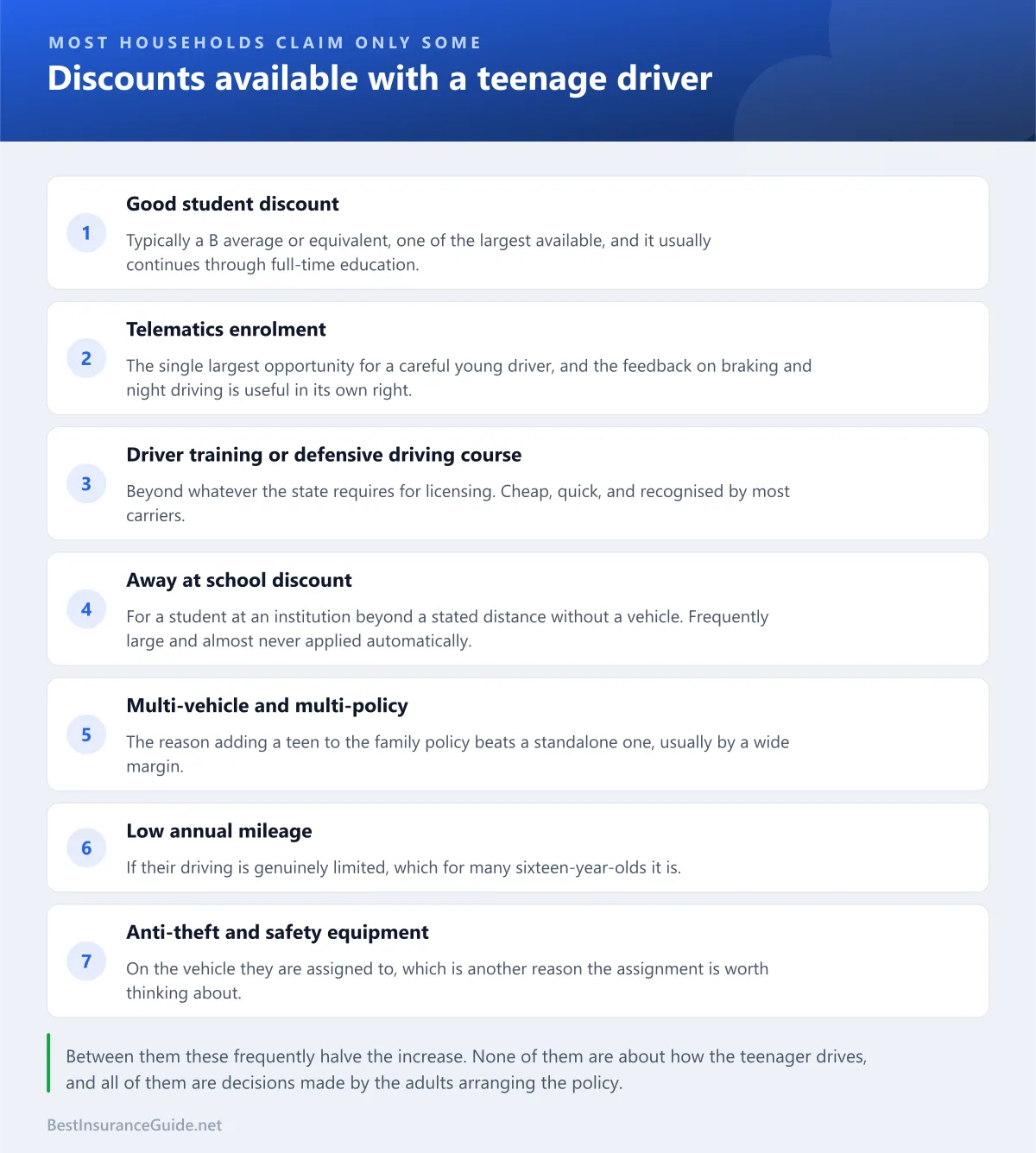
Good student discount, typically requiring a B average or equivalent, and one of the largest available. It usually continues through full-time education.
Driver training or defensive driving course, beyond whatever the state requires for licensing.
Telematics, which is the largest single opportunity for a careful young driver. Programmes measure braking, acceleration, speed, phone use and night driving, and a genuinely careful teenager can earn a substantial reduction. It also produces feedback that parents find useful for reasons unrelated to price.
Away at school discount, for a student attending an institution beyond a stated distance without a vehicle. Frequently a large reduction and frequently forgotten.
Multi-vehicle and multi-policy discounts, which is why adding to the family policy wins.
Low mileage, if their actual driving is limited.
Anti-theft and safety equipment on the vehicle they drive.
Paid in full and paperless, which are small and add up.
Worked example: the same teenager, two households
| Household A | Household B | |
|---|---|---|
| Teen on family policy | Standalone policy | Added to family policy |
| Assigned vehicle | Newest car | Oldest car |
| Good student discount | Not claimed | Claimed |
| Telematics | Not enrolled | Enrolled |
| Driver training course | No | Yes |
| Collision on the older car | Carried | Dropped, comprehensive kept |
| Relative annual cost | Highest available | Roughly half |
None of the differences in that table are about the teenager’s driving. All six are decisions made by the adults arranging the policy.
What to do in the first year
Raise the liability limits, not lower them. This is counterintuitive when the premium has just doubled, and it is important. A newly licensed driver is the highest-risk period in a driving lifetime, and the household’s exposure to a serious at-fault claim is at its peak. 100/300/100 as a floor, with an umbrella above it if you have assets.
Do not economise by cutting uninsured motorist cover, for the same reason.
Use telematics as a conversation rather than a surveillance tool. The feedback on hard braking and night driving is more useful to a new driver than any lecture.
Set rules about passengers and night driving, which are the two largest risk multipliers for new drivers and which most graduated licensing systems already restrict.
Report the licence promptly and get the policy properly rated rather than leaving it to the renewal.
When it starts to come down
Gradually from around eighteen, with meaningful steps at twenty and again at twenty-five, provided the record stays clean.
Two things accelerate it.
A clean record. A single at-fault claim or moving violation in the first years costs more, proportionally, than at any other point in a driving life, because it compounds with an already high base rate.
Re-shopping annually. Insurers weight young drivers very differently, and the spread between carriers on a household with a teenager is unusually wide. Annual re-quoting at matched coverage is worth more here than in any other situation.
Our guide to what age car insurance goes down sets out the age curve in detail, and car insurance for young drivers covers the wider picture.
The short version
Adding a sixteen-year-old commonly raises a household premium by 50% to 150%, and the cause is claim frequency among newly licensed drivers rather than anything about your teenager.
Add them to the family policy rather than buying a standalone one, assign them to the least expensive vehicle, and claim every discount available: good student, driver training, telematics and away at school between them frequently halve the increase.
Do not respond to the increase by cutting liability limits. The year you add a new driver is the year your household’s exposure to a serious claim is at its highest.
Then re-shop annually, because the spread between insurers on a household with a teenager is wider than at any other point.
For the age curve, see what age does car insurance go down, and for the discount list in full, auto insurance discounts.
Telematics, in more detail
For a household adding a teenager, this is the largest single opportunity available, and it is worth understanding what the programmes actually measure.
Hard braking and rapid acceleration, which are the most heavily weighted signals in most programmes and the most within a driver’s control.
Speed relative to the limit, in most but not all programmes.
Time of day, with late-night driving weighted heavily because crash rates for young drivers rise sharply after dark.
Phone handling, which several programmes now detect directly and which is the single most useful behaviour to change.
Mileage, which for a teenager is frequently low and is a discount in its own right.
Three things to check before enrolling.
Whether the programme can raise your rate, which some can and some cannot. A discount-only programme is a free option; one that can surcharge is not.
The monitoring period, since some assess for a few months and then apply a lasting discount while others monitor continuously.
Whether the parent can see the data. For most households this is the actual value: the feedback on hard braking and night driving is more persuasive to a new driver than anything a parent says.
The graduated licensing overlap
Every state operates some form of graduated licensing, and the restrictions map closely onto the two things that most raise crash risk for new drivers.
Passenger limits, because crash risk for a teenage driver rises sharply with each additional teenage passenger.
Night driving restrictions, because a disproportionate share of young driver crashes occur after dark.
Supervised hours before full licensing.
The insurance point is that these restrictions exist because the data behind them is strong, and a household that keeps to them beyond the legal expiry date is materially reducing the risk of exactly the claim that would compound an already high premium.
It is also worth telling the insurer when the restrictions end and the driver has been claim free through them, because some carriers reprice at that point and few do it unprompted.
What to review each year
Re-quote at matched coverage, which matters more with a teenager on the policy than at any other time.
Confirm the good student discount is still applied, since it can fall off silently at renewal.
Add the away-at-school discount the moment it applies, which is frequently large and almost never applied automatically.
Reassess the vehicle assignment, particularly if the household’s cars change.
Reassess collision on an older vehicle as its value falls.
Check the telematics discount is still in place and whether a better programme is now available.
The conversation worth having about coverage
The instinct when a premium doubles is to look for things to remove, and with a new driver in the household that instinct points in exactly the wrong direction.
Liability limits protect the household’s assets, and the year a sixteen-year-old starts driving is the year the household’s exposure to a serious at-fault claim is at its highest. Raising the limits at that moment costs a small amount relative to the increase you have already absorbed, and it is the only part of the policy that stands between a serious claim and everything the family owns.
An umbrella policy sits above the auto liability and is among the cheapest protection available per dollar of cover. For a household with assets and a new driver, it is the single most sensible addition.
Uninsured and underinsured motorist cover protects the teenager rather than other people, which is a distinction worth making when deciding what to keep.
Worked example: the exposure a new driver creates
An at-fault crash causing $340,000 of injuries and a $52,000 vehicle write-off.
| State minimum limits | 100/300/100 plus umbrella | |
|---|---|---|
| Bodily injury paid | Up to the state floor | $300,000, then umbrella |
| Property damage paid | Up to the state floor | $52,000 |
| Owed by the household | Most of it | Nothing |
The premium difference between those two columns is a fraction of what adding the driver cost in the first place.
Related reading
Two questions follow immediately. What age does car insurance go down covers the curve after the first year and the points at which it improves meaningfully. Good driver insurance covers the five mechanisms a clean record works through, which is what a new driver is building from the first day.
A note on scope
Percentage figures here are illustrative ranges rather than quotes, and the cost of adding a young driver varies enormously by state, vehicle, insurer and household. Discount availability and eligibility criteria differ between insurers and change over time.
Your state insurance department publishes consumer guidance on rating young drivers, and your state licensing authority publishes the graduated licensing restrictions that apply. This site is independent and not affiliated with any insurer.