Cheap Car Insurance in Oklahoma: Hail, Uninsured Drivers and Plate Readers
How Oklahoma car insurance is priced, the state minimums, why uninsured motorist cover matters here, hail and comprehensive, and how to compare quotes.

Table of contents
Oklahoma is an unusually instructive state to buy car insurance in, because two of the three things driving the price here are things you can insure against directly.
What the state requires
| Coverage | Oklahoma minimum |
|---|---|
| Bodily injury liability, per person | $25,000 |
| Bodily injury liability, per accident | $50,000 |
| Property damage liability | $25,000 |
| Uninsured motorist | Must be offered, may be rejected in writing |
Those minimums are the same as most of the region and they have the same problem: $25,000 of property damage does not replace a modern vehicle, and $25,000 per person of bodily injury does not fund a serious injury.
A driver carrying only the minimum in Oklahoma is compliant and exposed, which are different things.
The uninsured driver problem
Oklahoma records one of the higher uninsured driver rates in the country, and the state has responded with unusually direct enforcement.
Automated plate recognition. Oklahoma operates a programme matching licence plate reads against the state insurance verification database. An owner identified as uninsured receives a notice, with an option to resolve it, and unresolved cases escalate.
That enforcement is aimed at the uninsured driver. For everybody else the relevant question is what happens when one of them hits you, and the answer is your own policy.
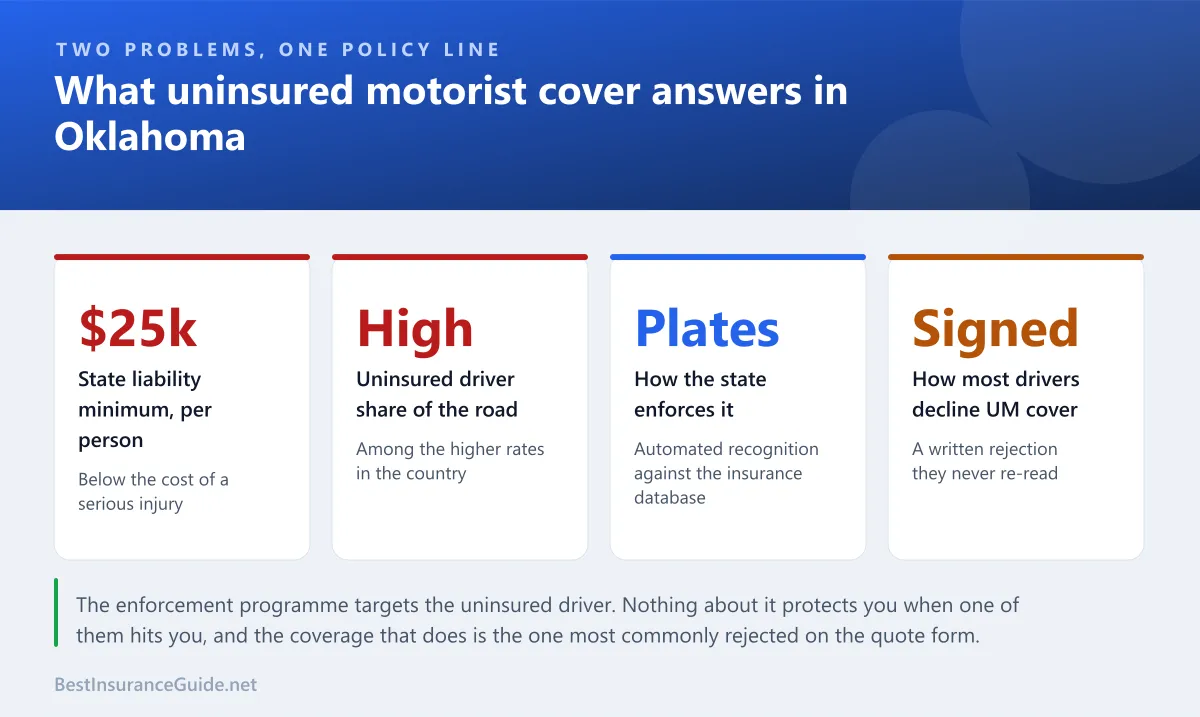
Uninsured motorist bodily injury covers your injuries when the at-fault driver has no insurance. It must be offered in Oklahoma and may be rejected in writing, which a great many drivers do without reading the form.
Underinsured motorist covers the gap when the at-fault driver has insurance but not enough. This is the larger problem, because minimum-limit drivers outnumber uninsured ones by a wide margin.
Worked example: hit by an uninsured driver
Injuries and lost income of $115,000, at-fault driver uninsured.
| With $100,000 UM | UM rejected | |
|---|---|---|
| At-fault driver’s insurer pays | $0 | $0 |
| Your uninsured motorist cover pays | $100,000 | $0 |
| Your health insurance may cover some medical | Partial | Partial |
| Recovered from the auto policy | $100,000 | $0 |
The premium for meaningful uninsured motorist cover is a small fraction of an Oklahoma policy. Rejecting it in a state with this many uninsured drivers is the worst trade on the quote.
The hail problem
Oklahoma sits in the core of the severe convective storm corridor, and hail is a vehicle risk here in a way it is not almost anywhere else.
Hail damage is a comprehensive claim. Not collision. A liability-only policy pays nothing toward it.
Three things follow from that.
Comprehensive is not optional in practice, on any vehicle you would not be happy to write off. It is inexpensive relative to what it does.
A hail claim is generally treated more gently at renewal than an at-fault collision, because it is not a fault-based loss. Frequency still counts, but a single hail claim is rarely dramatic.
A hail event can total a driveable car. Repair cost for extensive dent damage across panels, roof and glass frequently exceeds the vehicle’s actual cash value, and the settlement is that value rather than the repair estimate.
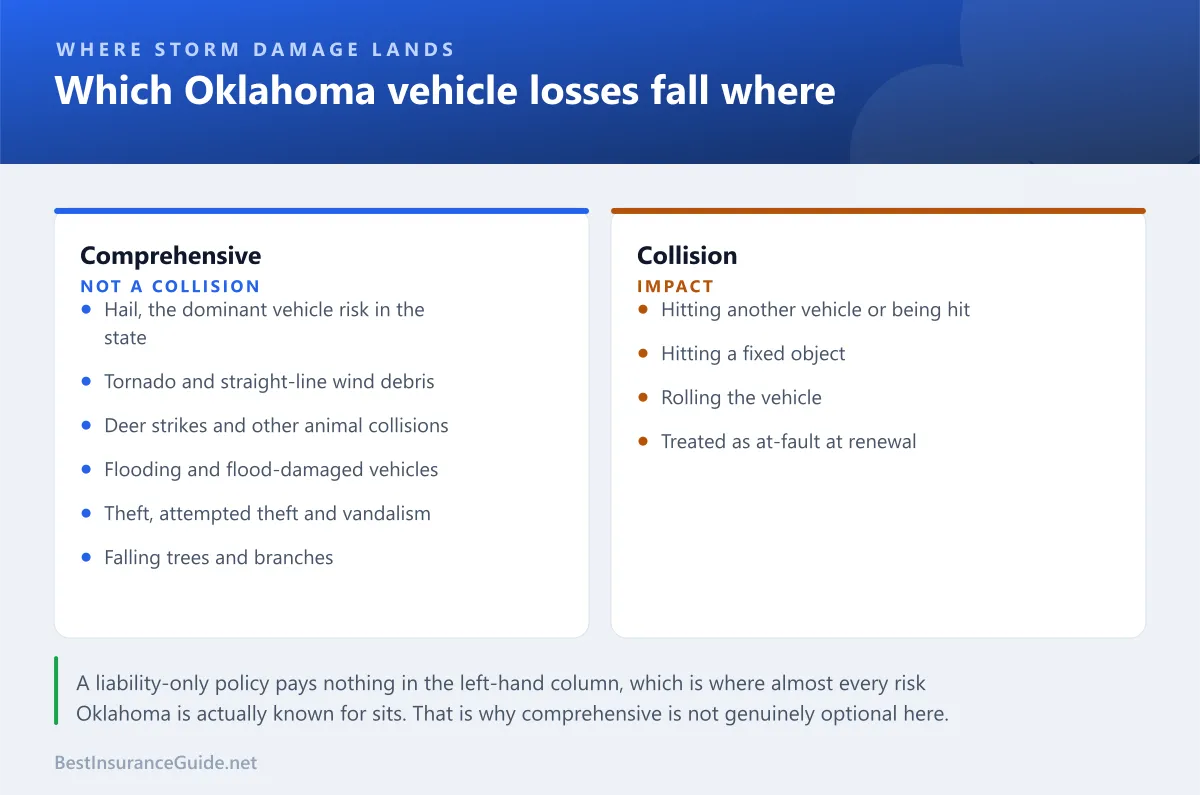
Two practical points. Covered parking is worth more here than the price suggests, both for the claims it prevents and occasionally for a discount. And photograph your vehicle before storm season, so pre-existing dents are not deducted from a later settlement.
What actually makes an Oklahoma quote cheap
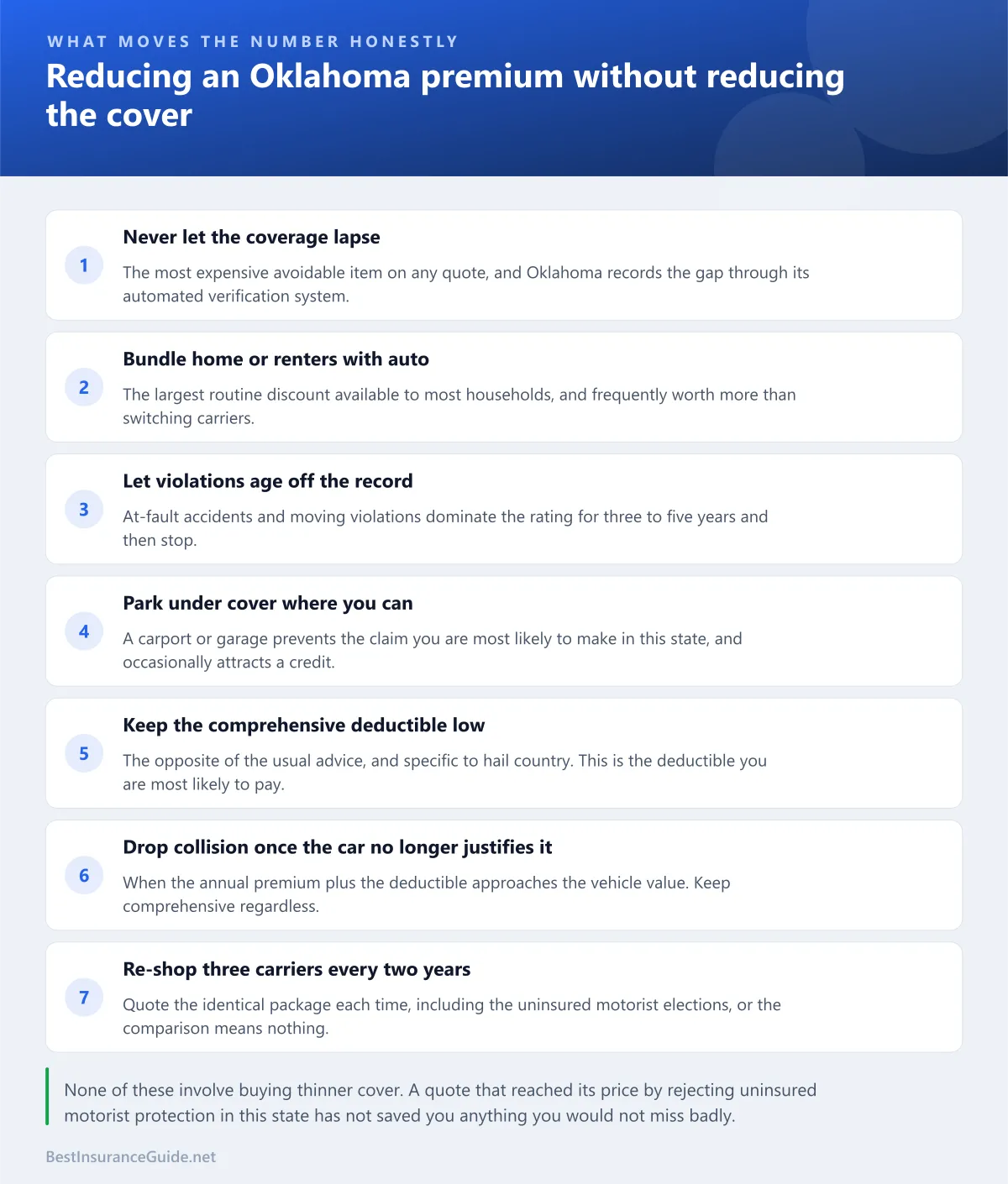
Continuous coverage with no lapse, which is the most expensive avoidable item on any quote and is entirely within your control. It matters more in Oklahoma than in most states, because the automated enforcement system creates a record of the gap.
Bundling home or renters with auto, the largest routine discount available to most households.
Your record over time. At-fault accidents and moving violations dominate the rating for three to five years.
Telematics, if you genuinely drive little. In a state with long rural distances this helps a smaller share of drivers than it does in a dense metro.
Deductible choice on comprehensive and collision, where one step up saves a real but modest amount. Be careful raising the comprehensive deductible far in a hail state, since that is the claim you are most likely to make.
Dropping collision on a low-value vehicle once the annual premium plus deductible approaches what the car is worth. Keep comprehensive.
Re-shopping every two years at matched coverage, which is the least glamorous and most reliable saving available.
What to carry
Liability at 100/300/100 or higher. The step up from the state minimum costs far less than most drivers expect.
Uninsured and underinsured motorist at matching limits. Do not sign the rejection form.
Comprehensive, without hesitation, on any vehicle worth keeping.
Collision, on any vehicle you could not comfortably replace.
A deductible you could produce this week, which is the same test that applies everywhere.
Rental reimbursement, which matters here because a regional hail event puts every body shop in the state into a queue measured in months.
An umbrella policy above the auto liability if you have assets.
The short version
Oklahoma is expensive for two reasons and you can insure directly against both.
Hail is a comprehensive risk, which means a liability-only policy pays nothing when a storm writes off a car that still drives. Uninsured drivers are a common problem here, which means the uninsured and underinsured motorist lines are doing more work in Oklahoma than in most states, and both are frequently rejected on the quote form without being read.
Everything else is ordinary: no lapse, bundle, let the record age, and re-shop every couple of years at genuinely matched coverage.
For the full discount list, see auto insurance discounts, and for switching without creating a gap, how to switch car insurance.
Surviving a hail season without losing money
Oklahoma’s storm season produces a predictable pattern, and drivers who handle it well recover substantially more than drivers who improvise.
Photograph the vehicle before the season. All four sides, the roof, the bonnet and the glass, in daylight. Pre-existing dents are otherwise deducted from a settlement and there is no way to argue about it after the fact.
Park under cover where you can. A carport, a garage, a parking structure, or in a pinch the far side of a building. This is the cheapest claim avoidance available and it occasionally attracts a discount as well.
Do not use blankets and cardboard as a plan. They help marginally and they require you to be at home when the storm arrives, which the storms are not obliged to arrange.
Report promptly after an event, before the regional queue forms. After a significant Oklahoma hail event, adjusters and body shops across the affected counties are booked within days and the wait extends into months.
Get the claim inspected before you accept a repair estimate from anybody knocking on your door. After every major event, out-of-state repair operations move into the affected area. Some are legitimate and some are not, and signing over your claim to a stranger at your door is a decision made under pressure.
Understand the total loss possibility. Extensive hail damage across panels, roof and glass frequently exceeds the vehicle’s actual cash value. The settlement is that value, not the repair estimate, and knowing what your car is genuinely worth before the conversation is worth doing.
Consider paintless dent repair where the damage suits it. It preserves the original paint, costs less, and on a vehicle near the total loss threshold it can be the difference between repair and write-off.
Worked example: a hail write-off, two policies
A six-year-old vehicle with an actual cash value of $11,400, hail damage estimated at $9,800.
| Comprehensive, $500 deductible | Liability only | |
|---|---|---|
| Repair or settlement offered | $9,800 repair | $0 |
| Deductible | $500 | n/a |
| Net recovery | $9,300 | $0 |
| Annual comprehensive premium | Roughly $180 to $320 | $0 |
One storm pays for the coverage many times over, and Oklahoma produces storms of that kind most years somewhere in the state.
Oklahoma regions, and what changes between them
Oklahoma City carries the highest combination of claim frequency, theft and severe weather exposure. Within the metro the ZIP code spread is meaningful.
Tulsa rates close behind on frequency, with its own hail history.
Norman, Lawton and Stillwater sit below the two large metros, with the university towns carrying a young driver market that affects household pricing more than territory rating does.
Rural Oklahoma rates lowest on frequency and highest on severity, driven by higher speeds, deer collisions and longer emergency response distances.
Across all of them the pattern holds: territory matters, and it matters less than your record, your continuous coverage history and whether you accepted or rejected the uninsured motorist cover.
Where Oklahoma drivers overpay
Rejecting uninsured motorist cover in a state with one of the higher uninsured driver rates in the country. This is the worst trade available on the quote.
Carrying state minimum liability, where the step up to 100/300/100 costs far less than most drivers expect.
Dropping comprehensive to save money in hail country, which is the single most likely claim they will ever make.
Raising the comprehensive deductible too far, for the same reason.
Keeping collision on a vehicle that no longer justifies it, where the annual premium plus the deductible approaches the car’s actual cash value.
Never re-shopping, where the spread between carriers on an identical driver is frequently several hundred dollars a year.
Two things worth doing before the next storm season
Check whether uninsured and underinsured motorist cover appear on your declarations page at all. If either shows as rejected, that is a decision somebody made, possibly years ago on a previous policy, and it carries forward silently through renewals. Reversing it is a phone call and a modest premium adjustment, with no waiting period and no underwriting hurdle.
Check what your comprehensive deductible is. In a state where the claim you are most likely to make is a hail claim, a deductible chosen to shave a few dollars off the premium is working directly against the coverage you are most likely to need. A $500 comprehensive deductible in Oklahoma is generally better value than a $1,000 one, which is the opposite of the usual advice and is specific to the risk here.
Both of those take ten minutes and neither requires shopping anything.
When to re-quote
Every two years as a baseline, and immediately after a move, a household change, a vehicle change, a violation ageing off the record at three to five years, or any renewal that arrived materially higher without an obvious cause.
Each time, write the coverage package down first, including the uninsured and underinsured motorist limits and the comprehensive deductible, and quote that exact specification with three carriers including an independent agent. Comparing a properly specified policy against a stripped one is the most common way drivers convince themselves they have saved money.
How neighbouring states differ
Oklahoma pairs a high uninsured driver rate with optional uninsured motorist cover, which is the combination to understand before signing a rejection form.
Missouri and South Carolina both mandate the cover instead. Kansas requires personal injury protection as a no-fault state. Arkansas shares the optional structure and the hail exposure almost exactly.
A note on scope
Premium figures here are illustrative rather than quotes, and Oklahoma pricing varies substantially by ZIP code, driving record, vehicle, coverage selected and individual insurer. Statutory minimums, enforcement programmes and rating practices are set by Oklahoma law and change over time.
The Oklahoma Insurance Department publishes the current requirements, consumer guidance and complaint records for licensed insurers, and the NAIC publishes comparative data by state. Nothing here is legal advice. This site is independent and not affiliated with any insurer.