Good Driver Insurance: What Being One Is Actually Worth
What a clean driving record is worth in car insurance, the five separate mechanisms that reward it, and how to make sure you are receiving all of them.

Table of contents

A clean driving record is the single largest thing you control in car insurance pricing, and treating it as one discount understates it considerably. It works through five separate mechanisms and most drivers are receiving two of them.
The five mechanisms
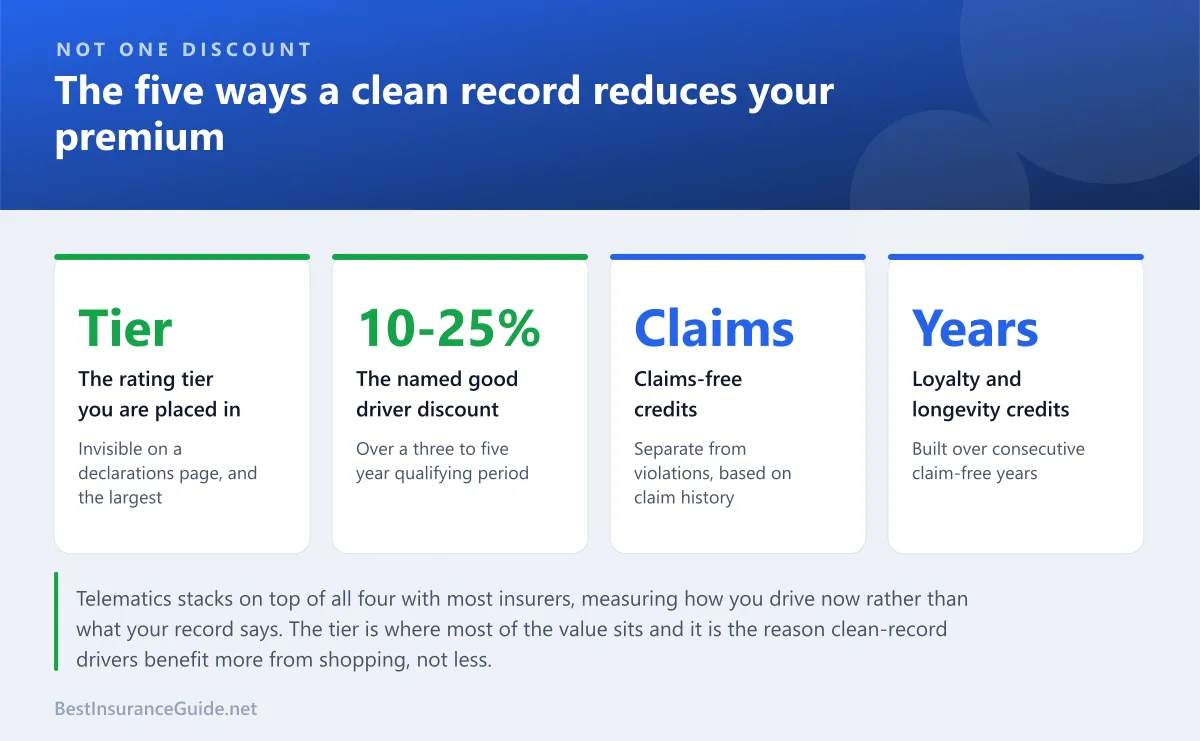
The rating tier. The largest and the least visible. Insurers place applicants into pricing tiers, and a clean record is what puts you in the better ones. This is not a percentage taken off a price; it is a different price to begin with, and it usually exceeds every named discount combined.
The named good driver discount. A stated reduction, commonly in the region of 10% to 25%, applied for having no at-fault accidents or moving violations over a qualifying period of three to five years.
Claims-free credits, which some insurers apply separately from the driving record, based on your claims history rather than your violations.
Loyalty and accident-free longevity credits, which build over consecutive claim-free years with the same insurer.
Telematics, which measures current behaviour and stacks on top of the historic record with most insurers.
The reason this distinction matters is practical. The named discount is the part you can see on a declarations page. The tier is where most of the money is, and it is the reason a driver with a clean record who shops around finds a wider spread than a driver with a claim, not a narrower one.
What a clean record is actually worth
Two ways of measuring it, and the second is more useful.
Against the named discounts, somewhere in the region of 10% to 25%.
Against the alternative, which is what a record with a single at-fault accident and a moving violation would cost, the difference is commonly 40% or more, sustained for three to five years.
Worked example: the same driver, two records
Same vehicle, same address, same coverage.
| Clean record | One at-fault claim and a speeding ticket | |
|---|---|---|
| Base rating tier | Preferred | Standard |
| Good driver discount | Applied | Removed |
| Claims-free credit | Applied | Removed |
| Accident surcharge | None | Applied |
| Violation surcharge | None | Applied |
| Relative annual premium | Baseline | Roughly 45% higher |
| Duration | Ongoing | Three to five years |
Note that four of those six rows changed. This is why a single incident costs more than the surcharge alone suggests: it removes credits at the same time as it adds a charge.
Making sure you are receiving all of it
Most drivers with clean records are leaving something on the table, and the checks are quick.
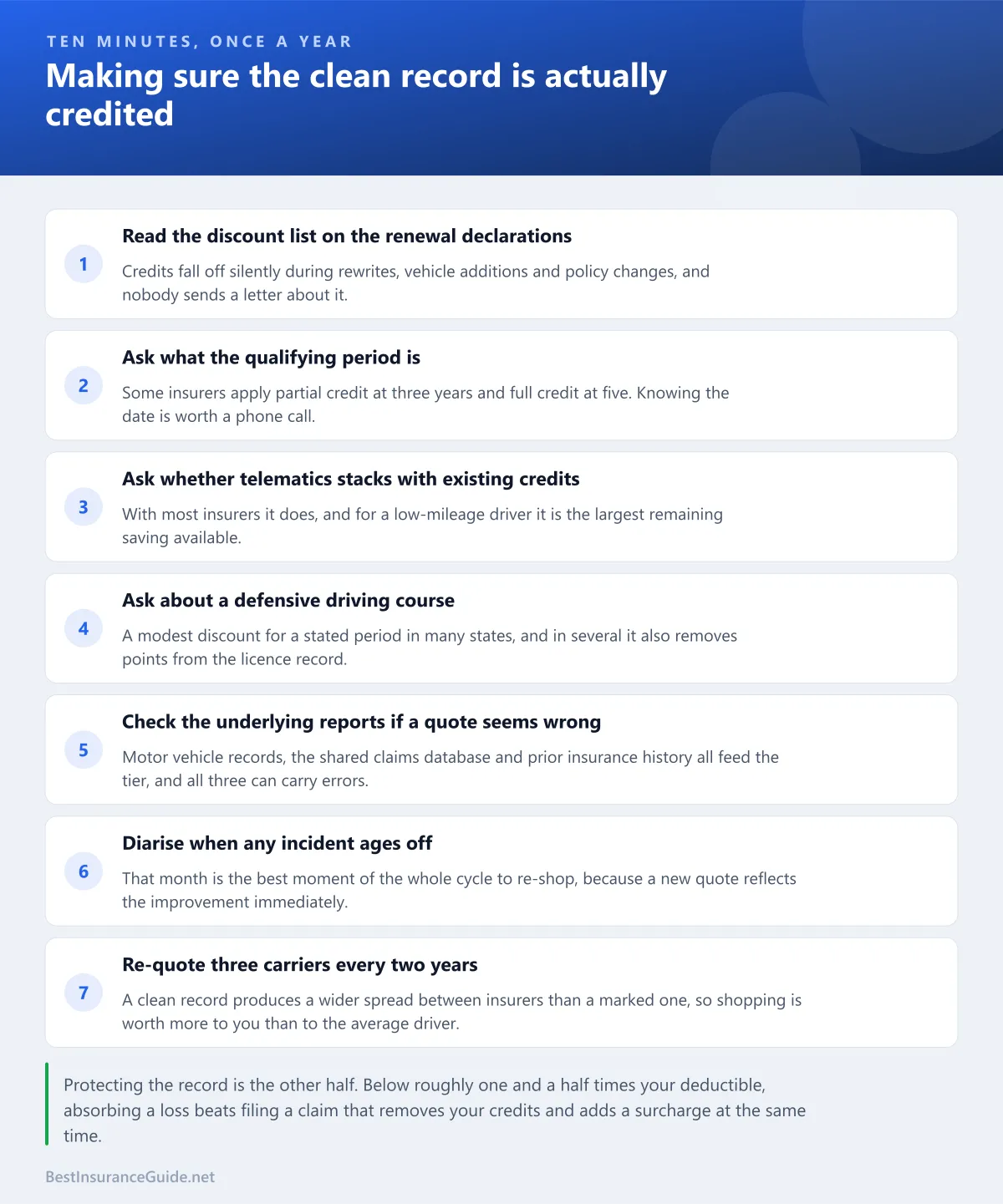
Read the discount list on your declarations page. Discounts fall off silently at renewal, particularly after a policy change, a vehicle addition or a rewrite. If good driver or claims-free credits are missing and you qualify, say so.
Ask what the qualifying period is with your insurer, since some apply a partial credit at three years and full credit at five. If you are approaching the threshold, it is worth knowing the date.
Ask whether telematics stacks with your existing discounts, which with most insurers it does.
Ask about a defensive driving course. In many states this attracts a discount for a stated period, commonly three years, and in several states it can also remove points from your record. The course is inexpensive and takes a few hours.
Check the underlying data. Insurers rate from motor vehicle records, a shared claims database and prior insurance history. Errors occur, and you are generally entitled to request your file and dispute inaccuracies. If a quote is inexplicably high on a clean record, check this before assuming it is the market.
Diarise the dates incidents age off, if you have any. The month an accident or violation drops off is the best moment of the whole cycle to re-shop, because your current insurer may not reprice promptly and a new quote reflects it immediately.
Telematics, and whether it suits you
Telematics is the largest additional saving available to a genuinely careful driver, and it is not free of risk.
What is measured, in most programmes: hard braking, rapid acceleration, speed relative to the limit, time of day, phone handling and total mileage.
What earns the discount, in practice: low mileage above everything, then smooth braking, then avoiding late-night driving.
Three things to check before enrolling.
Whether the programme can increase your rate. Some are discount-only, which makes them a free option. Others can surcharge, which makes them a bet.
The monitoring period. Some assess over a few months and then apply a lasting discount; others monitor continuously.
How mileage is treated, since for many drivers the mileage credit is the largest component and a long commute can outweigh careful driving.
For a driver with a short commute and a clean record, telematics is usually the single largest remaining saving. For a driver with a long motorway commute, it frequently is not.
Keeping the record clean
The obvious advice is not useful, so here is the specific version.
Think carefully before filing a small claim. A claim removes claims-free credits as well as adding a surcharge, and below roughly one and a half times your deductible the recovery rarely justifies that.
Contest a citation where you have grounds, or ask about a course that removes the point, because a violation costs more than the fine.
Know which claims are treated gently. Comprehensive claims — hail, theft, deer, glass — are generally weighted far more lightly than at-fault collisions, which changes the calculation on whether to claim.
Do not let coverage lapse, ever. A gap is a rating factor in its own right and undoes years of clean history.
Report changes honestly. A misstated mileage or garaging address is not a discount; it is a claim problem waiting to happen.
The short version
A clean driving record is the largest thing you control in car insurance, and it works through five mechanisms rather than one: the rating tier, the named good driver discount, claims-free credits, longevity credits and telematics.
The tier is where most of the value sits and it is invisible on a declarations page, which is why a driver with a clean record benefits more from shopping than one with a claim.
Check that the named discounts are actually applied, ask about a defensive driving course, consider telematics if your mileage is genuinely low, and check the underlying data if a quote seems wrong.
And protect the record deliberately: below about one and a half times your deductible, absorbing a loss beats filing a claim that removes your credits and adds a surcharge at the same time.
For the full discount list, see auto insurance discounts, and for what a claim actually costs, how much car insurance goes up after an accident.
Checking the data behind your quote
Because the rating tier does most of the work, an error in the underlying data costs more than a missing named discount. Three sources feed it and all three can be wrong.
Your motor vehicle record, held by the state licensing authority. Errors include violations recorded against the wrong person, citations that were dismissed but never updated, and out-of-state violations duplicated.
The shared claims database, which records property and auto claims across insurers. Errors include claims recorded against you that belonged to a previous owner of the vehicle or a previous occupant of the address, claims opened and withdrawn that still appear, and not-at-fault claims recorded without the fault indicator.
Prior insurance history, where a cancellation for an administrative reason is sometimes recorded as a lapse.
You are generally entitled to request these reports and to dispute inaccuracies, and the process is free. If a quote comes back materially higher than you expected on a record you believe is clean, this is the first thing to check rather than the last.
Building the record from a standing start
Two groups have clean records that insurers do not yet recognise: newly licensed drivers, and drivers new to the country or returning after time abroad.
For a new driver, the record builds with time and nothing accelerates it much. What helps meanwhile is staying on a household policy, a good student discount, a driver training course and telematics, which measures current behaviour rather than absent history.
For a driver with foreign licence history, some insurers will credit overseas driving experience and claims-free history if you can document it. It is worth asking specifically and worth obtaining a letter from the previous insurer before you leave, because getting one afterwards is considerably harder.
For a returning expatriate, the gap in domestic coverage is frequently treated as a lapse. Documentation of continuous cover abroad sometimes resolves it, and an independent agent is far more likely to know which carriers accept it.
The annual review that makes it stick
A clean record only pays if the policy reflects it, and the check takes ten minutes once a year.
Read the discount list on the renewal declarations page and compare it against last year’s. Credits fall off during rewrites and policy changes and nobody tells you.
Ask for the current qualifying periods, since a driver approaching the three or five year mark may be a phone call away from a better tier.
Ask what endorsements are available that you do not have, which is the most productive question in the whole conversation and one almost nobody asks.
Re-quote three carriers at matched coverage. A clean record produces a wider spread between insurers than a marked one, so shopping is worth more to you than to the average driver, which is the opposite of the intuition.
Check the underlying reports if any quote is inexplicably high.
Worked example: two clean-record drivers, one shops
| Stays put | Re-quotes every two years | |
|---|---|---|
| Discounts verified at renewal | Assumed | Checked |
| Spread between carriers captured | No | Yes |
| Endorsements reviewed | No | Yes |
| Five-year outcome | Drifts upward | Materially lower |
Neither driver changed how they drive. One of them checked.
What a clean record is worth over a decade
The compounding is the part people underestimate, because each individual year looks unremarkable.
A driver in a preferred tier with the full set of credits pays a materially lower base rate every year, and that base rate is what every future increase is applied to. A market-wide rate rise of eight percent applied to a lower base produces a smaller increase in dollars, every time, for as long as the record holds.
Add to that the effect of not filing marginal claims, which preserves the claims-free credit, and the gap between two otherwise identical drivers over ten years is substantial rather than marginal.
The practical implication is the one this article ends on: protect the record deliberately rather than passively. That means thinking before filing a small claim, contesting a citation where there are grounds, never allowing a lapse, and checking annually that the credits you have earned are actually on the policy.
None of that is dramatic. All of it compounds.
Related reading
How much car insurance goes up after an accident covers what a single claim does to the record this article is about protecting. What age does car insurance go down covers the other half of the same curve, where age and record improve together.
A note on scope
Discount names, percentages, qualifying periods and telematics programme terms vary considerably between insurers and between states, and change over time. Figures here are illustrative rather than quotes.
Your state insurance department publishes consumer guidance on rating factors and discounts, and consumer reporting rules generally give you a right to request and dispute the underlying reports insurers use. Your own declarations page is the authoritative statement of which discounts are applied. This site is independent and not affiliated with any insurer.