Renters Insurance and Earthquakes: Excluded, and Cheap to Add Back
Earthquake is excluded from standard renters insurance. How to buy it back, California CEA options, percentage deductibles and why loss of use matters most.

Table of contents

Earthquake is one of only a handful of things excluded from every standard renters policy in the United States, and it is the one renters are best placed to fix cheaply.
The exclusion is universal
Earthquake and earth movement are excluded from every standard renters policy. Not limited, not sublimited. Excluded.
The exclusion is usually drafted broadly, covering earthquake, landslide, mudflow, sinkhole collapse, subsidence and other earth movement, whether caused naturally or by human activity.
So a quake that brings shelves down, cracks a television, destroys crockery and writes off furniture produces no claim on a standard policy.
The exception worth knowing: fire following
Here is the nuance almost nobody knows, and it matters.
Fire is a named peril on every renters policy. If an earthquake causes a fire, and the fire destroys your belongings, that fire loss is generally covered by your standard policy even though the shaking damage is not.
The same logic frequently applies to sprinkler leakage triggered by a quake, and to water damage from burst plumbing, depending on the wording.
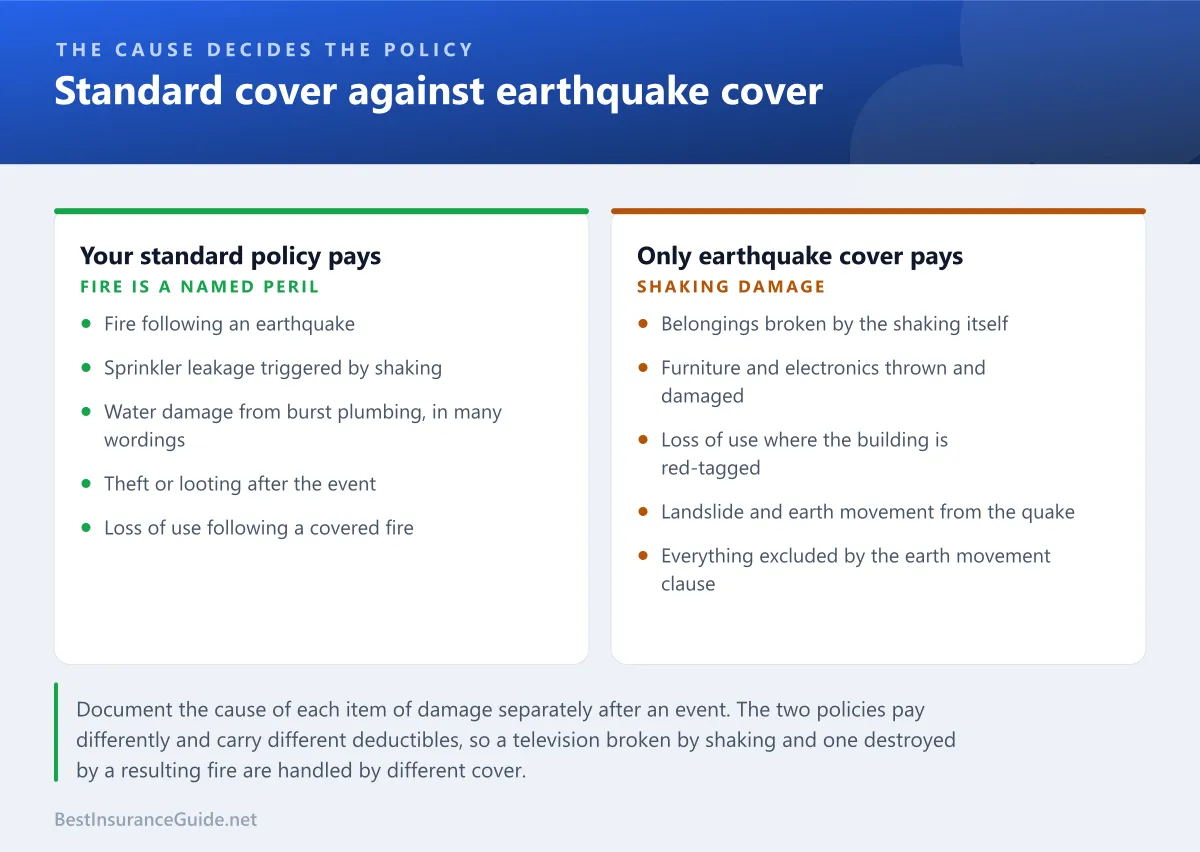
That is a genuinely useful piece of knowledge after an event, because the cause of the damage determines which policy responds. Shaking damage to a television is excluded; the same television destroyed by a fire that started because of the quake is normally covered.
Document the cause carefully after any seismic event, because it decides the claim.
Buying it back
Three routes, and which applies depends on where you are.
An earthquake endorsement on your existing renters policy. The simplest option where your insurer offers it, and it keeps everything on one policy.
A standalone earthquake policy from a specialist insurer. Available in most seismic states, and sometimes the only route if your renters insurer does not offer an endorsement.
The California Earthquake Authority, for California renters. The CEA is a publicly managed, privately funded organisation providing earthquake insurance through participating insurers. Its renters policy covers personal property and loss of use, with a choice of limits and deductible levels. There is no structural element, because as a renter you do not insure the building.
That last point is why renters get a better deal here than owners. A homeowner insuring a structure against earthquake faces a large premium and a percentage deductible on a large sum. A renter is insuring belongings and displacement, which is a much smaller and cheaper exposure.
The percentage deductible
Earthquake cover behaves differently from the rest of your policy in one important way.
The deductible is a percentage of the coverage limit, not a flat amount. Commonly somewhere between 5% and 25%, depending on the policy and what you select.
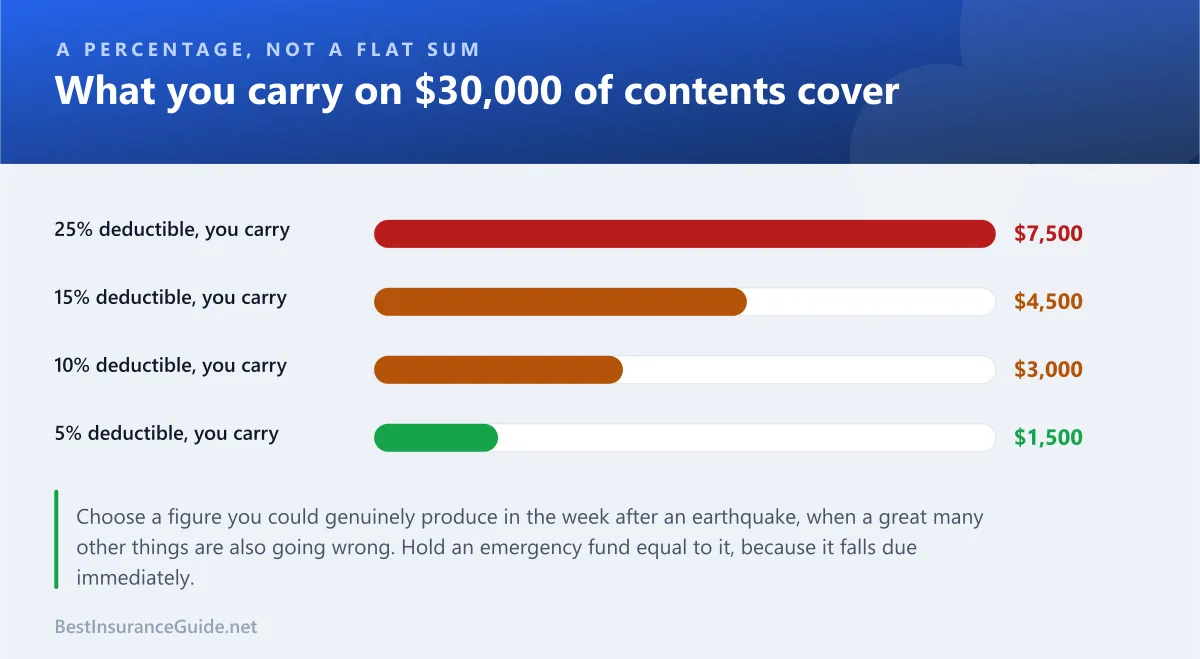
Worked example: the same loss at three deductible levels
$30,000 of contents cover, a quake causing $22,000 of damage to belongings.
| Deductible | You carry | Insurer pays |
|---|---|---|
| 5% ($1,500) | $1,500 | $20,500 |
| 15% ($4,500) | $4,500 | $17,500 |
| 25% ($7,500) | $7,500 | $14,500 |
The lower deductible costs more in premium, and the difference in a real event is substantial. Choose deliberately rather than accepting whatever appears first, and choose a figure you could genuinely produce in the week after an earthquake, when a lot of other things are also going wrong.
Loss of use is frequently the bigger benefit
This is the part renters underestimate, and it is the strongest argument for the cover.
After a significant earthquake, the common problem is not that your belongings were destroyed. It is that the building is red-tagged and you cannot go home. Structural assessment takes time, repairs take longer, and in the meantime you need somewhere to live.
Renters earthquake policies frequently include a meaningful loss of use amount covering additional living expenses: temporary accommodation, the difference in food costs, extra commuting, storage.
In an expensive rental market that benefit can exceed the contents payout comfortably. Finding a short-term let in San Francisco, Seattle or Los Angeles at short notice, competing with everyone else displaced by the same event, is precisely the situation the coverage exists for.
When comparing quotes, look at the loss of use figure as carefully as the contents limit.
Where this matters beyond California
California dominates the conversation and it is not the only place.
The Pacific Northwest. Washington and Oregon sit on the Cascadia subduction zone, and the seismic risk is genuine and under-insured relative to California.
Alaska, which experiences frequent seismic activity.
Nevada and Utah, both of which carry meaningful risk along their western and Wasatch fault systems respectively. Our guide to pet insurance in Utah is a different subject entirely, but the same Wasatch Front population concentration applies.
The New Madrid seismic zone, across parts of Missouri, Arkansas, Tennessee, Kentucky and Illinois. Historically significant earthquakes occurred here, and residents almost never carry cover because the risk is not culturally salient.
South Carolina, which experienced a major historical earthquake and retains measurable risk.
Take-up rates outside California are very low, and the premium for renters cover in those states is correspondingly modest.
What it does not cover
Even with earthquake cover in place, some things sit outside it.
The building. That is the landlord’s problem and their policy, and it is not your loss.
Flood or tsunami, which are separate exclusions requiring separate cover through the National Flood Insurance Program or a private flood policy.
Vehicles, which are covered by comprehensive on your auto policy rather than by a renters earthquake endorsement.
Land movement not caused by an earthquake, depending on the wording, though most earthquake policies do cover landslide and related earth movement triggered by seismic activity.
Practical preparation
Insurance pays afterwards. These reduce the loss.
Secure tall furniture to walls, which prevents both damage and injury and is frequently the largest single reduction in contents loss.
Use museum putty or straps on televisions, computers and anything on an open shelf.
Do not store heavy items above bed height.
Know where the gas shutoff is, since gas leaks cause the fires that produce the covered losses described above.
Video your contents and store it off-site, because a claim after a major event is settled against evidence and everyone is claiming at once.
Keep an emergency fund equal to your percentage deductible. That number is the whole point of the arrangement and it is due immediately.
The short version
Earthquake is excluded from every standard renters policy, and buying it back is cheaper for renters than for owners because you are insuring belongings and displacement rather than a building.
Fire following an earthquake is generally covered by your standard policy even though the shaking damage is not, which makes documenting the cause of any damage worth doing carefully.
Earthquake cover uses a percentage deductible rather than a flat one, commonly 5% to 25% of the limit, so choose a figure you could actually produce in a bad week.
And weigh the loss of use benefit as heavily as the contents limit, because in a real event the expensive problem is usually that you cannot go home.
For the full list of what a standard policy does and does not cover, see what renters insurance covers and the renters insurance guide.
After an earthquake
The claim process differs from an ordinary loss, mainly because everyone is claiming at once and access to your home may be restricted.
Establish the cause of each loss. As set out above, shaking damage falls under earthquake cover while fire, sprinkler leakage and some water damage following a quake are frequently covered by your standard policy. Photograph and describe each item’s cause specifically, because the two policies pay differently and the deductibles are different.
Report to both insurers if you hold separate policies. An earthquake endorsement on your renters policy is one claim; a standalone or CEA policy is a separate one with its own reporting process.
Do not throw anything away until it has been documented, even if the building manager is pressing for clearance.
Keep receipts from day one for accommodation, food, laundry and transport. Loss of use frequently starts from the moment you cannot occupy the home, not from when the claim is accepted.
Expect delays. After a significant event, adjusters are stretched and structural assessments take time. Insurers frequently release advance payments for immediate needs, and it is worth asking rather than waiting.
Get the red tag or inspection documentation from the building official. That paperwork is what evidences that the property was uninhabitable, and it supports the loss of use claim more effectively than your own account.
Comparing earthquake quotes
Four things decide the value of a renters earthquake policy, and only one of them is the premium.
The contents limit, measured against a real inventory rather than a guess.
The loss of use limit, which in an expensive rental market frequently matters more than the contents figure.
The deductible percentage, and whether it applies separately to contents and loss of use or as a single figure.
Whether it is written on replacement cost or actual cash value, which matters as much here as on the base policy.
Ask each insurer for those four numbers and compare them side by side. A cheaper policy with a 25% deductible and a thin loss of use limit is not a cheaper version of the same product.
Preparing properly
Video every room and store it in cloud storage, not on a device that will be inside the building.
Keep a copy of the policy schedule off-site, including the deductible percentage and the claims number.
Hold an emergency fund equal to the deductible. That figure is due immediately and there is no way around it.
Secure furniture and heavy items, which reduces both the loss and the injury risk.
Know your building’s construction era. Older unreinforced masonry and soft-storey buildings, common in parts of California, carry substantially higher red-tag risk, which raises the value of the loss of use element specifically.
Whether to buy it
The honest test has three parts.
Where you live. In California, the Pacific Northwest, Alaska, Nevada and Utah the case is straightforward. In the New Madrid zone and South Carolina it is genuinely underappreciated. Elsewhere it is usually unnecessary.
Your building. Older unreinforced masonry and soft-storey construction carry substantially higher red-tag risk than modern engineered buildings, and red-tagging is what drives the loss of use claim.
Your rental market. The more expensive and tight your local rental market, the more the loss of use benefit is worth, because finding somewhere at short notice while competing with everyone else displaced is precisely the problem.
For a renter in a seismic region, the premium is usually modest enough that the decision comes down to whether you could absorb both replacing your belongings and funding several weeks of alternative accommodation simultaneously. Most people could not.
A note on scope
Earthquake coverage availability, deductible options and loss of use limits vary by insurer and by state, and the California Earthquake Authority’s offerings change over time. The figures here are illustrative rather than any particular policy’s terms.
Confirm current options and limits with your insurer or, in California, with the CEA and participating insurers directly. This site is independent and not affiliated with any insurer.