How Much Does Car Insurance Go Up After an Accident?
What an at-fault accident does to a car insurance premium, how long it lasts, when a claim is not worth filing, and how accident forgiveness actually works.

Table of contents

The honest answer is a range rather than a number, and understanding what moves you within the range is more useful than the average.
The realistic range
For an at-fault accident, the increase at the next renewal commonly falls somewhere between 20% and 50%, with a long tail in both directions.
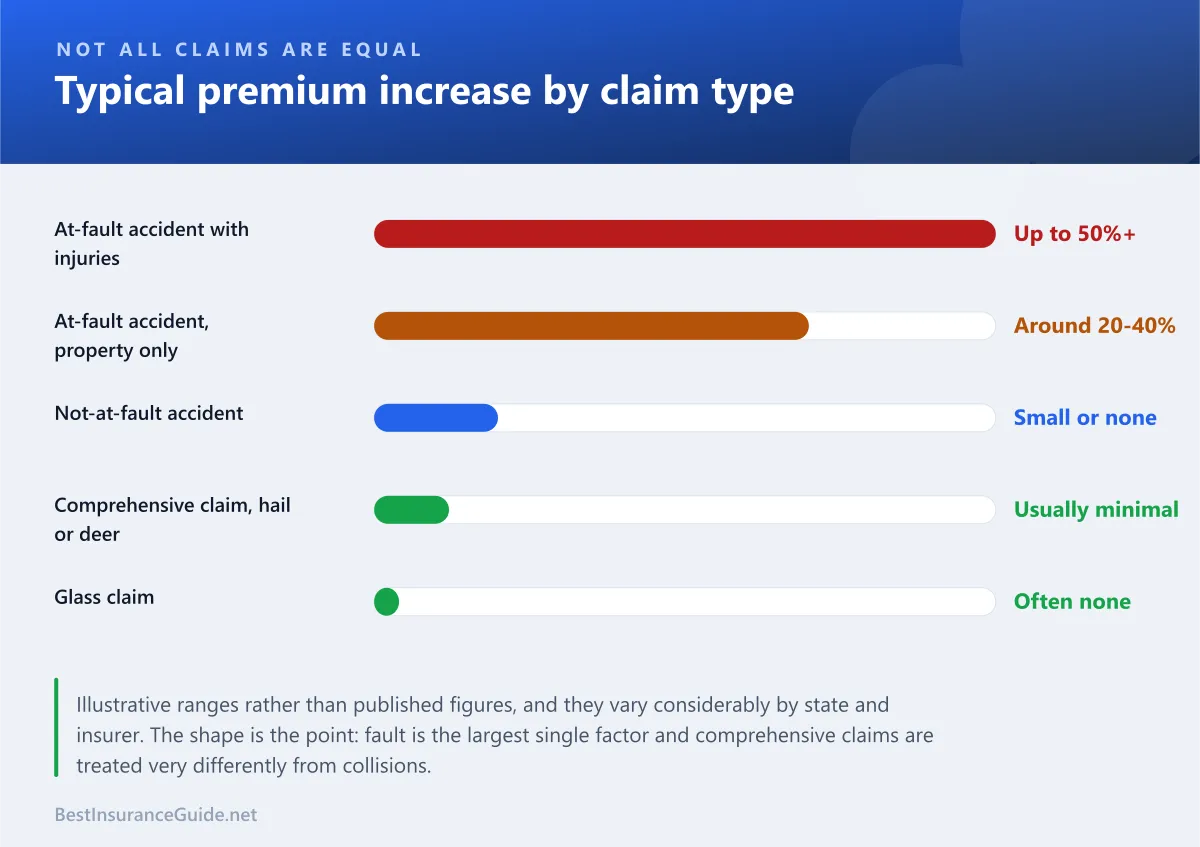
The variation is not random. Six things decide where you land.
Fault. The single largest factor. An at-fault collision is treated very differently from a claim where somebody else was responsible.
Severity. A $3,000 claim and a $60,000 claim with injuries are not weighted the same by most insurers.
Your record before it. A first incident on an otherwise clean record is treated far more gently than a second in three years.
Your state. Several states restrict what insurers may surcharge for, particularly on not-at-fault claims, and the rules vary considerably.
Your insurer. This is the underrated one. Carriers weight accidents very differently, which is why the spread between quotes is wider after a claim than before one.
Whether injuries were involved. Bodily injury claims are the most heavily weighted, because they drive the largest losses.
How long it lasts
Typically three to five years, depending on the state and the insurer.
The shape matters as much as the duration. The surcharge is normally largest at the first renewal after the claim, reduces in the second and third years, and then falls off entirely.
That has a practical consequence. The year an accident ages off your record is the year to re-shop, because your current insurer will not necessarily reprice you promptly and a new quote reflects the improved record immediately.
Not-at-fault, comprehensive and other claim types
Not every claim behaves the same way.
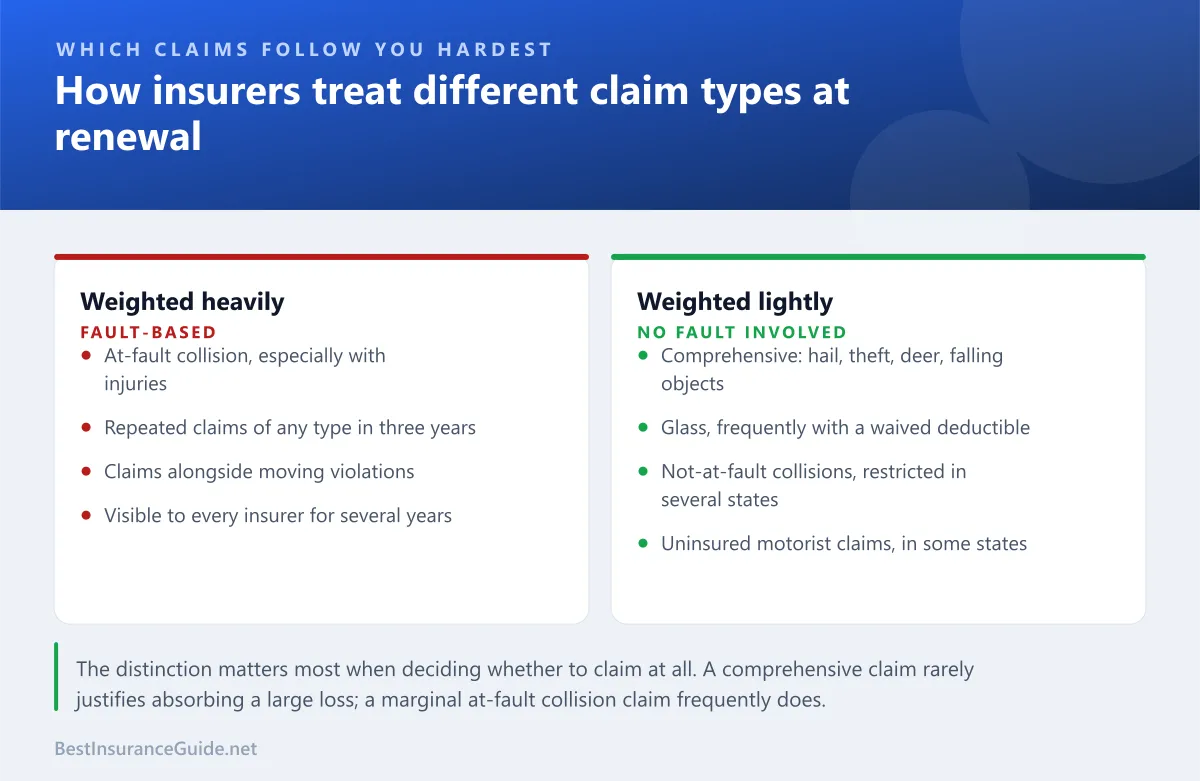
At-fault collision carries the heaviest weighting.
Not-at-fault collision carries much less, and in several states insurers are restricted from surcharging for it at all. Frequency can still matter.
Comprehensive claims — hail, theft, deer, falling objects, vandalism — are generally treated gently because no fault is involved. Repeated comprehensive claims can still affect your tier.
Glass claims are frequently treated most gently of all, and many policies carry a reduced or waived deductible for glass specifically.
Uninsured motorist claims vary by state and insurer, and in some states insurers may not surcharge for them.
The distinction matters when deciding whether to claim at all, because it changes the arithmetic considerably.
When not to claim
Separate from what an accident costs is whether to report it as a claim, and the answer is frequently no.
The general rule that holds across every line of insurance:
Below roughly one and a half times your deductible, absorb it. A $1,200 repair on a $1,000 deductible recovers $200 and buys a claim on your record for five years.
Between one and a half and three times, think about it, weighing the recovery against the likely surcharge over three to five years.
Above three times, claim. That is what the policy exists for.
Worked example: the true cost of a small claim
A $2,400 repair, $1,000 deductible, current premium $1,600 a year.
| File the claim | Absorb it | |
|---|---|---|
| Recovery now | $1,400 | $0 |
| Premium at 35% surcharge, year one | +$560 | $0 |
| Year two, reduced surcharge | +$380 | $0 |
| Year three, reduced surcharge | +$220 | $0 |
| Three-year net position | +$240 | -$2,400 |
That example still favours claiming, narrowly. Move the repair down to $1,700 and the same arithmetic reverses, which is why the deductible multiple rule is worth applying rather than reflexively claiming.
Two exceptions to all of this.
Always report anything involving injury, however minor it looks, because an injury claim can arrive months later and late notice can prejudice your cover.
Always report anything involving another party, even if you intend to pay for the damage, for the same reason. Reporting is not the same as claiming.
Accident forgiveness
A benefit that waives the surcharge for a first at-fault accident.
Three things to understand about it.
It is sometimes earned and sometimes bought. Some insurers grant it after a stated number of claim-free years; others sell it as an endorsement.
It usually applies to one accident, per policy rather than per driver in many wordings, which matters in a multi-driver household.
It does not remove the claim from your record. The claim remains visible to other insurers through the shared industry database, so the forgiveness protects your premium with your current insurer and does not protect a quote from anybody else.
That last point is the one people are surprised by, and it is a reason not to treat accident forgiveness as a licence to claim freely.
What to do at the next renewal
Read the renewal notice rather than autopaying. The surcharge is applied at renewal and is frequently the first you hear of it.
Ask your insurer what the accident contributed, specifically, and what it will contribute next year.
Ask whether accident forgiveness applied, and if you had earned it and it was not applied, say so.
Shop three carriers at matched coverage. The spread between insurers is wider after a claim than before one, because they weight accidents differently. This is the single most effective response available.
Do not reduce coverage to absorb the increase. Dropping to state minimum liability or removing uninsured motorist cover to offset a surcharge is a poor trade, and it is the most common reaction.
Look for discounts you are not receiving, including telematics, which for a genuinely careful driver can partly offset a surcharge.
Diarise the date the claim ages off, and re-shop that month.
The short version
An at-fault accident commonly raises a premium by roughly 20% to 50% at the next renewal and stays on the rating for three to five years, tapering as it ages.
Not-at-fault and comprehensive claims are treated far more gently, and in several states insurers are restricted from surcharging for not-at-fault claims at all.
On a small loss, absorbing it usually beats claiming: below about one and a half times the deductible the recovery is not worth the record. Injury and third-party incidents are the exception and should always be reported even if not claimed.
And after a claim, shop. Insurers weight accidents very differently and the spread between them is at its widest exactly when you most need it to be.
For what happens when the crash was not your fault, see car accident not your fault, and for the discount list, auto insurance discounts.
What is actually on your record
Insurers do not take your word for your history and they do not rely only on their own files.
Claims are reported to a shared industry database covering property and auto claims, visible to other insurers for several years when you apply. This is why switching does not escape a claim.
Motor vehicle records are checked with the state licensing authority, covering violations and licence status.
Prior insurance history is verified, including gaps.
Three practical consequences.
A claim you filed and withdrew may still appear, because the report is generated when the claim is opened rather than when it is paid.
A claim on a vehicle you no longer own still follows you, since the record attaches to the driver as well as the vehicle.
You are entitled to see the report. Consumer reporting rules generally give you a right to request your file and to dispute inaccuracies, and errors do occur. If a quote comes back inexplicably high, this is worth checking before assuming it is the market.
The two-year plan after a claim
Immediately. Read the renewal rather than autopaying. Ask your insurer exactly what the claim contributed and whether accident forgiveness applied.
Within a month. Shop three carriers at genuinely matched coverage. The spread between insurers is at its widest after a claim, and this is the single largest saving available.
Within three months. Review the coverage itself. Consider whether collision still makes sense on an older vehicle, whether the deductibles are set where you want them, and whether telematics would help.
Each renewal. Re-quote. The surcharge tapers each year and a new quote captures the improvement immediately, where an existing insurer may not.
At three years, and again at five. Diarise the dates the claim ages off in your state. That month is the best time to re-shop of the whole cycle.
What not to do at any point is reduce coverage to offset the increase. Dropping to state minimum liability or removing uninsured motorist cover after a claim leaves you worse protected at exactly the point your record suggests you should be more careful, and it saves a fraction of what shopping properly does.
What to do at the scene, which affects the price later
Fault determination is what decides whether a claim is surcharged, and it is largely settled by evidence gathered in the first ten minutes.
Call the police and get a report number. An official record of the circumstances is the most useful document in any later fault dispute.
Photograph before anything moves: positions, damage on both vehicles, road markings, signals, skid marks, debris, weather and light.
Photograph the other driver’s licence and insurance card rather than transcribing details.
Collect witness contact details, which decide contested fault more often than argument does.
Say nothing about fault. An apology at the scene is routinely used as an admission, and it can convert a not-at-fault claim into a shared-fault one, which is the difference between a small premium effect and a large one.
Report to your own insurer promptly, even where you do not intend to claim.
Where drivers make it worse
Filing a small claim reflexively. The most common expensive mistake, and the one the deductible multiple rule exists to prevent.
Cutting coverage after a surcharge. Reducing liability limits or dropping uninsured motorist cover to offset an increase leaves you worse protected and saves a fraction of what shopping properly would.
Staying put out of loyalty. Insurers weight accidents very differently and the spread after a claim is at its widest. Not shopping is the single largest avoidable cost.
Assuming the surcharge is permanent. It tapers and then falls off. Knowing the date and re-quoting that month is worth real money.
Two things to check on the renewal notice
Ask for the surcharge to be identified separately. A renewal that rose 40% may have risen partly for the claim and partly for a market-wide rate increase, and only one of those responds to shopping. Insurers will usually tell you the split if you ask.
Confirm every discount is still applied. Discounts fall off silently at renewal more often than anyone admits, and a claim year is exactly when a missing good driver or multi-policy credit is easy to attribute to the surcharge instead.
When the accident was not yours
If another driver was at fault and their insurer accepted it, the claim should carry little or no surcharge. Two things are worth confirming.
That your insurer recorded it as not-at-fault, which is not automatic where fault was initially disputed.
That your deductible was reimbursed through subrogation once their insurer paid. This happens routinely and it happens slowly, and a meaningful number of policyholders never notice the refund did not arrive.
A note on scope
Percentage figures here are illustrative ranges rather than quotes. Surcharge practices, how long a claim affects rating, and what insurers may surcharge for are set by state regulation and individual insurer filings, and vary considerably.
Your state insurance department publishes consumer guidance on surcharges and rating practices, and the NAIC publishes comparative material by state. Your own renewal notice and your insurer are the authoritative source on what a specific claim did to your premium. This site is independent and not affiliated with any insurer.