How Much Is International Health Insurance? And Do You Need It
What international health insurance costs, how it differs from travel medical cover, what drives the price, and which product suits which kind of traveller.

Table of contents
Two very different products answer the question “what happens if I get ill abroad”, and they differ in price by an order of magnitude. Choosing between them is mostly a question of how long you are gone.
The two products
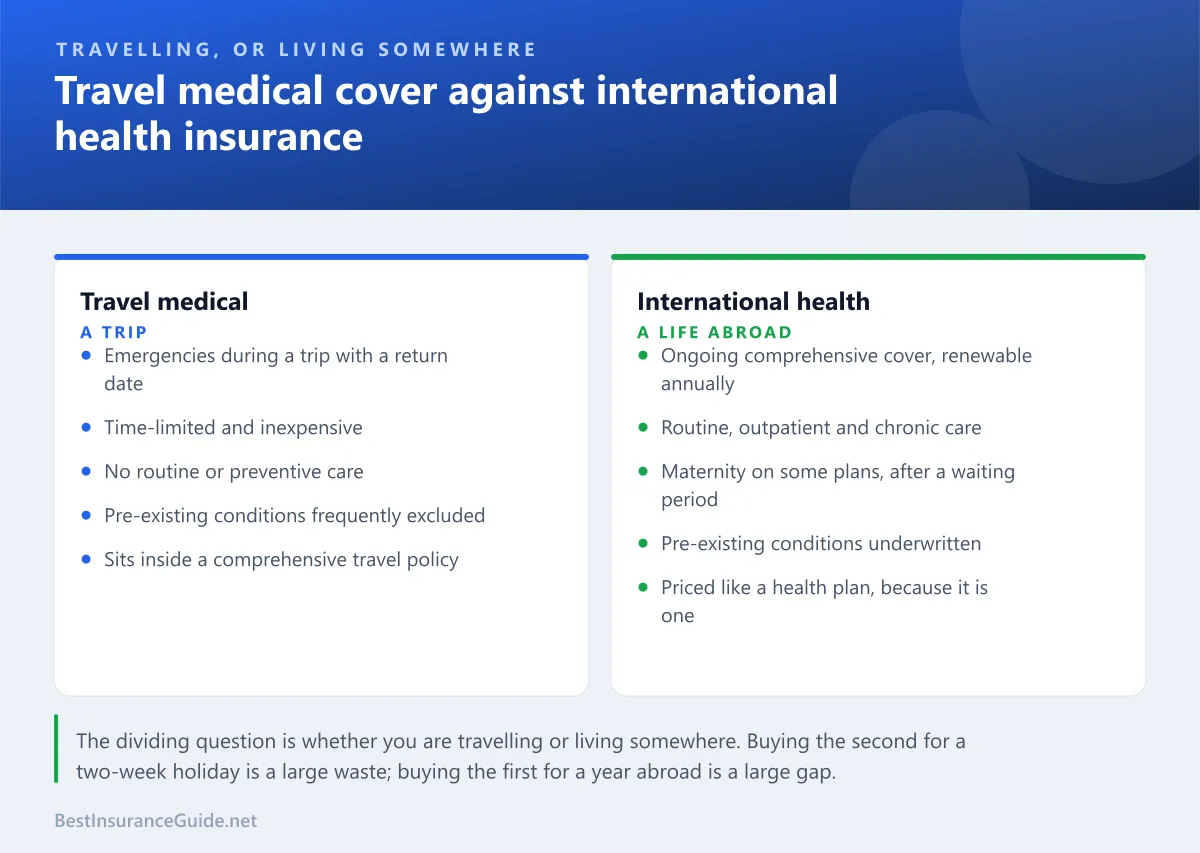
Travel medical insurance covers emergencies during a trip. It is time-limited, cheap, sold per trip or annually for multiple trips, and it does not cover routine or ongoing care. It is what sits inside a comprehensive travel insurance policy alongside cancellation and baggage benefits.
International health insurance is ongoing comprehensive cover, renewable annually, covering routine care, chronic conditions, maternity in some plans, and inpatient and outpatient treatment. It functions as a health plan rather than as trip protection.
The dividing question: are you travelling, or are you living somewhere?
Travelling, for days or weeks, on a trip with a return date: travel medical cover.
Living abroad, working abroad, studying for a year, or moving between countries: international health insurance.
What each costs
There is no single figure and the ranges differ by an order of magnitude.
Travel medical cover, within a travel insurance policy, is typically a small percentage of the trip cost, frequently in the region of 4% to 10% depending on age, trip length and benefits.
International health insurance is an annual premium comparable to a domestic health plan, running from a few thousand dollars for a young adult on a regional plan to many times that for an older applicant with worldwide cover.
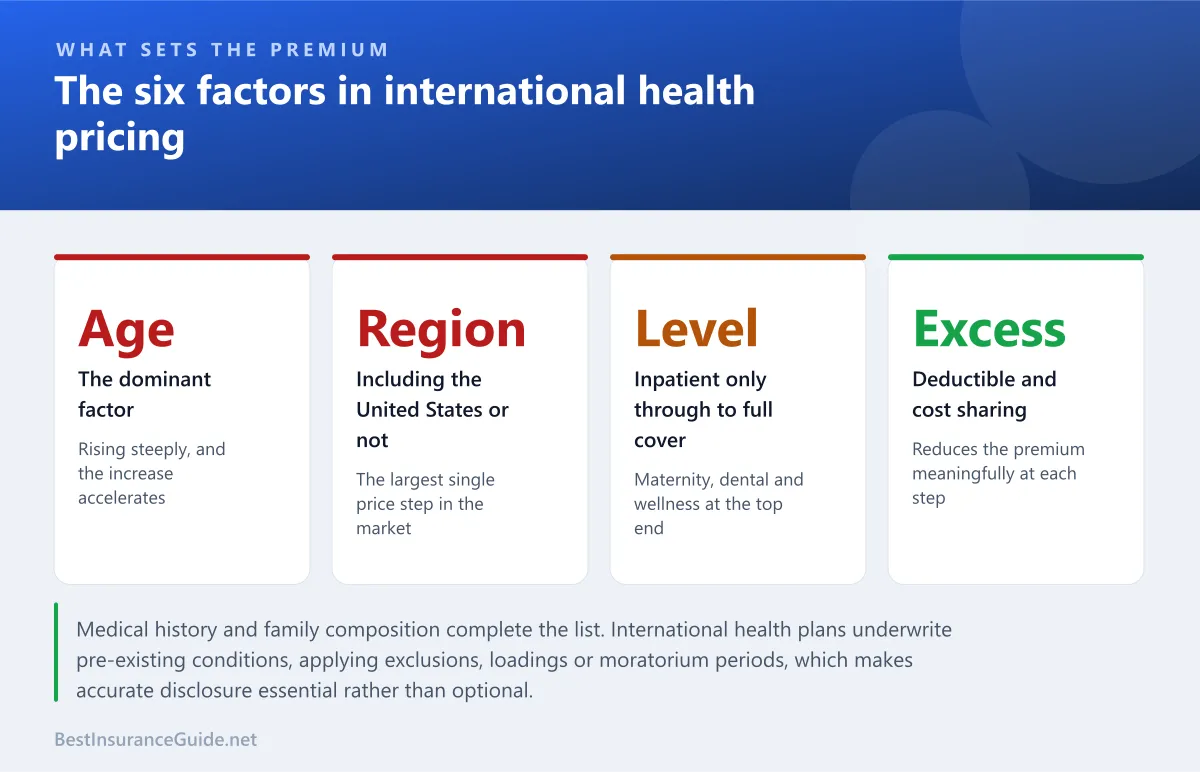
Six factors drive the international health premium.
Age, which dominates. Premiums rise steeply with age and the increase accelerates.
Region of cover. Plans are usually sold by geographic area, and the largest single price step is between plans excluding the United States and plans including it. Healthcare costs there are far higher than anywhere else, and including it commonly increases the premium substantially.
Plan level. Inpatient only at the bottom; inpatient plus outpatient, then adding maternity, dental, optical and wellness at the top.
Deductible and cost sharing, which work exactly as they do domestically and reduce the premium meaningfully.
Medical history, since international health plans underwrite, applying exclusions, loadings or moratorium periods on pre-existing conditions.
Family composition, with children commonly adding a smaller increment than adults.
Evacuation, which is the benefit people underestimate
Of everything on either product, medical evacuation is the coverage most travellers assume they will not need and most cannot afford to fund.
It covers transport to adequate care, or home, when local treatment is not sufficient.
The cost of an air ambulance is very large, particularly over long distances and particularly where a medical crew is required.
It is not the same as repatriation of remains, which is a separate and also worth-having benefit.
Some travel policies include it at a low limit, which for a remote destination is not adequate.
For anybody travelling to a location with limited medical infrastructure, or doing anything remote or adventurous, this is the benefit to check first and the one worth paying for at a meaningful limit.
What your existing cover actually does
Before buying either product, three things are worth checking.
Domestic health insurance. Most domestic plans provide very limited cover outside the country, frequently emergency only, and almost never evacuation. Providers abroad generally require payment up front regardless, leaving you to claim afterwards.
Credit card benefits. Some cards include travel medical or evacuation benefits when the trip is paid with the card. Limits are usually low and it is worth reading the benefit guide rather than assuming.
Employer arrangements, for anybody travelling for work, which frequently include a business travel medical policy and assistance services.
Duplicating cover you already hold is common. Assuming cover you do not hold is worse.
Choosing between them
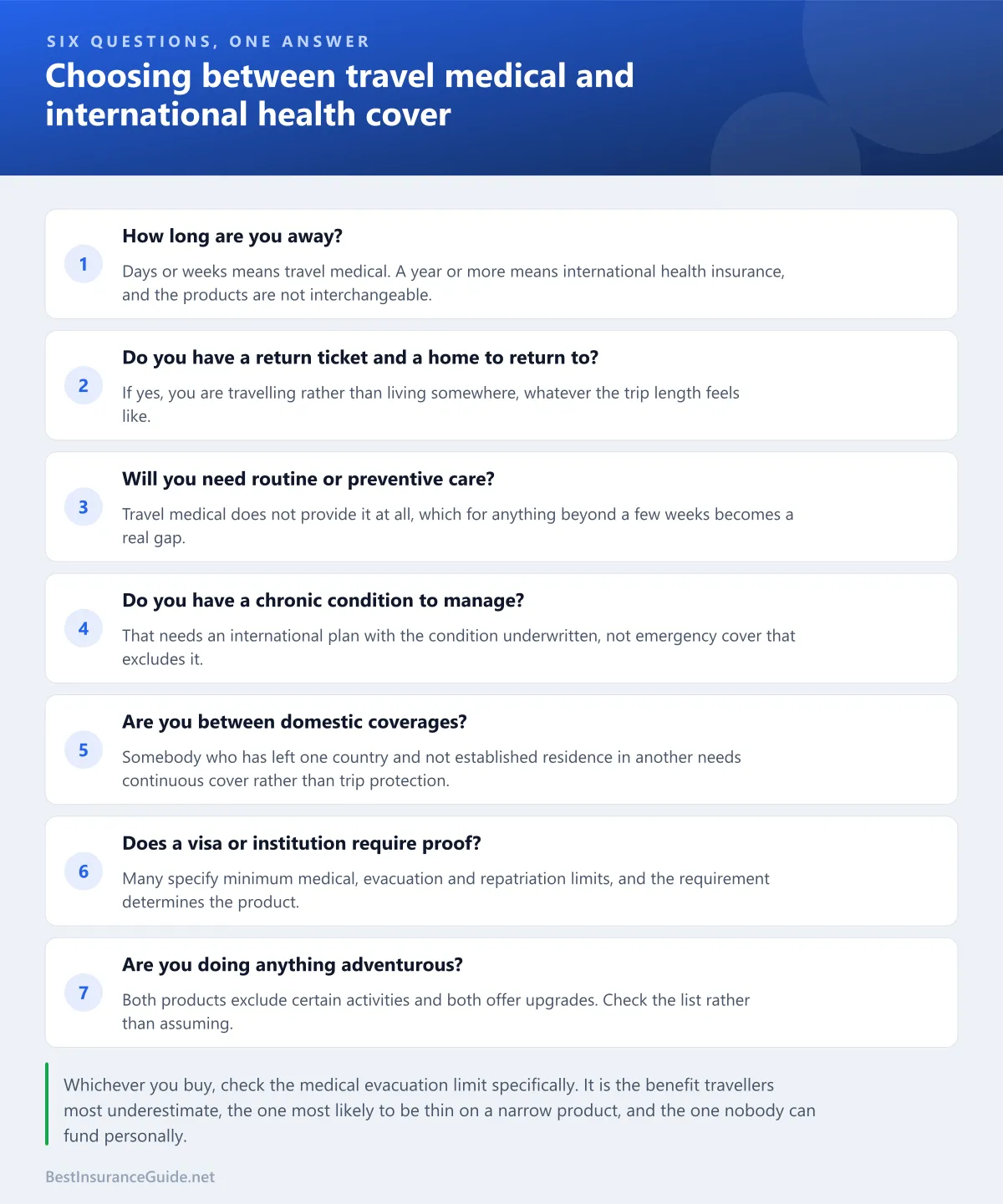
How long are you away? Weeks means travel medical; a year or more means international health insurance.
Do you have a return ticket and a home to return to? If yes, you are travelling.
Do you need routine and preventive care while away? Travel medical does not provide it.
Do you have a chronic condition requiring ongoing management? That needs an international health plan with the condition underwritten rather than emergency cover that excludes it.
Are you between domestic coverages? Somebody who has left one country and not yet established residence in another needs continuous cover rather than trip-by-trip protection.
Will a visa or a school require proof of cover? Many do, at specified minimums, and the requirement determines the product.
Are you doing anything adventurous? Both products commonly exclude certain activities, and both offer upgrades. Check the list rather than assuming.
Worked example: three travellers
| Two-week holiday | Six-month posting | Permanent relocation | |
|---|---|---|---|
| Right product | Travel insurance with medical | International health, short term | International health, annual |
| Routine care covered | No | Depends on plan | Yes |
| Chronic condition managed | No | With underwriting | With underwriting |
| Evacuation included | Check the limit | Usually, at a real limit | Usually, at a real limit |
| Relative cost | Small | Moderate | Substantial |
Buying either one well
Buy travel medical cover at the first trip payment, because the pre-existing condition waiver window runs from then.
Declare medical history accurately on an international health application. A non-disclosure discovered at claim time is the fastest route to an unpaid claim in any line of insurance.
Check the region of cover matches where you will actually be, including any travel outside the primary country.
Check whether the plan pays providers directly or reimburses you. Direct settlement matters enormously for an inpatient stay abroad.
Check the evacuation limit and whether it is realistic for the region.
Understand the exclusions for adventure activities, and buy the upgrade if you need it.
Keep the assistance number reachable from your phone, since the assistance service rather than the policy is what you actually use in an emergency.
The short version
Travel medical cover and international health insurance are different products at very different prices, and the dividing question is whether you are travelling or living somewhere.
For a holiday, travel medical cover inside a comprehensive travel policy is the right product and costs a small percentage of the trip. For living or working abroad, an international health plan is a health plan and is priced like one.
Age and region drive the international premium, and the largest single step is between plans excluding and including the United States.
Whichever you buy, check the medical evacuation limit specifically. It is the benefit travellers most underestimate and the one nobody can fund personally.
And check what your domestic plan, your credit card and your employer already provide, because both duplicating and assuming are common and both are expensive.
For the wider policy, see travel insurance essentials, and for the purchase timing, when to buy travel insurance.
What each plan level actually buys
International health plans are usually sold in tiers, and the differences between them are consistent across insurers even where the names are not.
Inpatient only. Hospital admission, surgery, cancer treatment and evacuation. The cheapest comprehensive option and a genuine safety net, and it pays nothing for a consultation or a prescription.
Inpatient plus outpatient. Adds consultations, diagnostics, prescriptions and routine care. The level most people living abroad actually need.
Plus maternity, which typically carries a waiting period measured in months and sometimes a year, so it has to be arranged well in advance of being needed.
Plus dental, optical and wellness, which are convenience benefits rather than protection and are where a budget is most easily trimmed.
Two structural choices sit alongside the tier.
The deductible, which works exactly as it does domestically and reduces the premium meaningfully at each step.
Direct settlement, meaning whether the insurer pays hospitals directly or reimburses you. For an inpatient stay abroad this matters enormously, because hospitals in many countries require payment or a guarantee before admission.
Worked example: the same person, four plan levels
| Level | What it answers | Relative cost |
|---|---|---|
| Inpatient only, high deductible | A serious illness or accident | Lowest |
| Inpatient plus outpatient | Ordinary healthcare needs | Moderate |
| Plus maternity | A planned pregnancy, after the waiting period | Higher |
| Plus dental, optical, wellness | Convenience and routine extras | Highest |
The first row is the one that prevents a financial catastrophe, and the trade-off decision is how much of the rest to buy on top of it.
Two things to check before committing
Whether the plan settles directly with hospitals in the country you will be living in, and whether it has a network there.
How the plan treats a return home. Many international plans include limited cover in your home country and some exclude it entirely, which matters for anybody who will be travelling back regularly or who may return permanently.
Two things to check before you travel or move
What your domestic health plan actually does abroad. Most provide limited emergency cover at best, no evacuation, and no direct settlement, which means paying up front and claiming afterwards. Confirm it in writing rather than assuming, because the assumption is the single most common gap in international travel.
Whether the destination requires proof of cover. Many visas, work permits and educational institutions specify minimum medical cover and sometimes evacuation and repatriation limits. Where a requirement exists it determines the product, and discovering it late is expensive because the compliant options are frequently not the cheapest ones.
The answer, summarised
Travelling for days or weeks: travel medical cover within a comprehensive travel policy, bought at the first trip payment.
Living or working abroad: international health insurance, at a plan level matching what you actually need rather than the top tier.
Either way: check the medical evacuation limit specifically, because it is the benefit travellers most underestimate and the one nobody can fund personally.
Before buying anything: establish what your domestic health plan, your credit card and your employer already provide, because duplicating cover is common and assuming cover you do not hold is worse.
And check the destination’s requirements, since visas, work permits and institutions frequently specify minimum medical, evacuation and repatriation limits that determine which product is acceptable.
Moving between the two products
People frequently need to move from one product to the other, and the transition is where gaps appear.
Leaving to live abroad. Travel medical cover is not designed for it and frequently has a maximum trip length. An international health plan should be in place from the departure date, and underwriting takes time, so start the application well before travelling.
Returning home. Many international plans provide limited cover in the home country and some none at all. Domestic coverage needs arranging to start when the international plan ends, and in some systems that means an enrolment window rather than an instant purchase.
Moving between countries. Region of cover matters, and a plan bought for one region may not extend to another. Tell the insurer before moving rather than after.
A gap year or extended trip. Neither product fits neatly. Some insurers offer long-stay travel medical products, and the choice depends on whether routine care will be needed and whether there is a fixed return date.
The common failure in all four is a gap between products, which is exactly the period in which somebody has neither domestic nor international cover, and it is entirely avoidable by arranging the second before ending the first.
Related reading
Is Airbnb travel insurance worth it covers the shorter-trip end of the same question, where a narrow product may be proportionate. Does travel insurance cover hurricanes covers destination risk, which for anybody living abroad in a storm-exposed region is an annual rather than an occasional concern.
A note on scope
Nothing here is medical or financial advice. Premiums, region definitions, underwriting practice, evacuation limits and exclusions vary considerably between insurers and plans and change over time, and the ranges given are illustrative rather than quotes.
Your policy or plan documents are the authoritative statement of what is covered, your domestic insurer is the authoritative source on what applies abroad, and your government’s travel advisory service publishes destination health guidance. This site is independent and not affiliated with any insurer.