Is Travel Insurance Worth It? Costs, Coverage and the Fine Print
Travel insurance runs 4-10% of trip cost. What medical and evacuation claims actually cost, what your credit card covers, and when it's safe to skip.

Table of contents
Travel insurance gets bought for the wrong reason and skipped for the wrong reason, often by the same person on different trips.
People buy it worried about cancelling a holiday. They skip it on the trip where they leave their health system behind, which is the one where it genuinely matters. The cancellation cover is the part that sells policies. The medical and evacuation cover is the part that justifies them.
Here’s what it costs, what it actually pays for, and how to tell which trips need it.
What it costs
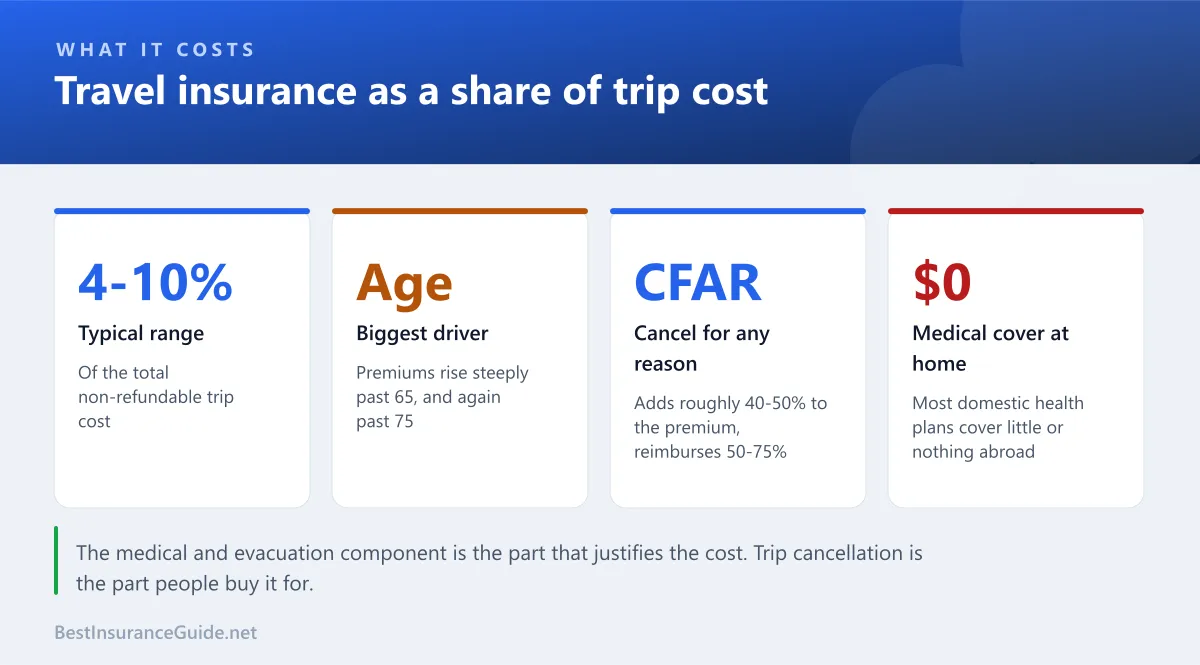
The 4% to 10% band holds reasonably well, with age doing most of the work inside it. A 30-year-old and a 70-year-old on the same trip can differ by a factor of four.
Worked example: the same trip, four travellers
A two-week trip to Italy, $6,400 non-refundable per person, comprehensive cover with $100,000 medical and $500,000 evacuation.
| Traveller | Age | Premium | % of trip cost |
|---|---|---|---|
| A | 29 | $248 | 3.9% |
| B | 45 | $312 | 4.9% |
| C | 64 | $498 | 7.8% |
| D | 73 | $891 | 13.9% |
The older traveller pays 3.6 times the younger one for identical cover, which reflects genuine claims experience rather than anything arbitrary.
Two things follow. Age-banded pricing means shopping matters more the older you are, because insurers band differently. And for a family group, quoting individually sometimes beats a family policy once one member crosses an age threshold.
The part that actually matters
Your domestic health plan mostly stops working when you leave the country. Most US plans provide very limited overseas cover, and Medicare provides essentially none abroad, which catches out a great many retirees on exactly the trips where the risk is highest.
Worked example: an ordinary medical emergency abroad
Appendicitis in Spain. Not exotic, not adventurous, just bad luck on day four.
| Item | Cost |
|---|---|
| Emergency admission and diagnostics | $4,200 |
| Laparoscopic appendectomy | $11,800 |
| Three nights inpatient | $5,400 |
| Follow-up and discharge medication | $900 |
| Changed flights, two travellers | $2,300 |
| Extra hotel nights for companion | $780 |
| Total | $25,380 |
The policy cost $312. It paid $25,380 less a $100 deductible.
Without it, that’s a bill payable before discharge in many countries, and a debt pursued at home afterwards.
Worked example: evacuation, the genuinely catastrophic one
Cancellation cover has a natural ceiling: your trip cost. Medical evacuation doesn’t.
| Scenario | Typical evacuation cost |
|---|---|
| Ground ambulance to a capable hospital, within Europe | $2,000 – $8,000 |
| Air ambulance within a region, e.g. Caribbean to Miami | $15,000 – $35,000 |
| Medically-staffed repatriation from Southeast Asia to the US | $80,000 – $200,000 |
| Evacuation from a cruise ship at sea | $50,000 – $250,000 |
| Helicopter rescue from a remote trekking route | $10,000 – $50,000 |
Nothing else you own covers this. Not your health plan, not your credit card in most cases, not the tour operator. It’s the single strongest reason to hold a policy on any trip that’s remote, at sea, or far from a hospital you’d trust.
What you might already have
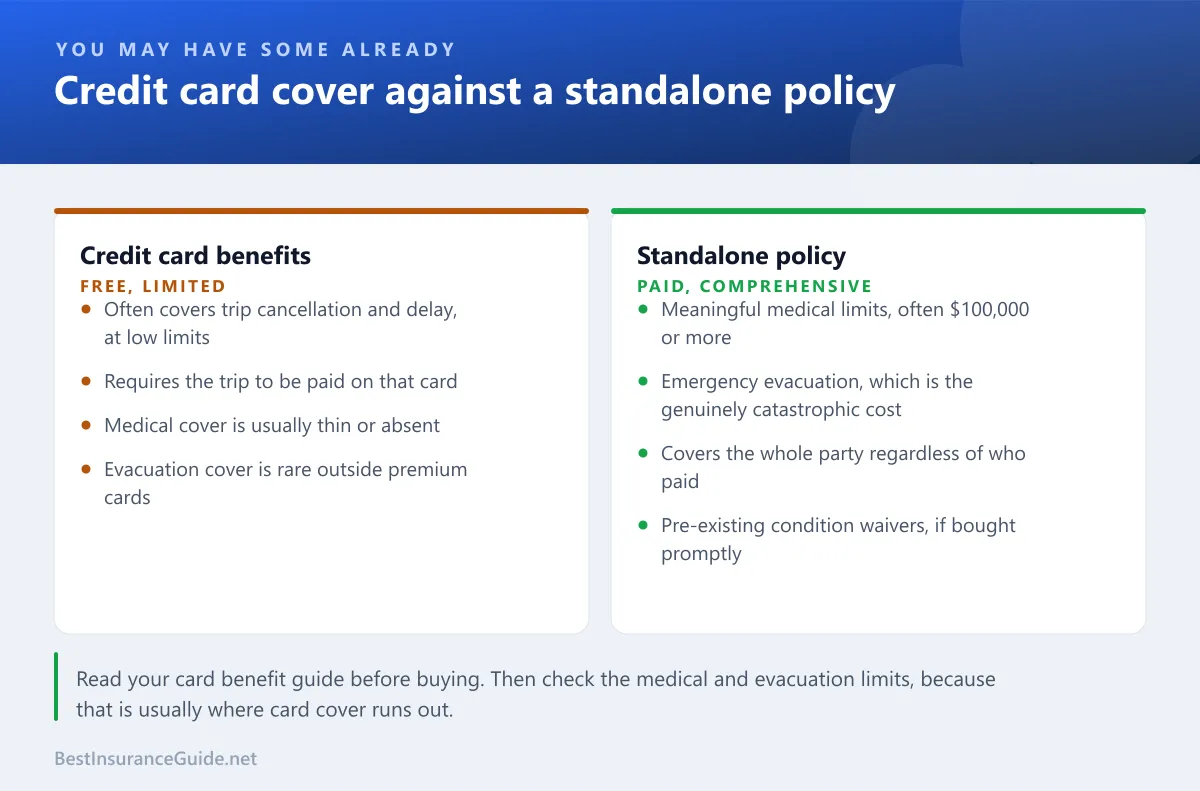
Credit card cover is real and frequently underused. It’s also frequently overestimated.
Worked example: card benefits against a policy
A mid-tier travel rewards card, compared with a standalone policy on the Italy trip above.
| Benefit | Credit card | Standalone policy |
|---|---|---|
| Trip cancellation | $5,000 per traveller | $6,400 (full trip cost) |
| Trip delay | $500 after 6 hours | $1,000 after 3 hours |
| Baggage delay | $300 | $600 |
| Emergency medical | $0 | $100,000 |
| Emergency evacuation | $0 | $500,000 |
| Requirement | Trip paid on that card | None |
The card handles the inconvenience claims respectably. It does nothing at all about the $25,380 appendectomy or the $200,000 repatriation.
For a domestic trip where your health insurance still works, card cover is often genuinely sufficient. For international travel it usually isn’t, and the gap is in exactly the category that could bankrupt you.
Read your card’s benefit guide, which is a specific document rather than the marketing page. Check the medical and evacuation limits first, because that’s where card cover almost always runs out.
When it’s worth it
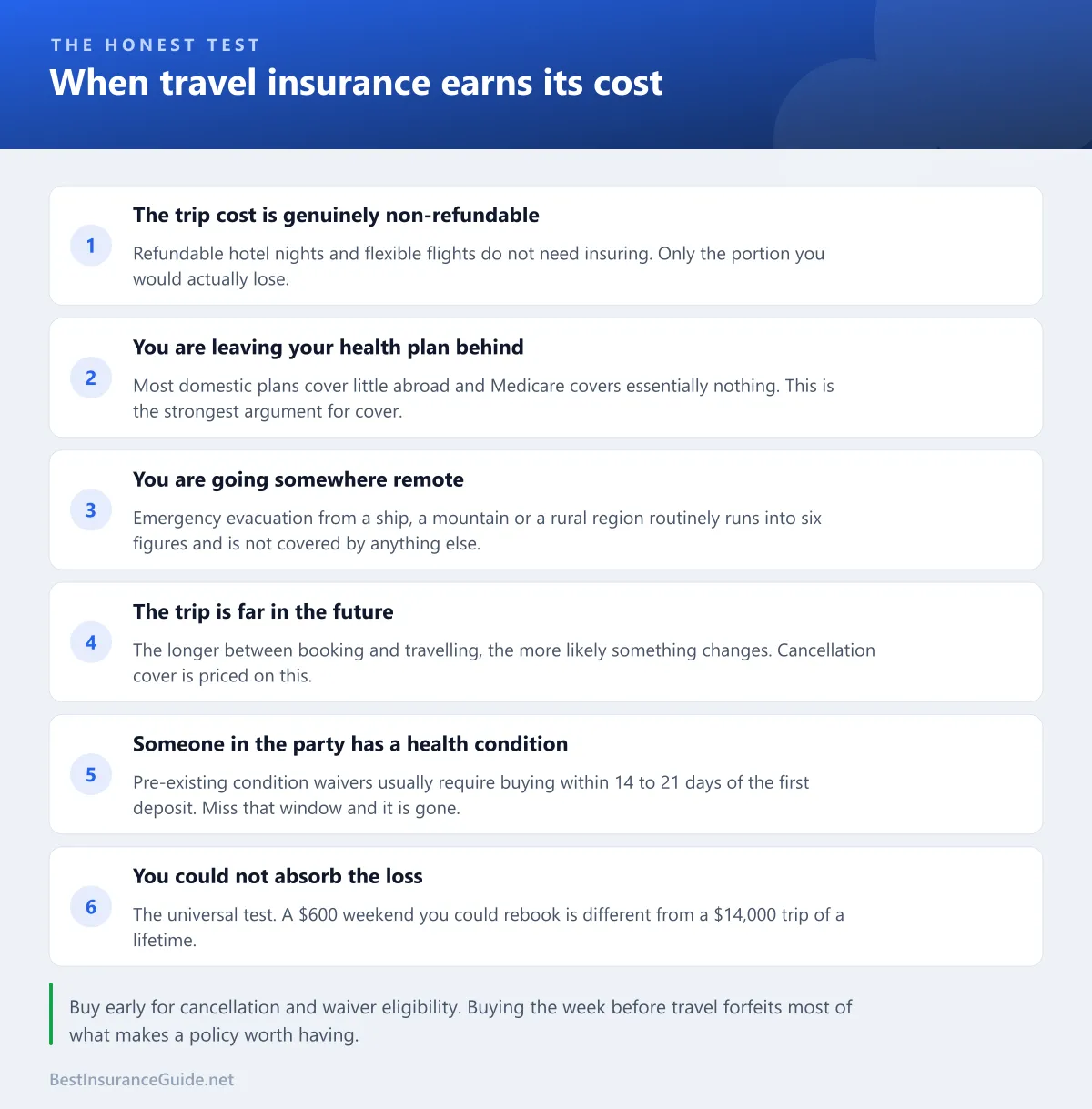
The last item is the universal test and it applies here as everywhere: could you absorb the loss?
A $600 weekend you could rebook is a different proposition from a $14,000 trip booked eleven months out with a non-refundable lodge deposit.
Reasonable places to skip it: short domestic trips with refundable bookings, travel where your health insurance still functions normally, and any trip where the total at risk is small enough that losing it would be annoying rather than serious.
Places not to skip it: anywhere your health plan doesn’t follow you, anywhere remote, cruises, and any trip with a large non-refundable component booked far ahead.
The timing rule
This is the most actionable thing on the page, and it’s the one most people get wrong.
Buy within 14 to 21 days of your first deposit, not the week before you fly.
That window is what makes you eligible for a pre-existing condition waiver at most insurers. Without one, any claim connected to a condition that existed before purchase, including a stable, managed, well-controlled one, can be denied. The lookback period is typically 60 to 180 days.
Worked example: what missing the window costs
A traveller with well-managed high blood pressure books a trip in January for September, and buys insurance in August.
| Bought within 21 days of deposit | Bought in August | |
|---|---|---|
| Pre-existing condition waiver | Included | Not available |
| Cardiac event abroad, $68,000 in costs | Paid | Denied as pre-existing |
| Premium | $412 | $389 |
They saved $23 and lost the only cover that mattered for their specific risk profile.
The waiver is free at most insurers. It just requires buying promptly, and it also generally requires insuring the full non-refundable trip cost.
What isn’t covered
- Changing your mind. Standard cancellation cover has a defined list of reasons. Wanting to stay home isn’t on it, which is what cancel-for-any-reason exists for.
- Known events. A named storm already forecast, or a travel advisory already issued, is not an insurable uncertainty once it’s public.
- Adventure sports. Skiing off-piste, scuba beyond a certain depth, motorcycling, climbing. Usually excluded without a specific add-on, and the add-on is cheap relative to a mountain rescue.
- Intoxication. Incidents while intoxicated are excluded on most policies, and this is applied more often than people expect.
- Undeclared conditions. Answer the medical questions accurately. This is where claims are lost.
Cancel for any reason, briefly
CFAR lets you cancel for reasons outside the standard list, reimbursing typically 50% to 75% rather than 100%. It adds roughly 40% to 50% to the premium and usually requires buying within the same early window.
Worth it for: expensive trips booked far ahead, travel with genuine uncertainty attached, or anyone who’d rather pay for optionality than worry about it.
Not worth it for: cheap trips, near-term travel, or anything with refundable bookings, where you’re paying a substantial premium for flexibility you already have.
Buying it properly
Work out your genuinely non-refundable trip cost first, which is often lower than the total. Refundable hotel nights and flexible flights don’t need insuring, and insuring them wastes premium.
Then compare on the coverage that matters: medical limit, evacuation limit, and whether the pre-existing waiver applies. Premium is the last comparison, not the first, exactly as covered in our guide to comparing quotes.
Our travel insurance budget calculator estimates cost from trip value, duration and traveller ages, and our guide to using insurance calculators covers entering the non-refundable portion correctly rather than the headline trip price.
If you remember two things
Buy it within about three weeks of your first deposit, because that’s what buys the pre-existing condition waiver and it costs nothing extra.
And judge the policy on its medical and evacuation limits rather than its cancellation cover. Cancellation is capped at your trip cost. Evacuation from the wrong place, at the wrong moment, isn’t capped by anything.